Table of Contents |
It is important to understand how responsive buyers and sellers are to the change in the price of a product. Own-price elasticity is a measure of elasticity when the price of a good changes, holding all other factors constant. Own-price elasticity can be applied to both demand and supply.
You have learned that the law of demand predicts that buyers will respond to a change in the price of a product; it does not tell how responsive buyers will be. The same is true for sellers. The law of supply tells us that sellers respond to price changes, but again, it doesn’t tell us if sellers will be highly responsive or not all.
Your responsiveness to a price change as a buyer is dependent on factors related to your circumstances. There are several factors that will determine how responsive you as a buyer are to a price change for a particular product. We call these various factors determinants.
Let's look at some of the most common determinants that impact how responsive a buyer is to price changes.
For buyers, a key determinant is the availability of a substitute product(s). The more substitutes available for a particular product, the more elastic (or sensitive or responsive) you are to a price change.
EXAMPLE
A beverage can be many different things. Non-alcoholic beverage products alone include tea, coffee, orange juice, energy drinks, soda, water, and milk. Within each type there are numerous brands. Because substitutes are available for most beverages, we as buyers tend to be responsive to a price change in the product. On the other hand, lacking an alternative to a $5 bottle of water at the amusement park means we are unresponsive to the price.For buyers, a second determinant is the time horizon; how much time do you have to shop around and respond to the price change in a product?
EXAMPLE
Suppose your toothpaste tube is virtually empty. If you need a quick replacement, then expect to pay a premium price at the convenience store (less responsive) as opposed to a more leisurely purchase at a Big Box store (highly responsive). Time horizon affects your responsiveness to a product’s price change.For buyers, a third determinant affecting your sensitivity to a price change is whether or not the item is considered a necessity or luxury good. When it comes to a 50% increase in the price of a no-frills white bread loaf from the supermarket, we tend not to hesitate on the purchase (less responsive), while a 50% increase in the price of artisan multigrain bread from the corner bakery is cause to stop-and-reconsider the (highly responsive) purchase.
A fourth determinant that influences a buyer's responsiveness to a price change is the size of the purchase relative to your overall budget. A price change in a product that represents a significant share of your budget, such as housing, will make us sensitive to a price change (highly responsive), while a change in the price of a small item such as house slippers will not (less responsive).
Like buyers, sellers are responsive to a change in the product price. Again, a seller’s sensitivity to a price change is dependent on their circumstances. For sellers, determinants include cost of production, resource availability, and time horizon. The time horizon is the key determinant. If the time horizon is too short and the seller can not adjust supply quickly enough, then the seller will be less responsive to a price change. Having more time to adjust production of the product will make the seller more responsive to a price change.
Own-price elasticity measures the elasticity of demand or supply when the price of the product itself changes, holding all other factors constant. Own-price elasticity ranges from perfectly inelastic to perfectly elastic with three in-between degrees of elasticity. Because there are several different types of elasticity, we will be using subscripts within the formula. For price elasticity, the symbol E will use the subscript “P” to remind us that we are calculating “price” elasticity, like this: ( ).
).
In the real world, businesses use their understanding of price elasticity to improve their bottom line. Movie theaters have learned how to divide their customer base into different groups and charge each group a different price such that it is the most that particular group is willing to spend. The practice of taking advantage of knowledge about different elasticities of demand is known as price discrimination. And there is nothing illegal about it!
EXAMPLE
Think about those early afternoon matinees: who is most likely to attend? Families and older folks with limited budgets. Ticket prices must be low enough to get families with their children in the door to see a show. Families are price-sensitive. Who is most likely to attend the after 5 PM shows into the late evening shows? Young people. The movie theater has enough experience to know younger folks are not price-sensitive.We will now use the elasticity formula to calculate the percentage change in the quantity of a product relative to the percentage change in the price of a product.

The elasticity coefficient, the result of the calculation, will lie between the number zero (0) and infinity (∞) along a continuum. An elasticity coefficient of zero (0) is interpreted as “highly unresponsive,” while a number approaching infinity is interpreted as “highly responsive” to a change in price.
The table below provides a summary to use when you interpret the own-price elasticity coefficient. Column 1 identifies the Degree of Responsiveness, Column 2 provides the classification of Type of Elasticity, and Column 3 interprets the value of the own-price elasticity coefficient. In the next section, you will practice calculating and classifying the coefficient value.
| Degree of Responsiveness | Type of Elasticity |
Price Elasticity Coefficient ( ) )
|
|---|---|---|
| Highly Unresponsive | Perfectly Inelastic |

|
| Inelastic |

|
|
| Unit Elastic |
 (absolute value) (absolute value)
|
|
| Elastic |
 (absolute value) (absolute value)
|
|
| Highly Responsive | Perfectly Elastic |

|
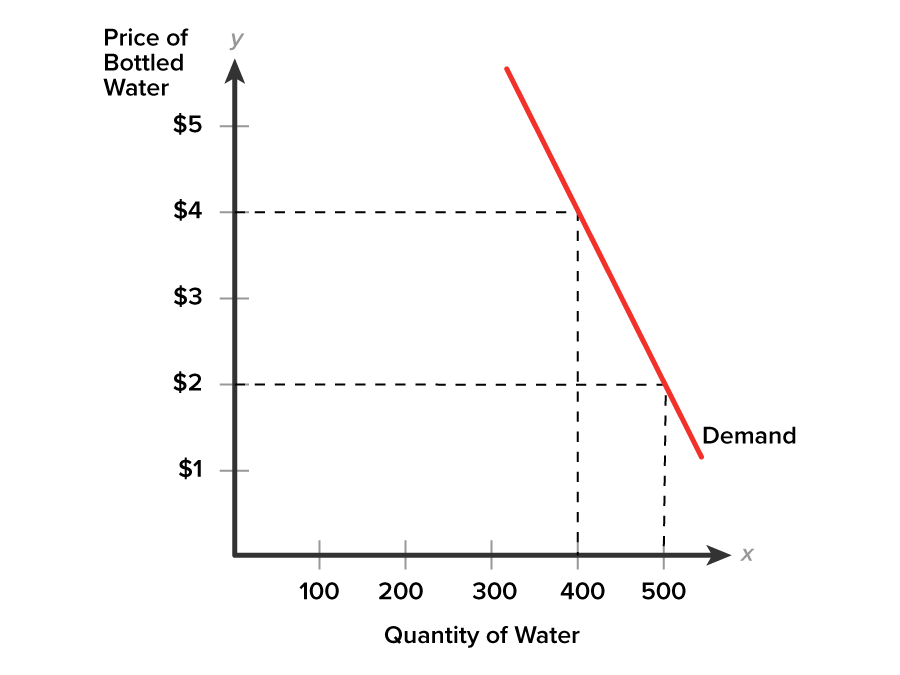
The graph below represents the market for bottled water. Price is found along the vertical y-axis and quantity along the horizontal x-axis. Suppose we identify two points on the demand curve. Point 1 occurs at a price of $4 dollars per bottle and a quantity demanded of 400 bottles. Point 2 occurs at a price of $2 dollars per bottle and a quantity demanded of 500 bottles.
Notice that the price of the product dropped by one-half from $4 to $2. As the price of water drops by one-half, consumers do not change their purchasing habits very much. They do purchase more bottles of water from 400 to 500 bottles…but not much more
Using these two prices and quantity points, we can now calculate own-price elasticity of demand for this segment of the curve.
To calculate own-price elasticity, we will use the midpoint formula for a straight line. The midpoint formula can be used when two points on a line are known. The midpoint formula uses the average of quantity and price when determining price elasticity.

From the example, we will simply substitute the values for points 1 and 2 from the table into the midpoint formula.
| Price | Quantity Demanded | |
|---|---|---|
| Point 1 | $4 | 400 |
| Point 2 | $2 | 500 |





From our calculation, using the midpoint formulas we learn that 0.33 is our price elasticity coefficient . Now, don't convert this to a percentage. It's a ratio, not a percentage. It's a coefficient (the value from the calculation) for price elasticity. Also note the subscript “P.” The subscript reminds us that we are calculating “price” elasticity.
According to the table below, when the coefficient is less than 1.0 (absolute value), the type of elasticity for that segment of the line is price inelastic. The negative sign tells us that the two variables, price and quantity, are inversely related. Since we are measuring the price elasticity of demand, we would expect an inverse relationship between price and quantity, one up and the other down.
Alternatively, if we were measuring the price elasticity of supply, we would expect a positive sign for the coefficient because price and quantity move together in the same direction; both up or both down.
| Degree of Responsiveness | Type of Elasticity |
Price Elasticity Coefficient ()
|
|---|---|---|
| Highly Unresponsive | Perfectly Inelastic |
|
| Inelastic |
(absolute value)
|
|
| Unit Elastic |
|
|
| Elastic |
(absolute value)
|
|
| Highly Responsive | Perfectly Elastic |

|
From the example, the price of bottled water dropped by half from $4 to $2 dollars. As the price of water drops, buyers do not change their purchasing habits very much. They do purchase more bottles of water from 400 to 500 bottles but not much more.
Interpretation: Demand for bottled water is classified as price inelastic because of .
The percentage change in quantity is less than the percentage change in price.
When the price of bottled water falls by 1%, buyers purchased only 0.33% more of the product. On the other hand, if the price of bottled water rises by 1%, buyers will reduce their purchases by only 0.33% or less than proportionally.
This is consistent with the idea of price inelastic demand. This is the type of demand elasticity that exists when the percentage change in quantity demanded is less than the percentage change in price; that is, buyers are not very sensitive to a change in the price of a good or service.
Similarly, this is why vendors can charge $20 per beer at stadiums and people still buy it. The demand curve for our bottled water example is relatively steep, which is consistent with it being inelastic.
. Let’s return to the amusement park scenario you pondered and consider the buyer’s situation. Suppose you are visiting an amusement park that prevents visitors from bringing in food and drink. The day is hot and you quite naturally get thirsty. You spot a vending machine dispensing beverages. You scan through your options and decide on a no-frills 16-ounce bottle of water before you notice the $5 price tag. What would you do? A change in the price will have little, if any, effect on how many bottles you buy. In this situation your demand elasticity for bottled water is price inelastic. Would your responsiveness be different if you were walking about town? Water is still a necessity, but you would have more places to make the purchase. You would be more price sensitive.
Let’s revisit the other scenario you pondered and consider the seller’s situation. You own a small business producing enhanced water drinks. A nearby amusement park has contacted you to supply your drink. The park will pay $5 per 16-ounce drink for 50,000 bottles if the drinks can be delivered in 30 days, $8 for each bottle of water if the drinks can be delivered in two weeks, or $10 for each bottle of water if the drinks can be delivered in two days. How will you respond? Because the order is so large and your time horizon is too short to expand your production, you will likely not receive $5 per 16-ounce drink. In this situation, your supply elasticity is price inelastic. Having more time, such as having six months to adjust your production, would allow you to be more responsive to the price.
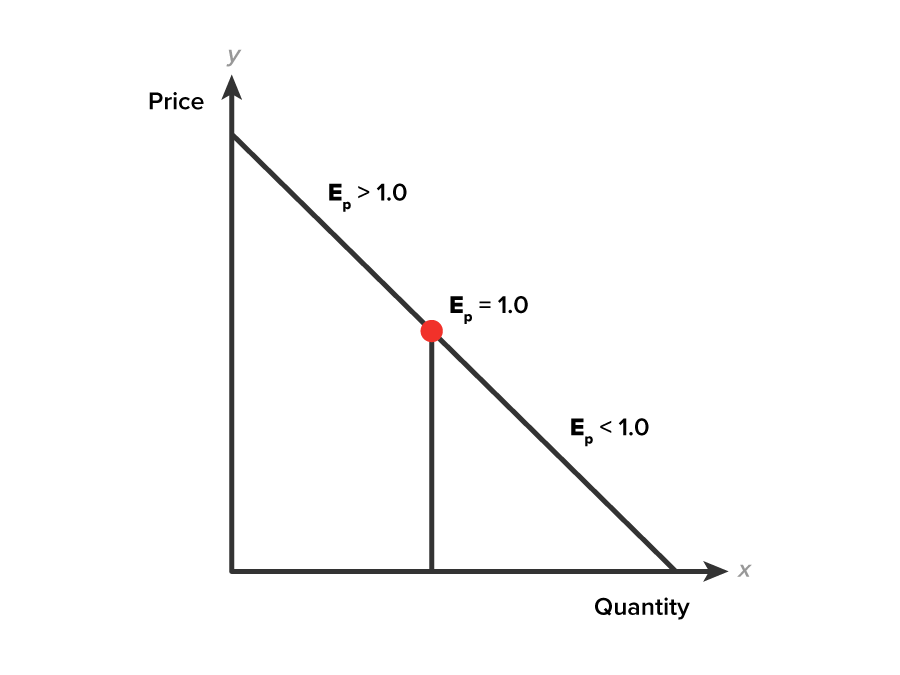
Along any downward-sloping demand curve, we are able to locate three types of price elasticity. However, not all demand curves are downward-sloping, but this does not prevent us from identifying the type of elasticity associated with the curve.
In the graph below, you will see different types of elasticity along the straight line. The segment near the top of the curve is price elastic, while the segment near the bottom is price inelastic. The curve itself is divided where the percentage change in quantity is proportional to the percentage change in price. This singular point is known as unit elasticity.
Below, you will find concise descriptions of all five types of elasticity. Whether we are examining a straight line demand curve or a supply curve, the interpretation of elasticity does not change.
| Numerical Value | Type of Elasticity | Description |
|---|---|---|
|
(absolute value) in the area above the unit elastic point. |
Price elastic | Demand is classified as price elastic when the change in quantity is greater than the changes in price. For example, the price of the product falls by 1% and the quantity demanded increases by more than 1%. |
|
|
Unit elastic | Demand is classified as unit elastic when the change in quantity is proportionate to the change in price. For example, the price of the product falls by 1% and the quantity demanded increases by 1%. |
|
(absolute value) in the area below the unit elastic point. |
Price inelastic | Demand is classified as price inelastic when the change in quantity is less than the change in price. For example, the price of the product falls by 1% and the quantity demanded decreases by less than 1%. |
|
|
Perfectly inelastic | Demand for a vertical curve is considered to be perfectly inelastic because quantity does not respond to any change in price. |
|
|
Perfectly elastic | Demand for a horizontal curve is considered to be perfectly elastic because the price is highly sensitive to quantity. |
Source: THIS TUTORIAL WAS AUTHORED BY SOPHIA LEARNING. PLEASE SEE OUR TERMS OF USE.





 .
. , how would you classify housing?
 , how would you classify beer?
 , how would you classify rail transit off-peak?
 , how would you classify restaurant meals?