Table of Contents |
The Federal Reserve’s main goals in managing our nation’s money supply are the exact same goals as the federal government’s in fiscal policy, which are to promote the following:
We will discuss monetary policy, which is, typically, policy set by a central banking authority whereby money supply access (the interest rate) is varied to assist in stabilizing economic activity.
The Fed uses tools that are different from what the federal government uses. The Federal Open Market Committee (FOMC) is part of the Federal Reserve and meets eight times a year to manage our nation’s money supply. The tools used by the FOMC include the following:
Let’s briefly review the fractional reserve system. Reserves are the portion of deposits required to be held by a bank. They are usually kept to maintain reserve requirements set by the Fed.
Reserve requirement is the amount of depository liabilities a bank must hold, as set by the Fed and typically quoted as a percentage (e.g., 10%).
It is important to remember that the fact that banks can lend out a portion of customer deposits makes it possible for them to create money in our economy. This point is essential in understanding the expansion or contraction of money supply, which we will cover later in the lesson.
Now, it is the money multiplier that actually calculates the amount by which the money supply can increase through the ability of banks to loan funds.
The money multiplier is the increase in the money supply resulting from the ability of banks to loan deposits. Its value is equal to 1 divided by R, where R is the reserve ratio.

EXAMPLE
Consider a 10% reserve requirement, expressed as 0.10. You can see that the multiplier becomes 10.Therefore, you can see that as we raise and lower the reserve requirement, the multiplier becomes either bigger or smaller.
If we lower the reserve requirement, it makes the multiplied effect, or the impact that banks can have on the money supply through their loaning, much greater. Conversely, raising the reserve requirement reduces this ability because the multiplier would be smaller.
Open market operations are another tool available to the Fed to regulate interest rates and the money supply. In this case, we are referring to the purchase and sale of U.S. Treasury securities.
The next tool is the Fed funds target rate, which is used when banks need to borrow money because they have not met the reserve requirement for the night. In this situation, they can actually borrow from one another.
The Fed funds target rate is the rate that Fed member banks charge other member banks for overnight loans, which are typically made to meet reserve requirements.
Now, if banks need to borrow from the Fed itself to meet their short-term liquidity needs, they will pay the discount rate, or window rate, to the Fed.
So, what does the Fed do when the economy is in a recession? Well, let’s examine what happens during a recession.
During a recession, economic activity is slowing, as measured by real GDP. Often, consumers and businesses are not spending as much money because of low confidence in the economy.
EXAMPLE
If consumers are not confident about the economy, they might exhibit behaviors like putting off a summer vacation and saving the money instead, in case they lose their jobs. Likewise, they might choose to eat in during the weekend instead of going out for the usual restaurant meal—again, saving that money.Now, how do these behaviors impact the money supply? When a consumer decides not to go out to eat on the weekend, it does not just impact that consumer. It also reduces the amount of money the restaurant is making. In turn, that restaurant has less money to pay its workers, and those workers are then less likely to make purchases elsewhere.
As you can see, this has a multiplied effect in the economy—specifically, a multiplied negative impact in the economy.
So, how does this impact the money supply? When consumers and businesses do not spend as much money or as frequently, the size of M1 is reduced.
There is now a risk of deflation since people are tending to hold on to money and save it, keeping it in the banks.
Therefore, in order to reduce this risk and get people to spend money again, the Fed can enact an expansionary monetary policy by increasing the money supply. This is also known as an easy money policy.
Expansionary policy is either monetary or fiscal policy—here, we are focusing on monetary policy—that is enacted to stimulate economic growth.
In other words, it aims to get the economy moving again, and it achieves this by enticing people to take money out of the banks and spend it.
The following are some of the actions the Fed can take:
Now, this is what it looks like when the Fed enacts an easy money policy. When it increases the money supply, it will lower interest rates throughout the economy.
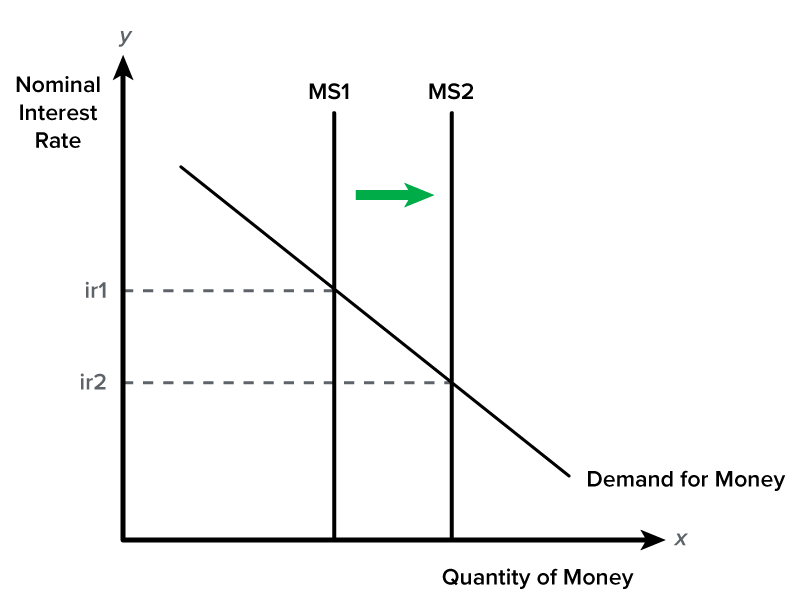
At lower rates, people and firms tend to take advantage of the lower rates by taking out loans for items like homes and cars. This has an expansionary effect on the economy.
Another way to think about this is that when the Fed increases the money supply, it essentially creates a little inflation. Now, this might sound like a bad thing, but the idea is that since the purchasing power of money is falling, people will want to spend money sooner rather than continuing to hold on to it. During a recession, a little inflation is not necessarily negative, because generally, inflation is very low during a recession.
EXAMPLE
During the housing crisis of 2007–2008, the Fed took many measures to ensure that banks did not fail and could continue to make loans. First of all, it purchased billions of dollars of Treasury and other securities, which is called credit easing. It drove the discount rate way down, essentially allowing member banks to borrow money from the Fed for free. The Fed continued to keep rates historically low, fearing another recession. With the onset of the 2020 pandemic, even more expansionary monetary policies were used, and rates hit all-time lows shortly thereafter.Now, let’s discuss the opposite situation, when there is inflation in the economy.
During a rapid expansionary period, there is growing economic activity. Consumers and businesses are spending a lot of money very quickly because of high confidence and prosperous economic times.
EXAMPLE
When consumer confidence in the economy is high, they might make choices such as taking that summer vacation or going out for dinner instead of eating in.When people make decisions like eating out, it increases the amount of money restaurants make. In turn, restaurants pay their workers, and those workers can go on to make purchases elsewhere. This has a multiplied positive effect on the economy.
However, this shows that when consumers and businesses are spending a lot of money, the size of M1 increases, leading to a risk of inflation. People are not holding on to money, and it is changing hands very quickly.
While a little inflation is fine, it is possible for the economy to get overheated. When that risk is high, the Fed will step in and enact contractionary monetary policy to try to slow down an overheated economy.
In this situation, the Fed will do the opposite and decrease the money supply. This is known as a tight money policy. Contractionary policy is a monetary or fiscal policy—in this case, monetary policy—that is enacted to slow economic growth.
Contractionary policy aims to slow down the economy. It can achieve this by enticing people to keep money in the banks and spend less.
The Fed can do this by taking the following actions:
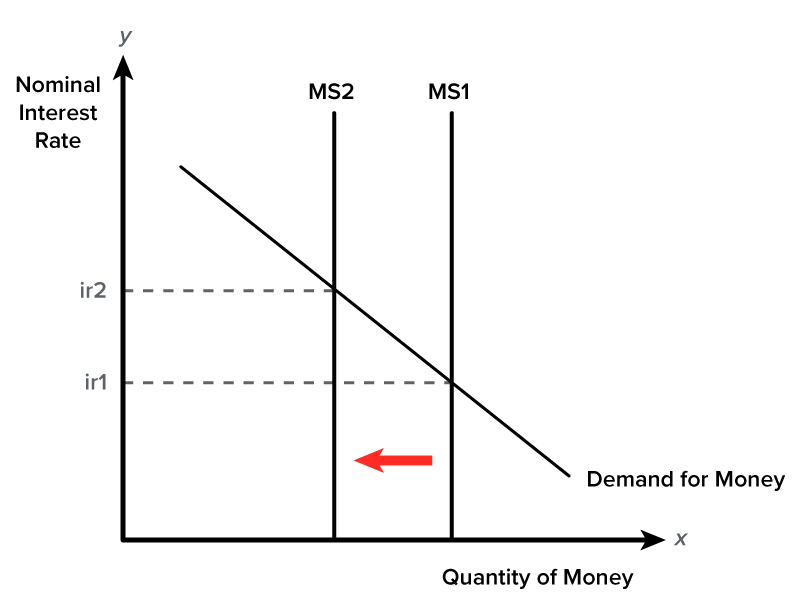
At higher rates, people and firms tend to keep money in the banks and take out fewer loans. This has a contractionary or slowing effect on the economy.
EXAMPLE
In the late 1970s and early 1980s, our economy experienced significant, double-digit inflation. The Fed sold securities and raised rates in an attempt to contract the money supply and slow down the rate of inflation. As our economy began to grow again after the 2020 pandemic, inflation figures started to become somewhat alarming and concerning in 2022. As a result, the Fed began a program of raising the Fed funds target rate to try to slow the rate of inflation in the economy.Source: THIS TUTORIAL WAS AUTHORED BY KATE ESKRA FOR SOPHIA LEARNING. PLEASE SEE OUR TERMS OF USE.




