Not all traits are inherited in a dominant-recessive pattern. In this lesson, you will learn about some patterns of inheritance that do not conform to the previously described dominant-recessive pattern, including codominance, incomplete dominance, and lethal alleles.
1. Codominance
Codominance is characterized by the equal, distinct, and simultaneous expression of both parents’ different alleles. This pattern differs from the intermediate, blended features seen in incomplete dominance. A classic example of codominance in humans is the ABO blood type.
think about it
Mendel implied that only two alleles, one dominant and one recessive, could exist for a given gene. We now know that this is an oversimplification. Many traits only have two alleles for the trait, but sometimes there can be three or more alleles that can represent a trait. When a gene has three or more alleles, it is called a multiple allele system.
Although individual humans (and all diploid organisms) can only have two alleles for a given gene, multiple alleles may exist at the population level, such that many combinations of two alleles are observed. Note that when many alleles exist for the same gene, the convention is to denote the most common phenotype or genotype in the natural population as the wild type (often abbreviated “+”). All other phenotypes or genotypes are considered variants (mutants) of this typical form, meaning they deviate from the wild type. The variant may be recessive or dominant to the wild-type allele.
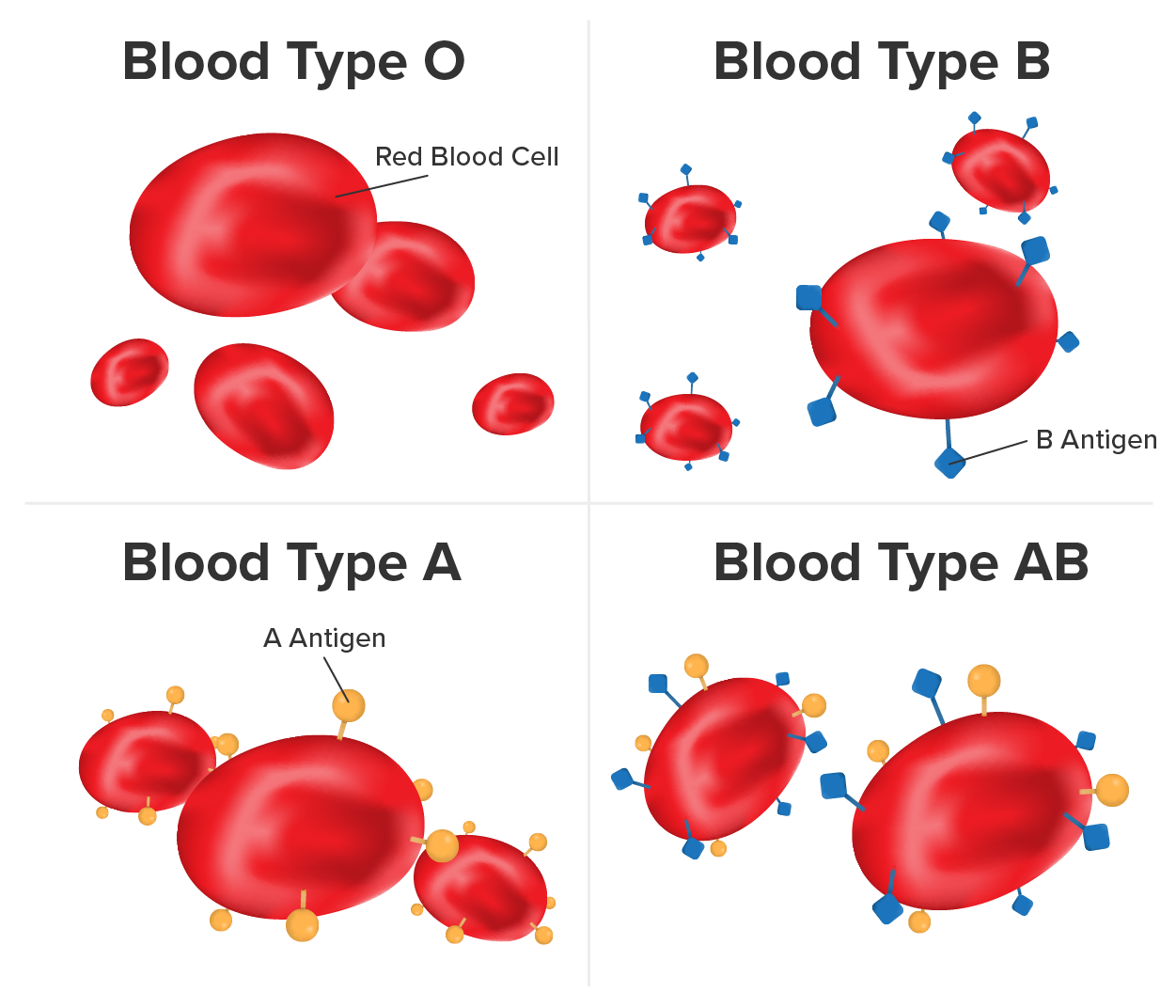
People are blood type A if they have an allele for an enzyme that facilitates the production of surface antigen A on their erythrocytes. This allele is designated Iᴬ. In the same manner, people are blood type B if they express an enzyme for the production of surface antigen B. People who have alleles for both enzymes (Iᴬ and Iᴮ) produce both surface antigens A and B. As a result, they are blood type AB. Because the effect of both alleles (or enzymes) is observed, we say that the Iᴬ and Iᴮ alleles are codominant.
ABO Blood Types—Both surface antigens A and B are expressed on a red blood cell, and they are therefore considered codominant traits.
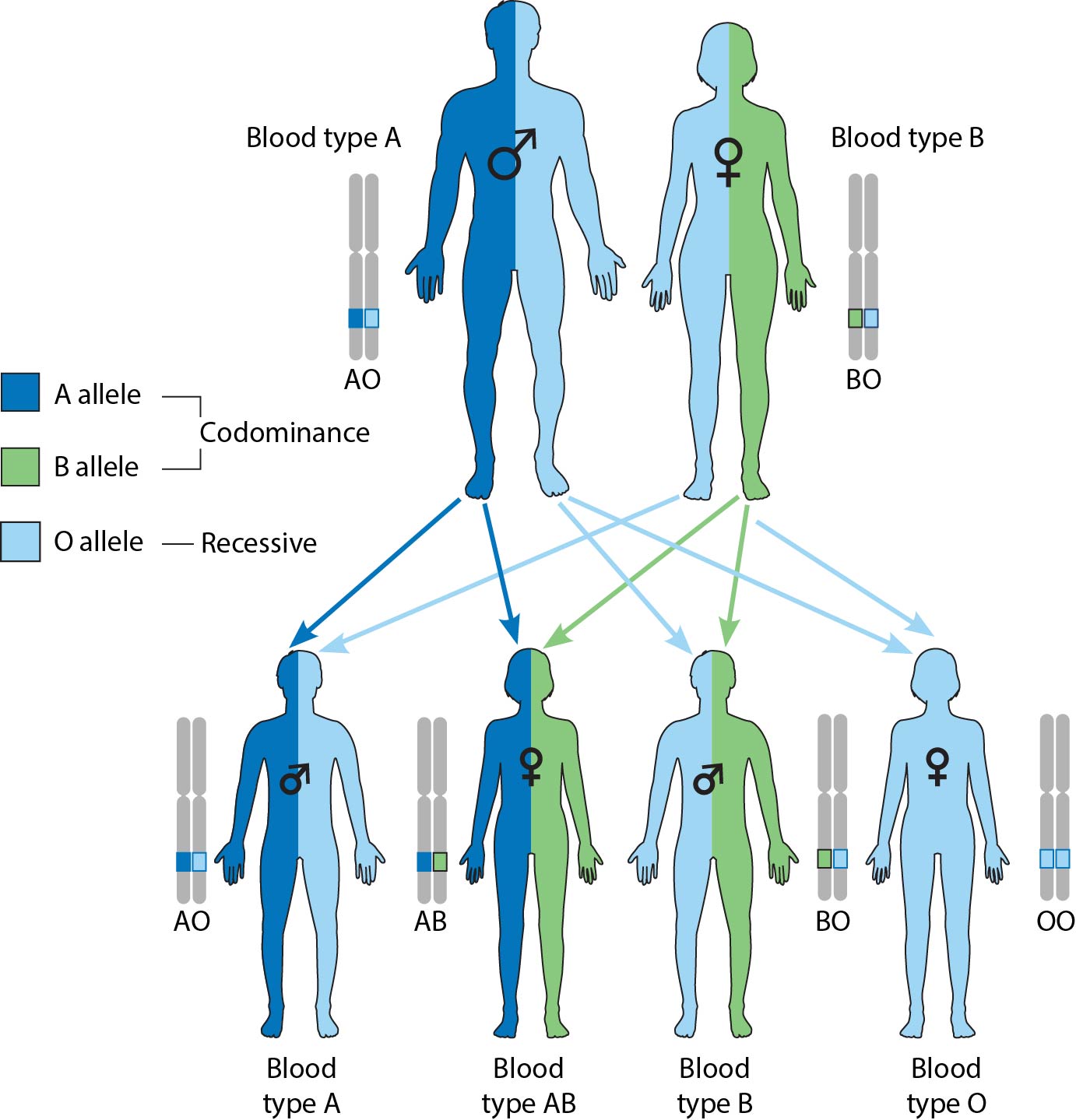
A child will inherit one of these alleles from each parent, which results in one of four possible phenotypes (A, B, AB, or O), commonly known as your blood type.
Codominance of ABO Blood Types—A child whose biological parents are heterozygous for the A, B, and O blood type alleles (AO and BO, in this example) will have equal probabilities of expressing any of the four blood type phenotypes (A, AB, B, or O). (credit: modification of work “ABO system codominance” by National Institutes of Health/Wikimedia Commons, Public Domain)
term to know
Codominance
The pattern of inheritance that corresponds to the equal, distinct, and simultaneous expression of two different alleles.
2. Incomplete Dominance
Mendel’s results, demonstrating that traits are inherited as dominant and recessive pairs, contradicted the view at that time that offspring exhibited a blend of their parents’ traits. However, the heterozygote phenotype occasionally does appear to be intermediate between the two parents. In incomplete dominance, the offspring express a heterozygous phenotype that is intermediate between one parent’s homozygous dominant trait and the other parent’s homozygous recessive trait.
IN CONTEXT
Incomplete dominance can be seen in snapdragons, Antirrhinum majus, when red-flowered plants and white-flowered plants are crossed to produce pink-flowered plants.
These pink flowers of a heterozygote snapdragon result from incomplete dominance. (credit: "storebukkebruse"/Flickr)
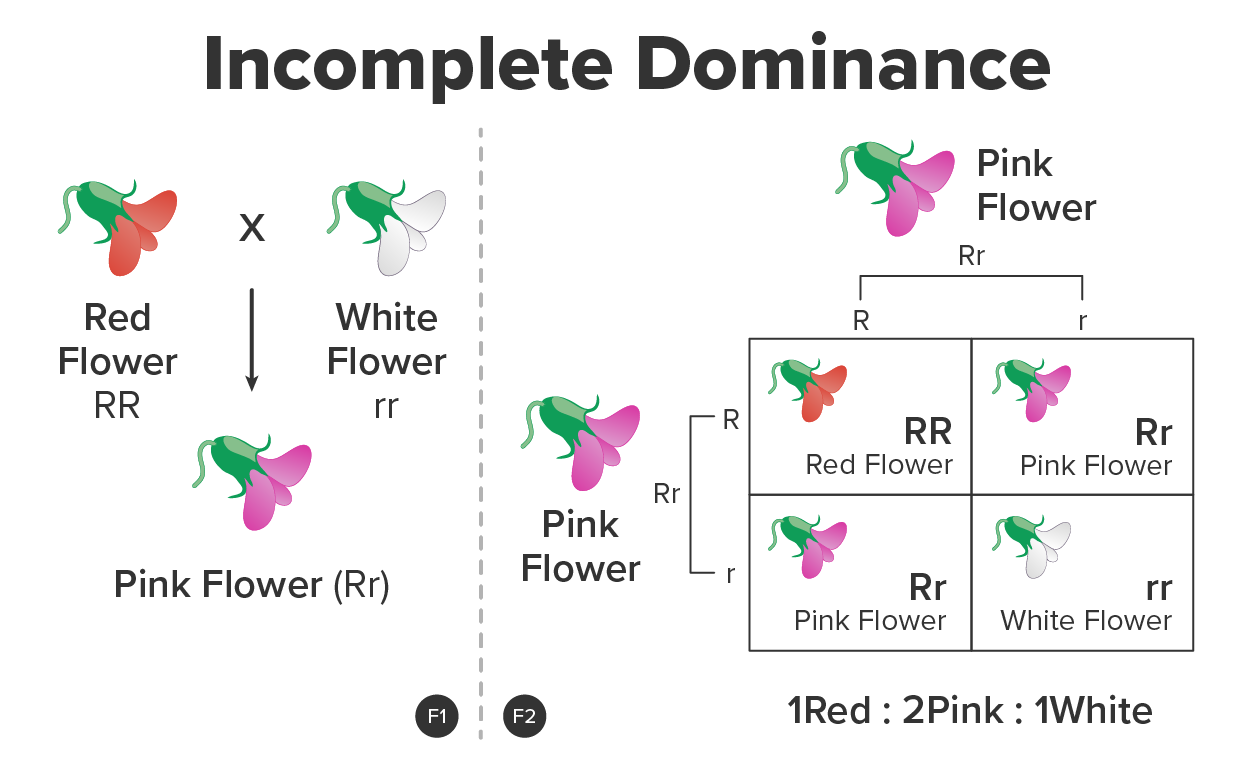
A cross between a homozygous parent with white flowers (CWCW) and a homozygous parent with red flowers (CRCR) will produce offspring with pink flowers (CRCW). (Note that different genotypic abbreviations are used for Mendelian extensions to distinguish these patterns from simple dominance and recessiveness.) This pattern of inheritance is described as incomplete dominance, meaning that one of the alleles appears in the phenotype in the heterozygote, but not to the exclusion of the other, which can also be seen.
The allele for red flowers is incompletely dominant over the allele for white flowers. However, the results of a heterozygote self-cross can still be predicted, just as with Mendelian dominant and recessive crosses. In this case, the genotypic ratio would be 1 CRCR:2 CRCW:1 CWCW, and the phenotypic ratio would be 1:2:1 for red:pink:white. The basis for the intermediate color in the heterozygote is simply that the pigment produced by the red allele (anthocyanin) is diluted in the heterozygote and therefore appears pink because of the white background of the flower petals.
Incomplete Dominance—Homozygous snapdragon flowers are red or white, whereas heterozygous snapdragon flowers are pink.
In humans, incomplete dominance occurs with one of the genes for hair texture. When one parent passes a curly hair allele (the incompletely dominant allele) and the other parent passes a straight hair allele, the effect on the offspring will be intermediate, resulting in hair that is wavy because alleles for both straight and curly hair are simultaneously expressed.
term to know
Incomplete Dominance
The pattern of inheritance in which a heterozygous genotype expresses a phenotype intermediate between dominant and recessive phenotypes.
3. Lethal Alleles
A large proportion of genes in an individual’s genome are essential for survival. Occasionally, a nonfunctional allele for an essential gene can arise by mutation and be transmitted in a population as long as individuals with this allele also have a wild-type, functional copy. The wild-type allele functions at a capacity sufficient to sustain life and is therefore considered to be dominant over the nonfunctional allele.
However, consider two heterozygous parents that have a genotype of wild-type/nonfunctional mutant for a hypothetical essential gene. In one quarter of their offspring, we would expect to observe individuals that are homozygous recessive for the nonfunctional allele. Because the gene is essential, these individuals might fail to develop past fertilization, die in utero, or die later in life, depending on what life stage requires this gene. An inheritance pattern in which an allele is only lethal in the homozygous form and in which the heterozygote may be normal or have some altered nonlethal phenotype is referred to as recessive lethal.
For crosses between heterozygous individuals with a recessive lethal allele that causes death before birth when homozygous, only wild-type homozygotes and heterozygotes would be observed in a population. The genotypic ratio would therefore be 2:1. In other instances, the recessive lethal allele might also exhibit a dominant (but not lethal) phenotype in the heterozygote. For instance, the recessive lethal Curly allele in Drosophila affects wing shape in the heterozygote form but is lethal in the homozygote.
A single copy of the wild-type allele is not always sufficient for normal functioning or even survival. The dominant lethal inheritance pattern is one in which an allele is lethal both in the homozygote and the heterozygote; this allele can only be transmitted if the lethality phenotype occurs after reproductive age. Individuals with mutations that result in dominant lethal alleles fail to survive even in the heterozygote form.
Dominant lethal alleles are very rare because, as you might expect, the allele only lasts one generation and is not transmitted. However, just as the recessive lethal allele might not immediately manifest the phenotype of death, dominant lethal alleles also might not be expressed until adulthood. Once the individual reaches reproductive age, the allele may be unknowingly passed on, resulting in a delayed death in both generations.
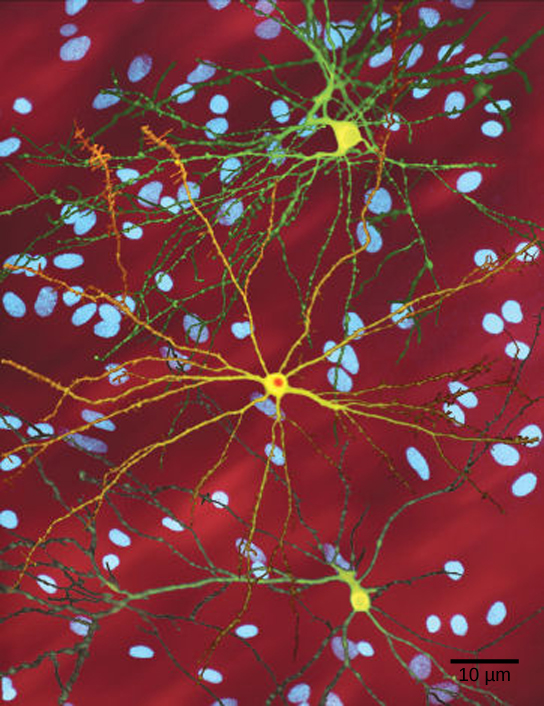
An example of this in humans is Huntington’s disease, in which the nervous system gradually wastes away. People who are heterozygous for the dominant Huntington allele (Hh) will inevitably develop the fatal disease. However, the onset of Huntington’s disease may not occur until age 40, at which point the afflicted persons may have already passed the allele to 50% of their offspring.
The neuron in the center of this micrograph (yellow) has nuclear inclusions characteristic of Huntington’s disease (orange area in the center of the neuron). Huntington’s disease occurs when an abnormal dominant allele for the Huntington gene is present. (credit: Dr. Steven Finkbeiner, Gladstone Institute of Neurological Disease, The Taube-Koret Center for Huntington's Disease Research, and the University of California San Francisco/Wikimedia)
terms to know
Recessive Lethal
The inheritance pattern in which an allele is only lethal in the homozygous form; the heterozygote may be normal or have some altered, nonlethal phenotype.
Dominant Lethal
The inheritance pattern in which an allele is lethal both in the homozygote and the heterozygote; this allele can only be transmitted if the lethality phenotype occurs after reproductive age.
summary
In this lesson, you learned about how some patterns of inheritance differ from the dominant-recessive pattern. First, you explored how codominance is when two alleles express themselves instead of one dominating another, such as with alleles for blood types. Then, you learned about incomplete dominance, in which a heterozygous genotype expresses an intermediate phenotype. Finally, you learned about how lethal alleles can result in death.
The pattern of inheritance that corresponds to the equal, distinct, and simultaneous expression of two different alleles.
Dominant Lethal
The inheritance pattern in which an allele is lethal both in the homozygote and the heterozygote; this allele can only be transmitted if the lethality phenotype occurs after reproductive age.
Incomplete Dominance
The pattern of inheritance in which a heterozygous genotype expresses a phenotype intermediate between dominant and recessive phenotypes.
Recessive Lethal
The inheritance pattern in which an allele is only lethal in the homozygous form; the heterozygote may be normal or have some altered, nonlethal phenotype.