Table of Contents |
Early organizational theorists broadly categorized organizational structures and systems as either mechanistic or organic. This broad, generalized characterization of organizations remains relevant. Mechanistic organizational structures are best suited for environments that range from stable and simple to low-moderate uncertainty and are characterized by top-down (or vertical) structures of control that are rule-based. The chain of command is highly centralized and uses formal authority; tasks are clearly defined and differentiated to be executed by specific specialized experts. Bosses and supervisors have fewer people working directly under them (i.e., a narrow span of control), and the organization is governed by rigid departmentalization (i.e., an organization is divided into different departments that perform specialized tasks according to the departments’ expertise). This form of organization represents a traditional type of structure that evolved in environments that were, as noted above, stable with low complexity. Historically, the U.S. Postal Service and manufacturing industries were mechanistic.
Organic organizational structures and systems, however, have opposite characteristics from mechanistic ones, with more horizontal structures of people who share power and responsibility. These organizational forms work best in unstable, complex, changing environments, such as with technology companies. Their structures are flatter, with participatory communication and decision making flowing in different directions. There is more fluidity and less rigid ways of performing tasks; there may also be fewer rules. Tasks are more generalized and shared; there is a wider span of control (i.e., more people reporting to managers). Organically structured organizations include high tech, computer, aerospace, and telecommunications companies that must deal with constant change and uncertainty. Contemporary corporations and firms engaged in fast-paced, highly competitive, rapidly changing, and turbulent environments are becoming more organic in different ways, as we will discuss in this chapter. However, not every organization may need an organic type of structure, and not every part of an organization must be organic. Understanding different organizational designs and structures is important to discern when, where, and under what circumstances a type of mechanistic system or part of an organization is needed.
| Mechanistic (Stable, Low-Uncertainty Environment) | Organic (Unstable, High-Uncertainty Environment) |
|---|---|
| Top-down hierarchy | Less rigid, horizontal organization |
| Narrow span of control | Wide span of control |
| Specialized tasks | Generalized, shared tasks |
| Formal rules | Flexible, few rules |
| Vertical communication | Two-way communication |
| Structured decision making | Participatory decision making |
EXAMPLE
In the early 2010s, online shoe retailer Zappos changed its structure to a holacracy, where teams form autonomously and are self-managed. The golden rule of holacracy is, "To fulfill your role, you have the full authority to make any decision or take any action, as long as there's no rule against it" (Hargrave, 2022). This structure is really the opposite of a traditional hierarchy and can be useful in environments that need flexibility and less structure.In this section, we will identify major types of structures and discuss the advantages and disadvantages of each. Note that in many larger national and international corporations, there is a mix and match among different structures used. Remember that organizational structures are designed to fit with external environments. Depending on the type of environments in which a company operates, from our earlier discussion, the structure should facilitate that organization’s capability to achieve its vision, mission, and goals. However, we can broadly view these structures as an evolutionary process, with organizations changing to adapt to new conditions.
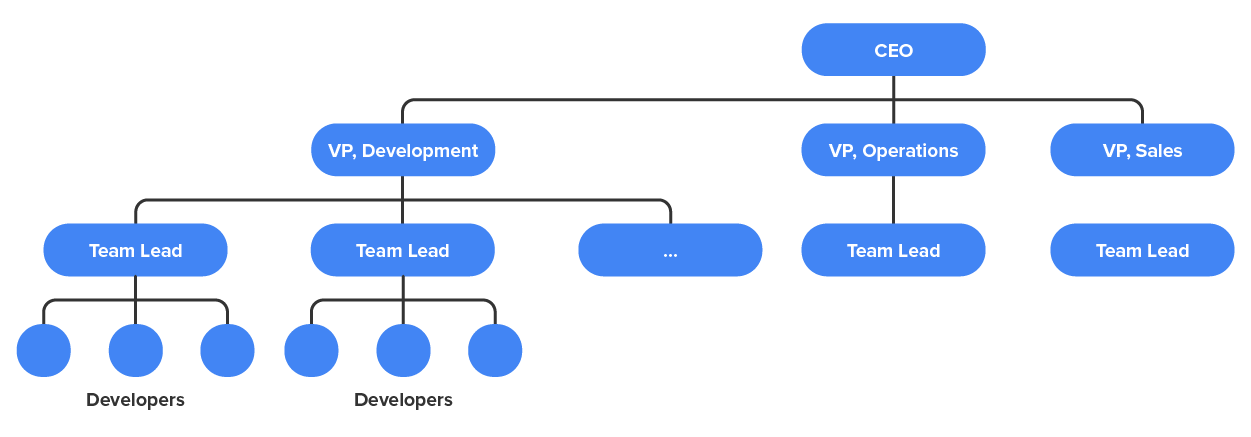
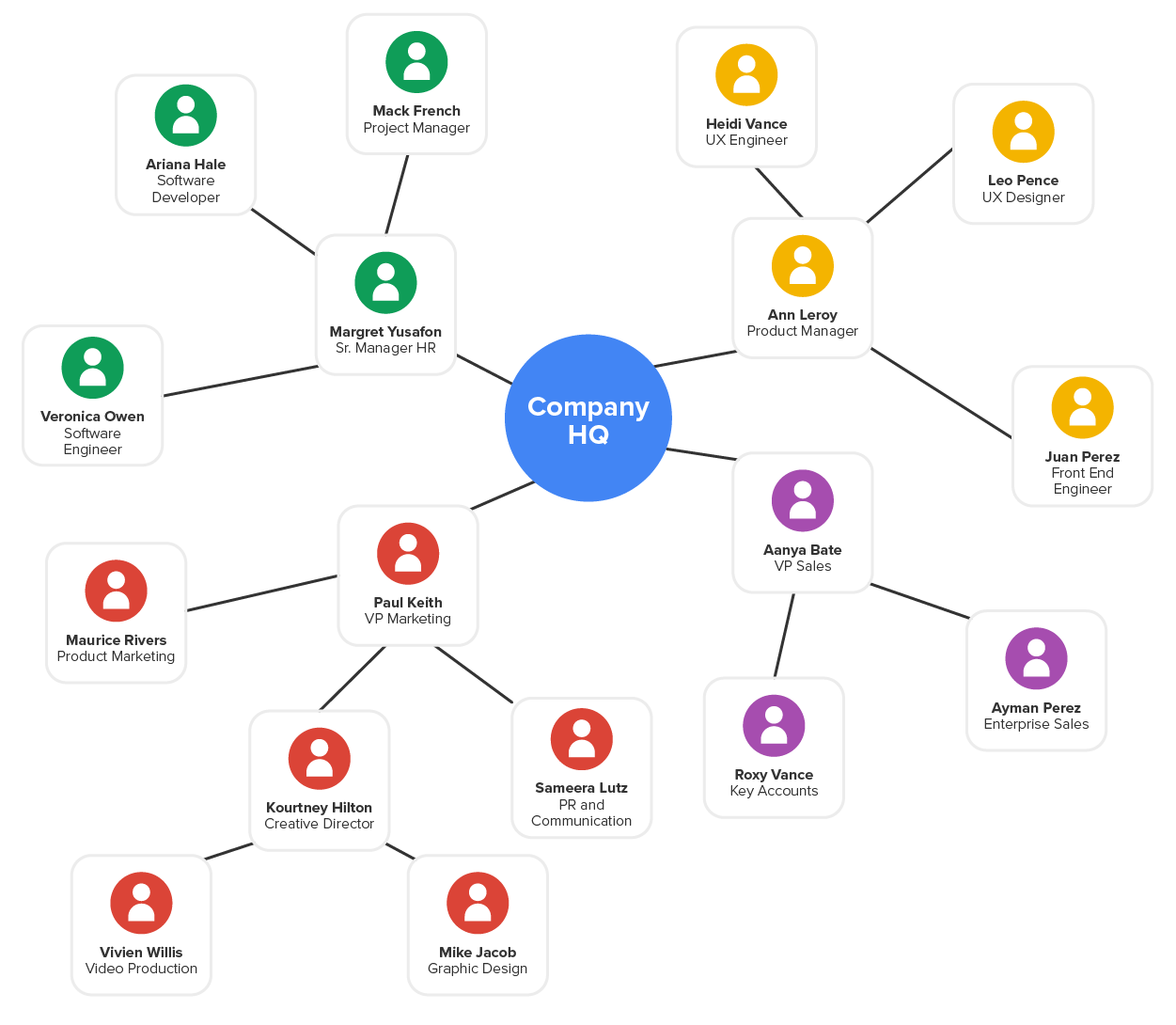
The functional structure is among the earliest and most used organizational designs. This structure is organized by departments and expertise areas, such as R&D (research & development), production, accounting, and human resources. Functional organizations are referred to as pyramid structures since they are governed as a hierarchical, top-down control system.
Small companies, start-ups, and organizations working in simple, stable environments may use this structure, as do many large government organizations and divisions of large companies for certain tasks.
The functional structure excels in providing for a high degree of specialization and a simple and straightforward reporting system within departments, offers economies of scale, and is not difficult to scale if and when the organization grows. Disadvantages of this structure include isolation of departments from each other since they tend to form “silos,” which are characterized by closed mindsets that are not open to communicating across departments, lack of quick decision making and coordination of tasks across departments, and competition for power and resources.
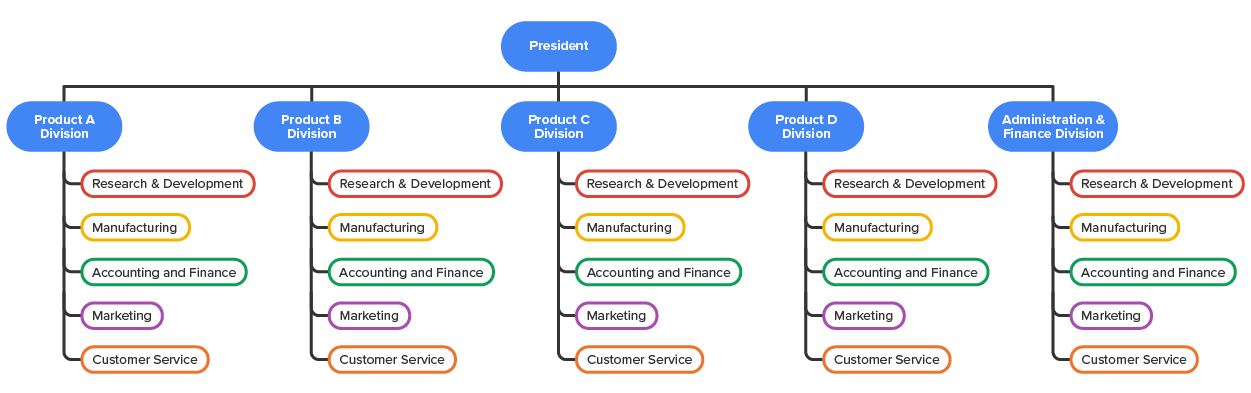
Divisional structures are, in effect, many functional departments grouped under a division head. Each functional group in a division has its own marketing, sales, accounting, manufacturing, and production team. This structure resembles a product structure that also has profit centers. These smaller functional areas or departments can also be grouped by different markets, geographies, products, services, or other whatever is required by the company’s business. The market-based structure is ideal for an organization that has products or services that are unique to specific market segments and is particularly effective if that organization has advanced knowledge of those segments.
The advantages of a divisional structure are that each specialty area can be more focused on the business segment and budget that it manages; everyone can more easily know their responsibilities and accountability expectations; customer contact and service can be quicker; and coordination within a divisional grouping is easier, since all the functions are accessible. The divisional structure is also helpful for large companies since decentralized decision making means that headquarters does not have to micromanage all the divisions. The disadvantages of this structure from an executive perspective are that divisions can easily become isolated and insular from one another and that different systems, such as accounting, finance, sales, and so on, may suffer from poor and infrequent communication and coordination of enterprise mission, direction, and values. Moreover, incompatibility of systems (technology, accounting, advertising, budgets) can occur, which creates a strain on company strategic goals and objectives.
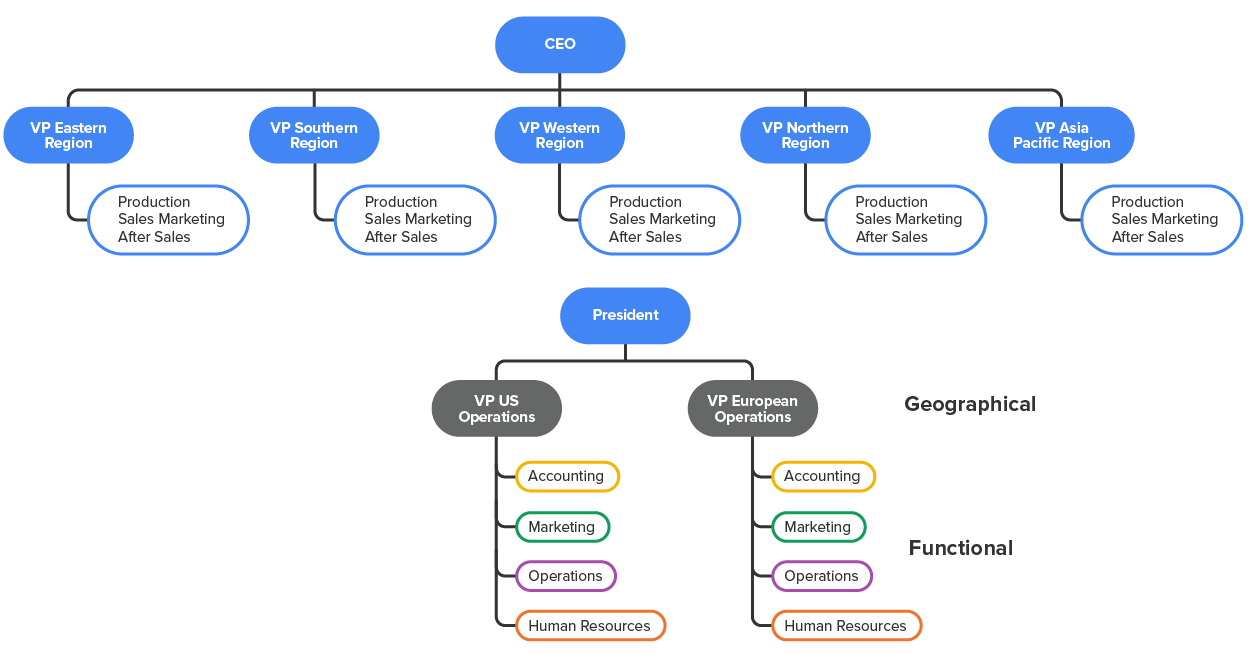
A geographic structure is another option aimed at moving from a mechanistic to more organic design to serve customers faster and with relevant products and services; as such, this structure is organized by locations of customers that a company serves. This structure evolved as companies became more national, international, and global. Geographic structures resemble and are extensions of the divisional structure.
Organizing geographically enables each geographic organizational unit (like a division) the ability to understand, research, and design products and/or services with the knowledge of customer needs, tastes, and cultural differences. The advantages and disadvantages of the geographic structure are similar to those of the divisional structure. Headquarters must ensure effective coordination and control over each somewhat autonomous geographically self-contained structure.
The main downside of a geographical organizational structure is that it can be easy for decision making to become decentralized, as geographic divisions (which can be hundreds, if not thousands, of miles away from corporate headquarters) often have a great deal of autonomy.
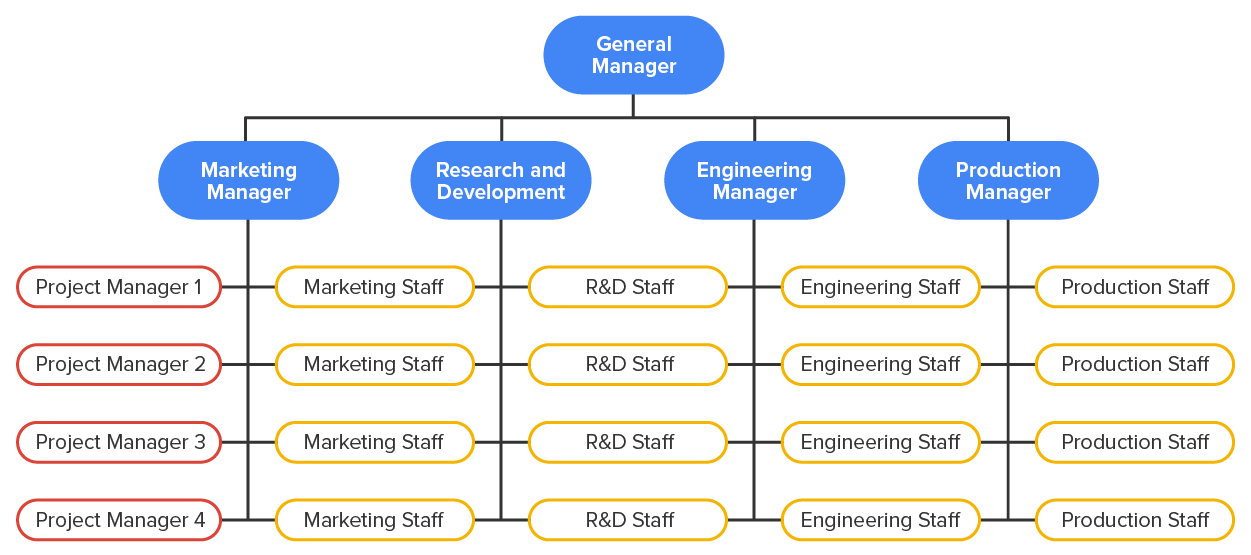
Matrix structures move closer to organic systems in an attempt to respond to environmental uncertainty, complexity, and instability. This structure largely resembles the divisional structure, but with emphasis on horizontals, representing communication and collaboration among functional departments across the matrix. This provides flexibility and helps integrate decision making in functionally organized companies.
Matrix designs use project teams to combine vertical with horizontal structures. The traditional functional or vertical structure and chain of command maintains control over employees who work on teams that cut across functional areas. In effect, matrix structures initiated horizontal team-based structures that provided faster information sharing, coordination, and integration between the formal organization and profit-oriented projects and programs.
This structure has lines of formal authority along two dimensions: Employees report to a functional, departmental boss and simultaneously to a product or project team boss. One of the weaknesses of matrix structures is the confusion and conflicts employees experience in reporting to two bosses. To work effectively, employees (including their bosses and project leaders) who work in dual-authority matrix structures require good interpersonal communication, conflict management, and political skills to manage up and down the organization.
Different types of matrix structures are used in more complex environments. For example, there are cross-functional matrix teams in which team members from other organizational departments report to an “activity leader” who is not their formal supervisor or boss. There are also functional matrix teams where employees from the same department coordinate across another internal matrix team consisting of, for example, HR or other functional area specialists, who come together to develop a limited but focused common short-term goal. There are also global matrix teams consisting of employees from different regions, countries, time zones, and cultures who are assembled to achieve a short-term project goal. Matrix team members have been and are a growing part of horizontal organizations that cut across geographies, time zones, skills, and traditional authority structures to solve customer and even enterprise organizational needs and demands.
Networked team structures are another form of horizontal organization. Moving beyond the matrix structure, networked teams are more informal and flexible. A networked organizational structure is one that naturally forms after being initially assigned. Based on the vision, mission, and needs of a problem or opportunity, team members will find others who can help—if the larger organization and leaders do not prevent or obstruct that process.
There is not one classical depiction of this structure, since different companies initially design teams to solve problems, find opportunities, and discover resources to do so. Stated another way, “The networked organization is one that is connected together by informal networks and the demands of the task, rather than a formal organizational structure. The network organization prioritizes its ‘soft structure’ of relationships, networks, teams, groups, and communities rather than reporting lines.”
Advantages of networked organizations are similar to those of organic, horizontal, and matrix structures, being highly flexible and collaborative across organizational boundaries. Weaknesses of the networked structure include:
Virtual structures emerged in the 1990s as a response to requiring more flexibility, solution-based tasks on demand, fewer geographical constraints, and accessibility to dispersed expertise. Virtual structures are highly dependent on technology for workers to communicate and collaborate.
These organizations move beyond network team structures in that the only stable part of the organization may be the headquarters or home base. Otherwise, this is a “boundaryless organization.” Increasingly, organizations are using different variations of virtual structures with call centers and other outsourced tasks, positions, and even projects.
Advantages of virtual teams and organizations include cost savings, decreased response time to customers, and greater access to a diverse labor. Disadvantages are social isolation of employees who work virtually, potential for lack of trust among employees and between the company and employees when communication is limited, and reduced collaboration among separated employees and the organization’s officers due to lack of social interaction. In addition, letting go of the idea of “face time” for promotional opportunities has been a challenge for some, as some managers still believe that productivity from an employee can only occur in the office, as opposed to at home. Successful virtual structures require trust but also mechanisms to engage employees in social interaction.
Source: THIS TUTORIAL HAS BEEN ADAPTED FROM OPENSTAX "ORGANIZATIONAL BEHAVIOR". ACCESS FOR FREE AT OPENSTAX.ORG/BOOKS/ORGANIZATIONAL-BEHAVIOR/PAGES/1-INTRODUCTION. LICENSE: CREATIVE COMMONS ATTRIBUTION 4.0 INTERNATIONAL. Accessed by August 2023.
REFERENCES
Hargrave, M. (2022, December 27). Holacracy Meaning, Origins, How It Works. Investopedia. www.investopedia.com/terms/h/holacracy.asp