Table of Contents |
Living organisms carry out a wide range of functions, each utilizing a unique set of anatomical structures. While two different organisms may share anatomical or physiological similarities, all organisms have at least one unique feature and function. However, to be considered living, every organism must meet a strict set of basic criteria:
Living organisms must be composed of one or more (1+) cells. Cells are the smallest unit considered living by science. Because of this, they are also known as the basic unit of all living things—all living things must be fundamentally composed of cells.
Cells can be eukaryotic (cells that have a membrane-bound nucleus and other membrane-bound compartments called organelles, which have specialized functions) or prokaryotic (simple cells that lack a well-defined nucleus or any other membrane-bound organelles). Single-celled organisms only have one cell and are very small (e.g., bacteria) and can be either prokaryotic or eukaryotic. Multicellular organisms have more than one eukaryotic cell and can range from very small (e.g., a tardigrade) to very large (e.g., an elephant). Both single-celled and multicellular organisms are composed of cells.
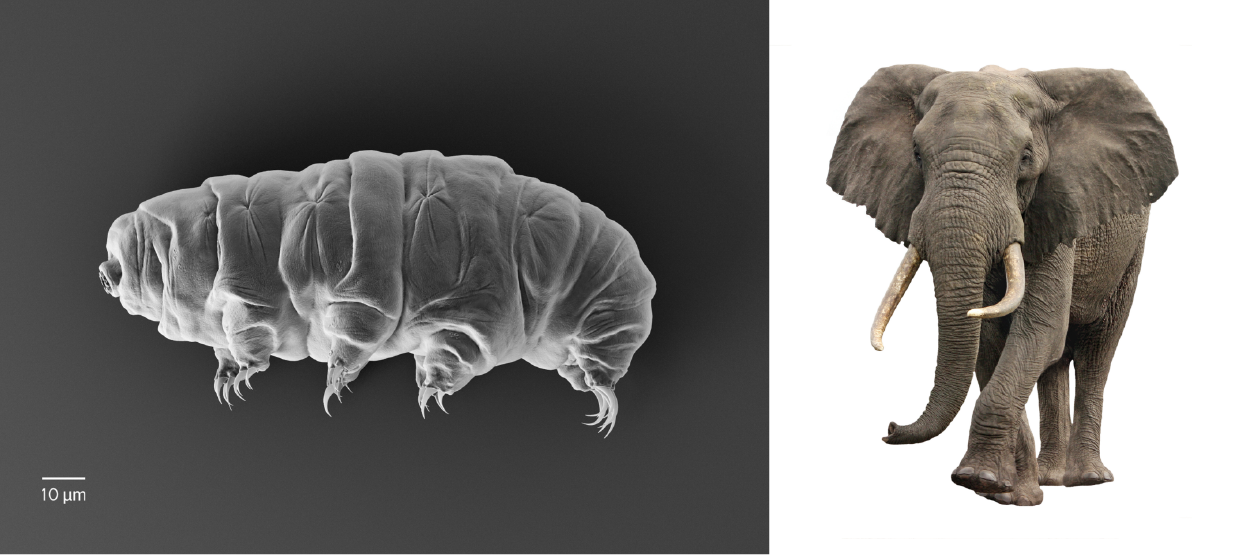
Living things must contain more complexity in their organization than an inanimate (non-living) object.
The adult human body is composed of approximately 37 trillion cells organized in specific locations, groups, and times. Each cell contains multiple internal compartments and structures that serve their own individual and shared cellular functions. These structures are composed of multiple chemicals that have their own unique properties. Some cells work alone, whereas others work with one another to perform collective tasks. These tasks can change based on location in the body, internal environmental conditions, or time of day.
In comparison to living organisms, inanimate objects have significantly less complexity in their organization.
Living organisms must grow and develop over time.
Growth is the increase in size. Humans, like all multicellular organisms, grow by increasing the number of existing cells, increasing the amount of noncellular material around cells (such as mineral deposits in bone), and, within very narrow limits, increasing the size of existing cells.
Development is all of the changes the body goes through in life. Development includes the process of differentiation, in which unspecialized cells become specialized in structure and function to perform certain tasks in the body. Development also includes the processes of growth and repair, both of which involve cell differentiation, which you will learn more about later in this course.

Living organisms must take in and use energy. Cells require energy to perform certain functions such as growth and development. To obtain that energy, organisms must consume molecules (i.e., food) and convert them into energy. Humans consume molecules in food and beverages, some of which are converted into energy. That energy will be utilized for movement or building and maintaining body structures.
Living organisms must maintain a relatively stable internal environment. All living things will be able to maintain homeostasis, which means they can maintain their internal environment.
All organisms survive within a range of various conditions, such as temperature. If the conditions go outside of the normal range, various diseases or disorders can develop. If these changes become exaggerated or prolonged, it can result in death.
The body has anatomical features and physiological processes that function within specific ranges to keep the internal environment stable in order to maintain life.
For example, on a hot day, the temperature of the human body begins to rise. To maintain a stable internal temperature, the body can sweat to cool itself by evaporative cooling. In cold weather, the body can shiver to generate extra heat. These processes work to maintain the internal body temperature.

Living organisms must be able to respond (adjust) to changes in the internal or external environment, also known as responsiveness.
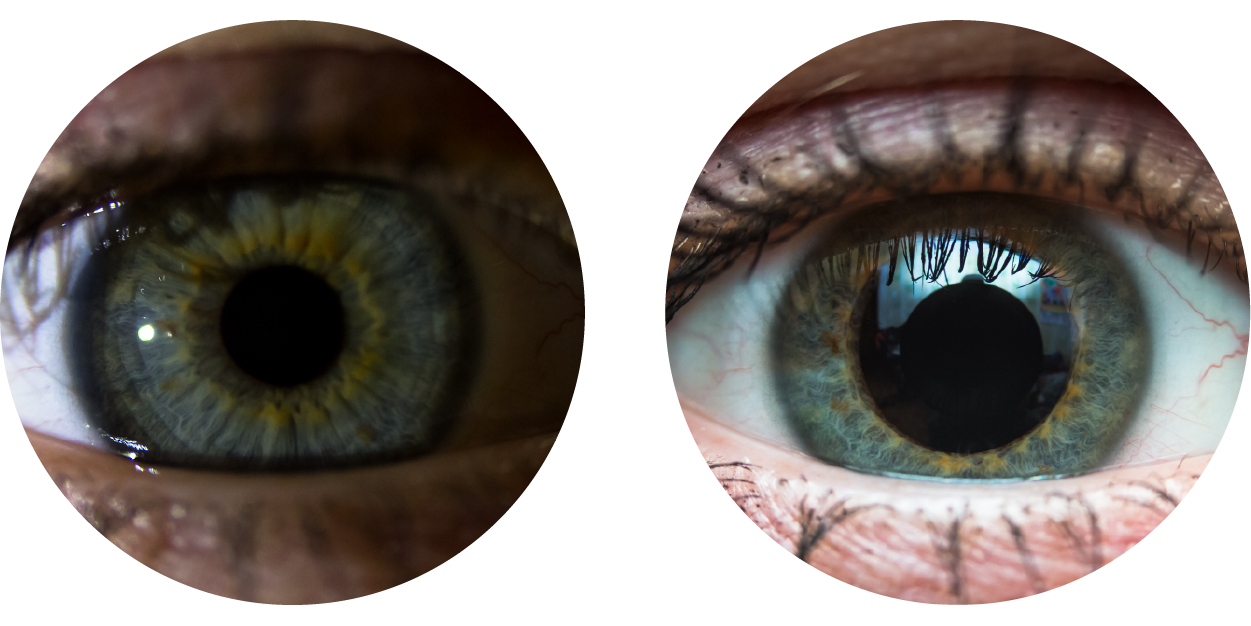
An example of responsiveness to external stimuli could include moving toward sources of food and water and away from perceived dangers. Changes in an organism’s environment can include increased or decreased light. Under low light, the black pupils in the eye expand to allow more light in. Under bright light, the pupils will constrict to allow less light in. This is an example of the body’s response to changes in the environment.
Living organisms must be able to reproduce using DNA.
Reproduction is the formation of a new organism from parent organisms. In humans, reproduction is carried out by the male and female reproductive systems. Because death will come to all complex organisms, without reproduction, the line of organisms would end.
Almost every cell contains DNA, the genetic material that contains the instructions for life. When an organism reproduces, it provides the new organism with its own set of DNA. This process allows for the inheritance of genetic traits, evolution, and more.
Living things are structured from very, very small to large. All living things are made up of atoms, and these atoms compose molecules.
EXAMPLE
The human body is made up of a lot of water, and water is made up of hydrogen and oxygen. Therefore, you're made up of atoms, which compose molecules; those molecules then compose cells.Before you begin to study human biology, it is helpful to consider the basic architecture of the human body; that is, how its smallest parts are assembled into larger structures. It is convenient to consider the structures of the body in terms of fundamental levels of organization that increase in complexity. For complex organisms like humans, our cells will make up tissues, and those tissues will make up organs. Then, those organs can make up organ systems. Finally, the organ systems will make up the entire organism.
EXAMPLE
All of your organ systems, such as your digestive system, your nervous system, and your cardiovascular system, work together to make up the full organism that is yourself.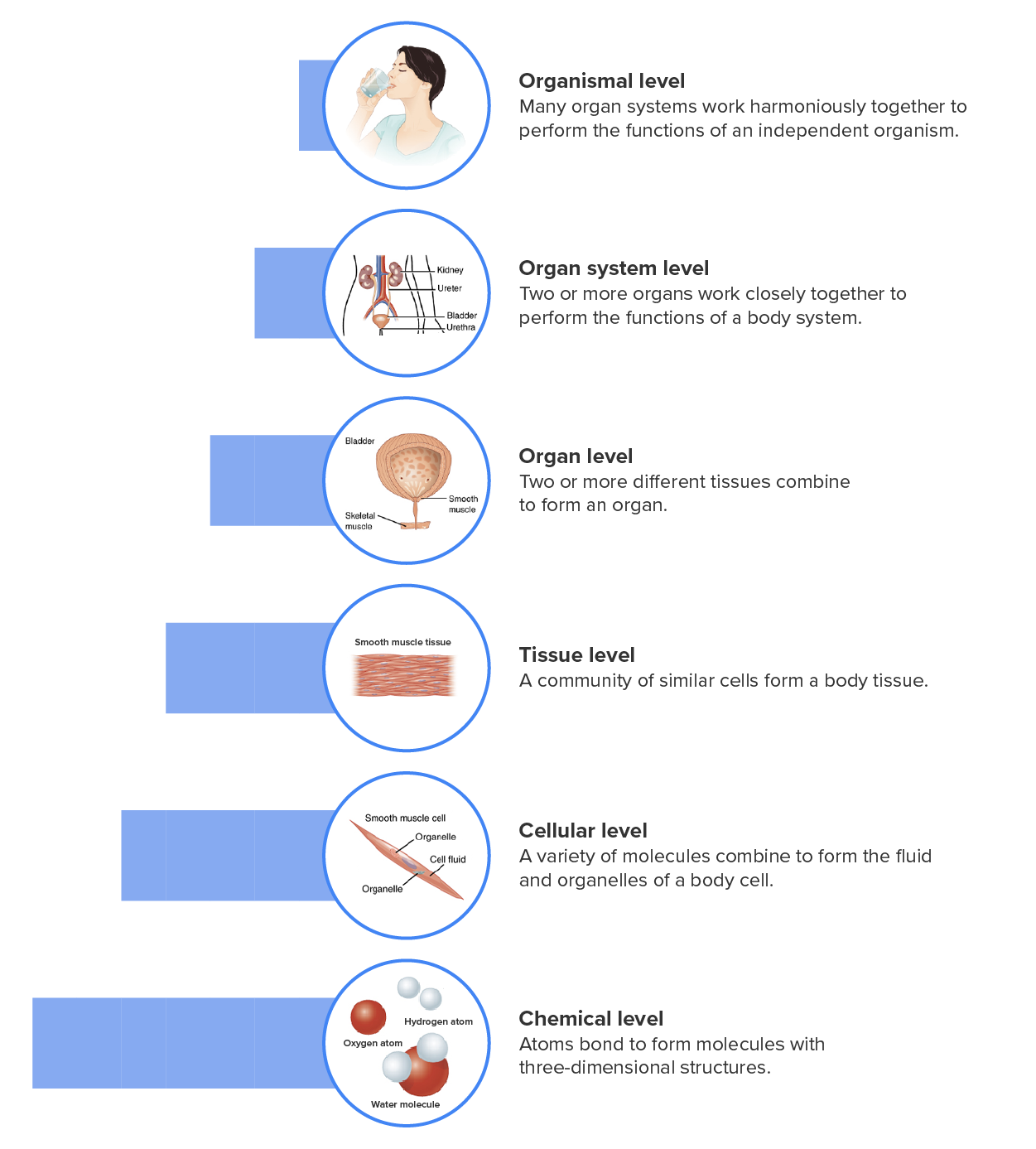
The chemical level is the lowest level of organization with the smallest units. All matter in the universe, whether solid, liquid, or gas, is composed of one or more unique pure substances called elements, some examples of which are hydrogen, oxygen, carbon, nitrogen, calcium, and iron. The smallest unit of any of these pure substances (elements) is an atom. Two or more atoms combine to form a molecule, such as the water molecules, proteins, and sugars found in living things. Molecules are the chemical building blocks of all body structures.
Many chemicals combine to form a cell. As you have learned, a cell is the smallest independently functioning unit of a living organism. Each cell contains small organs, called organelles, and other structures that provide organization to the cell. All living structures contain cells, and almost all functions of physiology are performed in cells or are initiated by cells. The human body is composed of over 200 different types of cells (Mostafa, 2021) that altogether number approximately 37 trillion total cells (Bianconi, et al., 2013).
Many cells combine to form a tissue. A tissue is a group of cells (generally alike though sometimes composed of a few related types) that work together to perform a specific function. A familiar example of this is muscle tissue, which is composed of many cells that work together to perform types of contractions. In total, all the cells of the body combine to create four primary tissue types: epithelial, connective, muscle, and nervous tissues. You will see more on each of these types later in the course. The structure and function of the chemical, cellular, and tissue level can be evaluated using a microscope.
Tissues combine to form an organ. An organ is an anatomically distinct structure of the body composed of two or more tissue types that work together to perform one or more functions. Examples include the skin, bones, muscles, brain, lungs, stomach, and kidneys.
Organs work together to form an organ system. An organ system is a group of organs that work together to perform major functions or meet physiological needs of the body. The human body has 11 organ systems. For example, one of these is the skeletal system composed of bones that all have their individual functions yet work together as the skeleton to provide structure and protection.
Lastly, organ systems work together to form an organism. The organism level is the highest level of organization with the largest sized unit. For all of biology, an organism is a living being that has a cellular structure and that can independently perform all physiologic functions necessary for life. In multicellular organisms, including humans, an organism is a group of organ systems that work together to maintain life.
The levels of organization are a framework that show how individual building blocks can be grouped together to form increasingly complex structures, including a human being or any other multicellular organism. While the terms for each level may be new, the concept of using small building blocks to construct something larger and more complex is quite familiar.
SOURCE: THIS TUTORIAL HAS BEEN ADAPTED FROM OPENSTAX “ANATOMY AND PHYSIOLOGY 2E”. ACCESS FOR FREE AT OPENSTAX.ORG/BOOKS/ANATOMY-AND-PHYSIOLOGY-2E/PAGES/1-INTRODUCTION. LICENSE: CREATIVE COMMONS ATTRIBUTION 4.0 INTERNATIONAL.
REFERENCES
Bianconi, E., Piovesan, A., Facchin, F., Beraudi, A., Casadei, R., Frabetti, F., Vitale, L., Pelleri, M. C., Tassani, S., Piva, F., Perez-Amodio, S., Strippoli, P., & Canaider, S. (2013). An estimation of the number of cells in the human body. Annals of human biology, 40(6), 463–471. doi.org/10.3109/03014460.2013.807878
Mostafa H. (2021). Different Cells of the Human Body: Categories and Morphological Characters. Journal of microscopy and ultrastructure, 10(2), 40–46. doi.org/10.4103/jmau.jmau_74_20



