Use Sophia to knock out your gen-ed requirements quickly and affordably. Learn more
×

Operating Activities: Indirect Method

Author: Sophia

before you start
In the previous tutorial, we were introduced to the operating activities section of the statement of cash flows, and how the format differs depending on if the company uses the direct or indirect method. The direct method adjusts each item in the income statement to a cash basis by deducting only the operating expenses that are paid in cash from cash sales. The indirect method makes these same adjustments but to net income rather than to each item in the income statement. It is performed by adjusting net income for items that affected net income but did not involve cash. Both methods eliminate not only the effects of non-cash items, such as depreciation, but also gains and losses on sales of plant assets. A large majority of companies use the indirect method.

In this tutorial, we will go into further detail about the indirect method, and in the next tutorial, we will look closer at the direct method.

1. Cash Flows From Operating Activities

The operating activities section of the statement of cash flows focuses on inflows and outflows of cash resulting from the normal day-to-day operations of the business. This includes such things as cash received from selling products and services, paying employees and vendors, and paying for operational costs like rent, utilities, and insurance. Paying interest to creditors and taxes is also addressed within the operating activities section.

Both the U.S. Generally Accepted Accounting Principles (GAAP) and the International Financial Reporting Standards (IFRS) permit companies to use either the direct or indirect method to calculate the net cash flows from operating activities. However, the majority of accountants choose the indirect method over the direct method. Ultimately, both methods have the same purpose but take separate approaches.

The indirect method adjusts net income (rather than adjusting individual items in the income statement) for changes in current assets and current liabilities, as well as items that were included in net income but did not affect cash. The most common example of an operating expense that does not affect cash is depreciation expense, which is a measurement of how much an asset has lost value over a time period.

If a company chooses to use the direct method for external reporting, they are required to provide an additional report that uses the indirect method, but companies that use the indirect method are not required to supplement their reporting using the direct method.

IN CONTEXT

Excerpt from the Financial Accounting Standards Board (FASB), Statement of Financial Accounting Standards No. 95
This Statement requires that a statement of cash flows reports the reporting currency equivalent of foreign currency cash flows, using the current exchange rate at the time of the cash flows. The effect of exchange rate changes on cash held in foreign currencies is reported as a separate item in the reconciliation of beginning and ending balances of cash and cash equivalents.

This Statement requires that information about investing and financing activities not resulting in cash receipts or payments in the period be provided separately.

This Statement is effective for annual financial statements for fiscal years ending after July 15, 1988. Restatement of financial statements for earlier years provided for comparative purposes is encouraged but not required.


2. Preparing the Statement of Cash Flows Using the Indirect Method

We will utilize a three step process to adjust the net income provided on the income statement to the net cash provided by the operating activities.

step by step
  1. Add expenses that do not impact cash, such as depreciation and amortization expense, back to the net income
  2. Adjust for any gains and losses from the sale of noncurrent assets
  3. Adjust for any changes to all other noncash current asset and liability accounts

Let’s look at each of these steps in more detail.

2a. Add Noncash Expenses Back to the Net Income—Step One

Depreciation and amortization are noncash expenses. Since the indirect method requires us to adjust net income for all of the changes to noncash accounts on the balance sheet, depreciation and amortization expenses must be added back since these are the amounts that would have increased the accumulated depreciation or amortization accounts on the balance sheet.

2b. Adjust for Any Gains and Losses From the Sale of Noncurrent Assets—Step Two

Noncurrent assets are assets that a company holds long term with the expectation that they will generate income; this includes fixed assets like property and equipment as well as intangible assets like copyrights and patents. The proceeds from the sale of noncurrent assets are included as a cash inflow in the investing activity section. Proceeds are cash received from the sale of a noncurrent asset. However, gains or losses must be adjusted from net income. Gains are the result of when proceeds received from the sale of an asset exceed the book value, and losses are the result of the proceeds of an asset’s sale being less than the book value.

  • Proceeds are included as a cash inflow in the investing activity section.
  • Gains are subtracted from net income.
  • Losses are added to net income.

2c. Adjust for Any Changes to All Other Noncash Current Asset and Liability Accounts—Step Three

There are a few different rules for indicating the balance of current assets and liabilities, depending on their increase or decrease:

  • If the balance of a current asset increases during the accounting period, then that amount will be subtracted from net income.
  • If the balance of a current asset decreases during the accounting period, then that amount will be added to net income.
  • If the balance of a current liability increases during the accounting period, then that amount will be added to net income.
  • If the balance of a current liability decreases during the accounting period, then that amount will be subtracted from net income.
Use the following table to guide the adjustments based on the changes in the balance sheet accounts.

If account balance has increased If account balance has decreased
Current Assets:
Inventory minus plus
Accounts receivable minus plus
Prepaid expenses minus plus
Current Liabilities:
Accounts payable plus minus
Accrued expenses payable plus minus
Income taxes payable plus minus

terms to know
Noncurrent Assets
The assets that a company holds long term with the expectation that they will generate income; this includes fixed assets like property and equipment as well as intangible assets like copyrights and patents.
Proceeds
The cash received from the sale of a noncurrent asset.
Gains
A gain results when the proceeds received from the sale of an asset exceeds the book value.
Losses
A loss results when the proceeds received from the sale of an asset are less than the book value.


3. Example Preparation of the Operating Activities Section

We will use Allentown Hydraulics Inc. as our example for preparing the operating activities section of the statement of cash flows. Allentown Hydraulics Inc. is a midsized producer of hydraulic parts used in many industries and has customers all over the world. We will notice that the net cash flows from operating activities end up being the same for both the direct and indirect methods. However, the path taken to the end result is quite different.

EXAMPLE

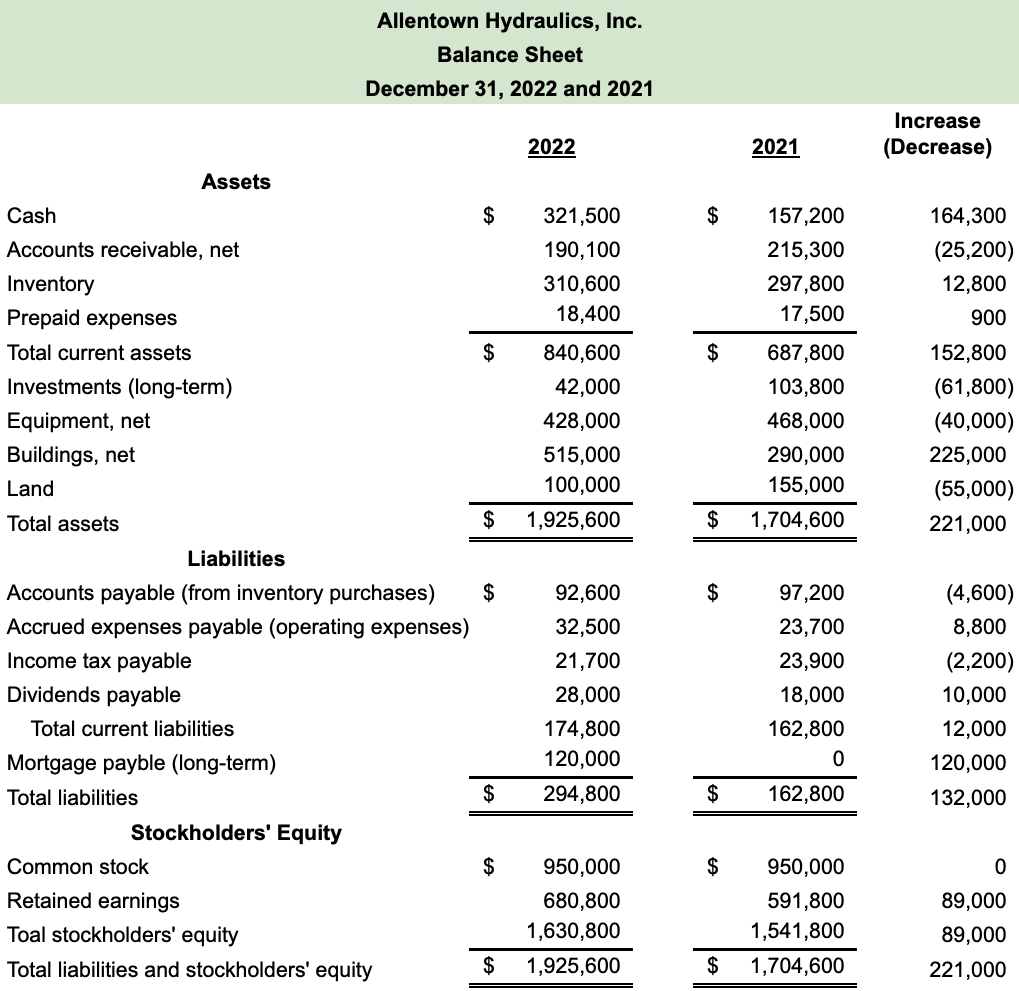
The most recent income statement for 2022 and a comparative balance sheet for 2022 and 2021 are used to demonstrate the process for preparing the operating activities section of the statement of cash flows using the indirect method.
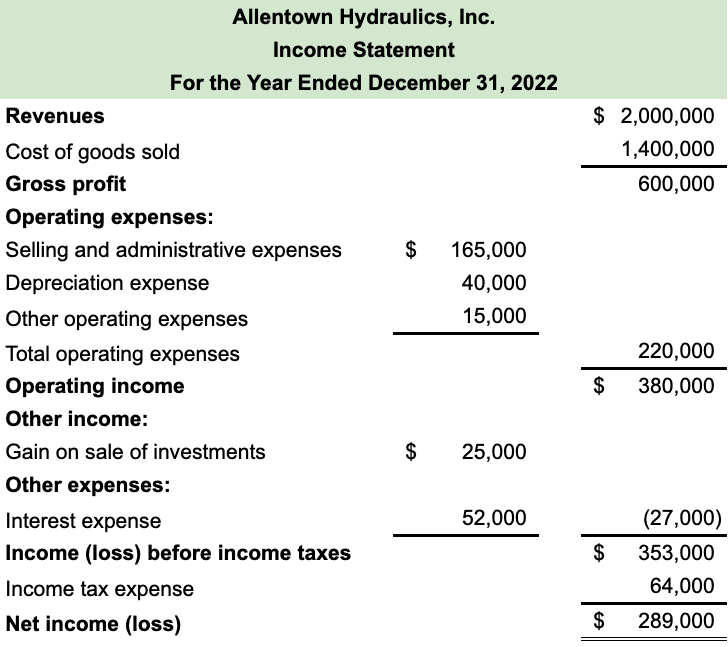
Observe the income statement for 2022:

View this spreadsheet in Google Sheets


And the comparative balance sheet for 2021 and 2022:

View this spreadsheet in Google Sheets

We will now walk through the steps with the information from these statements.

3a. Example Step One

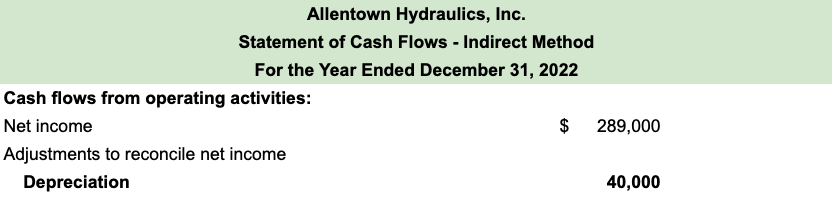
Step One: Add noncash expenses back to the net income.

Net income is increased by the amount of depreciation expense listed on the income statement.

EXAMPLE

Depreciation is the only noncash expense for Allentown. We add the noncash expense of depreciation back to the net income:
View this spreadsheet in Google Sheets

3b. Example Step Two

Step Two: Adjust for any gains and losses from the sale of noncurrent assets.

EXAMPLE

In the other income section of Allentown’s income statement, we can see that there is a gain in the sale of investments reported. We adjust by subtracting the gain on the sale of investments.

table attributes columnalign left end attributes row cell Net space Income space space space space space space space space space space space space space space space space space space space space space space space space space space space space space space space space space space space space space space space space space space space space $ 289 comma 000 end cell row cell plus space Depreciation space Expense space space space space space space space space space space space space space space space space space space plus space $ 40 comma 000 end cell row cell bold minus bold space bold Gain bold space bold on bold space bold sale bold space bold of bold space bold investments bold space bold space bold space bold minus bold space bold $ bold 25 bold comma bold 000 end cell end table

View this spreadsheet in Google Sheets

hint
Remember, gains are subtracted from net income, and losses are added to net income.

3c. Example Step Three

Step Three: Adjust for any changes to all other noncash current assets and liability accounts.


EXAMPLE

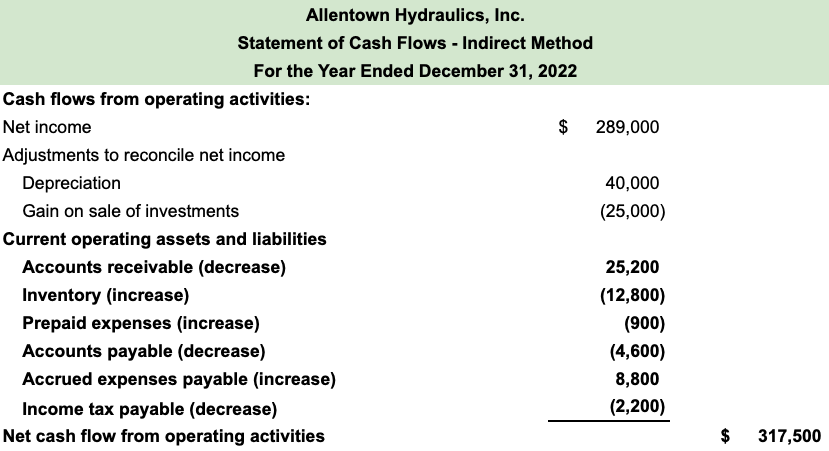
  • Accounts receivable decreased by $25,200. This amount should be added to net income.
  • Inventory increased by $12,800. This amount should be subtracted from net income.
  • Prepaid expenses increased by $900. This amount should be subtracted from net income.
  • Accounts payable decreased by $4,600. This amount should be subtracted from net income.
  • Accrued expenses payable increased by $8,800. This amount should be added to net income.
  • Income tax payable decreased by $2,200. This amount should be subtracted from net income.
table attributes columnalign left end attributes row cell Net space Income space space space space space space space space space space space space space space space space space space space space space space space space space space space space space space space space space space space space space space space space space space space space space space space space space space space space space space space space space $ 289 comma 000 end cell row cell plus Depreciation space Expense space space space space space space space space space space space space space space space space space space space space space space space space space space space space space space space space space plus space $ 40 comma 000 end cell row cell negative space Gain space on space sale space of space investments space space space space space space space space space space space space space space space space space space space space space space minus space $ 25 comma 000 end cell row cell bold plus bold space bold Decrease bold space bold in bold space bold accounts bold space bold receivable bold space bold space bold space bold space bold space bold space bold space bold space bold space bold plus bold space bold $ bold 25 bold comma bold 200 end cell row cell bold minus bold space bold Increase bold space bold in bold space bold inventory bold space bold space bold space bold space bold space bold space bold space bold space bold space bold space bold space bold space bold space bold space bold space bold space bold space bold space bold space bold space bold space bold space bold space bold space bold space bold space bold space bold space bold space bold space bold minus bold space bold $ bold 12 bold comma bold 800 end cell row cell bold minus bold space bold Increase bold space bold in bold space bold prepaid bold space bold expenses bold space bold space bold space bold space bold space bold space bold space bold space bold space bold space bold space bold space bold space bold space bold space bold space bold space bold space bold space bold space bold minus bold space bold $ bold 900 end cell row cell bold plus bold space bold Decrease bold space bold in bold space bold accounts bold space bold payable bold space bold space bold space bold space bold space bold space bold space bold space bold space bold space bold space bold space bold space bold space bold space bold minus bold space bold $ bold 4 bold comma bold 600 end cell row cell bold minus bold space bold Increase bold space bold in bold space bold accrued bold space bold expenses bold space bold payable bold space bold space bold plus bold $ bold 8 bold comma bold 800 end cell row cell bold plus bold space bold Decrease bold space bold in bold space bold income bold space bold tax bold space bold payable bold space bold space bold space bold space bold space bold space bold space bold space bold space bold space bold space bold space bold space bold minus bold space bold $ bold 2 bold comma bold 200 end cell end table

View this spreadsheet in Google Sheets


try it
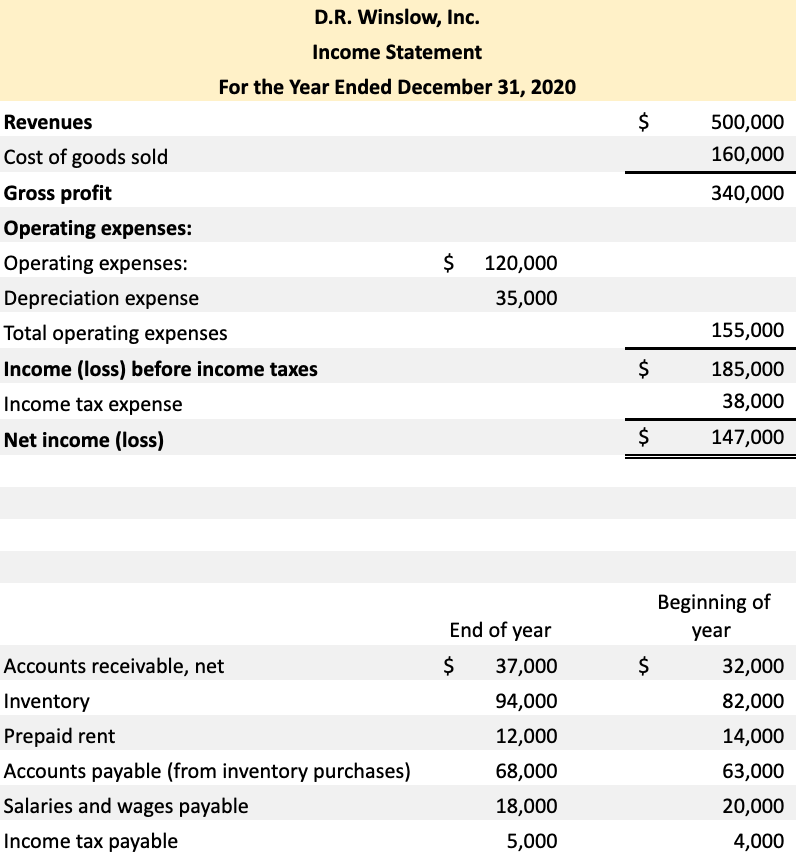
Now, let’s try to prepare the operating activities section for the statement of cash flows using the indirect method on our own. The 2020 income statement for D.R. Winslow Inc. is provided below along with select information from their balance sheet.

View this spreadsheet in Google Sheets

Begin by adding depreciation back to net income
Depreciation expense of $35,000 (from the income statement) is added to the net income (from the income statement) of $147,000
table attributes columnalign left end attributes row cell space space space space space Net space Income space space space space space space space space space space space space space space space space space space space space space space space space space space space space space space space space space space space space space space space space space $ 147 comma 000 end cell row cell plus space Depreciation space Expense space space space space space space space space space space space space space space space space space space space space plus space $ 35 comma 000 end cell end table

summary
In this lesson, you learned how to prepare the operating section of the statement of cash flows using the indirect method. The operating activities section of the statement of cash flows focuses on the inflows and outflows of cash resulting from the normal day-to-day operations of the business. These transactions include such things as cash received from selling products and services, paying employees and vendors, and paying for operational costs like rent, utilities, and insurance. Paying interest to creditors and taxes is also addressed within the operating activities section. The indirect method adjusts net income for changes in current assets and current liabilities, as well as items that were included in net income but did not affect cash.

There is a three-step process to adjust the net income provided on the income statement to the net cash provided by the operating activities, the steps include:

Step 1: Add expenses that do not impact cash, such as depreciation and amortization expense, back to the net income

Step 2: Adjust for any gains and losses from the sale of noncurrent assets

Step 3: Adjust for any changes to all other non-cash current asset and liability accounts

Source: THIS TUTORIAL HAS BEEN ADAPTED FROM “ACCOUNTING PRINCIPLES: A BUSINESS PERSPECTIVE” BY hermanson, edwards, and maher. ACCESS FOR FREE AT www.solr.bccampus.ca. LICENSE: CREATIVE COMMONS ATTRIBUTION 3.0 UNPORTED.


Terms to Know
Gains

A gain results when the proceeds received from the sale of an asset exceeds the book value.

Losses

A loss results when the proceeds received from the sale of an asset are less than the book value.

Noncurrent Assets

The assets that a company holds long term with the expectation that they will generate income; this includes fixed assets like property and equipment as well as intangible assets like copyrights and patents.

Proceeds

The cash received from the sale of a noncurrent asset.