The Old Kingdom in ancient Egypt has very notable architecture. From mastabas to pyramids, there were changes in architecture that took place during this time. In this lesson, you will learn about this evolution as well as the basic elements of funerary architecture. This lesson covers:
The Old Kingdom, the period covered in this lesson, begins in 2575 BCE and ends in 2150 BCE. As a reference, the Roman Republic was founded in 509 BCE.
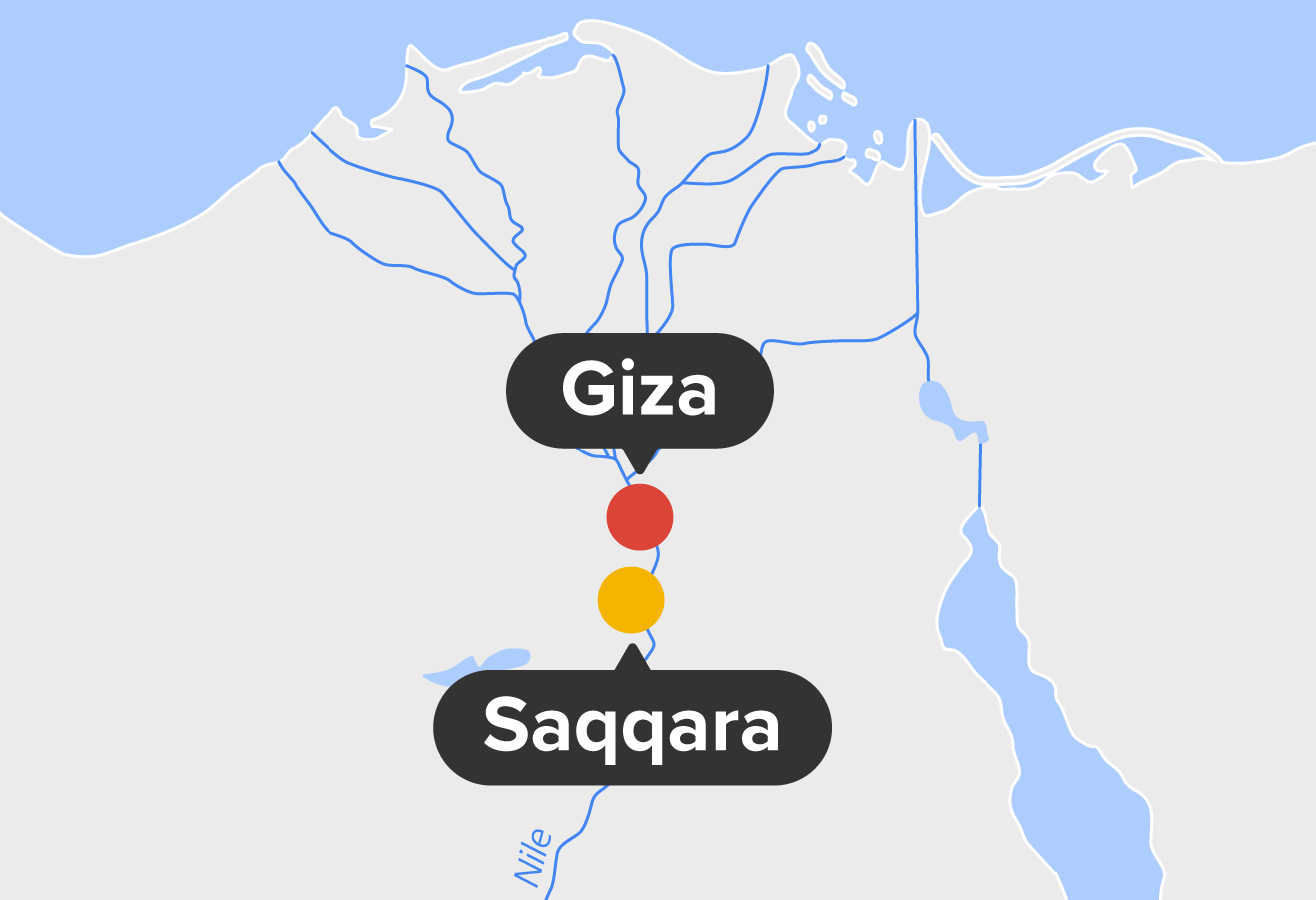
Near the fork in the northern part of the Nile River, before it spreads out into the Nile delta, is the Necropolis of Giza. And about 30 miles south is the Necropolis of Saqqara. Both of these areas are covered in this lesson, and both are noted on the map below.
term to know
Necropolis
A large cemetery or burial ground; literally, “city of the dead.”
2. The Mastaba and Serdab
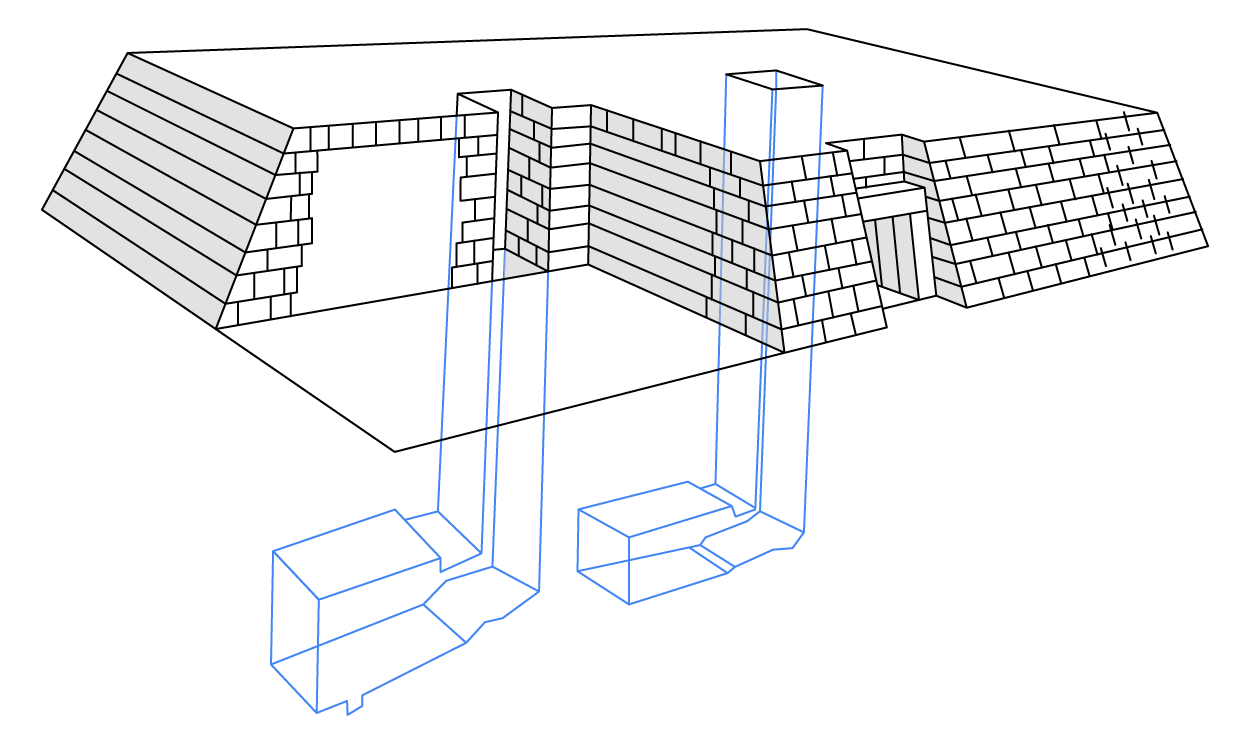
The mastaba is a stone or brick structure that is flat-roofed and has slanting sides. The burial chamber is underneath.
Here is a diagram of a mastaba:
Notice the flat roof, the slanting sides, and the burial chambers underneath the structure.
The serdab is a room in which the ka statue resides. It is inside the tomb, and there are openings for the ka statue so it would not be completely enclosed in this structure. This was intentional to allow ritualistic communication to continue through the hole(s).
terms to know
Mastaba
A type of Egyptian tomb, rectangular, made of brick or stone, flat-roofed with sloping sides built over a tomb and connected to it by a shaft.
Serdab
Used during the Old Kingdom, a cellar and a chamber in a tomb for the ka statue of a deceased person.
3. Imhotep
Imhotep, a historical figure who lived during this time, had many roles, including high priest, physician, architect, artist, and royal administrator. Notably, he was one of the only individuals in history that was not a pharaoh to achieve divine status after his death. This is referred to as "apotheosis."
Imhotep was the chief architect and right-hand man of Djoser, who was the pharaoh of the Third Dynasty. In fact, Imhotep is the first officially noted architect in history, and he designed the first known example of monumental architecture in Egypt, the funerary complex at Saqqara.
One interesting architectural element Imhotep used during this time was engaged columns. These are columns that partially reside in the wall. He also used fluting, which are vertical channels that run the length of the column. These are design elements that were seen again later in ancient Greek and ancient Roman architecture.
did you know
Are you familiar with mummy movies? If so, you might have heard the name Imhotep. He was the principal villain in many of these movies. Believe it or not, that is not a factual representation of Imhotep.
4. Architecture of Step Pyramids
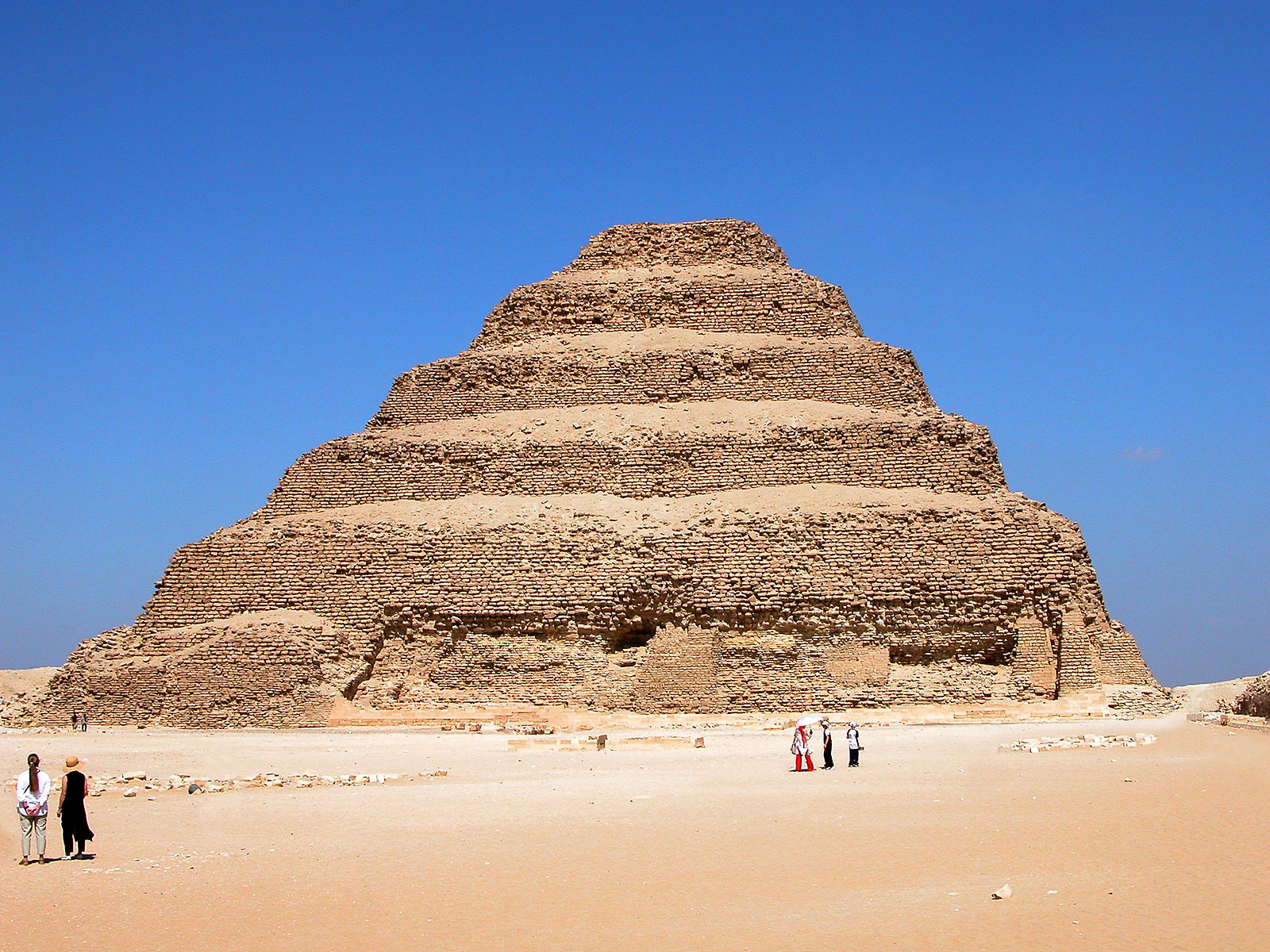
Step pyramids in ancient Egypt, while similar in appearance to Mesopotamian ziggurats, had a very different purpose. They were tombs and actually took on the form of a series of smaller mastabas stacked on top of one another. This is very similar to the idea of a stairway to heaven or an axis mundi linking the heavens to the earth and the underworld (this was discussed in an earlier lesson on architecture). The step pyramid itself appears to have been an intentional improvement on an earlier mastaba-only design.
Below is a picture of an actual step pyramid tomb.
Artist unknown The Step Pyramid of Djoser Saqqara, Egypt 2649 to 2575 BCE, Third dynasty Stone
IN CONTEXT
It is important to understand the evolution of the Egyptian funerary tomb. If you take mastabas and stack them on one another, you get a step pyramid, which is like several mastabas of decreasing size stacked on one another. Finally, the true pyramid, much like a refined version of the step pyramid, has smooth, sloping sides. These sides symbolize the rays of the sun god Ra.
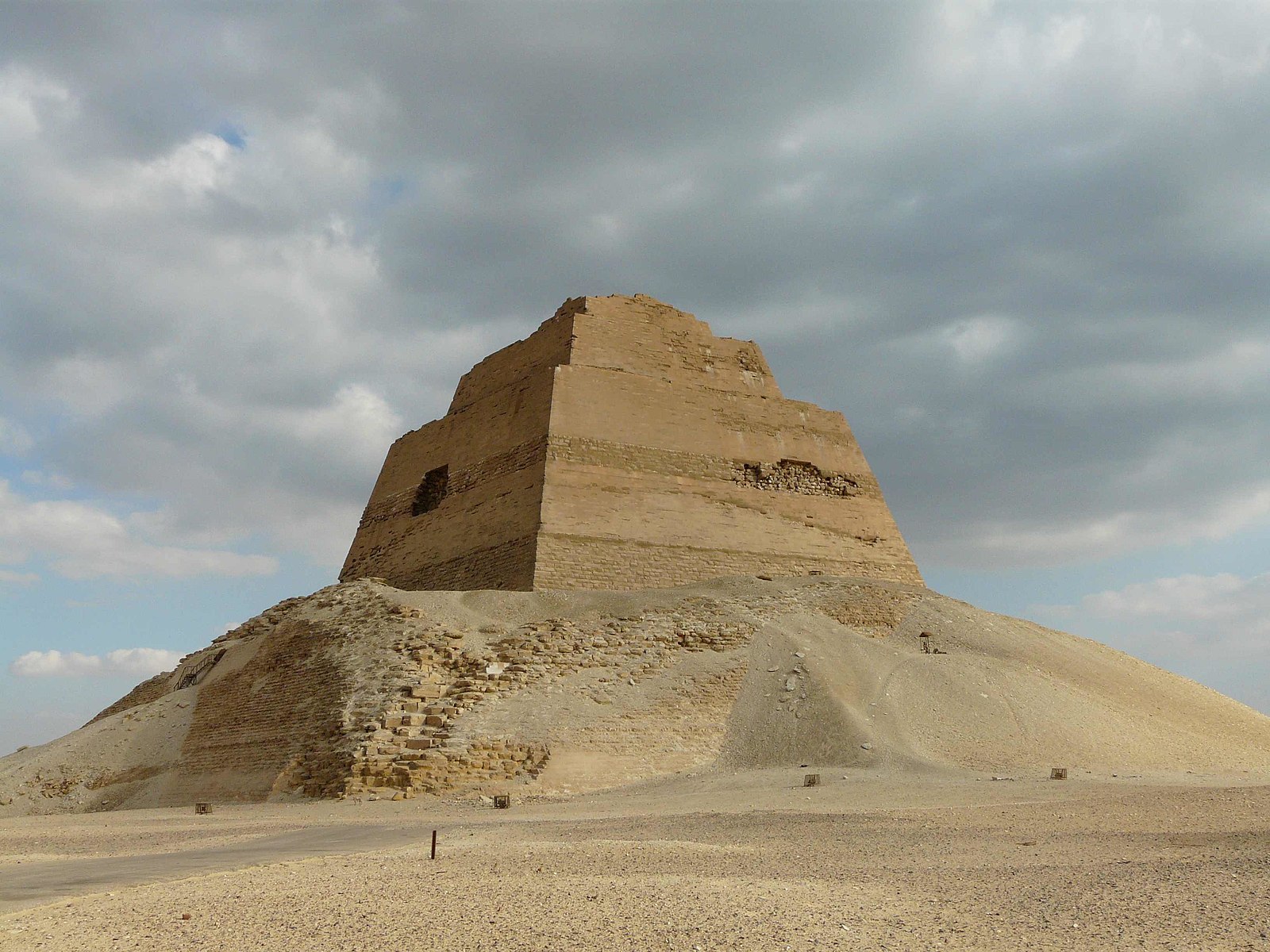
The mathematical calculations were amazingly precise, as the stones would have had to have been tapered gradually to meet at the very top in a precise point. They are true geometric pyramids, with a square base and four slanting triangles. Ancient Egyptian builders experimented with sloping the sides of pyramids at different angles, which sometimes had disastrous results. Below is the Meidoum pyramid, which had multiple structural issues and probably collapsed while it was still under construction.
Artist unknown Pyramid at Meidoum Lower Egypt c. 2650 BCE, Third dynasty Mudbrick
The slope of the Great Pyramids at Giza is approximately 51 degrees. The reason for this particular shape is that it is extremely stable and may also represent the rays of the sun emanating from a single source, the sun, at the top. The pharaohs were thought to climb the rays of the sun to join the sun god Ra, their principal deity. They are laid out east to west to follow the path of the sun as it travels east to west, which may be symbolic of a human lifespan, birth to death. There has been speculation that they also correspond to the stars making up the constellation of Orion’s Belt.
The interior of the pyramids was rather sparse. There wasn’t a lot of interior space, as large as they were. There were typically several access tunnels, with a few small rooms called chambers that housed the mummified remains and the relics.
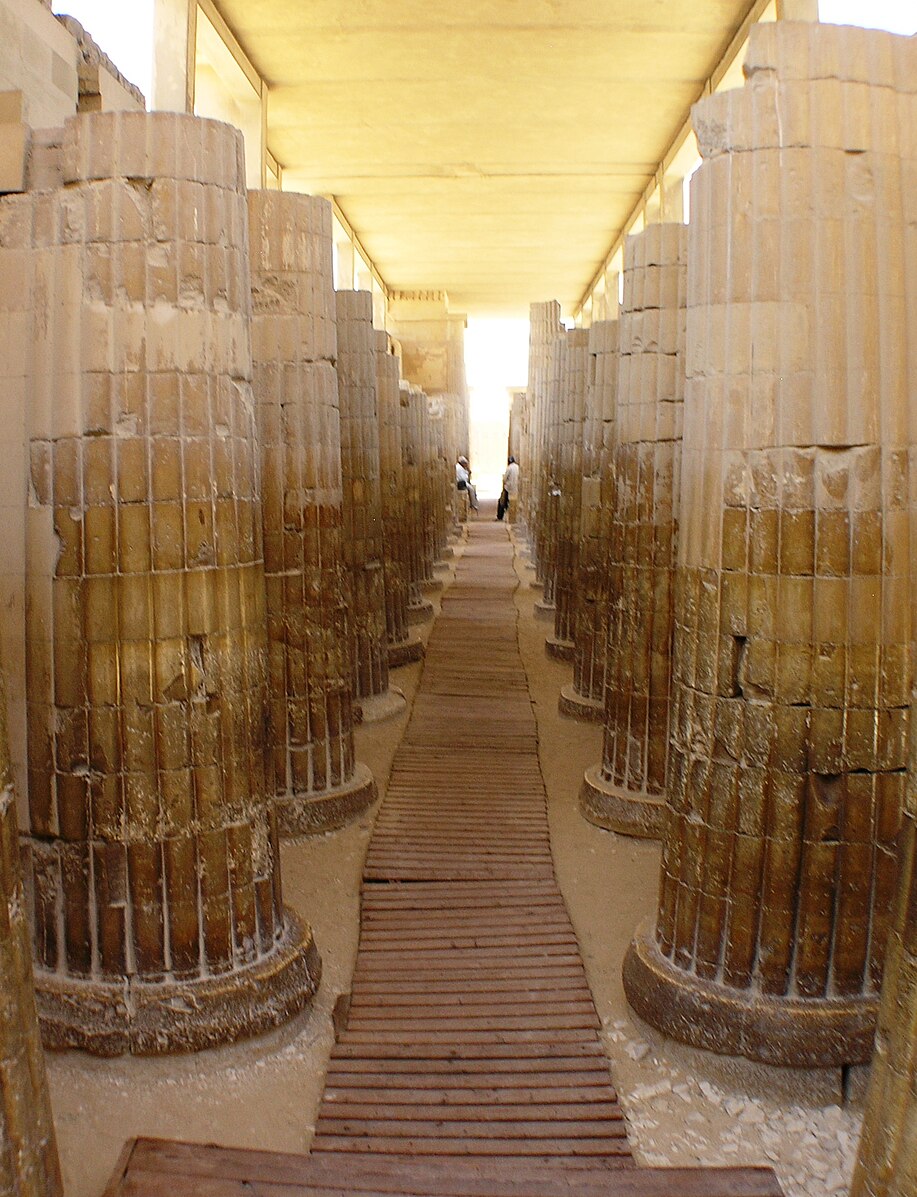
The next image, below, is of the entrance to the complex at Saqqara.
Artist unknown Hypostyle Hall and Entrance Colonnade at Djoser complex Saqqara, Egypt 2649 to 2575 BCE, Third dynasty Stone
The funerary complex was attached to the pyramid and created a space where priests could worship the pharaoh after his death. The funerary complex was located on the eastern side of the pyramid, oriented to the sun. Over time, the pharaoh began to claim that he was a manifestation of the sun god on earth and should be worshipped as such.
The columns are attached to the wall and known as "pilasters". They comprised a series of cylindrical stones stacked upon one another. They have fluting, or vertical carved lines, on them that deemphasize the horizontality of the stacked stones. They also resemble the bundles of reeds embedded in mud walls that would have been a feature of Egyptian domestic architecture. In fact, you could think of the funerary complex as a sort of "home" for the pharaoh’s ka. You should also notice how closely these pilasters resemble ancient Greek and Roman columns. As mentioned earlier, ancient Egyptian art and architecture profoundly influenced those cultures that followed.
Unfortunately, due to looting over time, much of the treasures and artifacts have been taken from these pyramids. The best archaeological artifacts tend to come from tombs that were hidden or buried, such as the largely untouched tomb of King Tutankhamen, or King Tut, whom you will learn about in another lesson.
5. Examples of Architecture
The complex at Saqqara was composed of architectural and design elements such as an entrance to the complex, the south tomb, festival complex, mortuary temple where the body would have been prepared, and the step pyramid, where it would have been entombed.
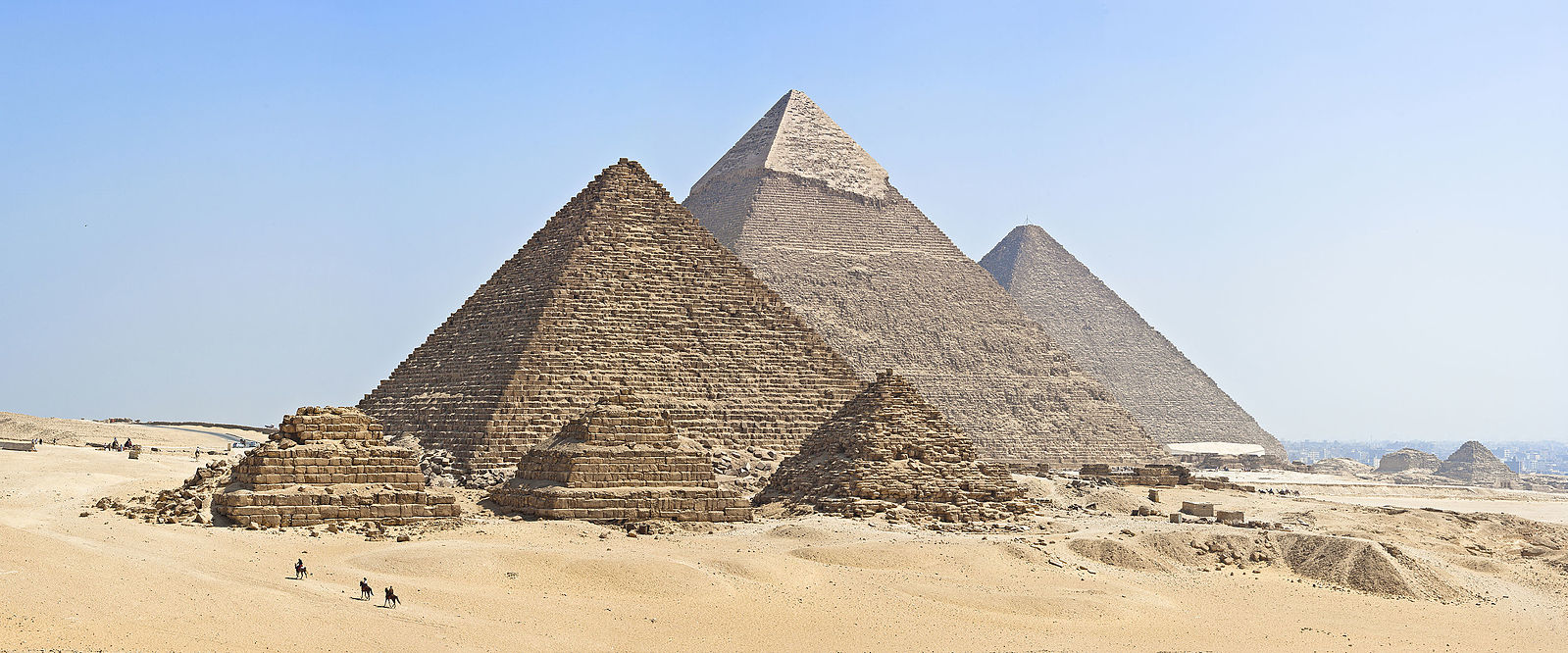
Probably the most recognizable funerary monuments in Egypt are the pyramids at Giza. Remember, Giza is roughly 30 miles north of Saqqara, just outside the modern-day city of Cairo.
Several of the structures found here are literally monumental feats of engineering. Included are the Great Pyramid of the Pharaoh Khufu of the 4th dynasty and two other pyramids, for the pharaohs Menkaure and Khafre.
Here is a picture of the remains of the pyramids at Giza. Menkaure, the smallest, is in the front.
Artist unknown Giza pyramid complex (the Great Pyramid, the Pyramid of Khafre, the Pyramid of Menkaure, and the Great Sphinx) Giza, Greater Cairo, Egypt c. 2600 – c. 2500 BCE, Early Dynastic Period to Late Period White limestone
Pyramids at Giza would have originally been covered in a smooth limestone casing that would have appeared gleaming, almost blinding, and pure white in the desert sun. The benben at the top of the pyramid would have been covered in gold leaf and also extremely shiny.
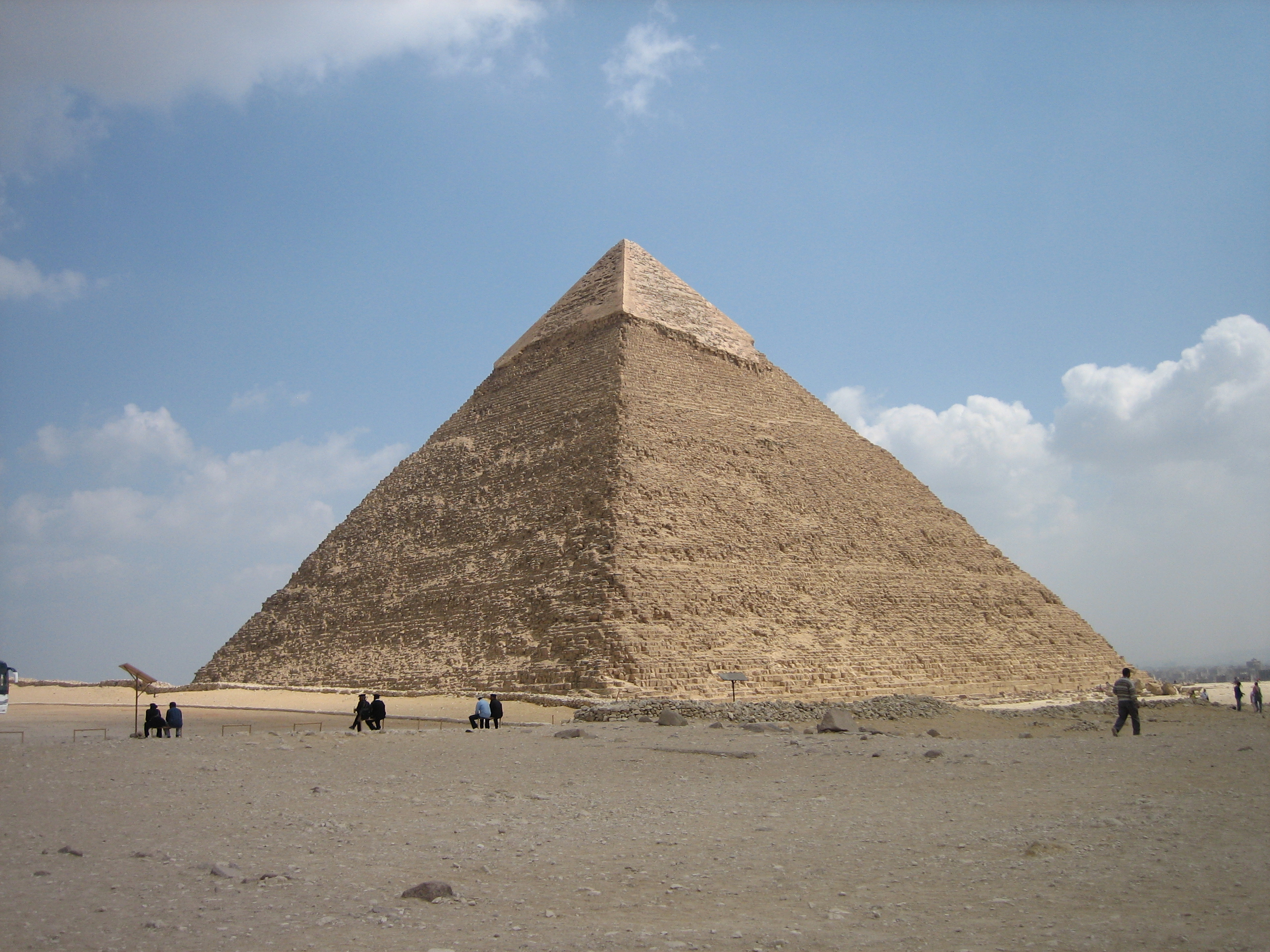
Here is a picture of the Great Pyramid of the Pharaoh Khufu of the 4th dynasty. This is the largest of the pyramids at Giza.
Artist unknown Great Pyramid of Khufu Giza, Greater Cairo, Egypt c. 2600 – c. 2500 BCE, Early Dynastic Period to Late Period White limestone
The size, shape, and coloring of the pyramids would have made them extremely obvious to everyone in the area. While this is an excellent example of controlled space (discussed in an earlier lesson), it also made the pyramids extremely susceptible to grave robbers. New Kingdom tombs would be moved to the Valley of the Kings, which was more remote and less accessible, as a way to prevent robbery.
big idea
Pyramids and funerary complexes are important examples of Egyptian architecture from the Old Kingdom.
summary
Architecture built during the Old Kingdom evolved over time. In this lesson, you learned about the period and location of the Old Kingdom.
The mastaba and serdab were both types of funerary architecture explored in this lesson, and Imhotep, a chief architect for the pharaoh Djoser, used many architectural techniques.
Finally, the architecture of step pyramids and notable evolution of architecture were covered, including examples of architecture.
Source: THIS TUTORIAL WAS AUTHORED BY IAN MCCONNELL AND ERIN ALDANA FOR SOPHIA LEARNING. PLEASE SEE OUR TERMS OF USE.