Right now, at this very moment, you’re pulling on the Moon, and it’s pulling on you. It sounds unbelievable, but it’s true. Every object in the universe tugs on every other object with a force we call gravity. You might not feel it, but it’s happening constantly, everywhere. Newton’s Law of Universal Gravitation tells us that every object in the universe attracts every other object with a force that depends on their masses and the distance between them.
The equation for this law calculates the gravitational force (F) between two objects:
formula to know
Newton’s Law of Universal Gravitation
F is the gravitational force.
and are the masses of the two objects.
r is the distance between the centers of each object.
G is the gravitational constant.
Before Newton, scientists like Galileo and Kepler had studied motion and the orbits of planets, but they couldn’t fully explain why planets stayed in orbit—a curved path an object follows as it moves around another object due to the pull of gravity—around the Sun. Newton took a huge leap by proposing that the same force that causes objects to fall on Earth also controls the motion of the planets and moons. This was a revolutionary idea because it linked the motion on Earth with the motion in space through one universal force. Newton’s law explained how gravity works over vast distances and allowed people to calculate the strength of this force precisely.
His work not only helped explain everyday phenomena like why things fall but also gave humanity the tools to better understand the movements of planets, moons, and even tides. Newton’s Law of Universal Gravitation became a fundamental part of physics and remains essential for space travel, astronomy, and understanding the universe. Without gravity, Earth wouldn’t have an atmosphere, water would float away, and life as we know it would be impossible.
make the connection
Though “gravity” and “universal gravitation” may sound alike, they actually focus on vastly different scales—one anchors us to Earth, while the other reaches across the cosmos to explain the attraction between any two masses.
Gravity is the everyday word we use to describe the attractive pull between objects with mass near the Earth’s surface. It’s local, intuitive, and mostly felt when we drop our phones or trip over a backpack.
Universal gravitation, on the other hand, is the more generalized form of gravitational interaction. It applies this same idea to any two masses in the universe, even distant stars, planets, or black holes. It’s the precise math behind planetary motion and why satellites stay in orbit.
Also, acceleration due to gravity (g) and the force of gravity (weight = mg) are Earth-specific cousins in the gravity family. They're what we use to help calculate weight and falling velocities near our planet’s surface.
IN CONTEXT Finding a Planet with Physics and Math
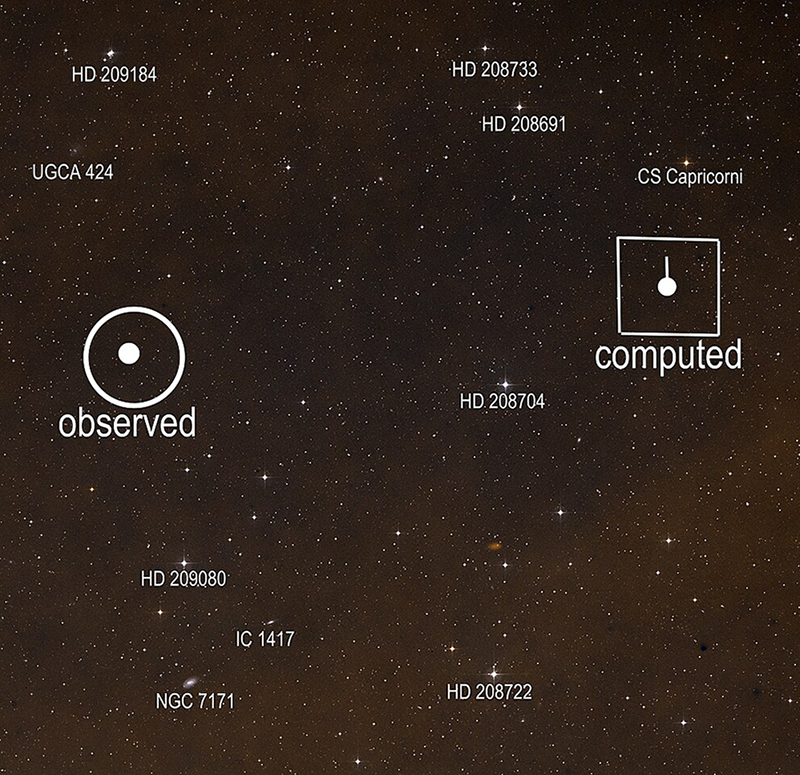
Combined red and infrared image showing the exact region of the sky where Neptune was discovered on September 23, 1846.
Neptune was the first planet to be discovered through math and through a telescope!
In the early 1800s, astronomers noticed that Uranus wasn’t moving the way Newton’s Law of Gravity predicted. Its orbit seemed slightly off, like something unseen was pulling on it. That mystery sparked action:
John Couch Adams in England and Urbain Le Verrier in France each used Newton’s equations to calculate what kind of planet might be causing the pull and exactly where it would be.
On September 23, 1846, astronomer Johann Gottfried Galle and student Heinrich Louis d'Arrest in Berlin used Le Verrier’s prediction to point their telescope and spotted Neptune almost immediately.
This was the first time a planet was discovered by following the math. Neptune became proof that gravity could guide astronomers to new worlds!
terms to know
Newton’s Law of Universal Gravitation
Every object in the universe attracts every other object with a force that depends on their masses and the distance between them.
Orbit
The curved path an object follows as it moves around another object due to the pull of gravity.
2. Relationship Between Gravity & Distance
One fascinating aspect of gravity is how it changes with distance. With Newton’s Law of Universal Gravitation, we see that the distance between the two objects, r, is squared and is the denominator. That’s important to note, and because of that relationship, we see:
If you double the distance between two objects, the gravitational force is cut in half, and it becomes one-fourth as strong. We can use the equation for Newton’s Law of Universal Gravitation to prove this.
If the distance between the objects is d, then the gravitational force is .
If distance is doubled, then the new distance is 2d.
Then: .
So the force becomes of its original strength.
If you triple the distance, the force drops to one-ninth of its original strength. The pull gets weaker much faster as objects move farther apart.
If the distance between the objects is d, then the gravitational force is .
If distance is tripled, then the new distance is 3d.
Then: .
So, the force becomes of its original strength.
Think about standing close to a campfire. You feel a lot of heat, but as you step farther away, the heat drops off quickly. Gravity acts in a similar way, but instead of heat, it's a pulling force that fades with distance.
IN CONTEXT Jupiter and Its Many Moons
Jupiter is the largest planet in our Solar System, and it has many moons. This video shows Jupiter spinning on its axis while its moons orbit around it, much like how planets orbit the Sun. Jupiter’s huge mass creates a strong gravitational pull that keeps its moons moving in steady paths around the planet. You can see the bright moons Europa, Ganymede, and Io, with Europa’s shadow crossing Jupiter’s surface. Even though Earth’s rotation makes the system look tilted, the moons always orbit in the same plane as Jupiter’s spin. This powerful gravity and smooth orbiting show how mass controls the movement of moons around planets.
learn more
Visit the NASA website to view a 48-second time-lapse video, where Jupiter’s rotation is seen through shifting dark belts, light zones, and the Great Red Spot appears after about 15 seconds.
IN CONTEXT The Forces of Dr. Kathy Sullivan
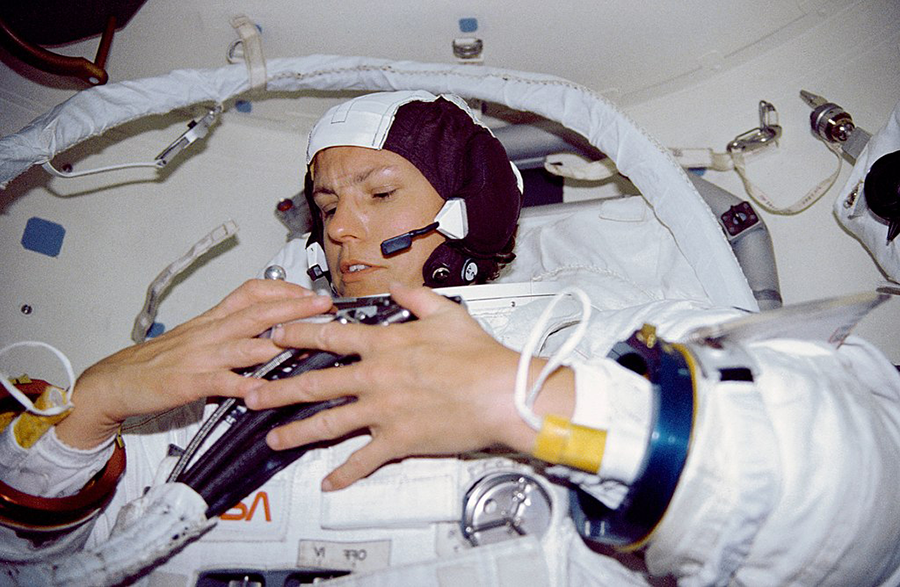
Dr. Sullivan puts on her extravehicular mobility unit (EMU) to be ready to help with the deployment of the Hubble telescope.
Dr. Kathryn D. Sullivan is a true hero in science. She was the first American woman to walk in space and later became the first human to both leave Earth’s orbit and reach the deepest point in the ocean. Her journey helps us visualize Newton's laws in extreme environments. In orbit, she experienced what’s often called “weightlessness,” because the gravitational force pulling her toward Earth was exactly balanced by the inertia of her spacecraft’s forward motion, creating a state of dynamic equilibrium. There was still a net gravitational force, but she was in continuous free fall.
Years later, during her dive to Challenger Deep in the Mariana Trench, the balance of forces reversed. There, unbalanced forces dominated: gravity and the immense pressure of the ocean pushed inward, while the submersible’s rigid structure provided the equal and opposite force needed for survival. Whether in the vacuum of space or the crushing depths of the sea, Sullivan’s career is a living demonstration of how net force determines motion, equilibrium, and survival.
summary
In this lesson, you explored Newton’s Law of Universal Gravitation, understanding how gravity acts as a universal force between masses. You investigated the relationship between gravity and distance, observing that gravitational force decreases as distance increases. You learned how gravity governs the motion of planets and moons in orbit due to the balance between forward motion and gravitational pull.
Every object in the universe attracts every other object with a force that depends on their masses and the distance between them.
Orbit
The curved path an object follows as it moves around another object due to the pull of gravity.
Formulas to Know
Newton’s Law of Universal Gravitation
•F is the gravitational force • and are the masses of the two objects •r is the distance between the centers of each object •G is the gravitational constant

 and
and  are the masses of the two objects.
 we see that the distance between the two objects, r, is squared and is the denominator. That’s important to note, and because of that relationship, we see:
 .
.  .
. of its original strength.
  .
. of its original strength.