Many historical events led to the rise of the New Kingdom. In this lesson, you will explore influential rulers of this time as well as elements associated with New Kingdom architecture. More specifically, this lesson covers:
The New Kingdom period, the time covered in this lesson, begins with Pharaoh Ahmose I in 1550 BCE and ends in 1069 BCE. Thebes is the geographical area of focus for this lesson.
2. From the Old Kingdom to the New Kingdom
The Old and New Kingdoms of ancient Egypt are separated by the Middle Kingdom, as well as a few intermediary periods of disorder within ancient Egypt.
IN CONTEXT
One of these periods was a time of rule by non-native Egyptians, a band of people from the near Middle East called Hyksos, or shepherd kings. This assortment of people from Syrian and Mesopotamian uplands eventually rose to power and ruled Egypt for a short period of time. About the 15th dynasty is attributed to these Hyksos rulers.
In addition to some innovations in weaponry, these non-native Egyptians introduced the horse to ancient Egypt. But their hold on Egypt was short-lived. The last of them was finally dispatched around 1555 BCE when Ahmose I, the first ruler of the 18th dynasty, finally rid Egypt of the Hyksos and non-native Egyptians, restoring native Egyptian rule.
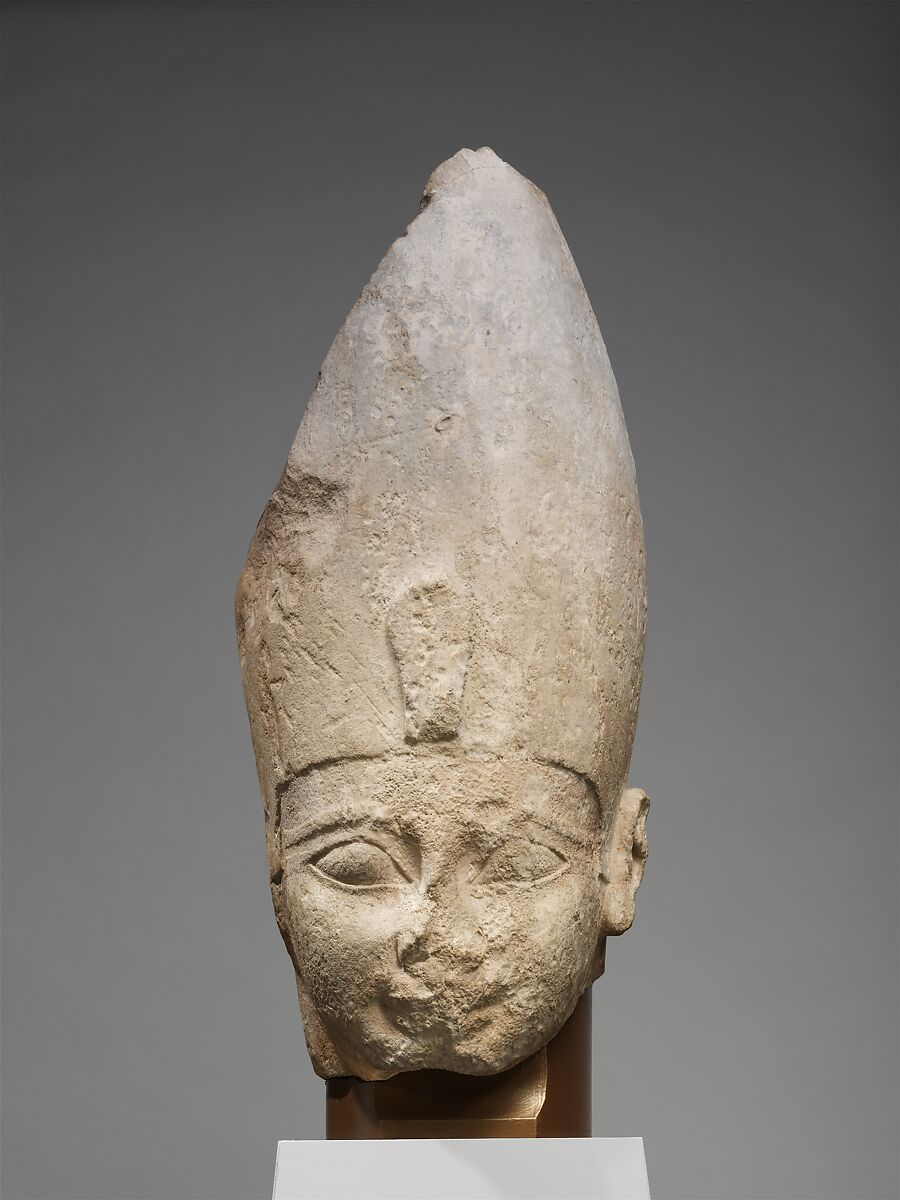
Below is a picture of Ahmose I.
Artist unknown Head of Ahmose I Egypt ca. 1550–1525 BCE, Dynasty 18 Limestone
Ahmose I finally drove out the remaining Hyksos, restoring native Egyptian rule.
With the start of the New Kingdom came a location change for the capital of the Egyptian kingdom to Thebes. This change resulted in some religious changes as well.
The patron god of Thebes was Amun, or Ammon, who, along with his wife, Mut, and their son, Khonsu, quickly became principal deities throughout the kingdom. In fact, Amun also became known as the king of the gods and eventually melded with the sun god Ra to become Amun-Ra.
did you know
This blending of gods isn’t unique to Egypt. It was a practice that we tend to see throughout history as cultures merge.
3. Queen Hatshepsut
Queen Hatshepsut was a notable figure during the New Kingdom. She reigned from around 1479 to 1458 BCE.
IN CONTEXT
The 18th dynasty pharaoh Thutmos II was married to Queen Hatshepsut. They had a son and heir to the throne named Thutmos III. Upon the death of Thutmos II, Hatshepsut became queen regnant due to the young age of Thutmos III.
When she eventually declared herself pharaoh, it marked the first time in recorded history that a female ruled absolutely. She wasn’t just a queen regnant; she was the pharaoh in charge.
During her reign, which lasted approximately 22 years, she rebuilt some of the major trade routes that had been damaged during the time of the Hyksos. She also commissioned some major construction projects.
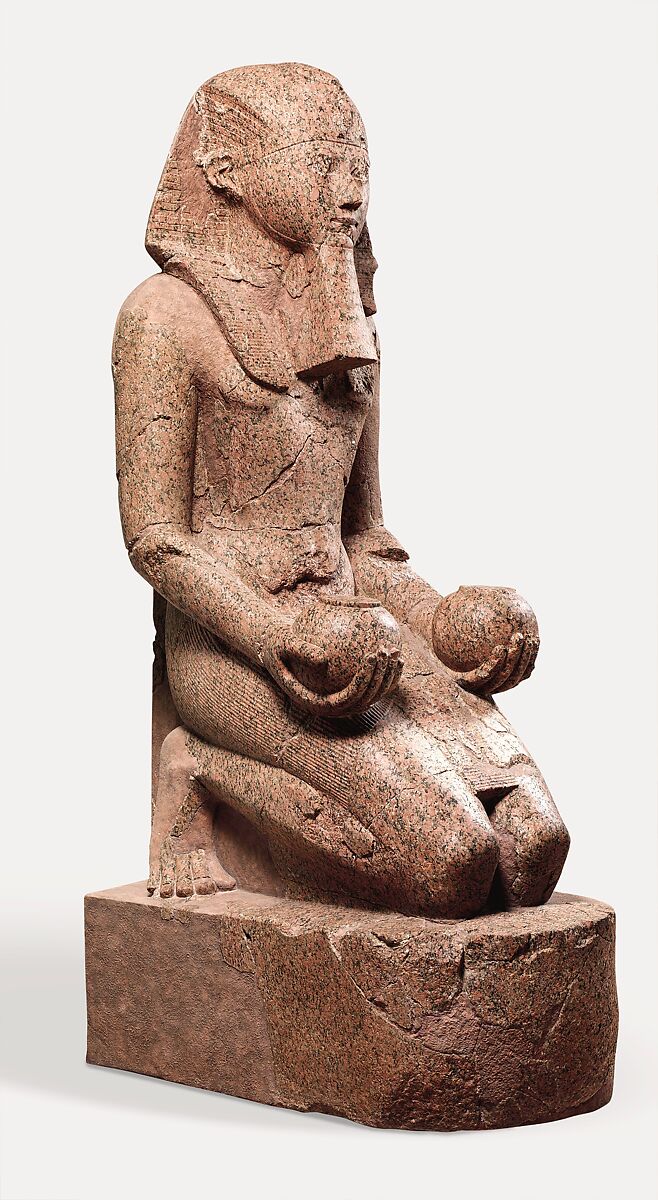
Artist unknown Large Kneeling Statue of Hatshepsut Deir el-Bahri, Thebes, Upper Egypt ca. 1479–1458 BCE, Dynasty 18 Granite
did you know
Queen Hatshepsut claimed her husband Thutmos II had intended to pass succession to her. This may be a reason why she’s dressed as a male pharaoh complete with the headdress and, originally, the false beard, which looks like it was broken up. There are also inscriptions calling her his majesty, as opposed to her majesty.
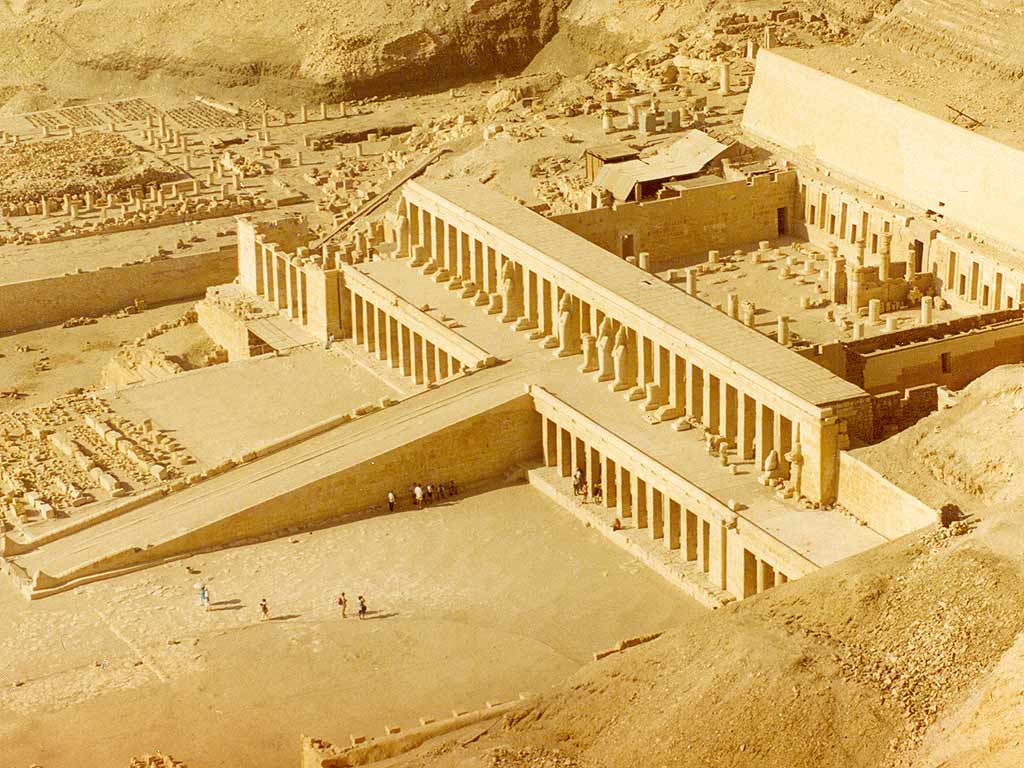
Queen Hatshepsut’s mortuary temple is a beautiful example of a royal funerary complex. Below is an image of it.
Artist unknown Mortuary temple of Hatshepsut Deir el-Bahri, Thebes, Upper Egypt c. 15th century BCE, Dynasty 18 Limestone, sandstone, granite
Notice in the above image that the colonnades, as well as the access ramps that run along the central axis in the temple, are clearly visible. What can’t be seen are the reliefs showing important moments from her life, such as her divine birth and her crowning, which would have served to help legitimize her ascent or her keeping her hold on the throne of Egypt.
4. New Kingdom Architecture
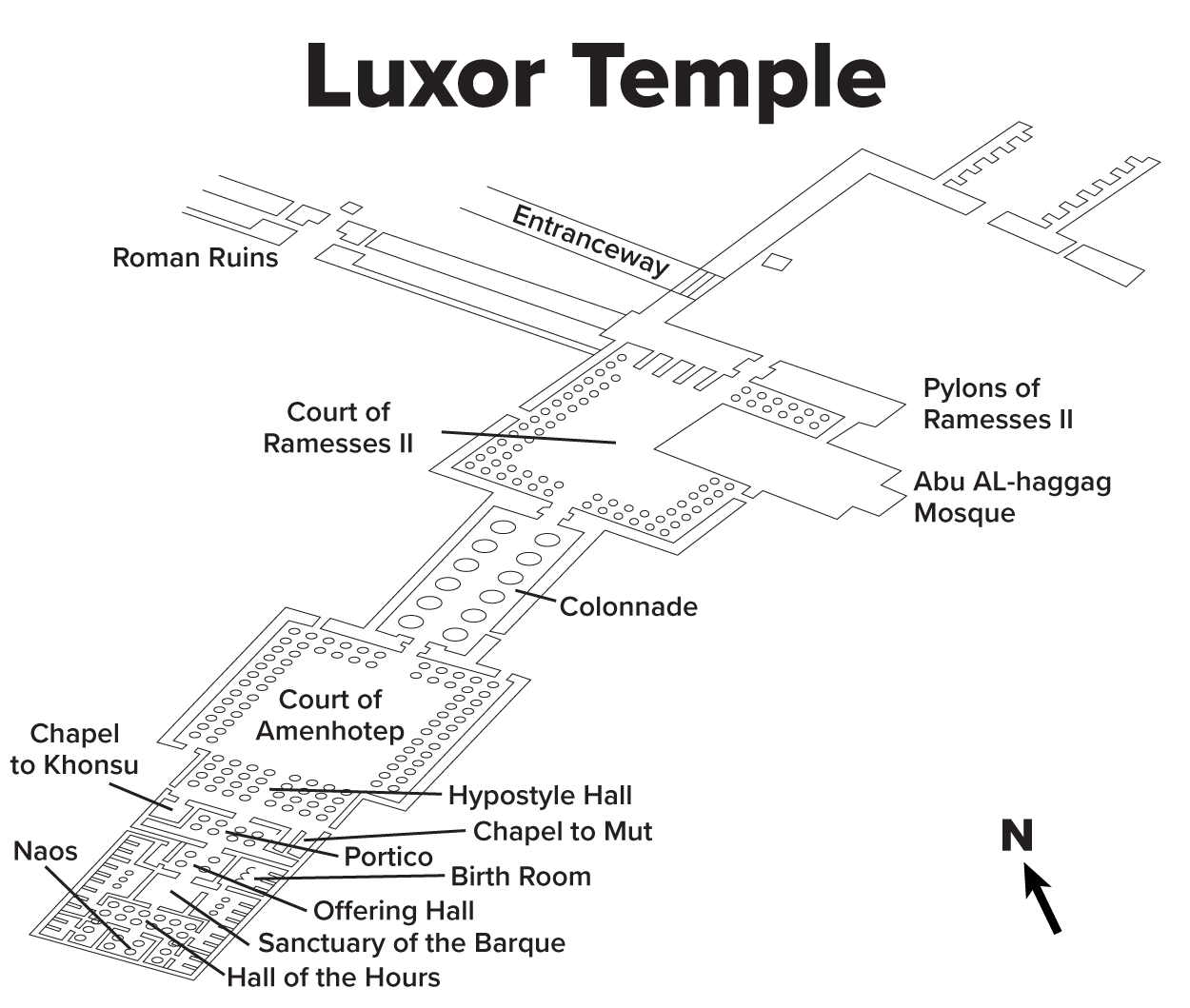
Across the river from Hatshepsut’s mortuary temple on the eastern side of the Nile, near Thebes, is the temple city of Luxor. The surviving temple of Amun-Mut-Khonsu remains one of the best-preserved examples of New Kingdom architecture. Its axial plan leant itself to long religious processions. In fact, an avenue lined with statues of sphynxes on either side linked Luxor to the neighboring holy city of Karnak. Successive pharaohs added on to the temple over long periods of time. In fact, this temple is dedicated to the very concept of kingship, the site where the ka of many kings could be worshipped, and perhaps even the site where new pharaohs were crowned.
Plan of the temple of Amun-Mut-Khonsu at Luxor
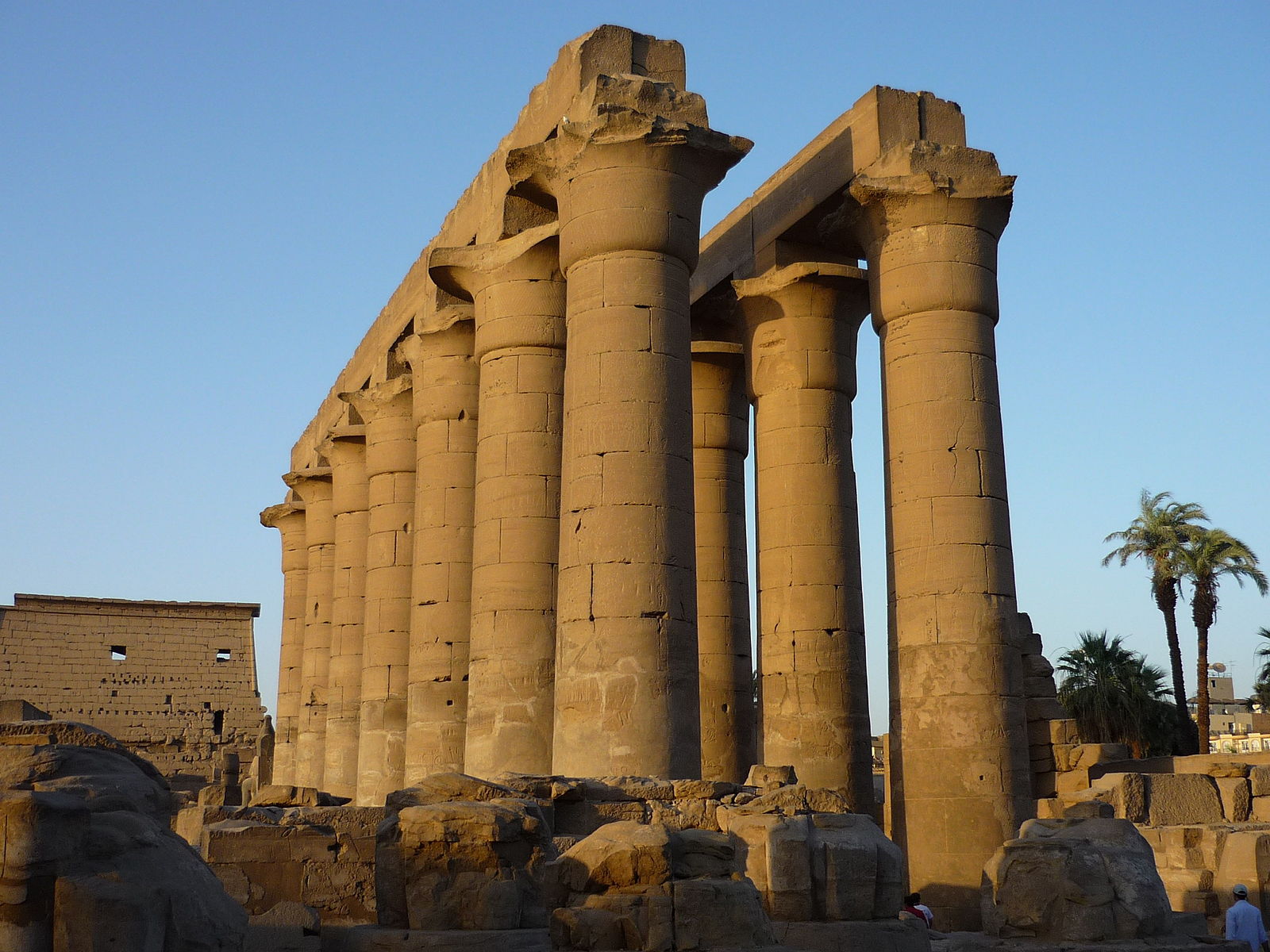
The temple includes several sets of colossal colonnades with columns rising up 52 feet in height. The tops of these columns resemble papyrus flowers and buds. At certain angles, the colonnades would appear like papyrus flowers and stalks rising out of the Nile. Next to the temple was a sacred lake. During certain festivals, ceremonial barges dedicated to the gods would be sailed on the water. This reinforced the ancient Egyptian creation story of the world rising up out of flood waters.
Artist unknown Colonnade of Amenhotep III Luxor Temple, Thebes, Upper Egypt 1400 BCE Sandstone
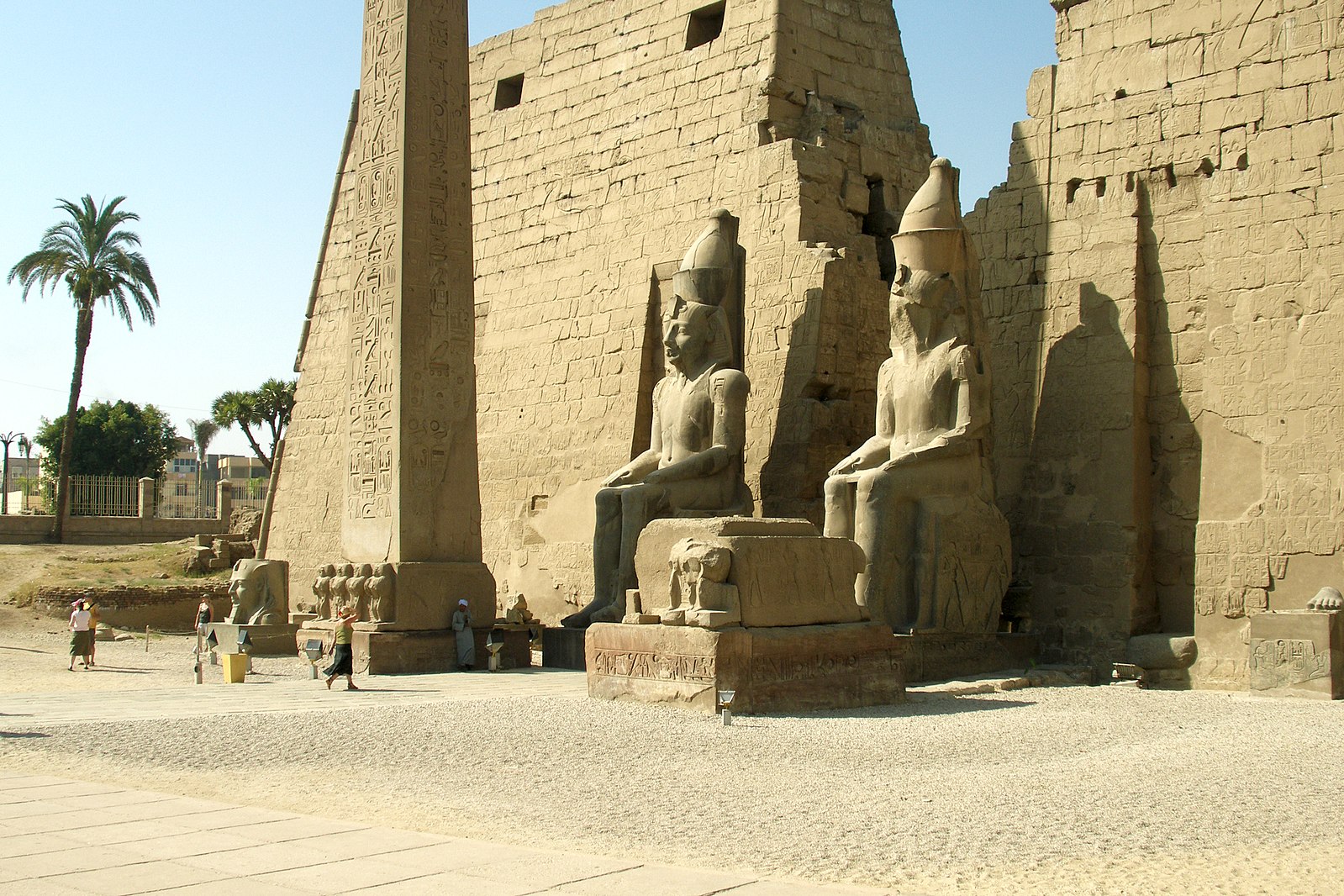
The pylon gates built by Ramses II can be seen here:
Artist unknown Pylon of Ramses II Luxor Temple, Thebes, Upper Egypt 1400 BCE Sandstone
One example of architecture in the New Kingdom is the pylon temple. Pylons are the broad, wedge-shaped slabs on either side of the opening. The entrance in the middle of the gates was a ramp that gave the impression of ascending the primordial mound of creation when walking on it. In addition to creating a gateway and processional pathway, the pylons would be adorned with historical reliefs from Egypt’s past. Some pylons that still exist today have an obviously propagandistic function and show the pharaoh smiting his enemies. Although the images have been lost on these pylons, it is likely that they had similarly grandiose and propagandistic subject matter. The tall structure in the front is called an obelisk, an important architectural element that has been used throughout time.
did you know
Our own Washington Monument is an obelisk. This monument is a rectangular structure with a pyramid shape on top and can be symbolic of the rays or ray of the sun. Originally, the pylon in the photo above would have had two obelisks, one on each side. Ever since Napoleon’s invasion of Egypt in 1798, there had been discussion of France acquiring one or both of the obelisks. In 1830, the ruler of Ottoman Egypt gave the missing obelisk to France. It was taken to Paris and installed at the Place de la Concorde, where it is still located today. In exchange, the French gave the Egyptians a clock.
What’s amazing about the construction of the ancient Egyptian architecture is that they didn’t use cement, because it had not yet been invented and Egypt had an abundance of stone that was ideal for building. The strength and stability of the structure came from the precise cutting and interlocking of the stone. The colonnade, or row of columns, would have supported a roof. This type of architecture is called a hypostyle.
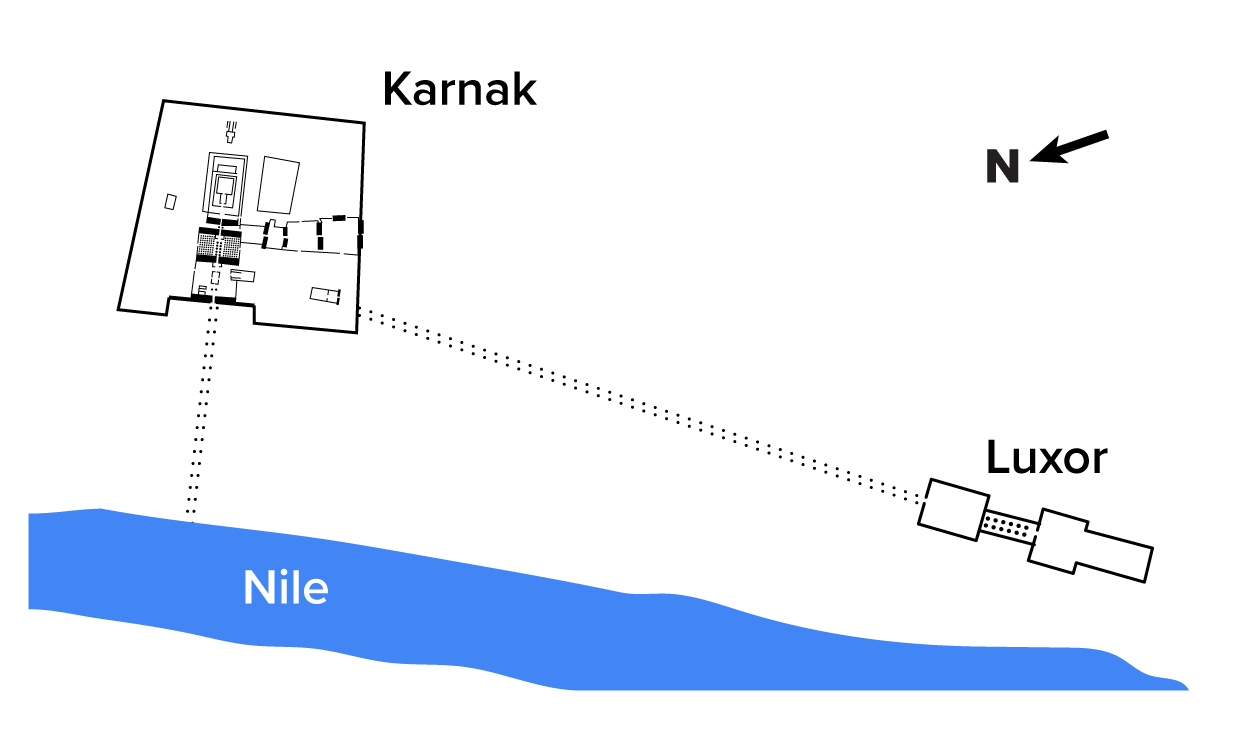
The temple at Luxor was located about a mile and a half away from another even larger and more magnificent temple at Karnak. The Egyptians believed that the earth needed an influx of new energy during the time that the Nile flooded. Processions that took place during the Opet Festival served this purpose. A statue of the god Amun was paraded along the Avenue of Sphynxes that extended from Karnak to the temple at Luxor, where it was bathed and given new jewelry. Statues of Amun, Mut, and Khonsu traveled from Karnak to Luxor on small boats.
Map of the temples at Karnak and Luxor, with the Avenue of the Sphynxes connecting them
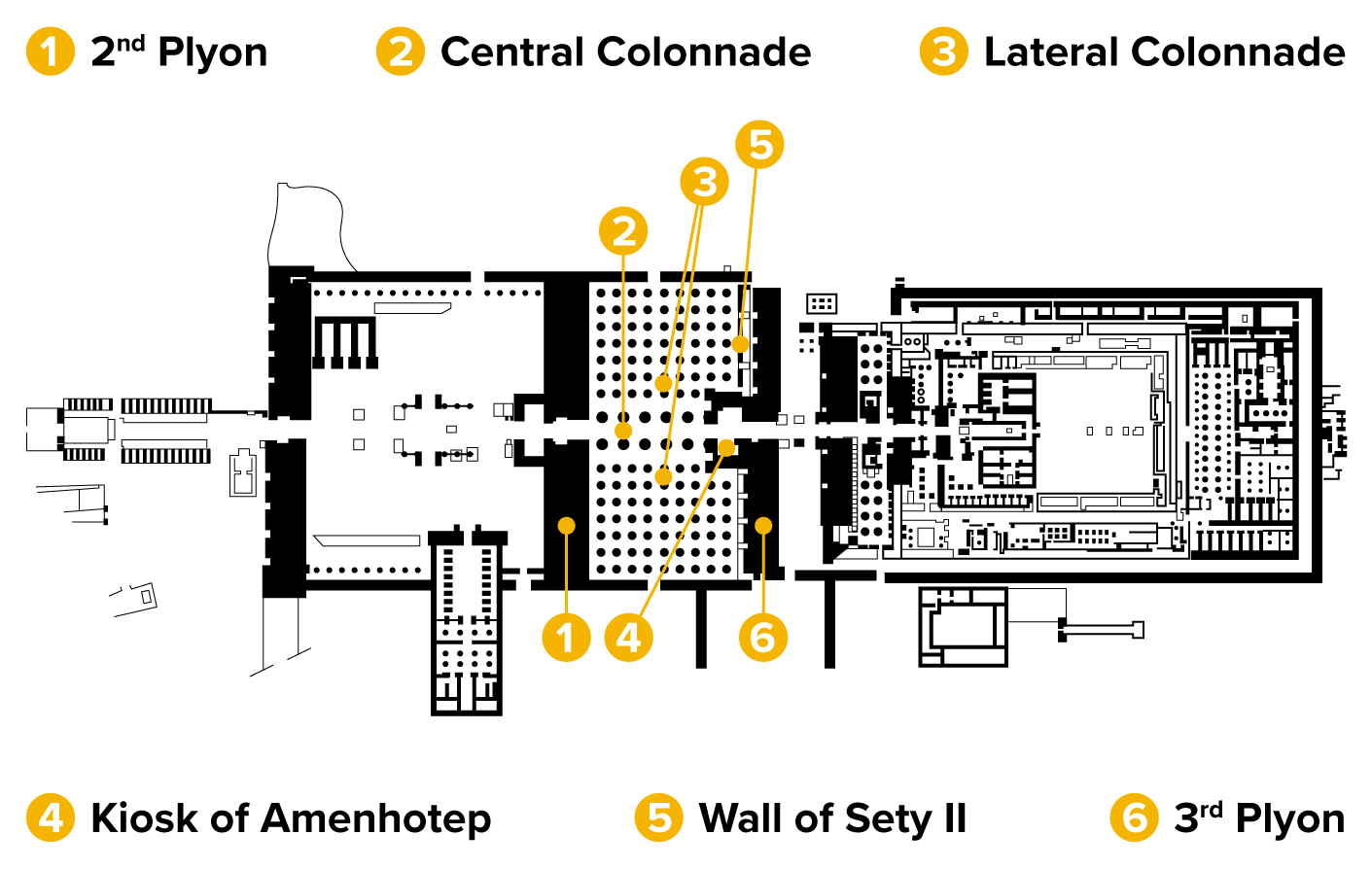
The temple at Karnak was originally built during the Middle Kingdom, and like the temple at Luxor, it became tradition for pharaohs to add on to the temple.
Plan of the temple of Amun-Re at Karnak, showing the hypostyle hall in the center
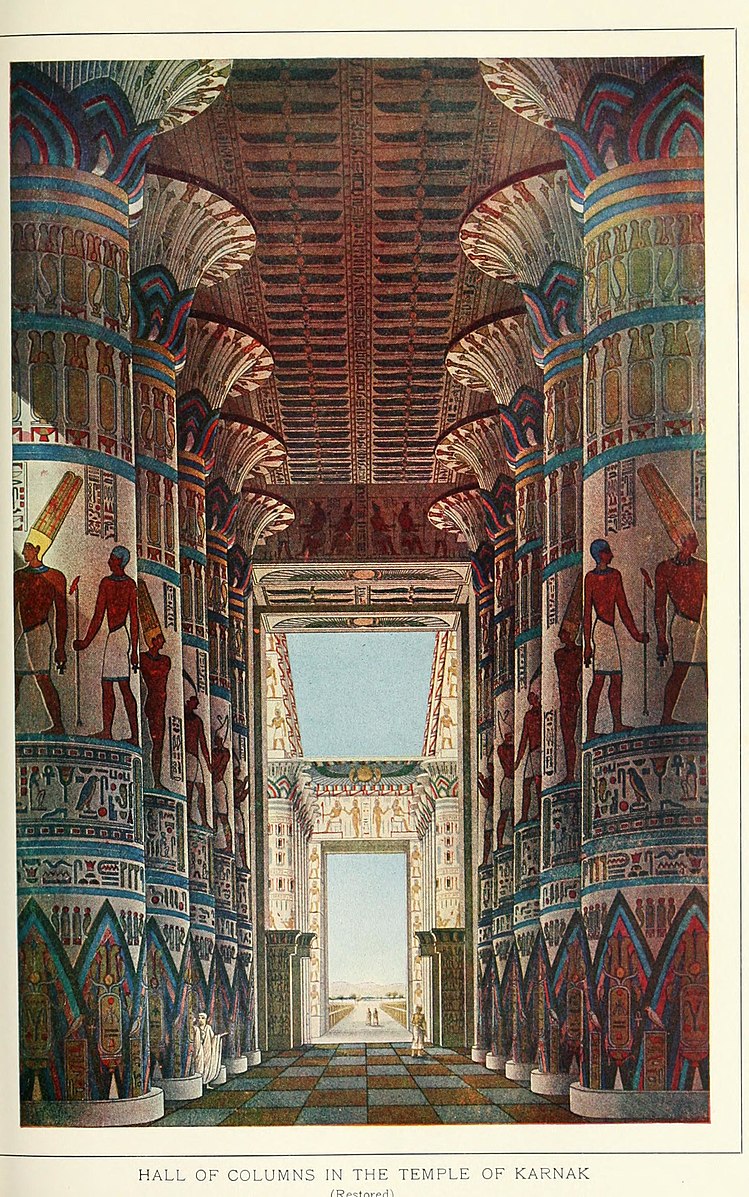
In time, Karnak became the largest religious structure ever built. The main hypostyle hall contains 134 columns that are 69 feet high and covers 50,000 square feet. The architraves, or lintels in between the columns, weigh 70 tons each. As with the temple at Luxor, the columns were carved and painted to look like the flowers of papyrus and other marsh plants, suggesting that the temple represented the primeval swamp of creation. Only the priests were allowed inside this space, which became increasingly exclusive as one moved deeper into the temple.
Frederick Converse Beach (1848-1918) and George Edwin Rines Hall of Columns in the Temple of Karnak (restored), from Scientific American New York, USA Published 1903
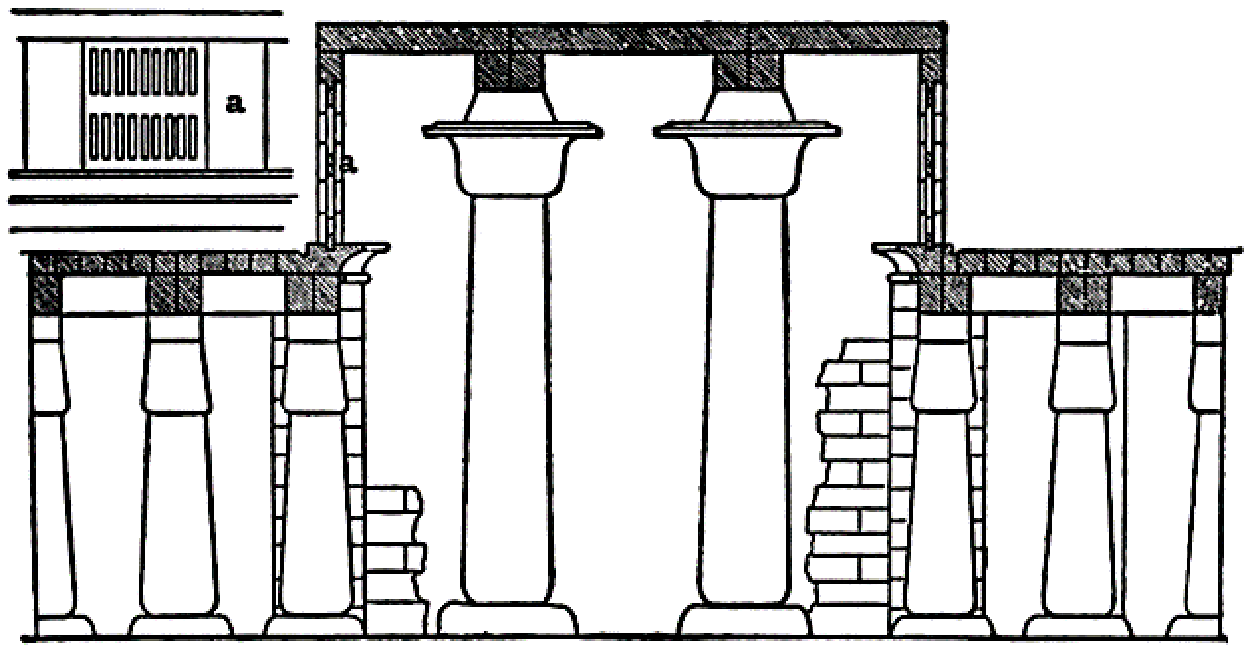
The temple at Karnak is not in good condition in the present day; however, we still have learned a lot about Egyptian culture and architecture by studying it. Karnak is the first example in world architecture of a clerestory. A clerestory is a part of the structure that rises above the roofs. These are openings to allow for ventilation and light. They’re different from windows in that they aren’t intended to provide a view, but they do allow in sunlight and air. Although the space of the hypostyle hall and the columns it contained were vast and massive, it still needed some form of natural lighting, which the clerestory provided. This innovation would influence the design of Greek and Roman temples, as well as Christian churches, for hundreds, if not thousands, of years.
During the New Kingdom, the capital moved to the city of Thebes (present-day Luxor) where a priestly class developed who used rituals and other activities to visually reinforce their authority. The massive temples that they built also served this purpose. As you consider the next tutorial on the Amarna Period, think about how the pharaoh Akhenaten implemented an artistic style different from mainstream Egyptian art to signal opposition to the Theban priests.
Diagram of a clerestory at the temple at Karnak
big idea
The New Kingdom in ancient Egypt marked the final expulsion of the Hyksos and the introduction of new architectural elements.
terms to know
Axial Plan
The horizontal arrangement of the elements of a building or town along a central axis.
Pylon Temple
In architecture, i.e., Egyptian temple, a large opening, doorway or entrance.
Colonnade
A series of columns.
Hypostyle
A form of architecture that has a roof supported by columns.
Clerestory
A part of a building that rises above the roofs—basically, windows above eye-level, primarily allowing for light and ventilation.
summary
A series of historical events led to the rise of the New Kingdom. In this lesson, you learned about the time period and location of the New Kingdom. Continuing on in this lesson, you navigated the series of events from the Old Kingdom to the New Kingdom.
Influential leaders such as Queen Hatshepsut, the first female pharaoh, had great influence on this period and architecture. Her mortuary temple is a beautiful example of a royal funerary complex.
Finally, you learned about New Kingdom architecture, specifically about elements of architecture from this period, including pylon temples, clerestories, hypostyles, colonnades, and an axial plan.
Source: THIS TUTORIAL WAS AUTHORED BY SOPHIA LEARNING. PLEASE SEE OUR TERMS OF USE.
Attributions
Head of Ahmose I | Author: Metropolitan Museum of Art | License: Public Domain