Table of Contents |
Nervous tissue is characterized as being excitable and capable of sending and receiving electrochemical signals that provide the body with information. Two main classes of cells make up nervous tissue: the neuron and neuroglia. Neurons propagate information via electrochemical impulses, called action potentials, which are biochemically linked to the release of chemical signals. Neuroglia (glia, glue), or glial cells, are a group of six different cells that play an essential role in supporting neurons and modulating their information propagation. You will learn more about neuroglia (glial cells) in future lessons on the nervous system.
The first class of nervous tissue cells are neurons. Neurons function to provide communication between different parts of the body, whether close to or far away from one another. This communication is done by the propagation of an electrochemical (electrical and chemical) signal. Neurons display a unique three-part morphology which suits this role. They are required to monitor a given area for electrochemical signals, generate electrochemical signals, and propagate electrochemical signals onto the next cell.
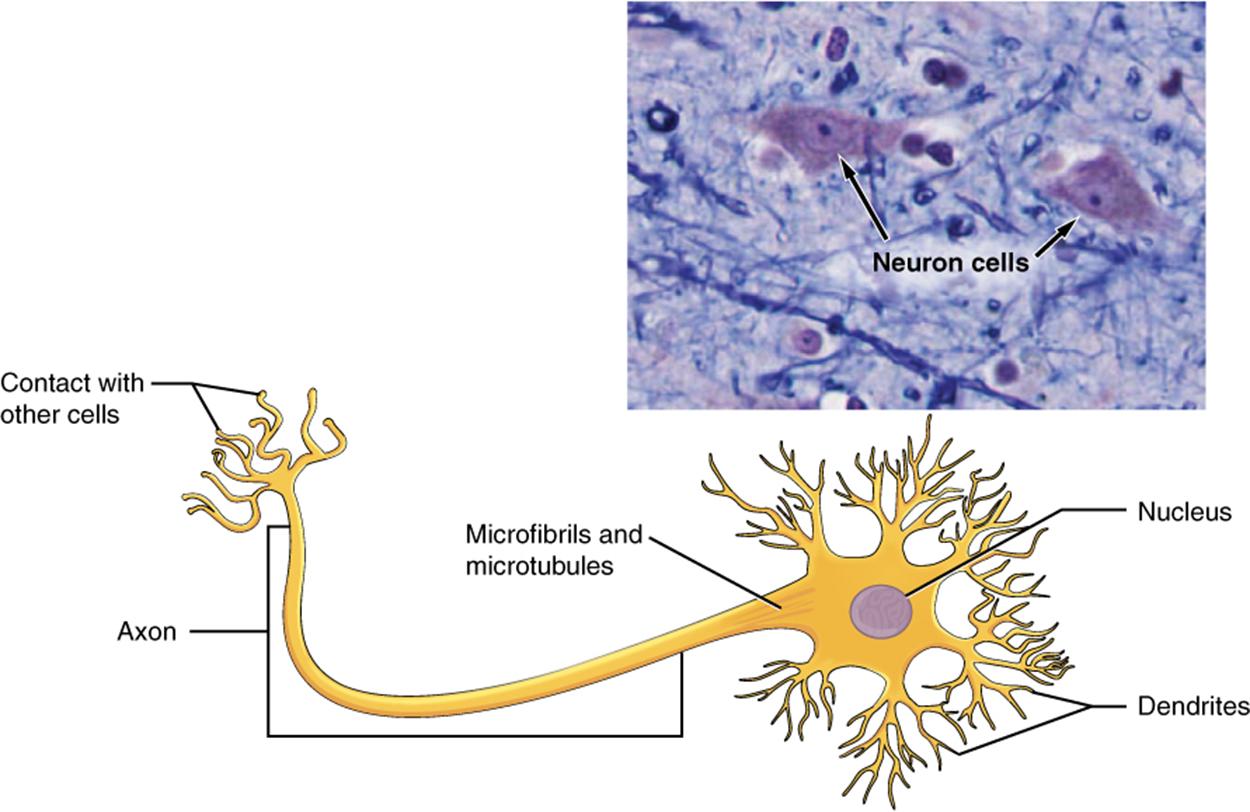
Neurons are formed by a cell body and two types of cell processes or extensions, dendrites and the axon, which most often form what resembles a tree. The branches of the tree are dendrites. These processes branch off of the cell body and monitor the electrochemical activity in their surrounding area. The cell body, also called the soma, includes most of the cytoplasm, the organelles, and the nucleus. This part of the cell receives incoming electrochemical input from the dendrites and is able to determine if a signal will be generated and sent forward. The trunk of the tree is the axon, the long “tail” (sometimes multiple) that extends away from the cell body and propagates an electrochemical signal onto the next cell.
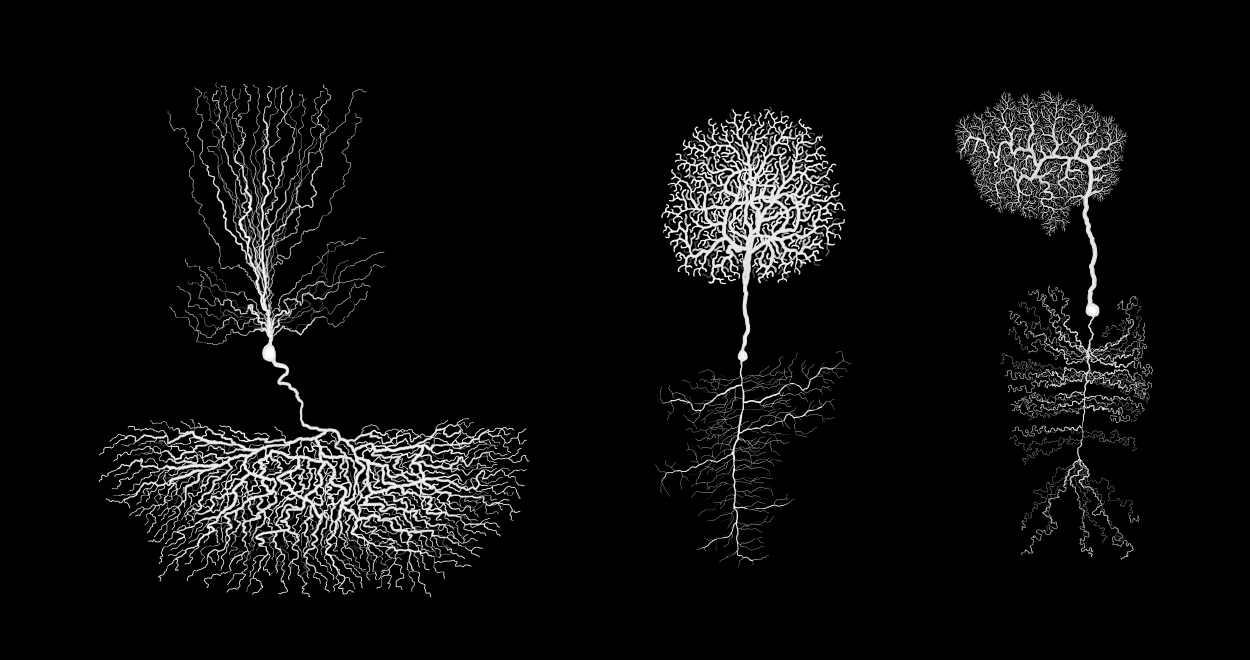
Some neurons have a protective wrapping around the axon called myelin which protects the axon and speeds up the propagation of the electrochemical signal. Myelin is produced by neuroglial cells as you will see later in this lesson. At the end of the axon are axon terminals (terminus, ending) which function to transfer the electrochemical signal onto the next cell, a cell-to-cell connection called a synapse.
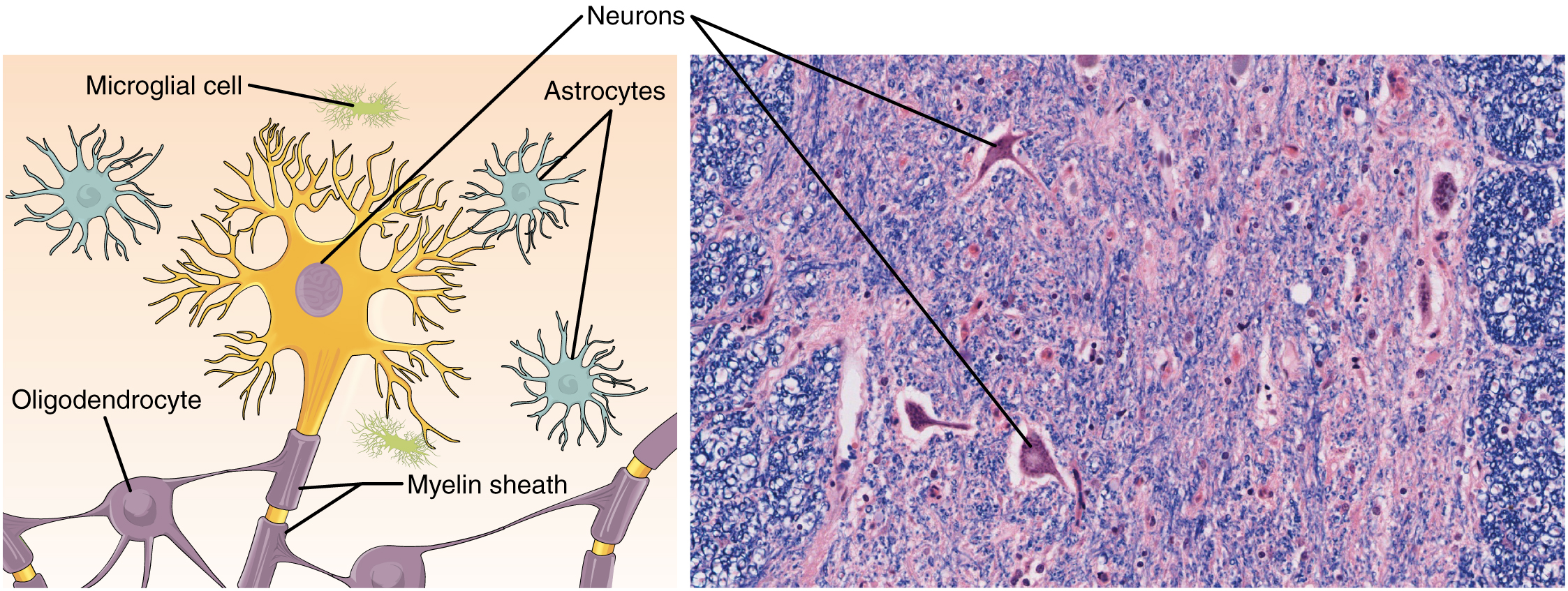
The second class of nervous tissue cells is the neuroglia or glial cells, which have been characterized as having a simple support role. There are six types of neuroglia in the body. Four of these are located in the central nervous system, the brain and spinal cord—astrocytes, microglia, ependymal cells, and oligodendrocytes. Two of these are located in the peripheral nervous system, outside of the brain and spinal cord—satellite cells and Schwann cells.
| Neuroglia | Description |
|---|---|
|
Astrocytes (astro, star) |
Named for their distinctive star shape and are abundant in the brain and spinal cord. The astrocytes have many functions, including regulation of ion concentration in the intercellular space, uptake and/or breakdown of some chemical signal molecules, and formation of the blood-brain barrier, the membrane that separates the circulatory system from the brain. |
|
Microglia (micro, small) |
Protect the nervous system against infection. |
| Ependymal cells | Produces a fluid that circulates around the brain and spinal cord to provide nutrients, remove waste, and provide cushion. |
| Oligodendrocytes | Produce myelin in the brain and spinal cord. This covering of the axon allows electrochemical signals to propagate faster and protects the neuron from damage. |
| Satellite cells | These work like astrocytes but in the peripheral nervous system, regulating ion concentration and the uptake/breakdown of some chemical signal molecules. |
| Schwann cells | Produce myelin in the peripheral parts of the nervous system (not the brain and spinal cord). |
Source: THIS TUTORIAL HAS BEEN ADAPTED FROM OPENSTAX “ANATOMY AND PHYSIOLOGY 2E.” ACCESS FOR FREE AT HTTPS://OPENSTAX.ORG/DETAILS/BOOKS/ANATOMY-AND-PHYSIOLOGY-2E. LICENSE: CC ATTRIBUTION 4.0 INTERNATIONAL.



