Nervous tissue is composed of two types of cells, neurons and neuroglia (commonly referred to as glial cells).
Neurons are the primary type of cell that most anyone associates with the nervous system. They are responsible for the computation and communication that the nervous system provides. They are electrically active and release chemical signals to target cells. Neuroglia, henceforward referred to as glial cells, or glia, are known to play a supporting role for nervous tissue. Ongoing research pursues an expanded role that glial cells might play in signaling, but neurons are still considered the basis of this function. Neurons are important, but without glial support, they would not be able to perform their function.
Neurons are the cells considered to be the basis of nervous tissue. They are responsible for the electrical signals that communicate information about sensations and that produce movements in response to those stimuli, along with inducing thought processes within the brain. An important part of the function of neurons is in their structure, or shape. The three-dimensional shape of these cells makes the immense number of connections within the nervous system possible.
1a. Parts of a Neuron
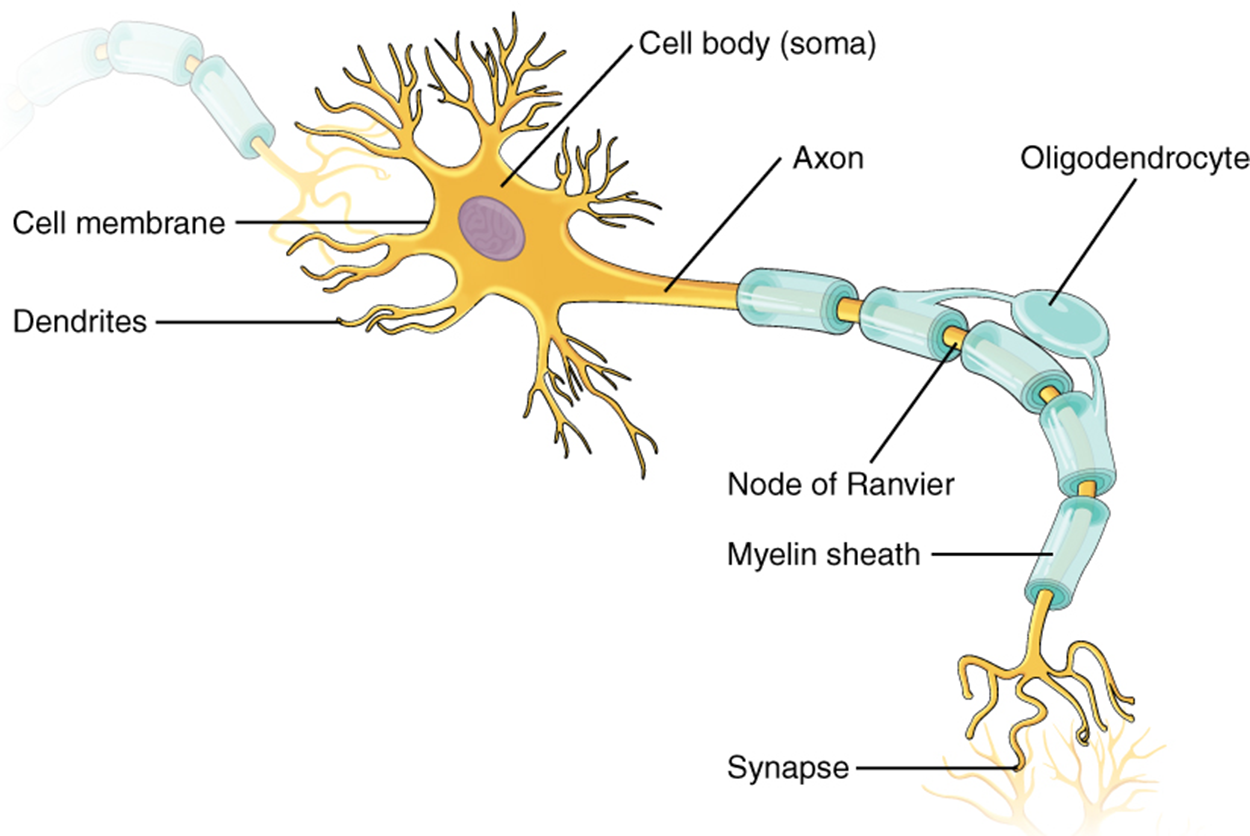
Recall that the main part of a neuron is the cell body, which is also known as the soma (soma, body). The cell body contains the nucleus and most of the major organelles. But, what makes neurons special is that they have many extensions of their cell membranes, which are generally referred to as processes. Neurons are usually described as having one, and only one, axon—a fiber that emerges from the cell body and projects to target cells. That single axon can branch repeatedly to communicate with many target cells. It is the axon that propagates the nerve impulse, which is communicated to one or more cells. The other processes of the neuron are dendrites, which receive information from other neurons at specialized areas of contact called synapses. The dendrites are usually highly branched processes, providing locations for other neurons to communicate with the cell body. Information flows through a neuron from the dendrites, across the cell body, and down the axon. This gives the neuron a polarity—meaning that information flows in this one direction. The image below shows the relationship between these parts to one another.
Parts of a Neuron - The major parts of the neuron are labeled on a multipolar neuron from the CNS.
Where the axon emerges from the cell body, there is a special region referred to as the axon hillock. This is a tapering of the cell body toward the axon. Within the axon hillock, the cytoplasm changes to a solution of limited components called axoplasm. Superficially, the proteins in the cell membrane change. The cell membrane around the axon is referred to as the axolemma. The proximal portion of the axon, distal and adjacent to the axon hillock, is known as the initial segment and plays a large role in the ability of the neuron to produce and transfer electrical signals. You’ll learn more about this in a future lesson.
Many axons are wrapped by an insulating substance called myelin, which is actually made from glial cells. Recall that myelin acts as insulation much like the plastic or rubber that is used to insulate electrical wires. A key difference between myelin and the insulation on a wire is that there are gaps in the myelin along an axon where the axolemma is exposed. Each gap is called a Node of Ranvier and is important to the way that electrical signals travel down the axon. At the end of the axon is the axon terminal, where there are usually several branches extending toward the target cell, each of which ends in an enlargement called a synaptic end bulb. These bulbs are what make the connection with the target cell at the synapse.
1b. Types of Neurons
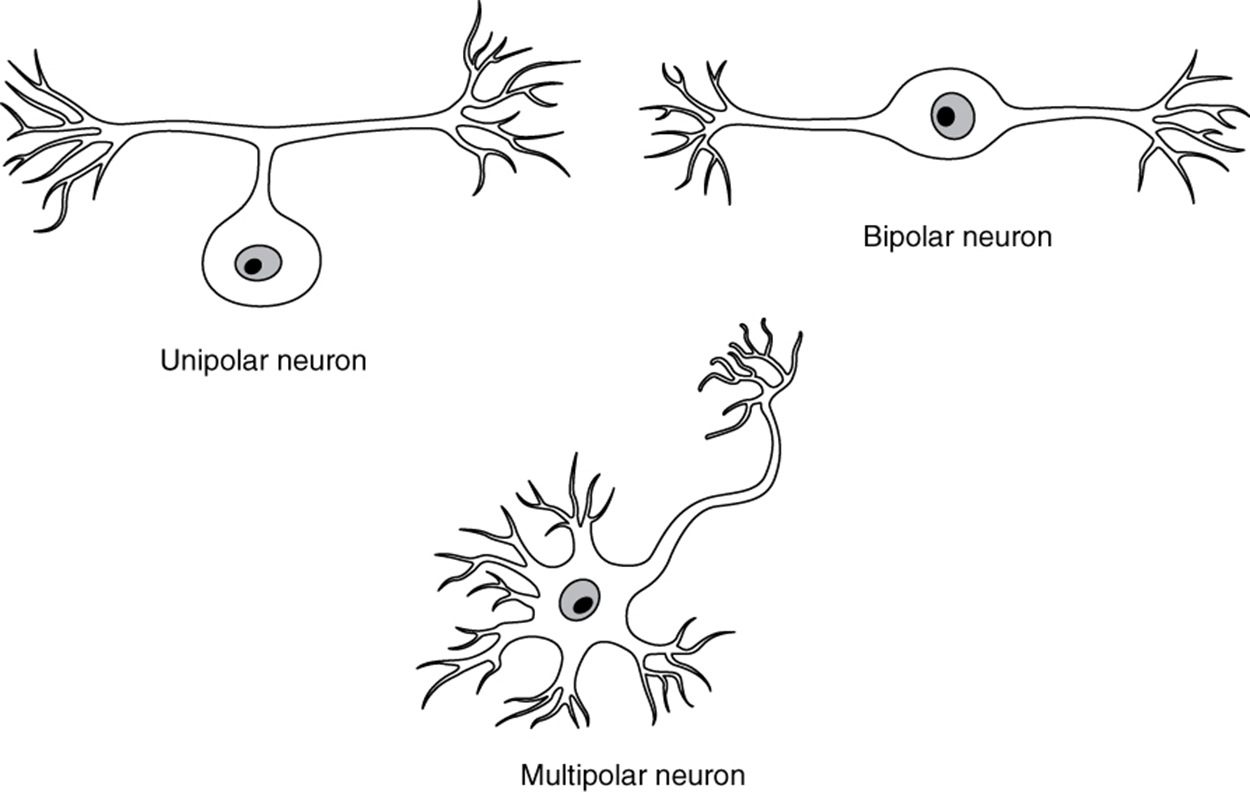
There are many neurons in the nervous system—a number in the trillions. And there are many different types of neurons. They can be classified by many different criteria. The first way to classify them is by the number of processes attached to the cell body. Using the standard model of neurons, one of these processes is the axon, and the rest are dendrites. Because information flows through the neuron from dendrites or cell bodies toward the axon, these names are based on the neuron's polarity.
Neuron Classification by Shape - Unipolar cells have one process that includes both the axon and dendrite. Bipolar cells have two processes, the axon and a dendrite. Multipolar cells have more than two processes, the axon and two or more dendrites.
Unipolar neurons have only one process emerging from the cell. True unipolar cells are only found in invertebrate animals, so the unipolar cells in humans are more appropriately called “pseudo-unipolar” cells. Invertebrate unipolar cells do not have dendrites. Human unipolar cells have an axon that emerges from the cell body, but it splits so that the axon can extend along a very long distance. At one end of the axon are dendrites, and at the other end, the axon forms synaptic connections with a target. Unipolar cells are exclusively sensory neurons and have two unique characteristics.
First, their dendrites are receiving sensory information, sometimes directly from the stimulus itself.
Secondly, the cell bodies of unipolar neurons are always found in ganglia (groups of neuron cell bodies located in the peripheral nervous system). Sensory reception is a peripheral function. The axon projects from the dendrite endings, past the cell body in a ganglion, and into the central nervous system.
Bipolar neurons have two processes, which extend from each end of the cell body, opposite to each other. One is the axon, and one is the dendrite. Bipolar cells are not very common. They are found mainly in the olfactory epithelium (where smell stimuli are sensed) and as part of the retina.
Multipolar neurons are all of the neurons that are not unipolar or bipolar. They have one axon and two or more dendrites (usually many more). The majority of neurons in the human body are multipolar. Some cutting-edge research suggests that certain neurons in the CNS do not conform to the standard model of “one, and only one” axon. Some sources describe a fourth type of neuron, called an anaxonic neuron. The name suggests that it has no axon (an, without), but this is not accurate. Anaxonic neurons are very small, and if you look through a microscope at the standard resolution used in histology (approximately 400X to 1000X total magnification), you will not be able to distinguish any process specifically as an axon or a dendrite. Any of those processes can function as an axon depending on the conditions at any given time. Nevertheless, even if they cannot be easily seen and one specific process is definitively the axon, these neurons have multiple processes and are therefore multipolar.
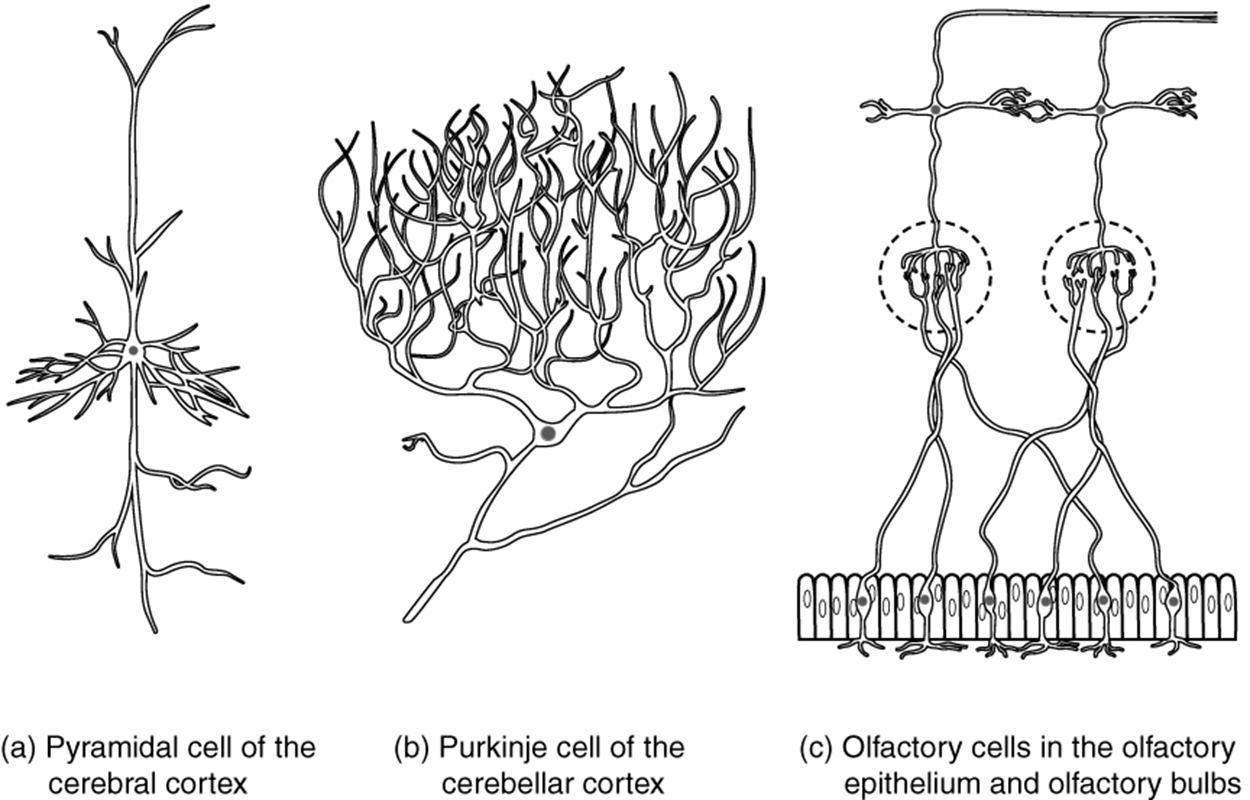
Neurons can also be classified on the basis of where they are found, who found them, what they do, or even what chemicals they use to communicate with each other. Some neurons referred to in this Unit on the nervous system are named on the basis of those sorts of classifications. For example, a multipolar neuron that has a very important role to play in a part of the brain called the cerebellum is known as a Purkinje (per-KIN-gee) cell. It is named after the anatomist who discovered it (Jan Evangelista Purkinje, 1787–1869).
Other Neuron Classifications - Three examples of neurons that are classified on the basis of other criteria. (a) The pyramidal cell is a multipolar cell with a cell body that is shaped something like a pyramid. (b) The Purkinje cell in the cerebellum was named after the scientist who originally described it. (c) Olfactory neurons are named for the functional group with which they belong.
terms to know
Synapse
A cell-to-cell connection by which information is transferred and received.
Axon Hillock
A tapering of the neuron cell body towards the axon.
Axoplasm
The cytoplasm within the axon of a neuron.
Axolemma
The cell membrane of the axon of a neuron.
Initial Segment
The first portion of the axon of a neuron.
Node of Ranvier
A gap in the myelin surrounding a neuron where the axon is exposed.
Synaptic End Bulb
The expansion at the end of the axon where a synapse is formed.
Unipolar Neuron
A neuron with a single process.
Bipolar Neuron
A neuron with two processes.
Multipolar Neuron
A neuron with more than two processes.
2. Glial Cells
recall
You first learned about neuroglia or glial cells back in Unit 1 (towards the end of that unit). While you learned the basics about the types of glial cells, here, they will be broken out in more detail. Remember you can always go back and review previous lessons if desired.
Glial cells, or neuroglia or simply glia, are the other type of cell found in nervous tissue. They are considered to be supporting cells, and many functions are directed at helping neurons complete their function for communication. The name glia comes from the Greek word that means “glue” and was coined by the German pathologist Rudolph Virchow. Today, research into nervous tissue has shown that there are many deeper roles that these cells play, and research may find much more about them in the future.
There are six types of glial cells. Four of them are found in the CNS and two are found in the PNS. The table below outlines some common characteristics and functions.
Table: Glial Cell Types by Location and Basic Function
CNS glia
PNS glia
Basic function
Astrocyte
Satellite cell
Support
Oligodendrocyte
Schwann cell
Myelination (the wrapping of neuronal axons with myelin)
Microglia
-
Immune surveillance and phagocytosis (the endocytosis of large particles, aka “cell eating”)
Ependymal cell
-
Creating cerebrospinal fluid (CSF)
2a. Glial Cells of the CNS
Recall that there are four glial cells that are located in the central nervous system (CNS). Below is a review of each of these four cell types—astrocyte, oligodendrocyte, microglia, and ependymal cell.
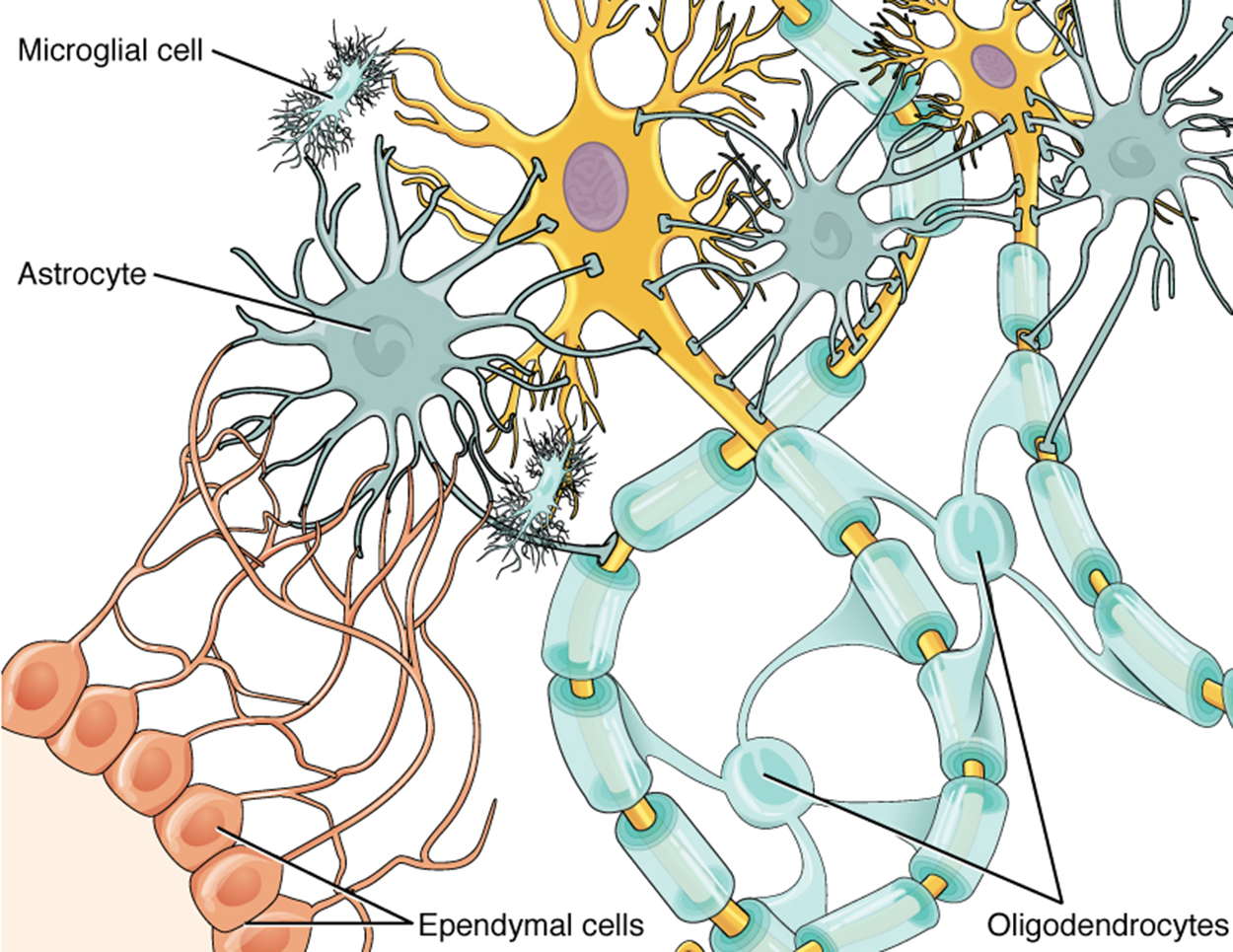
1. The astrocyte is named because it has many processes extending in all directions which makes it appear star-shaped (astro, star). These processes extend to interact with neurons, blood vessels, or a connective tissue covering the CNS. Astrocytes support neurons by maintaining the concentration of chemicals in the extracellular space, removing excess signaling molecules, reacting to tissue damage, and contributing to the blood-brain barrier (BBB). The blood-brain barrier is a layer of astrocyte membrane around the blood vessels in the brain which serves to restrict what can cross from circulating blood into the CNS. Nutrient molecules, such as glucose or amino acids, can pass through the BBB but other items cannot. This protects the CNS from toxins and pathogens but also restricts items such as cells of the immune system from being able to enter to protect the body. Pharmaceutical companies are challenged to design drugs that can cross the BBB as well as have an effect on the nervous system.
Glial Cells of the CNS - The CNS has astrocytes, oligodendrocytes, microglia, and ependymal cells that support the neurons of the CNS in several ways.
2. Also found in CNS tissue is the oligodendrocyte, sometimes called just “oligo,” which is the glial cell type that insulates axons in the CNS. The name means “cell of a few branches” (oligo, few; dendro, branches; cyte, cell). There are a few processes that extend from the cell body. Each one reaches out and surrounds an axon to insulate it in myelin. One oligodendrocyte will provide the myelin for multiple axon segments, either for the same axon or for separate axons. The function of myelin will be discussed later.
3. Microglia (micro, small) are, as the name implies, smaller than most of the other glial cells. While their origin is not conclusively determined, their function is to ingest and digest diseased or damaged cells or the pathogens that cause disease.
4. The ependymal cell is a glial cell that filters blood to make cerebrospinal fluid (CSF), the fluid that circulates through the CNS. Because of the privileged blood supply inherent in the BBB, the extracellular space in nervous tissue does not easily exchange components with the blood. Ependymal cells line four cavities in the brain. These glial cells appear similar to epithelial cells, making a single layer of cells with little intracellular space and tight connections between adjacent cells. They also have cilia on their apical surface to help move the CSF.
2b. Glial Cells of the PNS
Recall that there are two glial cells that are located in the peripheral nervous system (PNS). Below is a review of each of these two cell types—satellite and Schwann cells.
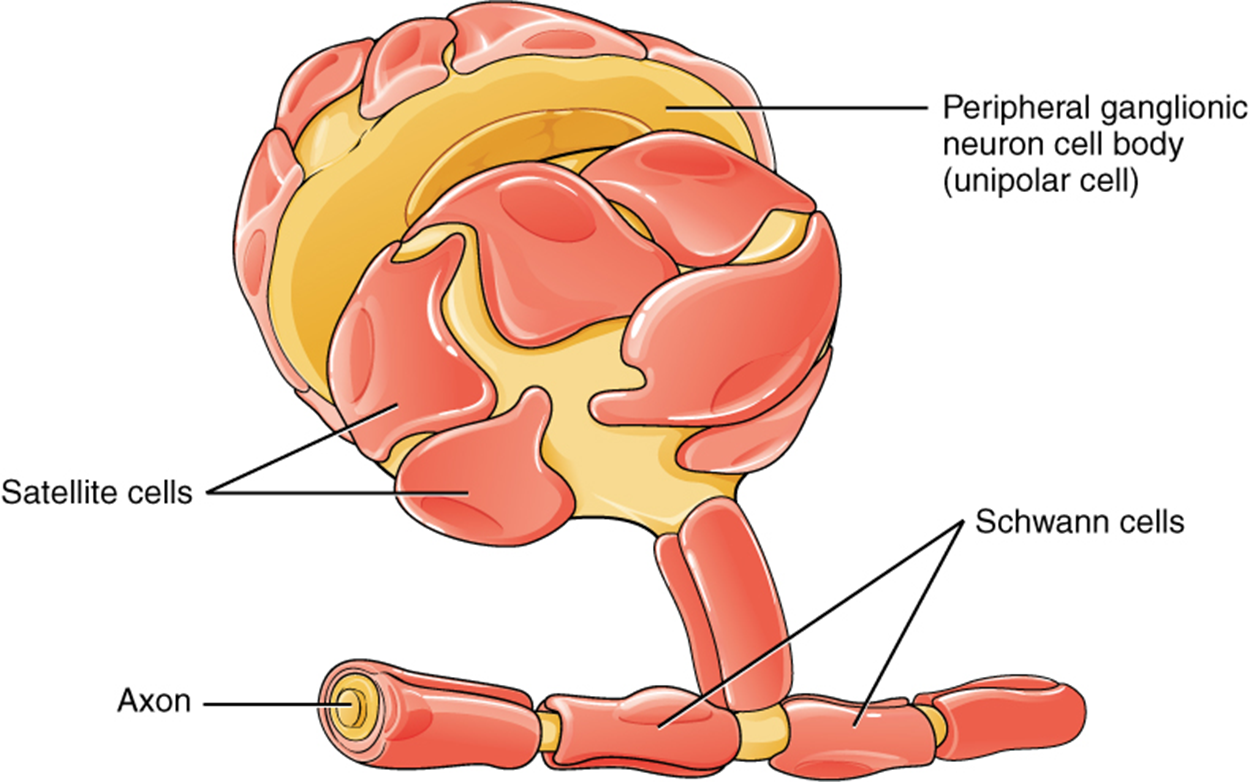
1. Satellite cells are found in sensory and autonomic ganglia, where they surround the cell bodies of neurons. This accounts for the name, based on their appearance under the microscope. They provide support, performing similar functions in the periphery as astrocytes do in the CNS—except, of course, for establishing the BBB.
2. The second type of glial cell is the Schwann cell, which insulates axons with myelin in the periphery. Schwann cells are different than oligodendrocytes, in that a Schwann cell wraps around a portion of only one axon segment and no others. Oligodendrocytes have processes that reach out to multiple axon segments, whereas the entire Schwann cell surrounds just one axon segment. The nucleus and cytoplasm of the Schwann cell are on the edge of the myelin sheath. The relationship of these two types of glial cells to ganglia and nerves in the PNS is seen in the image below.
Glial Cells of the PNS - The PNS has satellite cells and Schwann cells.
2c. Myelin
The insulation for axons in the nervous system is provided by glial cells, oligodendrocytes in the CNS, and Schwann cells in the PNS. Whereas the manner in which either cell is associated with the axon segment, or segments, that it insulates is different. The means of myelinating an axon segment is mostly the same in the two situations.
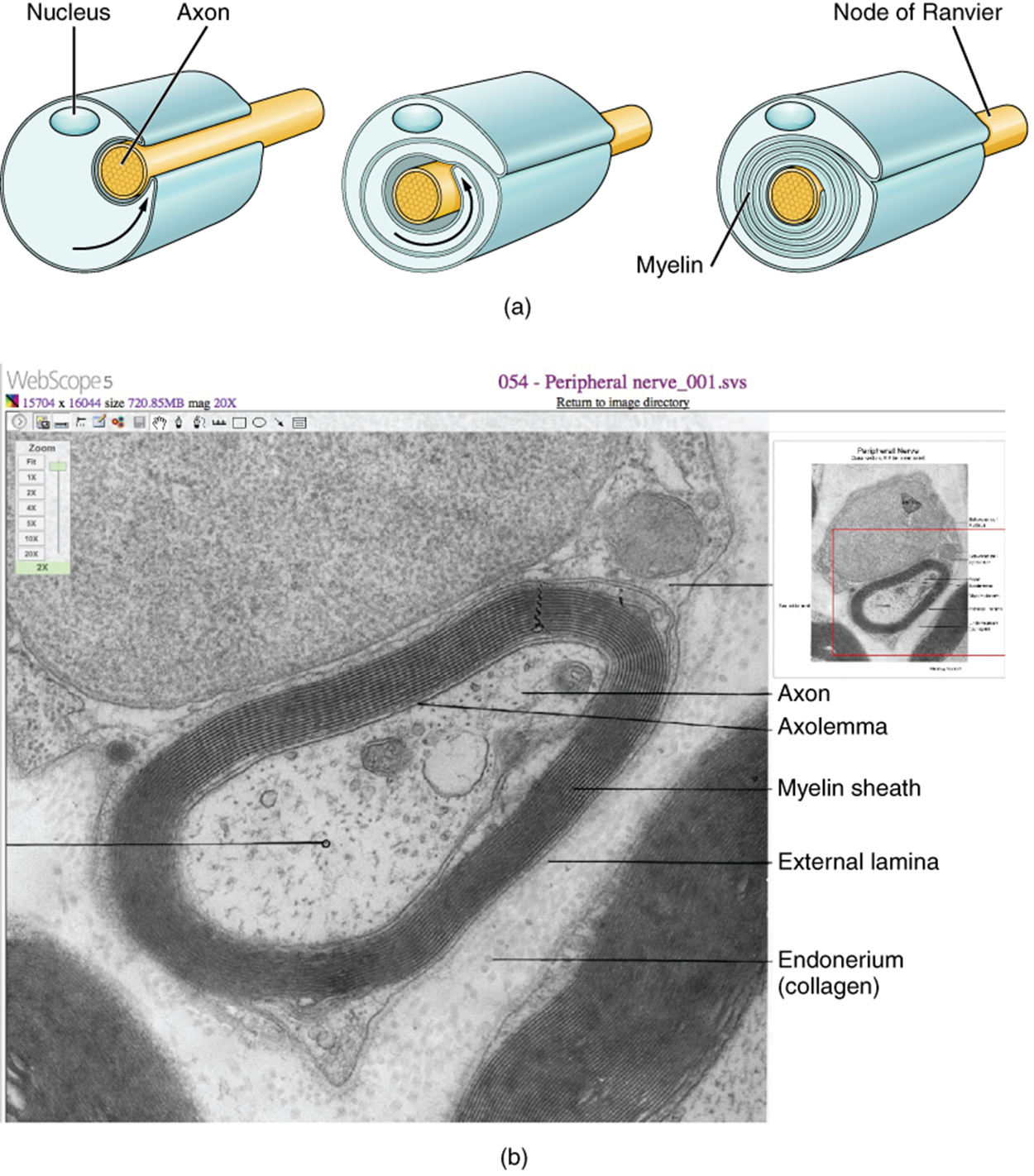
Recall that every cell contains a cell membrane and those cell membranes are primarily composed of phospholipids. Oligodendrocyte and Schwann cells insulate their respective CNS or PNS neurons by wrapping extensions of their cell body around the axon. This wrapping is the cell membrane of each cell and is therefore lipid (mostly phospholipid) rich. The myelin wrapping is known as a myelin sheath (close-fitting covering) facilitates the transmission of electrical signals along the axon. Myelin, however, is more than just the membrane of the glial cell. It also includes important proteins that are integral to that membrane. Some of the proteins help to hold the layers of the glial cell membrane closely together.
key concept
The appearance of the myelin sheath can be thought of as similar to the pastry wrapped around a hot dog for “pigs in a blanket” or similar food. The glial cell is wrapped around the axon several times with little to no cytoplasm between the glial cell layers. For oligodendrocytes, the rest of the cell is separate from the myelin sheath as a cell process extends back toward the cell body. A few other processes provide the same insulation for other axon segments in the area. For Schwann cells, the outermost layer of the cell membrane contains cytoplasm and the nucleus of the cell as a bulge on one side of the myelin sheath.
The Process of Myelination - Myelinating glia wrap several layers of cell membrane around the cell membrane of an axon segment. A single Schwann cell insulates a segment of a peripheral nerve, whereas in the CNS, an oligodendrocyte may provide insulation for a few separate axon segments. EM × 1,460,000.
IN CONTEXT Disorders of the Nervous Tissue
Several diseases can result from the demyelination of axons. The causes of these diseases are not the same; some have genetic causes, some are caused by pathogens, and others are the result of autoimmune disorders. Though the causes are varied, the results are largely similar. The myelin insulation of axons is compromised, making electrical signaling slower.
Multiple sclerosis (MS) is one such disease. It is an example of an autoimmune disease. The antibodies produced by lymphocytes (a type of white blood cell) mark myelin as something that should not be in the body. This causes inflammation and the destruction of the myelin in the central nervous system. As the insulation around the axons is destroyed by the disease, scarring becomes obvious. This is where the name of the disease comes from; sclerosis means hardening of tissue, which is what a scar is. Multiple scars are found in the white matter of the brain and spinal cord. The symptoms of MS include both somatic and autonomic deficits. Control of the musculature is compromised, as is control of organs such as the bladder.
Guillain-Barré (pronounced gee-YAN bah-RAY) syndrome is an example of a demyelinating disease of the peripheral nervous system. It is also the result of an autoimmune reaction, but the inflammation is in peripheral nerves. Sensory symptoms or motor deficits are common, and autonomic failures can lead to changes in the heart rhythm or a drop in blood pressure, especially when standing, which causes dizziness.
terms to know
Blood Brain Barrier (BBB)
A physiological barrier between the blood and central nervous system that restricts the movement of substances into or out of the CNS.
Cerebrospinal Fluid (CSF)
Fluid produced by ependymal cells that circulates within the central nervous system.
Myelin Sheath
A lipid-rich layer of insulation produced by oligodendrocytes and Schwann cells that surrounds an axon.
summary
In this lesson, you learned about the cells of nervous tissue, neurons and glial cells. You learned to identify the parts of a neuron as well as the types of neurons present in the body. You also learned to identify the glial cells of the CNS and PNS. Lastly, you learned about the production and formation of myelin.