Table of Contents |
In this lesson, you will learn terminology related to the nervous system.
The nervous system includes the brain, the spinal cord, and a complex system of nerves (structures that carry impulses/signals). It uses electrical signals and chemical substances called neurotransmitters for communication across body parts. The nervous system works with the endocrine system to control the body.
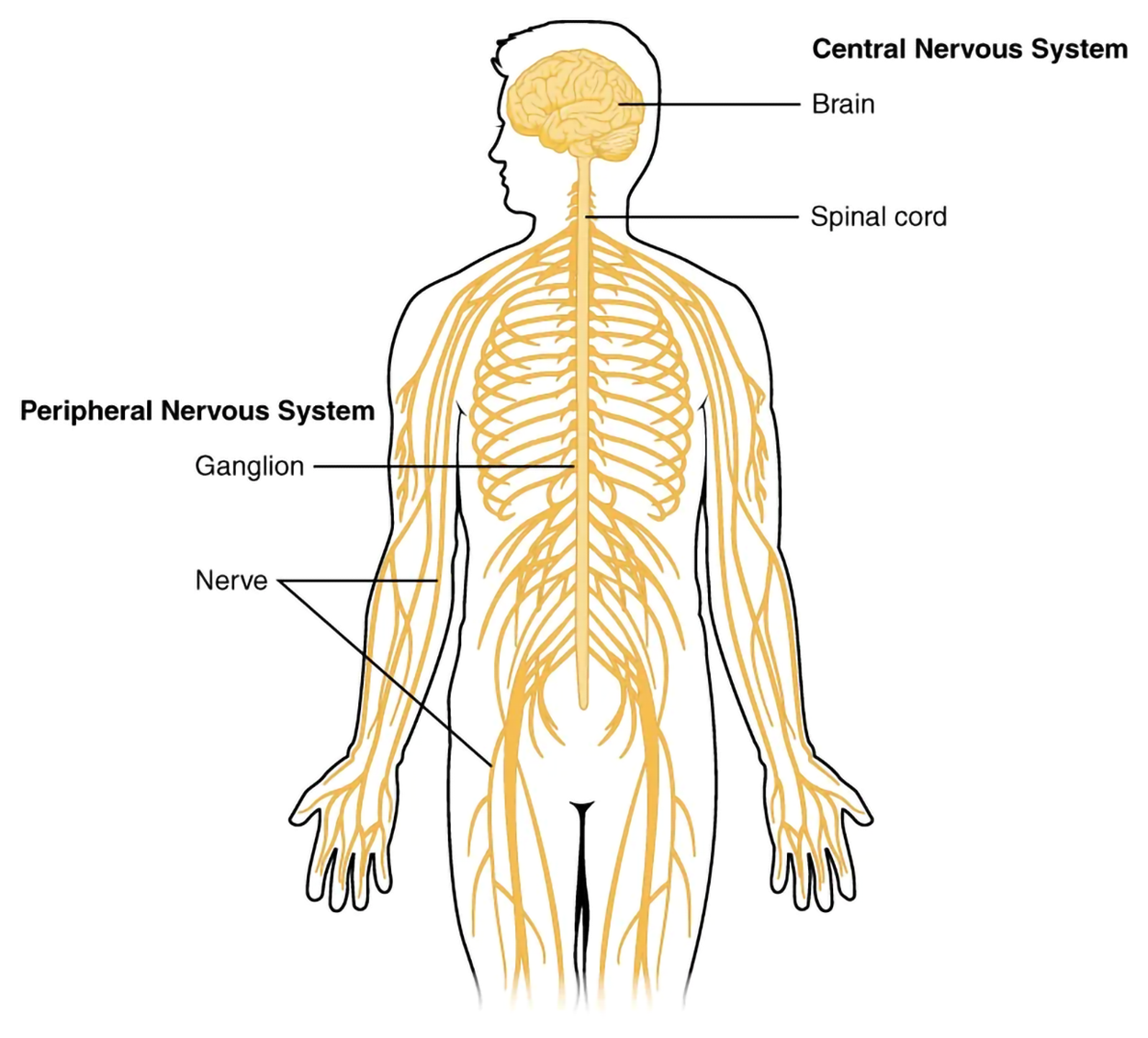
The figure below shows the nervous system. You can see that there are two major parts: the central nervous system (CNS) and the peripheral nervous system (PNS). The central nervous system consists of the brain and the spinal cord. The peripheral nervous system extends throughout the entire body, carrying information to and from the central nervous system. The peripheral nervous system includes nerves that carry impulses. The peripheral nervous system also includes ganglia (singular ganglion), which are clusters of nervous tissue cell bodies (the equivalent structure in the central nervous system is a nucleus).
The brain itself can be divided into three major parts that appear during embryonic development and then become more specialized. These parts are the forebrain, the midbrain, and the hindbrain. The hindbrain extends down to the spinal cord and is responsible for basic functions of life, including essential reflexes such as breathing. Together, the midbrain and hindbrain make up the brain stem (Cleveland Clinic, 2024a).
The peripheral nervous system is divided into two parts: the somatic nervous system and the autonomic nervous system. The major differences between the two systems are evident in the responses that each produces. The somatic nervous system causes contraction of skeletal muscles, meaning that it produces voluntary movement (remember that skeletal muscle is under voluntary control). The autonomic nervous system controls cardiac and smooth muscle, as well as glandular tissue. While the somatic nervous system is associated with voluntary responses (though many can happen without conscious awareness, like breathing), the autonomic nervous system is associated with involuntary responses, such as those related to homeostasis.
The autonomic nervous system regulates many of the internal organs through a balance of two aspects, or divisions. In addition to the endocrine system, the autonomic nervous system is instrumental in homeostatic mechanisms in the body. The two divisions of the autonomic nervous system are the sympathetic division (sympathetic nervous system) and the parasympathetic division (parasympathetic nervous system). The sympathetic system is associated with the fight-or-flight response, and parasympathetic activity can be described as rest and digest. Homeostasis is produced by the balance between the two systems.
EXAMPLE
The heart receives connections from both the sympathetic and parasympathetic divisions. One causes the heart rate to increase, whereas the other causes the heart rate to decrease.The nervous system contains nervous tissue. There are two major types of cells in nervous tissue. Neurons are cells that conduct impulses to transmit nervous system signals. Glial cells (or neuroglial cells) are supportive nervous tissue cells.
The figure below shows the basic structure of a typical neuron. The cell body (soma) contains organelles and performs metabolic processes. There is a distinct nucleus in the cell body. Many dendrites branch out from the cell body (note that dendro- means tree). These dendrites pick up incoming signals. The axon carries impulses away from the cell body to another cell. There are cylindrical bundles wrapped around some axons, with small gaps between the cylinders. Several of these cylinders are joined to an oligodendrocyte, which is a type of central nervous system glial cell that produces the myelin sheath formed by these cylinders (similar cells in the peripheral nervous system are Schwann cells). The myelin sheath speeds up how quickly an impulse moves through the axon. The gaps between the myelin cylinders are nodes of Ranvier, which are involved in signal transmission. The axon ends by branching at a synapse with another cell.
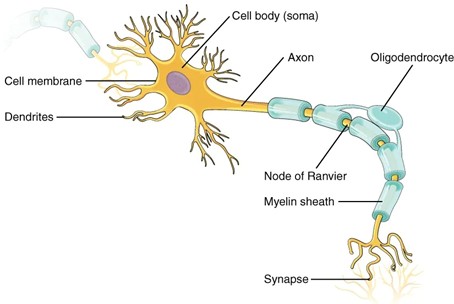
Note that the term nerve, which is used in everyday language and which you have already encountered in this lesson, can be more formally defined once you know the parts of a neuron. Specifically, a nerve is a bundle of the axons of multiple neurons all traveling together within the peripheral nervous system (the same structure in the central nervous system is called a tract).
The table below shows common prefixes that you will encounter as you learn about the nervous system. Most of these should be familiar. Remember that many other prefixes are also used, including prefixes that you have already learned.
| Term | Definition | Example | Definition of Example |
|---|---|---|---|
| A-, an- | Absence of, without, no, not | Ataxia | Having poor balance and coordination; having difficulty coordinating movement (Mayo Clinic, 2024) |
| Dys- | Abnormal, difficult, labored | Dystonia | A condition involving inappropriate muscle contractions (Mayo Clinic, 2025) |
| Hemi- | Half | Hemiplegia | Paralysis affecting one side of the body, such as an arm and a leg on the same side |
| Inter- | Between | Intervertebral disc | A disc located between vertebrae of the spine (Merriam-Webster, n.d.a.) |
| Intra- | Within | Intracranial pressure (ICP) | Pressure inside the skull and thus in the brain tissue and cerebrospinal fluid, usually in the context of illness or injury |
| Para- | Beside, beyond, around, abnormal | Paresthesia | An abnormal sensation, such as tingling, pricking, or numbness, typically with no apparent physical cause |
| Poly- | Many, much | Polyneuropathy | A condition in which multiple peripheral nerves do not function properly; a type of peripheral neuropathy that affects multiple nerves (Callaghan et al., 2016) |
| Post- | After | Post-traumatic stress disorder (PTSD) | A mental health condition triggered by experiencing or witnessing a terrifying event, characterized by flashbacks, nightmares, severe anxiety, and uncontrollable thoughts about the event |
| Pre- | Before | Prefrontal cortex | The front part of the frontal lobe, involved in complex behaviors such as planning and contributing to personality development |
| Sub- | Below, under | Subdural hematoma | A type of hematoma, usually associated with traumatic brain injury (TBI), involving bleeding in the outermost meningeal layer (a membrane called the dura or dura mater), just under the skull |
Many combining forms that you have already learned are relevant to learning about the nervous system, but there are quite a few new ones. The table below focuses on combining forms related to the brain and closely related structures.
| Term | Definition | Example | Definition of Example |
|---|---|---|---|
| Cerebell/o | Cerebellum (a posterior part of the brain that controls fine motor skills) | Cerebellar ataxia | A type of ataxia caused specifically by dysfunction of the cerebellum (Cleveland Clinic, 2024b) |
| Cerebr/o | Cerebrum (largest part of the brain; involved in complex brain functions) | Cerebral hemispheres | The hemispheres (halves) of the cerebrum of the brain; these halves make up the cerebrum (Bui and Das, 2023) |
| Dur/o | Dura mater, hard | Subdural hematoma | A type of hematoma, usually associated with traumatic brain injury, involving bleeding in the outermost meningeal layer (a membrane called the dura), just under the skull |
| Encephal/o | Brain | Encephalitis | Brain inflammation |
| Mening/o, meningi/o | Meninges (the three membranes around the brain) | Meningitis | Inflammation of the meninges |
| Pont/o | Pons (structure in the hindbrain that connects the cerebellum to the brain stem) | Pontocerebellar hypoplasia (PCH) | Conditions in which the pons and cerebellum are not fully developed, either due to initial failure to develop or atrophy (NORD, 2025) |
| Thalam/o | Thalamus (structure in the brain; relay center for sensory and motor signals to the cerebral cortex) | Thalamotomy | Surgical intervention to disrupt nervous signaling through the thalamus; sometimes used to treat conditions such as Parkinson’s disease if other approaches have failed (Merriam-Webster, n.d.b.; WebMD Editorial Contributors, 2024) |
| Vag/o | Vagal nerve (a cranial nerve that extends from the brain to the abdomen, playing critical roles in the heart, lungs, and digestive tract functioning) | Vasovagal syncope | Syncope (fainting) due to nervous stimulation that affects the vagus nerve (Cleveland Clinic, 2025b) |
Here are more examples of combining forms that are useful to know as you learn about the nervous system. This table focuses on structures.
| Term | Definition | Example | Definition of Example |
|---|---|---|---|
| Cephal/o | Head | Cephalic | Toward the head |
| Gangli/o, ganglion/o | Ganglion (group of nerve cell bodies in the peripheral nervous system, not the central nervous system; editors of the Encyclopedia Britannica, 2017) | Postganglionic neurons | Specific neurons in the peripheral nervous system that receive signals from ganglia (LeBouef et al., 2023) |
| Gli/o | Glial, gluey substance | Glial cells | Nervous system cells other than neurons |
| Myel/o | Spinal cord | Myelitis | Inflammation of the spinal cord |
| Neur/o | Nerve | Neurology | Study of the nervous system; medical specialty that focuses on the nervous system |
| Poli/o | Gray matter (nervous tissue without myelin, such as cell bodies) | Poliomyelitis (polio) | A condition caused by poliovirus; affects the spinal cord and brain stem and can sometimes cause paralysis (Mayo Clinic Staff, 2024) |
| Radic/o, radicul/o, rhiz/o | Nerve root | Radiculopathy | Disorder of the nerve root (typically a nerve root extending from the spine; Cleveland Clinic, 2022a) |
| Thec/o | Sheath | Intrathecal anesthesia | Anesthesia administered into the spinal fluid, below the arachnoid membrane (one of the meninges; Merriam-Webster, n.d.c.) |
Here are more examples of combining forms that are useful to know as you learn about the nervous system.
| Term | Definition | Example | Definition of Example |
|---|---|---|---|
| Alges/o | Sensitivity to pain | Analgesia | Pain relief |
| Esthei/o | Sensation, sensitivity | Anesthesia | The loss of sensation or feeling in a part or all of the body, often induced for medical procedures |
| Ment/o | Mind | Mental | Related to the mind |
| Psych/o | Mind | Psychology | Study of the mind and specialty involving the study of the mind |
| Quadr/i | Four | Quadriplegia (tetraplegia) | Paralysis that affects all four limbs (Cleveland Clinic, 2022b) |
In addition to prefixes and combining forms, there are many suffixes that are useful in discussing the nervous system. The table below includes familiar suffixes and a few new suffixes that will be helpful.
| Term | Definition | Example | Definition of Example |
|---|---|---|---|
| -algesia | Sensitivity to pain | Analgesia | Pain relief |
| -cyte | Cell | Oligodendrocyte | Type of glial cell involved in myelin sheath formation |
| -ectomy | Excision, surgical removal | Carotid endarterectomy | A surgical procedure to remove plaque from the carotid arteries and restore blood flow to the brain, often used to prevent stroke |
| -gram | Record | Electroencephalogram (EEG) | A test that detects electrical activity in the brain using small, flat metal discs (electrodes) attached to the scalp |
| -iatrist | Specialist, physician | Psychiatrist | A medical doctor specializing in the diagnosis, prevention, study, and treatment of mental disorders, including prescribing medication |
| -iatry | Specialty, treatment | Psychiatry | The medical specialty devoted to diagnosing, preventing, studying, and treating mental disorders |
| -ictal | Seizure, attack | Postictal state | A brain condition present following a seizure (Cleveland Clinic, 2024c) |
| -lepsy | Seizure (an uncontrolled electrical disturbance in the brain, which can cause changes in behavior, movements, feelings, and levels of consciousness) | Epilepsy | Seizure disorder |
| -oid | Resembling | Arachnoid mater | Middle membrane surrounding the brain; one of the three meninges (membranes) surrounding a human brain; it has an appearance that resembles a spider web |
| -osis | Abnormal condition | Thrombosis | A condition involving a blood clot or blood clots in a blood vessel |
| -paresis | Slight paralysis | Hemiparesis | Weakness on one side of the body only (Cleveland Clinic, 2023b) |
| -phasia | Speech | Aphasia | Lacking speech (a speech disorder; involves difficulty finding, using, and understanding words) |
| -plegia | Paralysis | Paraplegia | Paralysis affecting both legs and sometimes the torso |
| -praxia | To perform, action | Dyspraxia | A developmental condition in which children have difficulty with motor coordination and physical skills (also called developmental coordination) or broader issues of movement and coordination in adults (Cleveland Clinic, 2022c) |
| Term | Definition | Audio |
|---|---|---|
| Polyneuropathy | A condition in which multiple peripheral nerves do not function properly; it is a type of peripheral neuropathy that affects multiple nerves (Callaghan et al., 2016) |
|
| Subdural hematoma | A type of hematoma, usually associated with traumatic brain injury, involving bleeding in the outermost meningeal layer (a membrane called the dura), just under the skull |
|
| Cerebellar ataxia | A type of ataxia caused specifically by dysfunction of the cerebellum (Cleveland Clinic, 2024b) |
|
| Vasovagal syncope | Syncope (fainting) due to nervous stimulation that affects the vagus nerve (Mayo Clinic, 2025) |
|
| Postganglionic neurons | Specific neurons in the peripheral nervous system that receive signals from ganglia (LeBouef et al., 2023) |
|
| Carotid endarterectomy | A surgical procedure to remove plaque from the carotid arteries and restore blood flow to the brain, often used to prevent stroke |
|
| Electroencephalogram (EEG) | A test that detects electrical activity in the brain using small, flat metal discs (electrodes) attached to the scalp |
|
SOURCE: THIS TUTORIAL HAS BEEN ADAPTED FROM (1) “OPEN RN | MEDICAL TERMINOLOGY – 2E” BY ERNSTMEYER & CHRISTMAN AT OPEN RESOURCES FOR NURSING (OPEN RN). (2) "ANATOMY AND PHYSIOLOGY 2E" AT OPENSTAX. ACCESS FOR FREE AT WTCS.PRESSBOOKS.PUB/MEDTERM/ AND OPENSTAX.ORG/DETAILS/BOOKS/ANATOMY-AND-PHYSIOLOGY-2E. LICENSING: CREATIVE COMMONS ATTRIBUTION 4.0 INTERNATIONAL.
REFERENCES
Brainstem. (2024a, June 12). Cleveland Clinic. Brainstem: What It Is, Function, Anatomy & Location
Ataxia. (2024a, January 30). Mayo Clinic. Ataxia - Symptoms and causes - Mayo Clinic
Dystonia. (2025, January 25). Mayo Clinic. Dystonia - Symptoms and causes - Mayo Clinic
Callaghan, B. C., Price, R. S., & Feldman, E. L. (2015). Distal symmetric polyneuropathy: A review. JAMA, 314(20), 2172–2181. doi.org/10.1001/jama.2015.13611
Merriam-Webster. (n.d.). Intervertebral disc. In Merriam-Webster.com dictionary. Retrieved July 25, 2025, from www.merriam-webster.com/dictionary/intervertebral%20disc
Encephalopathy. (2023a, October 2). Cleveland Clinic. Encephalopathy: What It Is, Symptoms, Types & Treatment
Chronic Traumatic Encephalopathy (CTE). (2025a, July 16). Cleveland Clinic. Chronic Traumatic Encephalopathy (CTE): What It Is
The Editors of Encyclopaedia Britannica (2017, July 4). Ganglion. Encyclopedia Britannica. www.britannica.com/science/ganglion
Bui T, Das JM. [2023 Jul 24]. Neuroanatomy, Cerebral Hemisphere. StatPearls Publishing. www.ncbi.nlm.nih.gov/books/NBK549789/
Pontocerebellar Hypoplasia. (2025, July 18). National Association for Rare Disorders (NORD). Pontocerebellar Hypoplasia - Symptoms, Causes, Treatment | NORD
Merriam-Webster. (n.d.b.). Thalamotomy. In Merriam-Webster.com medical dictionary. Retrieved July 25, 2025, from www.merriam-webster.com/medical/thalamotomy
WebMD Editorial Contributors. (2024. July 24). Essential Tremor and Stereotactic Thalamotomy. WebMD. Essential Tremor and Stereotactic Thalamotomy
Cleveland Clinic. (2025b, February 15). Vasovagal Syncope. Cleveland Clinic. Vasovagal syncope - Symptoms and causes - Mayo Clinic
LeBouef T, Yaker Z, Whited L. Physiology, Autonomic Nervous System. [Updated 2023 May 1]. In: StatPearls [Internet]. Treasure Island (FL): StatPearls Publishing; 2025 Jan-. Available from: www.ncbi.nlm.nih.gov/books/NBK538516/
Mayo Clinic Staff. (2024, June 20). Polio. Mayo Clinic. Polio - Symptoms and causes - Mayo Clinic
Radiculopathy. (2022a, March 16). Cleveland Clinic. Radiculopathy: Symptoms, Causes & Treatment
Quadriplegia. (2022b, August 10). Cleveland Clinic. Quadriplegia (Tetraplegia): Definition, Causes & Types
Merriam-Webster. (n.d.c.). Intrathecal. In Merriam-Webster.com dictionary. Retrieved July 25, 2025, from www.merriam-webster.com/dictionary/intrathecal
Postictal State. (2024c, July 23). Cleveland Clinic. Postictal State: What It Is, How Long It Lasts & Symptoms
Hemiparesis. (2023b, May 4). Cleveland Clinic. Hemiparesis: What It Is, Causes, Symptoms, Treatment & Types
Dyspraxia. (2022c, August 9). Cleveland Clinic. Dyspraxia: What It Is, Causes, Symptoms, Diagnosis & Treatment
Physiatrist. (2024d, July 11). Cleveland Clinic. What Is a Physiatrist?



