In this lesson, you will learn about the structure of a nerve as well as reflexes as the simplest nerve pathways. Specifically, this lesson will cover:
The PNS is not as contained as the CNS because it is defined as everything that is not the CNS. Some peripheral structures are incorporated into the other organs of the body. In describing the PNS, it is necessary to describe the common structures, the nerves and the ganglia, as they are found in various parts of the body. Many of the neural structures that are incorporated into other organs are features of the digestive system; these structures are known as the enteric nervous system and are a special subset of the PNS.
1. Nerve Structure
Nerves are basically just bundles of nerve fibers. Nerve fibers are the long axons of either a sensory or a motor neuron. Each axon of these sensory or motor neurons is surrounded by something called a myelin sheath, which is an insulating layer that allows action potentials to propagate more quickly.
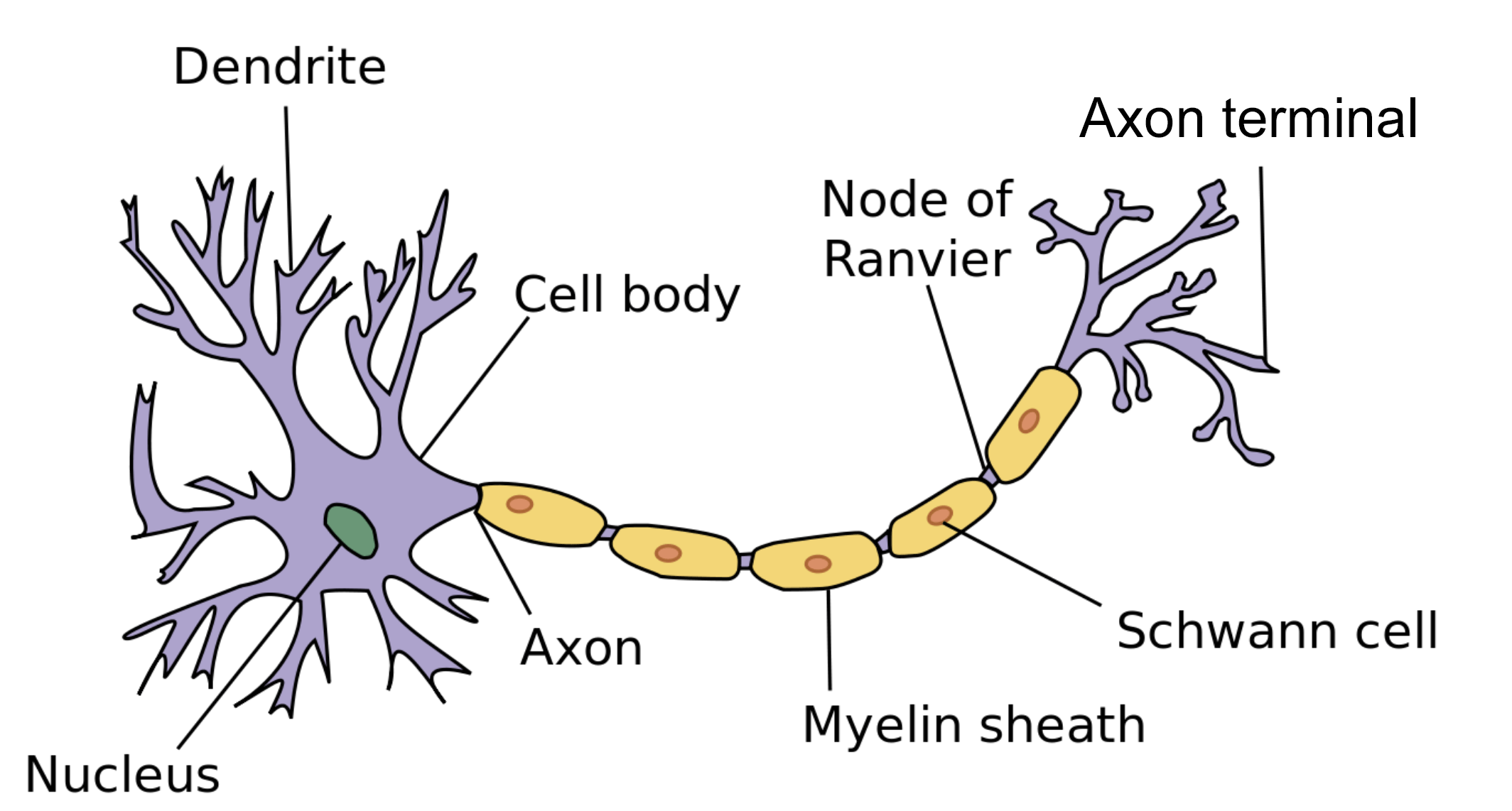
In the illustration below, you see a neuron with its axon wrapped. It is wrapped in glial cells; where most cells are roughly ball-shaped, glial cells are more like flattened sheets that wind around the axon like scrolls.
A Neuron—A myelin sheath covers the axon of this nerve, allowing action potentials to propagate faster. The myelin sheath is made of something called glial cells. These cells allow these action potentials to happen much faster than they would otherwise.
Because myelin sheaths are made mostly of the flattened glial cells' plasma membrane, they are mostly made of nonpolar, hydrophobic (water-repelling) lipids of the plasma membrane's phospholipid bilayer. Lipids don't just repel water—they repel anything with an electrical charge (such as an electron). Thus, the myelin sheaths act as insulators surrounding the axon, which we can think of as an electrically conductive wire. Because insulators repel charges, as the action potential flows down the length of the axon, the electrons will jump over the myelin sheaths, making them move faster than if they just strolled down the naked axon. Think of it like this: When myelin sheaths are present, an action potential moves like an Olympic hurdler; when myelin sheaths are not present, the action potential moves like it's strolling down the street.
Myelin sheaths are present around the axons of neurons all over the nervous system, but their structure is slightly different depending on where they are located. In the brain and spinal cord (the central nervous system), glial cells, called oligodendrocytes (also known as oligodendroglia) form the myelin sheath. In the rest of the nervous system (the peripheral nervous system), glial cells called Schwann cells form the myelin sheath. They're a little bit different, but their structure is similar, allowing these action potentials to propagate much more quickly.
did you know
Action potentials can actually travel up to about 150 meters per second thanks to these myelin sheaths made of glial cells. By contrast, action potentials of unmyelinated axons travel up to approximately 0.5 to 10 meters per second.
Compared with the central nervous system, regeneration in the peripheral nervous system is more robust. This is partly because there is a contrast in how axon elongation is affected by oligodendrocytes, which have an inhibitory effect, and Schwann cells, which have a stimulatory effect.
terms to know
Nerve
A bundle of axons of neurons.
Myelin Sheath
An insulating layer that surrounds axons of neurons in the nervous system and allows action potentials to propagate more quickly.
Schwann Cells
The glial cells that compose the myelin sheath in the peripheral nervous system.
2. Reflexes
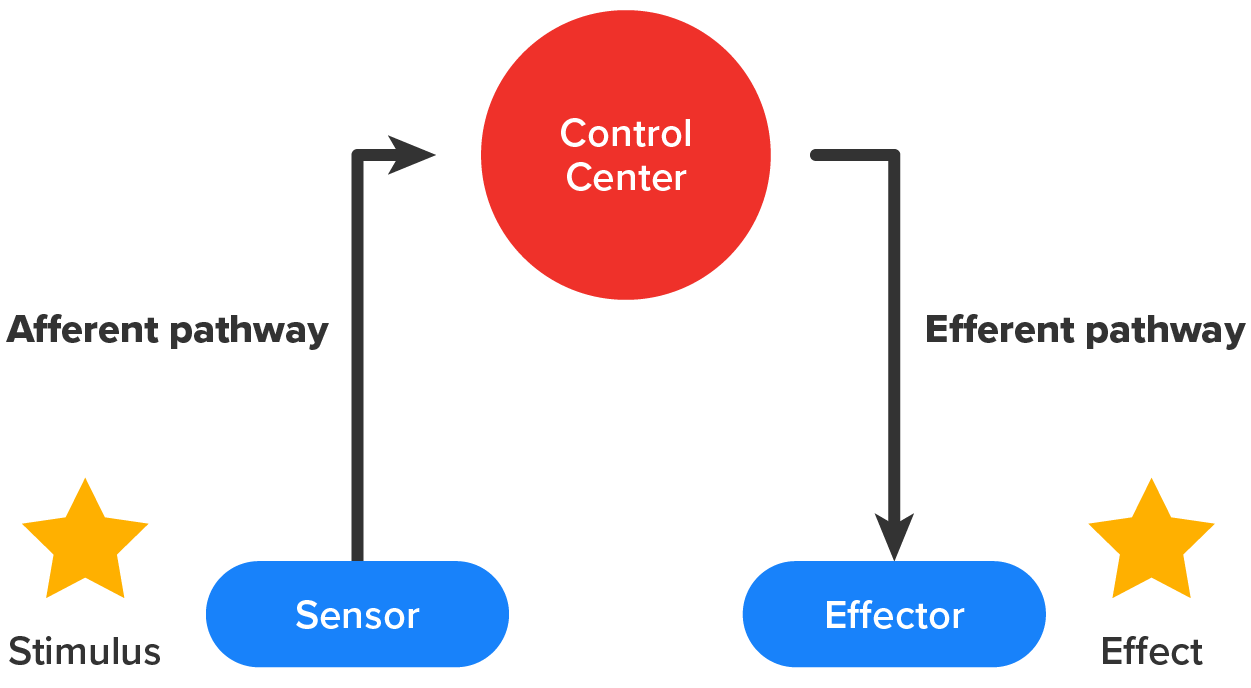
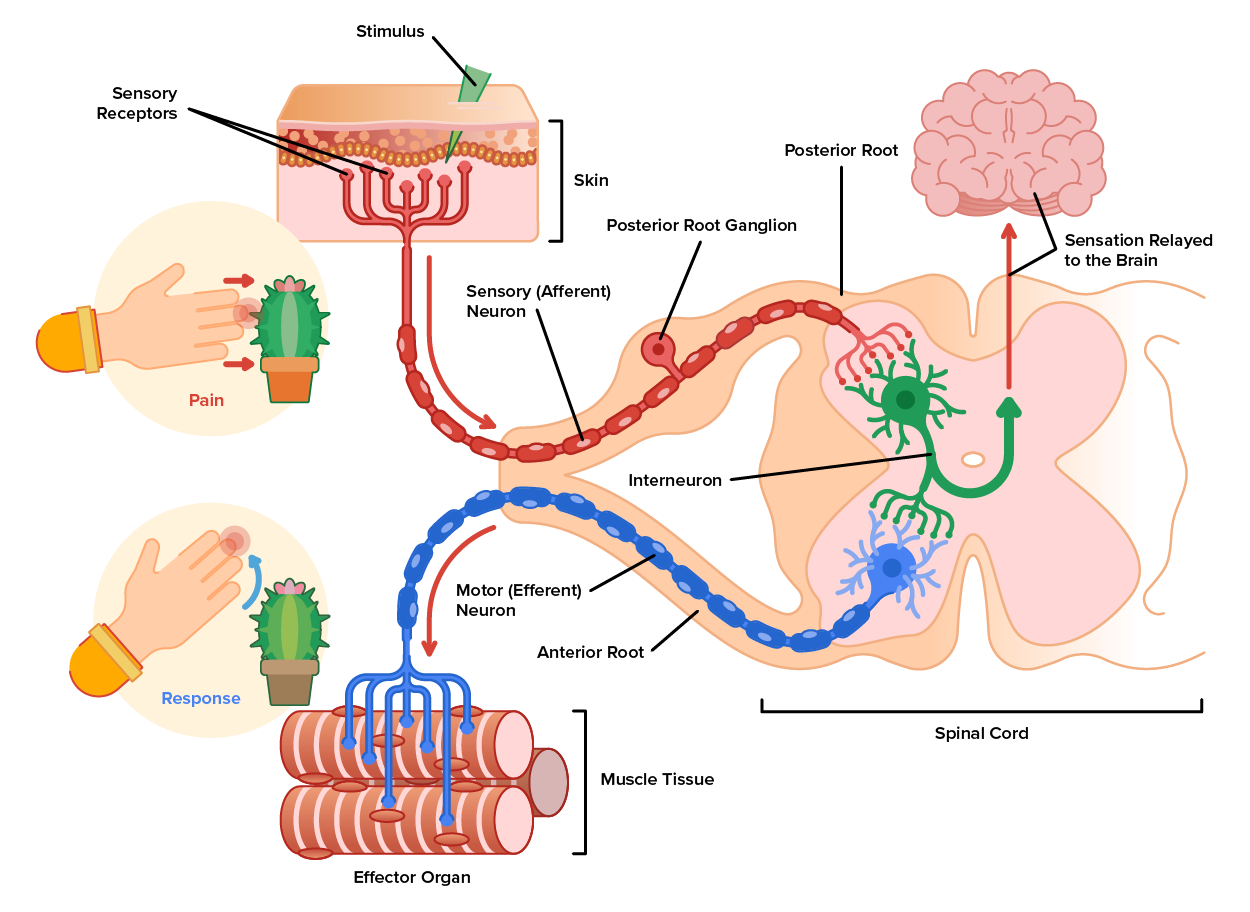
A reflex is an automatic motor response to given sensory input. A reflex arc enables immediate and involuntary responses to stimuli, and it contains multiple components. A reflex is first initiated by a change in the environment, called a stimulus. This change is detected by a receptor, and an action potential is generated in a sensory neuron. This action potential, also referred to as a sensation, travels along the afferent pathway to the control center, most often the central nervous system. This sensation is processed, and if a motor response is warranted, it travels along the efferent pathway, also known as a motor neuron, to cause a change in the effector. Reflex arcs are associated with the nervous system and homeostasis, which you will learn more about in a future lesson.
Generic homeostatic reflex arc indicating stimulus, sensor, afferent pathway, control center, efferent pathway, effector, and effect.
Reflex Arc—Reflexes provide automatic transport of sensory and motor signals along a preset neuron circuit. Sensory (afferent) nerves transport sensory signals from the sensor(s) to the CNS. In the CNS, different amounts of processing occur depending on the complexity of the reflex. Motor (efferent) nerves transport motor signals from the CNS to the effector(s).
Reflexes can be classified based on multiple criteria:
Their development
Innate reflexes are ones you are born with.
Acquired reflexes are ones you have learned over time.
The target effector
Somatic reflexes have skeletal muscle tissue as a target effector.
Autonomic reflexes have cardiac muscle, smooth muscle, or glandular tissue as a target effector.
The complexity of the circuit
Monosynaptic reflexes have only one synapse and two neurons.
Polysynaptic reflexes have more than one synapse and three or more neurons.
The processing site
Spinal reflexes are processed in the spinal cord.
Cranial reflexes are processed in the brain.
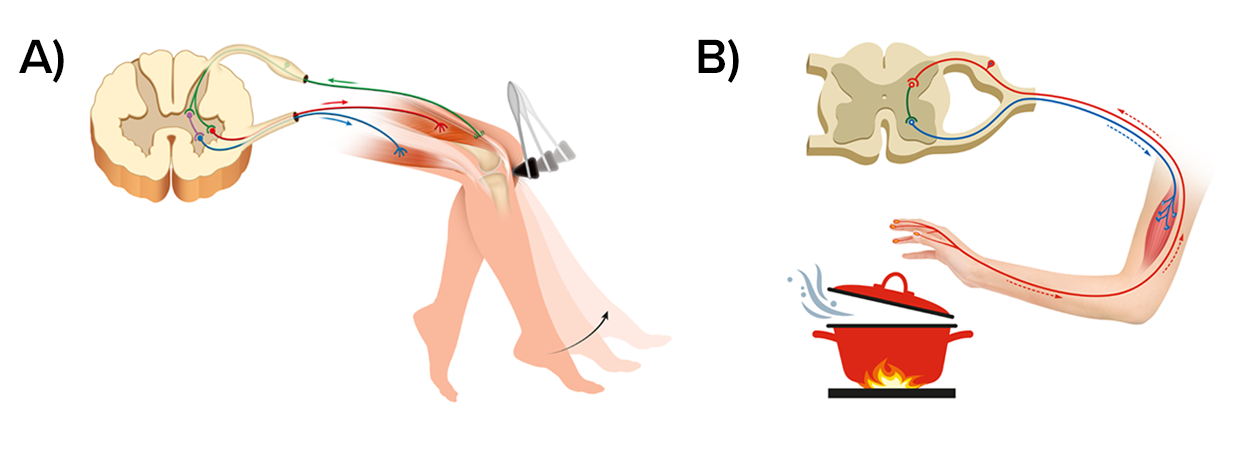
You may be familiar with certain reflexes of the body. Every reflex is unique in its location, processing speed, and action. The patellar tendon (knee-jerk) reflex, shown below, is an innate somatic monosynaptic spinal reflex performed at the doctor's office to test the health of your lower spinal cord. Using a reflex hammer, the doctor will strike the patellar ligament on the distal end of the knee, which causes the patellar tendon proximal to the knee to stretch. This sensory signal is sent to the spinal cord, directly transferred to the motor nerve for the quadricep muscle group, and sent back out. The effect is to shorten the stretched patellar tendon.
In contrast, when your hand touches a hot surface, the sensory signal travels to the spinal cord and requires additional processing compared to the knee-jerk reflex. The hot surface signal is transferred first to an interneuron and then transferred again to a motor nerve. This setup is a polysynaptic reflex and requires additional time. You may notice that this type of reflex may not have as fast of a reaction compared with a monosynaptic reflex.
Spinal Reflexes—Spinal reflexes are automatic motor responses to a given sensory input that is programmed to protect the body. (A) The patellar tendon (knee-jerk) reflex is an innate somatic monosynaptic spinal reflex that protects the quadricep from being overstretched. (B) An innate somatic polysynaptic spinal reflex protects your hand when it touches hot surfaces.
terms to know
Reflex
An automatic motor response to a given sensory signal.
Reflex Arc
A pathway that facilitates an immediate and involuntary response to stimuli.
Innate Reflex
A reflex that you are born with.
Acquired Reflex
A reflex that is learned over time.
Somatic Reflex
A reflex of the somatic nervous system involving a skeletal muscle effector.
Autonomic Reflex
A reflex of the autonomic nervous system involving cardiac muscle, smooth muscle, or glandular tissue effectors.
Monosynaptic Reflex
A reflex that has two neurons and one synapse.
Polysynaptic Reflex
A reflex that has three or more neurons and two or more synapses.
Spinal Reflex
A reflex that is processed in the spinal cord.
Cranial Reflex
A reflex that is processed in the brain.
summary
In this lesson, you learned about nerves and how reflexes cause nerves to work as information pathways. You first explored nerve structure and how action potentials will jump from one unsheathed node to another, allowing new action potentials to happen, and how the myelin sheath helps speed up the action potential process. Then, you learned about reflexes and how sensory and motor neurons of the central nervous system coordinate functions to protect the body without the processing power of the brain.