In this lesson, you will learn about how muscle fascicles are organized and the general naming system of skeletal muscles. Specifically, this lesson will cover:
Skeletal muscle is enclosed in connective tissue scaffolding at three levels. Each muscle fiber (cell) is covered by endomysium and the entire muscle is covered by epimysium. When a group of muscle fibers is “bundled” as a unit within the whole muscle by an additional covering of a connective tissue called perimysium (plural, perimysia), that bundled group of muscle fibers is called a fascicle.
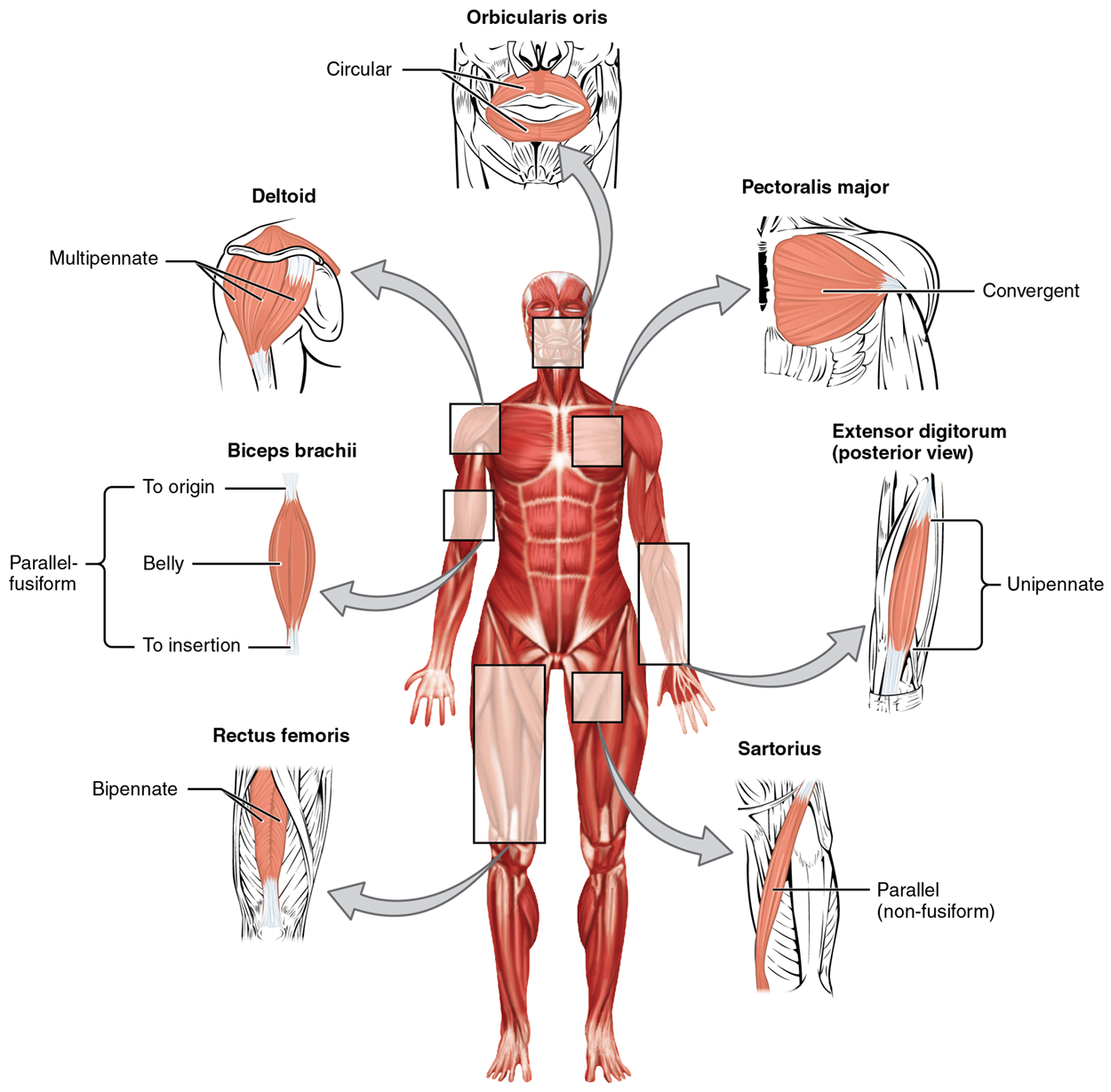
Fascicle arrangement by perimysia is correlated to the force generated by a muscle; it also affects the range of motion of the muscle. Based on the patterns of fascicle arrangement, skeletal muscles can be classified in several ways. The following are the most common fascicle arrangements.
1. Parallel muscles have fascicles that are arranged in the same direction as the long axis of the muscle. The majority of skeletal muscles in the body have this type of organization. Some parallel muscles are flat sheets that expand at the ends to make broad attachments. Other parallel muscles are rotund with tendons at one or both ends. Muscles that seem to be plump have a large mass, called a belly, of tissue located in the middle of the muscle, between the insertion and the origin, which is known as the central body. When a muscle contracts, the contractile fibers shorten it to an even larger bulge. For example, extend and then flex your biceps brachii muscle in your anterior arm; the large, middle section is the belly.
2. When a parallel muscle has a central, large belly that is spindle-shaped, meaning it tapers as it extends to its origin and insertion, it sometimes is called fusiform (tapered).
Muscle Shapes and Fiber Alignment - The skeletal muscles of the body typically come in seven different general shapes.
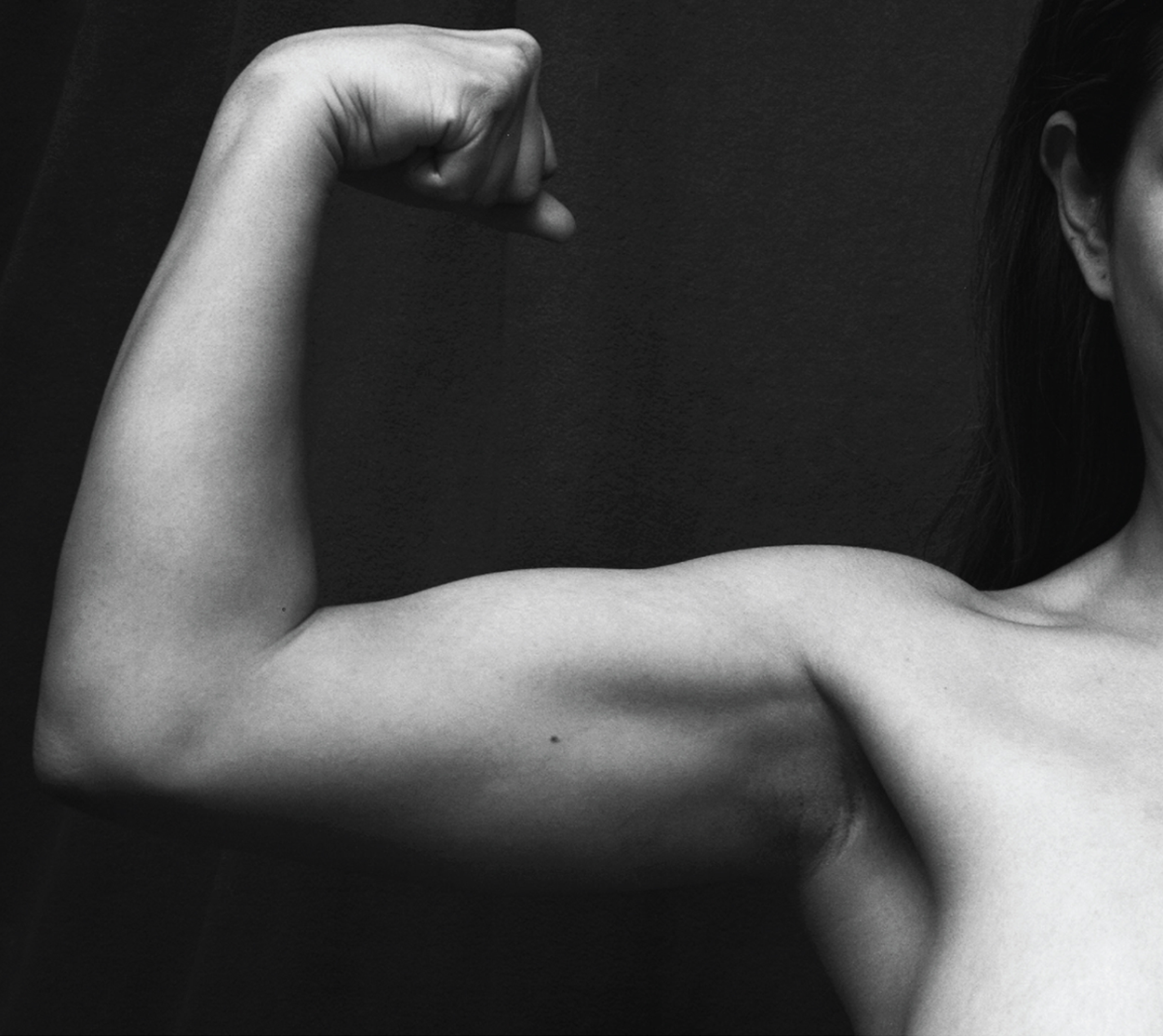
Biceps Brachii Muscle Contraction - The large mass at the center of a muscle is called the belly. Tendons emerge from both ends of the belly and connect the muscle to the bones, allowing the skeleton to move. The tendons of the bicep connect to the upper arm and the forearm. Credit: Victoria Garcia
3. Circular muscles, also called sphincters, are concentrically arranged bundles of muscle fibers of increasing size around and opening—an exit or entrance to the body or an organ. When they contract, the size of the opening shrinks to the point of closure. The orbicularis oris muscle is a circular muscle that goes around the mouth. When it contracts, the oral opening becomes smaller, as when puckering the lips for whistling. Another example is the orbicularis oculi, one of which surrounds each eye. Consider, for example, the names of the two orbicularis muscles (orbicularis oris and oribicularis oculi), where part of the first name of both muscles is the same. The first part of orbicularis, orb (orb, circular), is a reference to a round or circular structure; it may also make one think of orbit, such as the moon’s path around the earth. The word oris (oris, oral) refers to the oral cavity or the mouth. The word oculi (ocular, eye) refers to the eye.
did you know
There are other muscles throughout the body named by their shape or location. The deltoid is a large, triangular-shaped muscle that covers the shoulder. It is so-named because the Greek letter delta looks like a triangle. The rectus abdominis (rector = “straight”) is the straight muscle in the anterior wall of the abdomen, while the rectus femoris is the straight muscle in the anterior compartment of the thigh.
4. When a muscle has a widespread expansion over a sizable area, but then the fascicles come to a single, common attachment point, the muscle is called convergent. The attachment point for a convergent muscle could be a tendon, an aponeurosis (a flat, broad tendon), or a raphe (a very slender median tendon). The large muscle on the chest, the pectoralis major, is an example of a convergent muscle because it converges on the greater tubercle of the humerus via a tendon. The temporalis muscle of the cranium is another.
Pennate muscles (penna, feathers) blend into a tendon that runs through the central region of the muscle for its whole length, somewhat like the quill of a feather with the muscle arranged similarly to the feathers. Due to this design, the muscle fibers in a pennate muscle can only pull at an angle, and as a result, contracting pennate muscles do not move their tendons very far. However, because a pennate muscle generally can hold more muscle fibers within it, it can produce relatively more tension for its size. There are three subtypes of pennate muscles.
5. In a unipennate muscle, the fascicles are located on one side of the tendon. The extensor digitorum of the forearm is an example of a unipennate muscle.
6. A bipennate muscle has fascicles on both sides of the tendon.
7. In some pennate muscles, the muscle fibers wrap around the tendon, sometimes forming individual fascicles in the process. This arrangement is referred to as multipennate. A common example is the deltoid muscle of the shoulder, which covers the shoulder but has a single tendon that inserts on the deltoid tuberosity of the humerus.
Because of fascicles, a portion of a multipennate muscle like the deltoid can be stimulated by the nervous system to change the direction of the pull. For example, when the deltoid muscle contracts, the arm abducts, but when only the anterior fascicle is stimulated, the arm will abduct and flex.
terms to know
Parallel
A pattern of muscle fascicle arrangement in which the fascicles are arranged in the same direction as the long axis of the muscle.
Belly
The large central mass or body of a muscle between the insertion and origin.
Fusiform
Spindle-shaped; tapered.
Circular
A pattern of muscle fascicle arrangement in which the fascicles are arranged concentrically around a body or organ opening.
Convergent
A pattern of muscle fascicle arrangement in which the fascicles expand widely over a sizable area on one end but then come together at a single, common attachment point on the other.
Pennate
A pattern of muscle fascicle arrangement in which the fascicles blend into a tendon that runs through the central region of the muscle for its whole length.
Unipennate
A pennate muscle fascicle arrangement in which the fascicles are located on one side of the tendon.
Bipennate
A pennate muscle fascicle arrangement in which the fascicles are located on both sides of the tendon.
Multipennate
A pennate muscle fascicle arrangement in which the fascicles wrap around the tendon.
2. Naming Skeletal Muscles
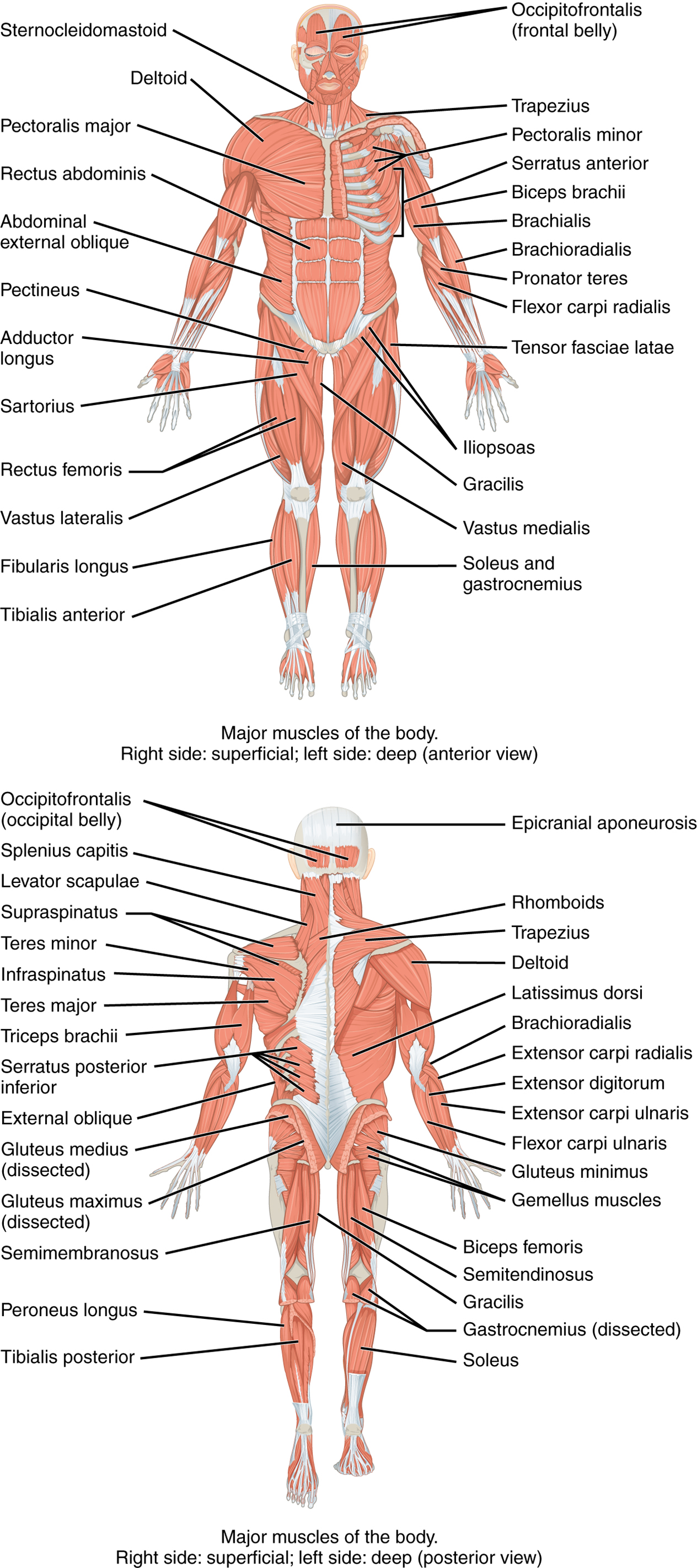
The following image represents many of the muscles that you will learn in the coming lessons. Each of these muscles performs a function and many of them do so in coordination with one another.
Overview of the Muscular System - On the anterior and posterior views of the muscular system above, superficial muscles are shown on the right side of the body while deep muscles are shown on the left half of the body. For the legs, superficial muscles are shown in the anterior view while the posterior view shows both superficial and deep muscles.
reflect
As you look over the muscles above, if you find yourself thinking ‘Why weren’t the muscles named something a little easier to remember?,’ you’re not alone. This assumes, however, that you don’t speak Greek and Latin.
did you know
The Greeks and Romans conducted the first studies done on the human body in Western culture. The educated class of subsequent societies studied Latin and Greek, and therefore, the early pioneers of anatomy continued to apply Latin and Greek terminology or roots when they named the skeletal muscles. These muscles were named based on their location, structure, or function to make understanding and identifying them easier.
EXAMPLE
In the table below are two muscles. From their name on the left, it may not seem apparent where they are located or what they do. However, read through the breakdown of their root words and see if the naming makes more sense. If so, all we need to better understand the muscle names is to know the Greek and Latin root words.
Table: Understanding a Muscle Name from the Latin
Example
Word
Latin Root 1
Latin Root 2
Meaning
Translation
Abductor digiti minimi
abductor
ab = away from
duct = to move
A muscle that moves away from
A muscle that moves the little finger or toe away.
digiti
digitus = digit
Refers to a finger or toe
minimi
minimus = mini, tiny
little
Adductor digiti minimi
adductor
ad = to, towards
duct = to move
A muscle that moves towards
A muscle that moves the little finger or toe toward.
digiti
digitus = digit
Refers to a finger or toe
minimi
minimus = mini, tiny
little
did you know
The large number of muscles in the body and unfamiliar words can make learning the names of the muscles in the body seem daunting, but understanding the etymology can help. Etymology is the study of how the root of a particular word entered a language and how the use of the word evolved over time. As you’ve seen above, taking the time to learn the root of the words is crucial to understanding the vocabulary of anatomy and physiology. When you understand the names of muscles, it will help you remember where the muscles are located, their structure, and what they do.
Below is a list of root words you will encounter in the muscles of future lessons. This is also a good time to review your directional terms (i.e., anterior, posterior, medial, lateral, and more), anatomical regions (i.e., cranial, brachial, gluteus, and more), and body movements (i.e., flexion, extension, rotation, supination, and more).
Table: Mnemonic Device for Latin Roots
Example
Latin or Greek Translation
Mnemonic Device
ad
to; toward
ADvance toward your goal.
ab
away from
ABduction moves a body part away from the midline.
sub
under
SUBmarines move under water.
ductor
something that moves
A conDUCTOR makes a train move.
anti
against
If you are ANTIsocial, you are against engaging in social activities.
epi
on top of
The EPIdermis is the tissue on top of the dermis.
apo
to the side of
An APOstle is someone who is sent away on a mission.
longissimus
longest
“Longissimus” is longer than the word “long.”
longus
long
long
brevis
short
brief
maximus
large
max
medius
medium
“Medius” and “medium” both begin with “med.”
minimus
tiny; little
mini
rectus
straight
To RECTify a situation is to straighten it out.
oblique
at an angle
An oblique section is at an angle to any of the three planes of the body.
multi
many
If something is MULTIcolored, it has many colors.
uni
one
A UNIcorn has one horn.
bi/di
two
If a ring is DIcast, it is made of two metals.
tri
three
TRIple the amount of money is three times as much.
quad
four
QUADruplets are four children born at one birth.
externus
outside
EXternal
internus
inside
INternal
semi
half
Semi-transparent materials can only partially be seen through
Anatomists name the skeletal muscles according to a number of criteria, each of which describes the muscle in some way. These include naming the muscle after its shape, its comparative size, its location in the body or the location of its attachments to the skeleton, how many origins it has, or its action.
The skeletal muscle’s anatomical location or its relationship to a particular bone often determines its name.
EXAMPLE
The frontalis muscle is located on top of the frontal bone of the skull.
Similarly, the shapes of some muscles are very distinctive and the names reflect the shape. Muscles can be named based on their size—maximus (largest), medius (medium), and minimus (smallest). For example, the primary muscles of the buttocks are the gluteus maximus, gluteus medius, and gluteus minimus. Muscles can also be named based on their length—brevis (short), longus (long), and longissimus (longest). The muscle fibers within a muscle can be arranged in many different patterns—rectus (straight) or oblique (at an angle). For example, the rectus abdominis is a muscle of the abdomen region with straight, parallel muscle fibers. Lastly, muscles can be named based on how superficial or deep they are—external (superficial) or internal (deep). For example, the external obliques are a muscle with angled muscle fibers that are superficial in relation to the internal obliques which are deeper.
terms to know
Maximus
The Latin/Greek term for “largest”.
Medius
The Latin/Greek term for “medium-sized”.
Minimus
The Latin/Greek term for “smallest”.
Brevis
The Latin/Greek term for ‘short”.
Longus
The Latin/Greek term for “long”.
Longissimus
The Latin/Greek term for “longest”.
Rectus
The Latin/Greek term for “straight”.
Oblique
The Latin/Greek term for “at an angle”.
External
The Latin/Greek term for “superficial”.
Internal
The Latin/Greek term for “deep”.
summary
In this lesson, you learned the patterns of fascicle organization in skeletal muscles which determines the directionality of muscle tension during contraction. You also learned how Greek and Latin root terms are used in naming skeletal muscles.
The large central mass or body of a muscle between the insertion and origin.
Bipennate
A pennate muscle fascicle arrangement in which the fascicles are located on both sides of the tendon.
Brevis
The Latin/Greek term for ‘short”.
Circular
A pattern of muscle fascicle arrangement in which the fascicles are arranged concentrically around a body or organ opening.
Convergent
A pattern of muscle fascicle arrangement in which the fascicles expand widely over a sizable area on one end but then come together at a single, common attachment point on the other.
External
The Latin/Greek term for “superficial”.
Fusiform
Spindle-shaped; tapered.
Internal
The Latin/Greek term for “deep”.
Longissimus
The Latin/Greek term for “longest”.
Longus
The Latin/Greek term for “long”.
Maximus
The Latin/Greek term for “largest”.
Medius
The Latin/Greek term for “medium-sized”.
Minimus
The Latin/Greek term for “smallest”.
Multipennate
A pennate muscle fascicle arrangement in which the fascicles wrap around the tendon.
Oblique
The Latin/Greek term for “at an angle”.
Parallel
A pattern of muscle fascicle arrangement in which the fascicles are arranged in the same direction as the long axis of the muscle.
Pennate
A pattern of muscle fascicle arrangement in which the fascicles blend into a tendon that runs through the central region of the muscle for its whole length.
Rectus
The Latin/Greek term for “straight”.
Unipennate
A pennate muscle fascicle arrangement in which the fascicles are located on one side of the tendon.