Use Sophia to knock out your gen-ed requirements quickly and affordably. Learn more
×

Multi-Step Linear Equations

Author: Sophia

what's covered
In this lesson, you will review how to solve an algebraic equation and combine like terms so you can solve multi-step linear equations. Practicing multi-step linear equations will further strengthen your problem solving skill. Specifically, this lesson will cover:

Table of Contents

1. Solving a Multi-Step Linear Equation

As you know, you use the properties of equality and inverse operations to solve an algebraic equation. However, as the equation becomes longer, the question becomes, which step do you do first?

Ultimately, the goal is to isolate the variable on one side of the equation and your answer on the other side. As we learned earlier, you should start with the constants because isolating the variable from the coefficient can make the equation look needlessly messy with fractions or decimals. This makes sense, but what happens when there are more than two steps needed to isolate the variable? Use reverse order of operations to isolate the variable, meaning you use the acronym PEMDAS backwards. Therefore, addition and subtraction are undone before any multiplication or division is undone.

EXAMPLE

Solve for x in the equation 3 x minus 8 equals 2 x plus 1

3 x minus 8 equals 2 x plus 1 The equation.
3 x minus 8 plus 8 equals 2 x plus 1 plus 8 Start with the constant by adding 8 to both sides, which will undo subtracting 8 on the left side.
3 x equals 2 x plus 9 The constant is now removed on the left side.
3 x minus 2 x equals 2 x minus 2 x plus 9 Next, we want to combine the variables onto one side of the equation. To do this, subtract 2x from both sides to undo the 2x on the right side. Why not -3x? Because our constant is already on the right side so we want to move the variable to the left. Also, it is recommended to try to keep the variable positive so you don't have to multiply both sides by -1 in the end.
1 x equals 9 3x minus 2x equals 1x.
x equals 9 We can write 1x as x, and our solution is x = 9.

hint
When trying to isolate a variable, it is always a good idea to simplify the equation as much as possible before starting to isolate the variable with inverse operations. This usually means that we should combine like terms whenever possible.

try it
Consider the equation short dash 3 x plus 15 plus x equals 2 x minus 35 plus 10.
Solve for x in this equation.
short dash 3 x plus 15 plus x equals 2 x minus 35 plus 10 The equation
short dash 2 x plus 15 equals 2 x minus 25 There are multiple variables so start by combining like terms on the left and on the right. We can combine -3x and x on the left and the negative 35 and 10 on the right.
short dash 2 x plus 15 minus 15 equals 2 x minus 25 minus 15 Now, we can start to isolate x, moving the constants to the other side of the equation. Subtract 15 on both sides of the equation.
short dash 2 x equals 2 x minus 40 The constant on the left side is canceled. Note that subtracting 15 from negative 25 equals negative 40.
short dash 2 x minus 2 x equals 2 x minus 40 minus 2 x Next, remove the 2x on the right side of the equation by subtracting 2x from both sides.
short dash 4 x equals short dash 40 This leaves us with negative 4x on the left.
fraction numerator short dash 4 x over denominator short dash 4 end fraction equals fraction numerator short dash 40 over denominator short dash 4 end fraction Lastly, divide both sides of the equation by negative 4 to isolate the variable x. Why by -4 instead of 4? If we don't address the negative now, it will require another step of multiplying both sides of the equation by -1.
x equals 10 -40 divided by -4 is equal to 10, which is the solution for x.

try it
Consider the equation 2 x minus 4 equals 5 x plus 3.
Solve for x in this equation.
2 x minus 4 equals 5 x plus 3 The equation
2 x minus 4 minus 5 x equals 5 x plus 3 minus 5 x Move the x terms to the left side by subtracting 5x from both sides.
short dash 3 x minus 4 equals 3 Note that 2x minus 5x equals -3x.
short dash 3 x minus 4 plus 4 equals 3 plus 4 Move the constant term 4 to the opposite side of the equation.
short dash 3 x equals 7 The variable is now isolated on the left side.
fraction numerator short dash 3 x over denominator short dash 3 end fraction equals fraction numerator 7 over denominator short dash 3 end fraction Divide both sides by -3 to isolate the x variable.
x equals short dash 7 over 3 We can leave the solution as a fraction since it does not divide evenly into a decimal.

1a. Using Distribution

Other times, when we try to isolate a variable, it may be better to simplify the equation before we perform any inverse operations. This may require using distribution, like in the example below.

EXAMPLE

Solve for x in the equation 5 left parenthesis 2 x minus 6 right parenthesis equals 7.

There are two ways we can go about solving this equation. First, we can distribute 5 into the 2x and –6, and then isolate the variable, or we can divide both sides of the equation by 5 first, and then solve for x. Either method will work, and you are free to use either when trying to isolate the variable. Let's take a look at how we can use both methods to solve the equation above.

By Distribution:

5 left parenthesis 2 x minus 6 right parenthesis equals 7 The equation.
10 x minus 30 equals 7 Distribute 5 into 2x - 6.
10 x minus 30 plus 30 equals 7 plus 30 Add 30 to both sides.
10 x equals 37 Now we have the variable isolated on the left side.
fraction numerator 10 x over denominator 10 end fraction equals 37 over 10 Divide both sides by 10.
x equals 3.7 37 divided by 10 is 3.7, which is the solution to x.

Dividing by 5 First:

5 left parenthesis 2 x minus 6 right parenthesis equals 7 The equation
fraction numerator 5 left parenthesis 2 x minus 6 right parenthesis over denominator 5 end fraction equals 7 over 5 Divide both sides by 5.
2 x minus 6 equals 1.4 The 5 divided by 5 on the left cancels. We can express 7/5 as the decimal 1.4.
2 x minus 6 plus 6 equals 1.4 plus 6 Add 6 to both sides.
2 x equals 7.4 Now we have the variable isolated on the left side.
fraction numerator 2 x over denominator 2 end fraction equals fraction numerator 7.4 over denominator 2 end fraction Divide both sides by 2.
x equals 3.7 7.4 divided by 2 is 3.7, which is the solution to x.

try it
Consider the equation 9 equals 3 left parenthesis 2 x minus 5 right parenthesis.
Solve for x using distribution.
9 equals 3 left parenthesis 2 x minus 5 right parenthesis The equation.
9 equals 6 x minus 15 Distribute 3 on the right side.
24 equals 6 x Undo -15 by adding 15 to both sides of the equation.
4 equals x Undo x times 6 by dividing both sides by 6 to get a solution of x = 4.
Solve for x by dividing first.
9 equals 3 left parenthesis 2 x minus 5 right parenthesis The equation
3 equals 2 x minus 5 Divide both sides of the equation by 3.
8 equals 2 x Undo -5 by adding 5 to both sides.
4 equals x Undo x times 2 by dividing both sides by 2 to get a solution of x = 4.

1b. Variable in the Denominator

When a variable appears in the denominator of a fraction, it can be difficult to isolate that variable until it is moved into a numerator. When the denominator contains the variable, the first step we take is to multiply the entire equation by the expression in the denominator. This eliminates the variable from the denominator on one side of the equation, and makes it part of the numerator on the other side of the equation.

EXAMPLE

Solve for x in the equation 8 equals fraction numerator 48 over denominator 2 x end fraction.

8 equals fraction numerator 48 over denominator 2 x end fraction The equation.
8 left parenthesis 2 x right parenthesis equals fraction numerator 48 over denominator 2 x end fraction left parenthesis 2 x right parenthesis Get rid of the fraction by multiplying both sides of the equation by 2x.
8 left parenthesis 2 x right parenthesis equals 48 When multiplying both sides by 2x, the 2xs on the right cancel, leaving 48. The left side is now 8 times 2x.
16 x equals 48 Distribute 8 into 2x.
x equals 3 Divide both sides of the equation by 16 to get a solution of x = 3.

try it
Consider the equation fraction numerator 40 over denominator 4 x end fraction equals short dash 2.
Solve for x in this equation.
fraction numerator 40 over denominator 4 x end fraction equals short dash 2 The equation
open parentheses 4 x close parentheses fraction numerator 40 over denominator 4 x end fraction equals short dash 2 open parentheses 4 x close parentheses Get rid of the fraction by multiplying both sides of the equation by 4x.
40 equals short dash 2 open parentheses 4 x close parentheses When multiplying both sides by 4x, the 4xs on the left cancel, leaving 40. The right side is now -2 times 4x.
40 equals short dash 8 x Distribute -2 into 4x.
short dash 5 equals x Divide both sides of the equation by -8 to get a solution of x = -5.

2. Real-World Examples

There are many scenarios in the real-world where you will need to solve multi-step equations. Consider the examples below.

IN CONTEXT

Speedy Taxi Company charges $5 for the initial pick up and then $1/mile. Thrifty Taxi Company charges $15 for the initial pick up and then $0.50/mile. How many miles would you need to travel in each before they would charge the same amount at the end of the trip?

First, establish the variable: x = miles traveled

Now set up your equation to show that both taxi charges are equal.
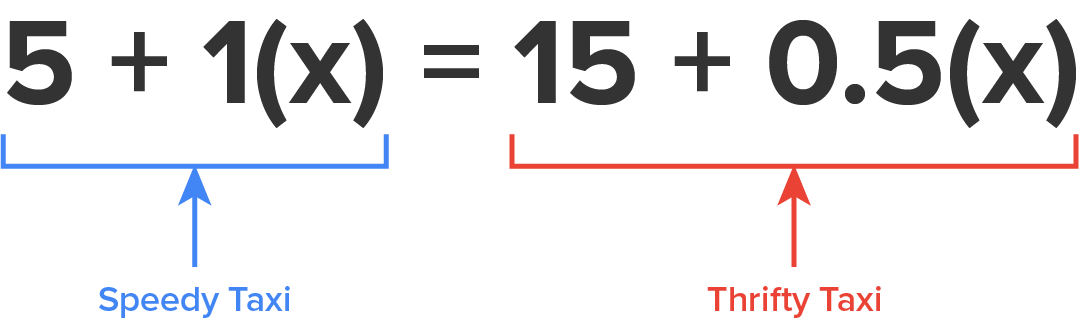
An equation stating 5 plus 1 times (x) equals 15 plus 0.5 times (x), where 5 plus 1 times (x) represents the charges of ‘Speedy Taxi’ and 15 plus 0.5 times (x) represents the charges of ‘Thrifty Taxi’.

5 plus 1 left parenthesis x right parenthesis equals 15 plus 0.5 left parenthesis x right parenthesis The equation
5 minus 5 plus 1 left parenthesis x right parenthesis equals 15 minus 5 plus 0.5 left parenthesis x right parenthesis Combine the constants by subtracting 5 from both sides because it is the opposite of a positive 5.
1 x equals 10 plus 0.5 x The constant is canceled from the left side.
1 x minus 0.5 x equals 10 plus 0.5 x minus 0.5 x Subtract both sides by 0.5x because it is the opposite of addition. You want to have all the variables on one side of the equation
0.5 x equals 10 Now the variable is isolated on the left side.
fraction numerator 0.5 x over denominator 0.5 end fraction equals fraction numerator 10 over denominator 0.5 end fraction Divide both sides by 0.5 because it is the opposite of multiplication.
x equals 20 space miles 10 divided by 0.5 is equal to 20, which is the solution for x.

So our conclusion would be that the companies would charge you the same amount if you travel 20 miles. However, if you travel less than 20 miles, the Speedy Taxi Company would cost you less. If you are traveling more than 20 miles, you should use the Thrifty Taxi Company to save you more money.

IN CONTEXT

Susan earns $22/hour and her husband earns an unknown amount per hour. If they both work for 4 hours and earned a total of $148, how much does Susan’s husband make per hour?

First, establish the variable: x = Susan's husband's hourly rate of pay

Now set up your equation to show how much they made total from working four hours.

4 open parentheses x plus 22 close parentheses equals 148

4 left parenthesis x plus 22 right parenthesis equals 148 The equation.
4 x plus 88 equals 148 Distribute the 4 into the parenthesis.
4 x plus 88 minus 88 equals 148 minus 88 Subtract both sides by 88 because it is the opposite of addition. You want to have all the variables on one side of the equation.
4 x equals 60 Now the variable is isolated on the left side.
fraction numerator 4 x over denominator 4 end fraction equals 60 over 4 Divide both sides by 4 because it is the opposite of multiplication.
x equals 15 60 divided by 4 is 15, which is the solution for x.

This solution tells us that Susan's husband makes $15/hour.

IN CONTEXT

Rick is moving to a new home that is 465 miles away. He travels at 65 mph for 5 hours. He takes a break and then drives at 70 mph for the rest of the way. How long did Rick drive for 70 mph?

First, establish the variable: t = time

Set up the equation using the distance = rate x time formula and substituting the information that we need to find how long he drove for 70 mph. This can be expressed in the following equation: 465 equals 65 open parentheses 5 close parentheses plus 70 t

465 equals 65 open parentheses 5 close parentheses plus 70 t The equation
465 equals 325 plus 70 t Simplify the right side by multiplying 65 times 5.
140 equals 70 t Isolate the variable on the right side by subtracting 325 from both sides.
2 equals t Divide both sides by 70 to get the solution of t = 2.

In conclusion, Rick's drove 70 mph for 2 hours.

Skill Reflect
Reflect on multi-step linear equations and how you might use them in everyday life. Also reflect on how these equations strengthen your problem solving skill and how that will help you succeed in your professional and personal life. What have you learned about variables and equations in relation to problem solving?

summary
Today you learned about solving multi-step linear equations with like terms. The process for solving an equation involves using inverse operations in the reverse order of operations, or PEMDAS backwards. If possible, it is best to simplify the equation before using those inverse operations, which may require using distribution. If a variable is in the denominator of a fraction, you need to multiply both sides of the equation by that variable to solve the equation. By practicing these types of complex problems, you are building confidence and preparing to tackle complicated problems in the real world.

Best of luck in your learning!

Source: THIS TUTORIAL WAS AUTHORED BY SOPHIA LEARNING. PLEASE SEE OUR TERMS OF USE.