Table of Contents |
Let's explore the concept of movements up and down the supply curve. This should seem familiar to you.
We return to the supply schedule of a producer: in this case, Farmer Jones who grows apples for sale. In this schedule, price per apple is located in the first column and quantity of apples in the second column.
| Price of Granny Smith Apples |
Quantity of Granny Smith Apples Each Week |
|---|---|
| $2.00 | 7 |
| $1.75 | 6 |
| $1.50 | 5 |
| $1.25 | 4 |
| $1.00 | 3 |
| $0.75 | 2 |
| $0.50 | 1 |
| $0.25 | 0 |
Notice the relationship between price and the quantity per unit (apple) that the farmer is willing and able to supply. In the schedule, if the price per apple is $2, which is quite an expensive apple, the farmer is willing to offer a larger number of apples because he knows that he will have higher earnings.
However, as the price starts to fall, the seller is willing to offer lower and lower quantities of apples.
Visually this relationship can be represented as a graph. Plot the points from the schedule with the product price on the y-axis and the number of apples that the seller is willing to offer to on the x-axis.
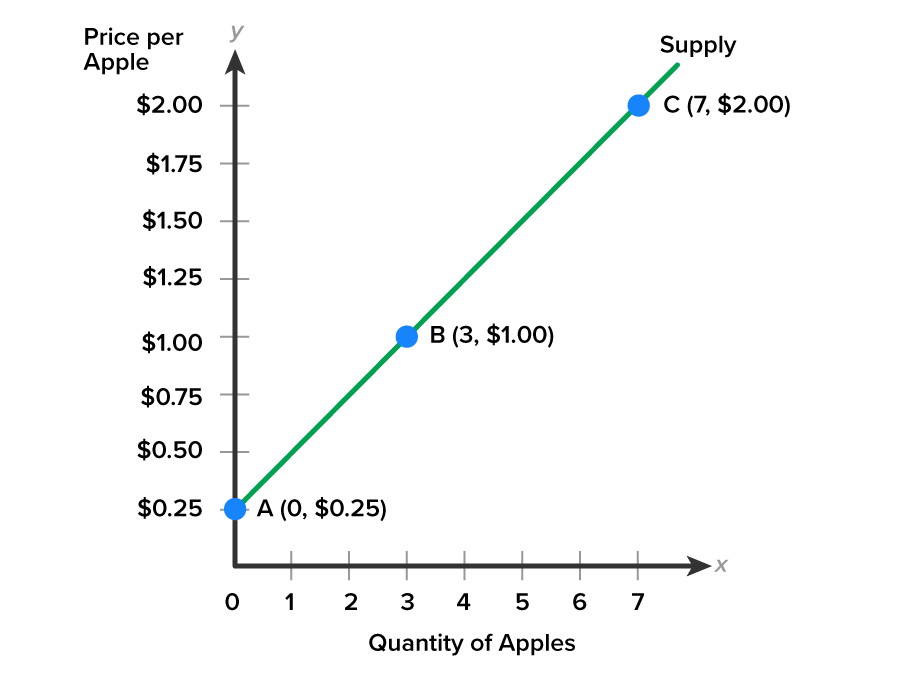
Notice the relationship between price and quantity. As the price rises, the farmer is willing to offer more apples. As the price falls, the farmer is willing to offer fewer apples. In fact, he is not willing to offer any apples when the price is $0.25 per apple.
Price and quantity move together; both go up or both go down. The two variables have a direct relationship causing the supply curve to slope upward.
The effect of a price change for a specific product, assuming all other factors remain unchanged, is to cause a movement up or down the curve to the new product prices and quantities.
Let’s confirm this conclusion. Begin at point A. If the farmer is offered a price higher than $0, say $1 per apple, then it will cause a movement up along the curve to the new price at point B where the quantity supplied is 3 apples. Quantity supplied rises. If the farmer had been receiving $2 per apple and the price falls to $1, then it will cause a movement down along the curve to the new prices where the quantity is three apples. Quantity supplied falls.
We call this action a movement along a supply curve caused by a change in the product’s price.
The example above demonstrates the law of supply at work. A fall in the product’s price causes a fall in the quantity supplied, and a rise in product price causes a rise in the quantity supplied. This is what is meant by a movement along the curve. As price changes, the producer is willing to offer a different quantity, so we simply move along the curve in the same direction as the price change from one point to the next point, assuming nothing else changes.
To help you remember this relationship for supply and differentiate it from the relationship for demand, refer to the image below.

In economic terminology, as price goes up, the quantity supplied rises and vice versa. Again, there is a direct relationship between the two variables (price and quantity) as stated by the law of supply, which is illustrated by a movement up or down along a supply curve. Remember, no other factor that might influence the seller is allowed to be considered, only a change in the product’s own price.
Price is only one of several factors that influence the willingness and ability of suppliers—sellers and producers—to offer products to the market. In the real world, we know many factors are constantly changing. What if the farmer's fertilizer becomes more expensive, or what if the farmer has to pay workers more? What if new technology is developed that makes apple picking much more efficient? Or what if the farmer faces more competition from other growers?
In these cases, we can't simply move along the curve because sellers may not be willing to supply the same amount of apples at the same prices if any of these events occur.
Let's consider the effect of a change in a non-price factor such as the cost of fertilizer. This means we need to modify the supply schedule while keeping the same prices. Only one thing can change at a time.
| Price of Granny Smith Apples |
Quantity of Granny Smith Apples Each Week |
Quantity Supplied (Rightward Shift) |
|---|---|---|
| $2.00 | 5 | 8 |
| $1.75 | 4 | 7 |
| $1.50 | 3 | 6 |
| $1.25 | 2 | 5 |
| $1.00 | 1 | 4 |
| $0.75 | 0 | 3 |
| $0.50 | 0 | 2 |
| $0.25 | 0 | 1 |
Notice what’s happened in the quantity column. At all of the prices—the same prices as before—Farmer Jones is now offering a lower number of apples. He is not even willing to offer apples at $0.50 or $0.75 and is only willing to offer one at $1, instead of the three in the previous example.
If we plot these new quantity and price numbers, then we are going to create a new supply curve. The quantity numbers are different, even though the price column did not change. This is a new relationship between price and quantity producing a new supply curve. The change in the position of the new curve relative to the old one is what we term a shift of the curve.
A new relationship between price and quantity requires a new supply curve. The new curve represents a shift in supply, caused by a change in something other than the price of the good itself. The seller rethinks the price-quantity decisions.
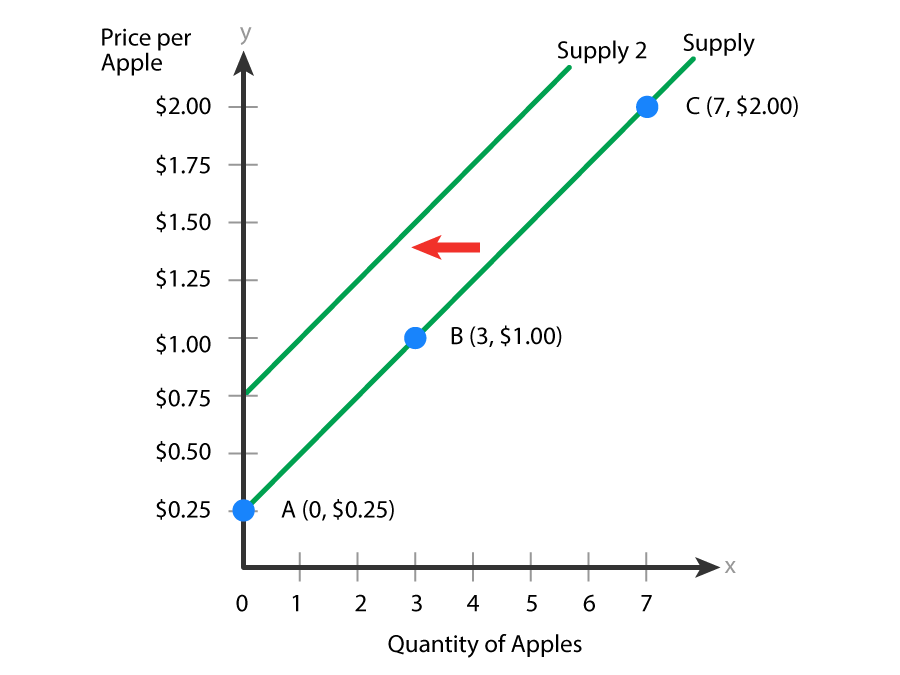
As you can see in the graph a change in production costs caused a shift in the supply curve.
EXAMPLE
A small trucking business is hired to transport apples to local grocery stores. Suppose stores in surrounding areas contact the business requesting deliveries to their stores. This is great for the trucking business as it stands to earn more income. However, traveling greater distances to those surrounding areas will likely increase the cost of gasoline, oil, vehicle repairs, and workers’ hours. To cover these additional costs, the business must be compensated with higher selling prices.Source: THIS TUTORIAL HAS BEEN ADAPTED FROM OPENSTAX "PRINCIPLES OF ECONOMICS 2E". ACCESS FOR FREE AT openstax.org/books/principles-economics-2e/pages/1-introduction. LICENSE: CC ATTRIBUTION 4.0 INTERNATIONAL. Accessed by August 2022.



