In this lesson, you will explore how objects change their motion over time and how to represent that change using graphs. Specifically, this lesson will cover:
Think about the fastest land animal on Earth, the cheetah. In just a few seconds, it can rocket from 0 to 60 miles per hour, faster than most cars. Consider what a cheetah gains by reaching top speed faster than any other land animal. What do you think a tradeoff for having explosive speed might be?
In physics, acceleration means any change in an object’s velocity over time. That includes speeding up, slowing down, or even changing direction.
formula to know
Acceleration
Where is the acceleration, is the velocity change, and is the time.
When you hear the word “acceleration,” what do you picture? Probably a car blasting off when the light turns green, or maybe a roller coaster picking up speed. That’s a great start, but it’s only part of the story.
Let’s begin with that familiar acceleration. Positive acceleration is when something speeds up in the direction it's already moving. In this case, the velocity and the acceleration are both in the same direction, so they work together to increase speed.
A car that is accelerating forward
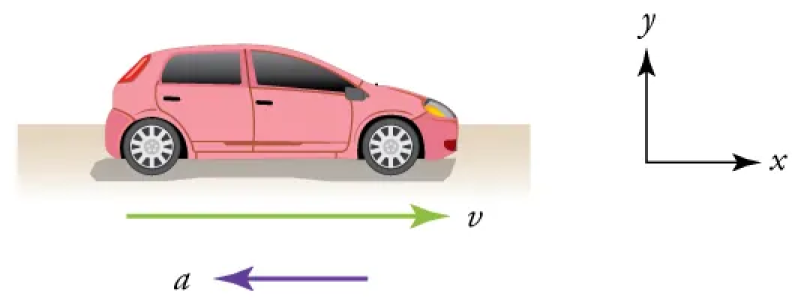
Now flip the situation: The car is still moving in the same direction, but this time, the driver hits the brakes. The car starts to slow down. This is called negative acceleration (deceleration) because now the velocity points east, but the acceleration points west (opposite directions). That opposing force reduces the car’s speed.
A car accelerating forward with velocity and acceleration vectors pointing in opposite directions.
key concept
It’s a common misconception that only speeding up counts as acceleration. In reality, both speeding up and slowing down are forms of acceleration. Whether the object is gaining or losing speed, it’s still experiencing a change in velocity; so, both are classified as acceleration. So, whether you're hitting the gas (positive acceleration) or slamming the brakes (negative acceleration), you're accelerating!
IN CONTEXT Powerful Paddling Through Physics
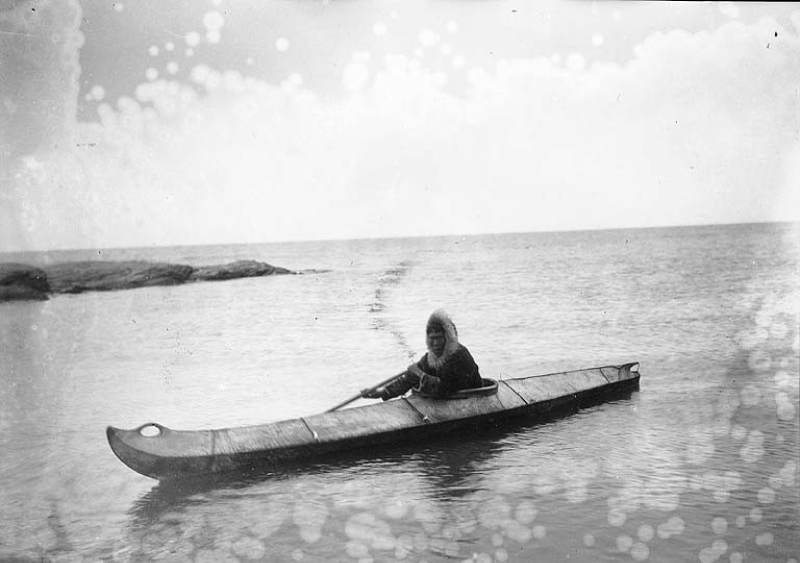
An Inuit hunter in a sleek, low-profile kayak.
Inuit hunters used sleek, narrow kayaks that were perfectly designed for agility in icy waters. Getting up to speed quickly was critical, especially when launching from stillness in rough or dangerous conditions. Their solution? A series of quick, forceful paddle strokes that generated rapid acceleration right off the start. This burst technique wasn’t random; it reflected deep cultural knowledge about how the body interacts with water and how specific movements can create powerful forward motion with minimal effort.
These traditional launch methods were about survival, not just skill. Reading currents, adjusting posture, and using paddle angle to cut cleanly through the water all came together to help hunters navigate unpredictability with precision. Long before physics classrooms talked about force and acceleration, Inuit kayakers were mastering these, as they were guided by experience, tradition, and an intimate understanding of their environment.
term to know
Acceleration
Any change in an object’s velocity over time.
2. Velocity vs. Time Graphs
A velocity-time graph shows how fast something is moving over time, as well as in what direction. It is like a motion story told through lines instead of video. On this graph, time is also always on the horizontal (x) axis, and it is velocity that is on the vertical (y) axis.
Here’s where it gets really useful: the slope of the line tells you how the motion is changing—whether the object is speeding up, slowing down, or moving at a steady pace.
A line slanting upward means the object is accelerating; its velocity is increasing.
A line slanting downward shows deceleration; the object is slowing down.
A flat, horizontal line means it’s moving at a constant velocity; no change in speed or direction.
Imagine a skateboarder pushing off at the top of a hill. At first, the velocity increases; the graph would show a line climbing upward. Then, on level ground, they coast at a steady pace; the graph would show a flat line. Finally, they start up another hill and slow down; the line slopes downward. That’s how a velocity-time graph captures the motion, moment by moment, in a single picture.
A velocity-time graph showing the skateboarder’s motion.
try it
Does a decreasing velocity always mean an object is returning to its starting point? Consider how direction and speed interact over time.
Consider the following scenarios:
A car slowing as it climbs a hill
A roller-coaster car decreasing in speed just before the top of a loop
A decreasing velocity simply means the object is slowing down, not necessarily reversing direction. If velocity remains positive, the object continues forward, just more slowly. Only when the velocity changes sign (goes from positive to negative, or vice versa) does the object reverse and head back toward its start.
IN CONTEXT Making Sprinting History
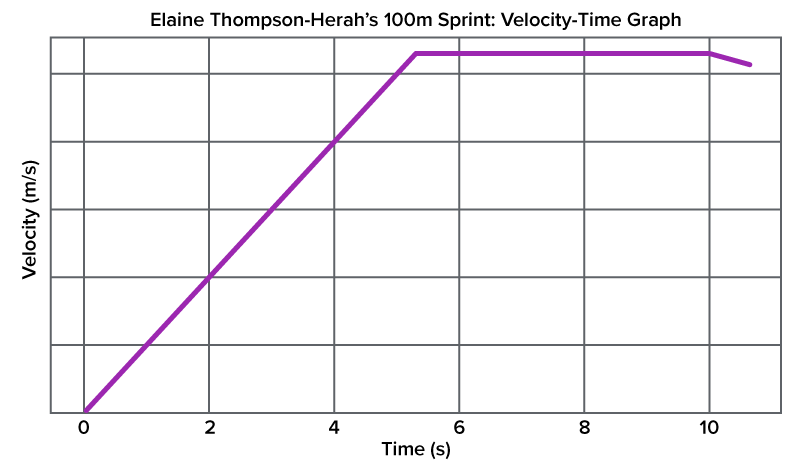
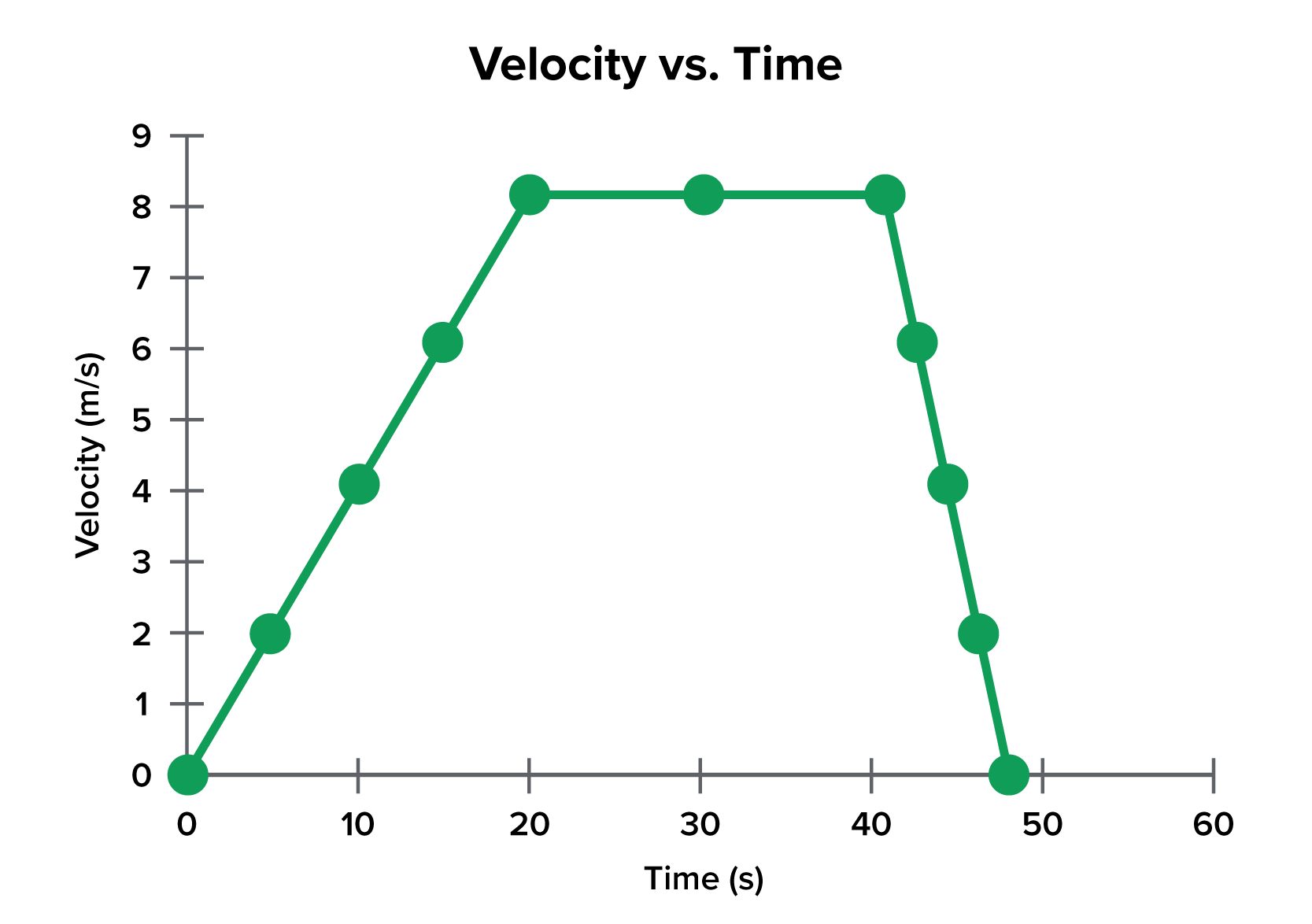
At the 2021 Tokyo Olympics, Jamaica’s Elaine Thompson-Herah made history in the women’s 100-meter final. She exploded off the starting blocks and accelerated rapidly during the first 30 meters. This would show as a curve with increasing steepness on a position-time graph.
Around the 50-meter mark, Elaine Thompson-Herah hit her top speed, maintaining it nearly to the finish line. This would look like a straight, steep slope. In the final moments, she slightly slowed as she crossed the line in 10.61 seconds; still fast, but with a subtle flattening of the slope at the end.
Velocity-time graph of Elaine Thompson-Herah’s 100m sprint. The sharp rise shows her powerful acceleration out of the blocks, followed by a steady top speed phase and a slight decrease in speed at the finish.
learn more
The “Moving Man” Simulation
1. Open the simulation link in your browser.
2. Familiarize yourself with the three main controls. Notice that when you change one, the others self-adjust.
Position Slider/Input box: sets the initial position of the man.
Velocity Slider/Input box: sets the constant walking speed of the man.
Acceleration Slider/Input box: sets the acceleration rate of the man.
Investigation 1: Constant Speed
Reset all settings.
Switch to the Charts tab
Set velocity = +2 m/s.
Press the play button and let it run until the man reaches the house.
Investigate the man’s motion graphed over time.
Questions to answer:
Describe the shape of the Position vs. Time and Velocity vs. Time graphs.
How does each graph show constant speed?
Investigation 2: Reversing Direction
Reset all settings.
Start with velocity = +3 m/s, then after 4 s pause and set velocity = –3 m/s.
Run for a total of 10s.
Questions to answer:
What changed when the velocity was turned to a negative value on each graph?
Investigation 3: Acceleration
Reset all settings.
Start with velocity = +3 m/s, acceleration =
Run for a total of 2 s.
Questions to answer:
Describe the shape of the Velocity vs. Time.
How does the Velocity vs. Time graph show constant acceleration?
term to know
Velocity-Time Graph
Shows how an object’s speed and direction change over time.
summary
In this lesson, you learned how to describe and analyze changes in motion using acceleration and velocity-time graphs. In Acceleration, you explored how any change in velocity—including speeding up, slowing down, or changing direction—counted as acceleration and how both positive and negative acceleration affected motion. Then, in Velocity vs. Time Graphs, you examined how the slope of the graph represented acceleration, while the area under the line revealed displacement. Together, these tools helped you understand not only how fast something moved, but how its motion changed over time.

 is the acceleration,
  is the velocity change, and
  is the time.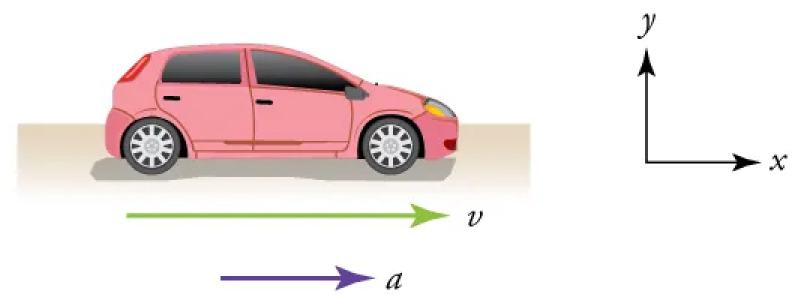



 is the acceleration,
  is the velocity change, and
  is the time.