Table of Contents |
The monumental architecture covered in this lesson is from the years 81 CE to 313 CE. This is essentially from the first century to the fourth century CE. With the exception of one structure in Trier, Germany, the monumental architecture in this lesson is situated in Rome.
Monuments, or monumental architecture, were important because columns and triumphal arches celebrated individuals and their accomplishments, especially military accomplishments. They were the focus of lavish parades and ceremonies, known as triumphs, that took place when there was a military victory. The army would march through the arch, the victorious commander would make speeches and hand out awards to his soldiers, and there might also be music, dancing, flag bearing, and the display and distribution of war booty. Triumphal ceremonies were highly propagandistic and reinforced an image of the power and glory of the empire.
Trajan’s Column, built in 113 CE, commemorated the Roman emperor Trajan’s conquest of the Dacians, a civilization based in modern-day Romania. In fact, the spiral frieze that encircles the column depicts the story of that conquest. This frieze culminates at the very top of the column, which was originally capped with a bronze statue of Trajan. This statue was later replaced with the current statue of St. Peter.
One of the best examples of a commemorative monumental column is Trajan’s Column. Here’s what it looks like today:
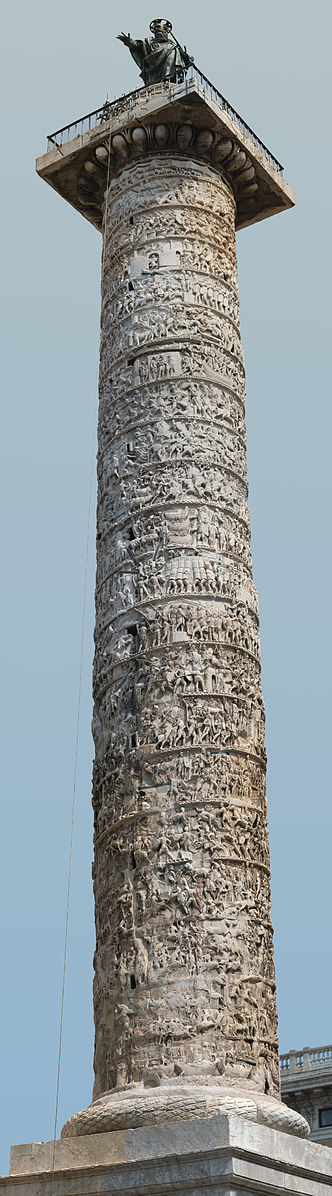
Trajan's Column
Rome, Italy
107- 113 CE
Luna marble
The earliest surviving triumphal arch is the Arch of Titus from around 90 CE. Titus was the son of Vespacian and died after only having been emperor for two years. His younger brother Domitian built the arch to honor him. This arch celebrated his conquest of Palestine, which is modern-day Israel and surrounding areas.
The Arch of Titus consists of a concrete core with a marble exterior. The central, rounded arch is flanked by two rectangular supports, which include the first examples of the composite order. This is essentially a combination of the Corinthian column with the iconic, scroll-shaped capital. The sacking of the temple in Jerusalem is shown on the sculptural relief. The attic, which is that larger section on top, can also be seen. The only thing shown here is the inscription commemorating Titus’s accomplishment.
Below is an image of the Arch of Titus.
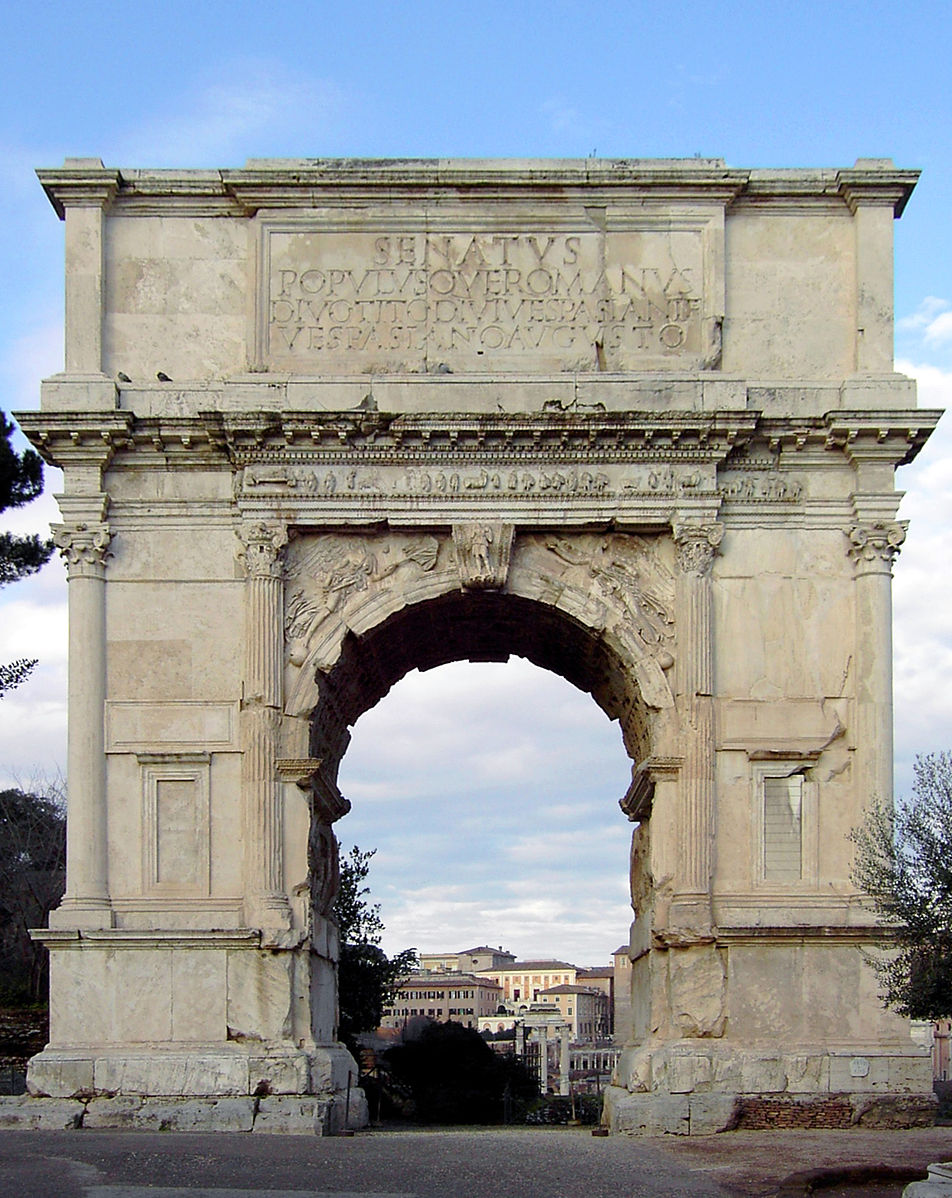
Arch of Titus
Rome, Italy
c. 81 CE
Marble over concrete core
Underneath the arch, in the passageway, there are two relief sculptures. One side depicts the sack of Jerusalem and shows Roman soldiers carrying off stolen war booty from the Temple of Jerusalem—in this case, a menorah. On the other side is a sculpture of Titus's triumphal parade after the conquest of Judea, which includes a number of allegorical figures.
The Arch of Constantine is an arch that commemorates Constantine’s rise as sole emperor after the defeat of a political rival, Maxentius. This defeat took place at the Battle of the Milvian Bridge.
Here is an image of the triumphal arch of the emperor Constantine, the Arch of Constantine:
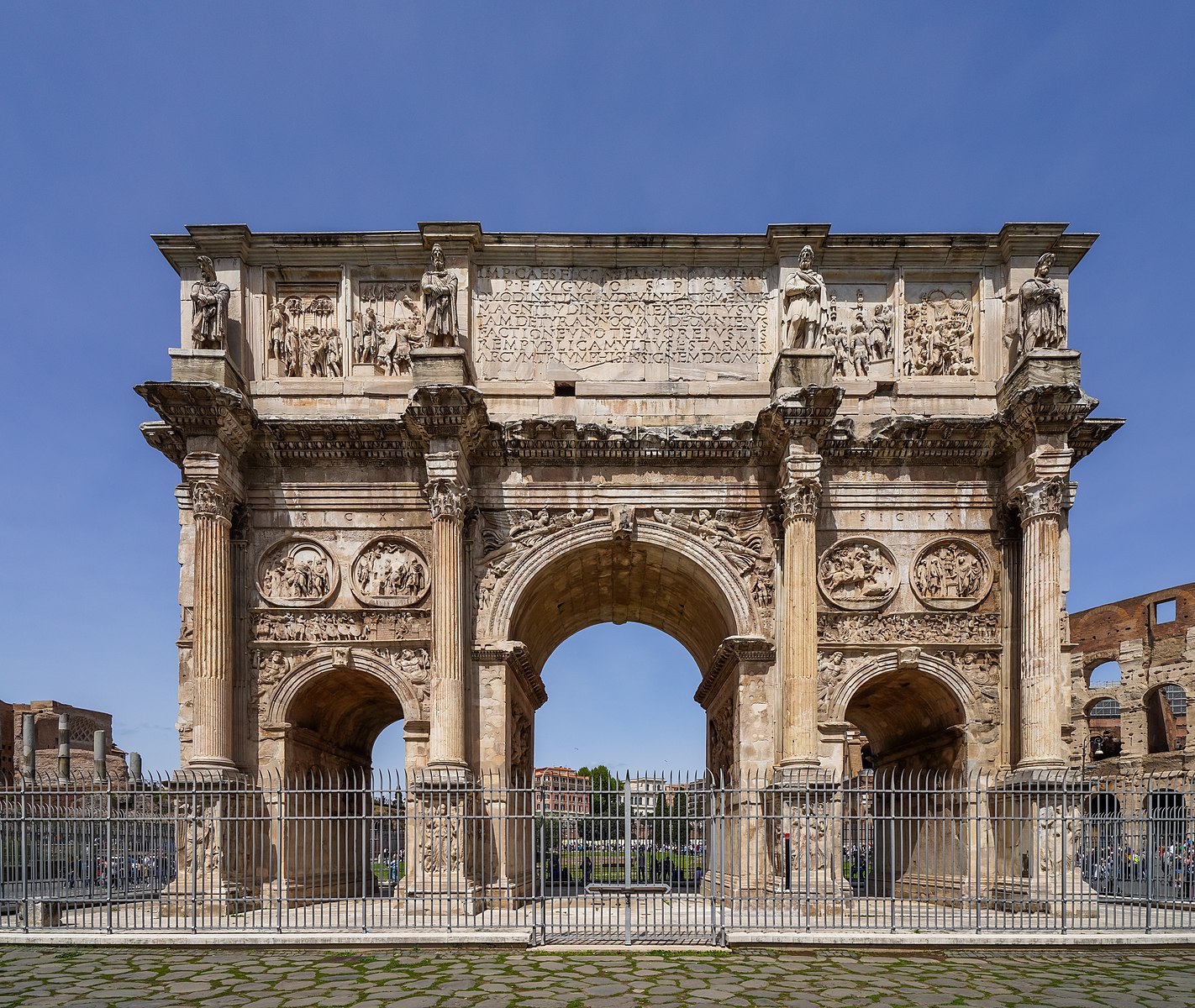
Arch of Constantine
Rome, Italy
315 CE
Marble
The above arch is notable for several things, including:
IN CONTEXT
The Arch of Constantine is essentially a collage of spolia taken from other monuments and put together in a sort of hodgepodge. The figures in some of the images also look stiff and unnatural. For these reasons, this arch is often cited as an example of the decline of form in ancient Rome. Furthermore, some scholars have argued that the decline of form seen in the Arch of Constantine also indicates the larger decline of Rome itself. However, it might be more useful to view the shift away from the humanism of ancient Greece and Rome as a change in values that is manifested as a change in artistic style.
This partial image of Constantine might also be called monumental:
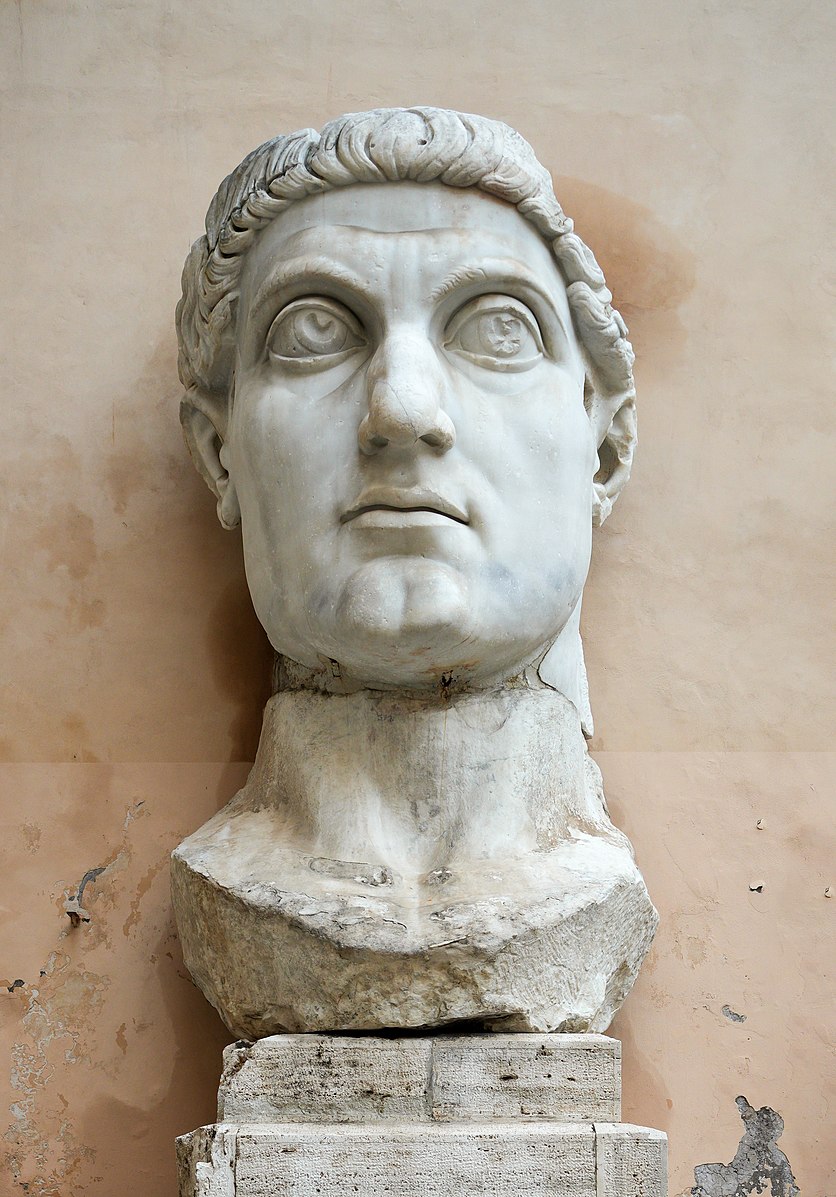
Colossus of Constantine, head
Museo Capitolini, Rome, Italy
c. 312–315 CE
Marble
Originally, his head would have been attached to a body. The classical ideals we see in early Roman examples are largely missing. In fact, based on a quick glance, it almost seems to recall elements we saw in archaic art of the Etruscans and Greeks, especially with the geometric-shaped eyes. It has been noted by some scholars for its seemingly aloof appearance. Some believe that this might depict a sense of emotional disconnectedness from his subjects.
A basilica was originally a columned meeting hall in ancient Rome that later became associated with a Christian building with a large central nave or hall. The Basilica at Trier, originally called the Aula Palatina, began life as an imperial reception hall for the emperor Constantine when he was visiting the imperial city of Trier in modern-day Germany. The windows near the end of the basilica, or apse, are slightly smaller, enhancing the perspective and making the emperor look larger than life when he was present.
It is now notable for its design, as it boasts a large, illuminated rectangular hall called the nave. It is also known for its use of brick as a building material, which is different than what we’ve seen so far.
Below is an image of the Basilica at Trier.
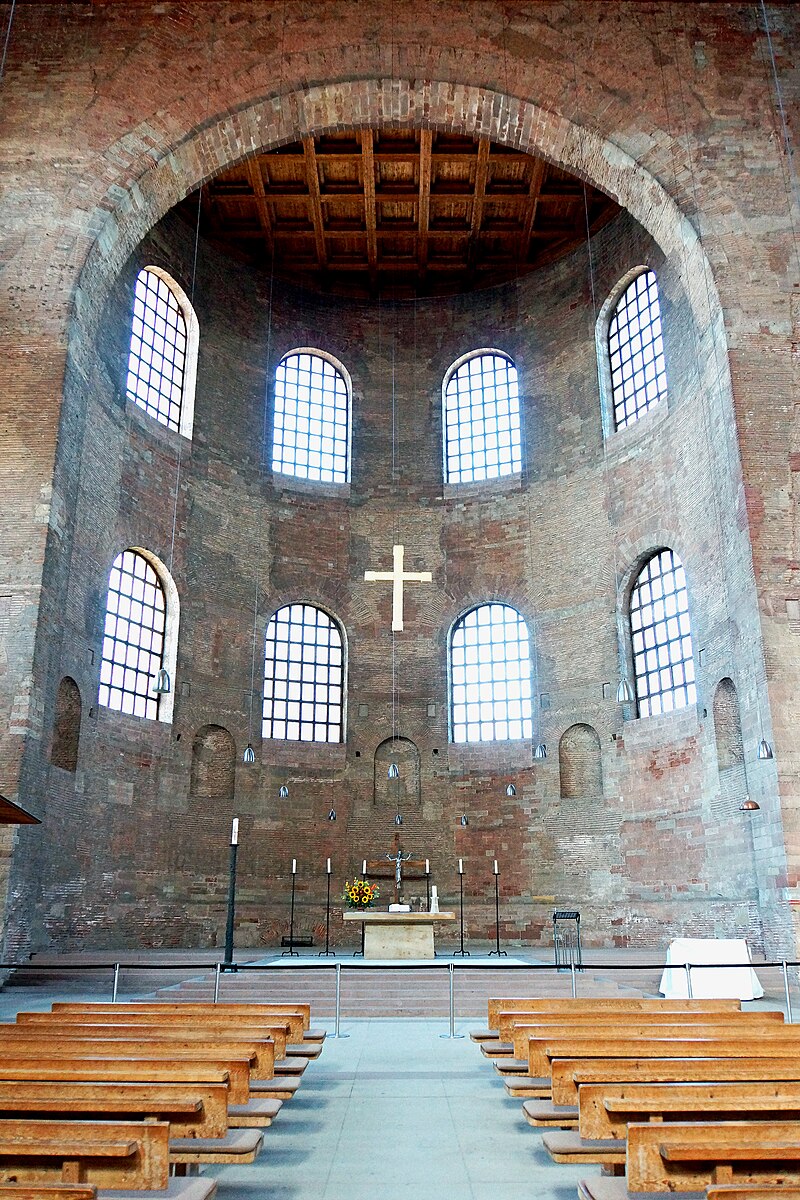
Aula Palatina (Basilica of Constantine)
Trier, Germany
300 - 310 CE
Brick and stone
Source: THIS TUTORIAL WAS AUTHORED BY SOPHIA LEARNING. PLEASE SEE OUR TERMS OF USE.