Use Sophia to knock out your gen-ed requirements quickly and affordably. Learn more
×

Monetary and Fiscal Policy: Impact on Aggregate Demand

Author: Sophia

what's covered
This lesson will discuss how monetary and fiscal policy work to stabilize and stimulate the economy through aggregate demand. Specifically, this lesson will cover the following:

Table of Contents

1. Tools of Fiscal Policy Versus Monetary Policy

The following two graphs show two different situations where the economy is not in equilibrium. At equilibrium, the long-run aggregate supply (LRAS) curve intersects the point where the short-run aggregate supply (SRAS) and aggregate demand intersect.

At times, our economy produces below full employment, as shown on the left. In this case, there are unemployed resources, and unemployment is a concern.

It is also possible for the economy to produce beyond full employment in the short term, illustrated on the right. In this case, inflation can become a major concern.
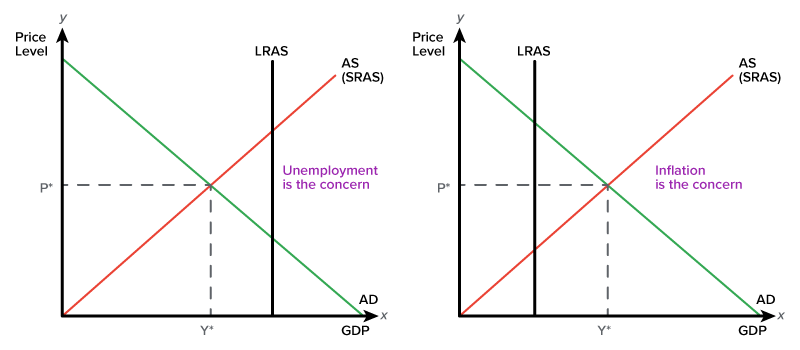
Two macroeconomic diagrams with two different economic conditions when the output deviates from long-run equilibrium. The x-axis represents GDP, and the y-axis is labeled ‘Price Level’. Both the graphs have a line labeled ‘A D’ sloping downward from left to right, another line labeled ‘A S/S R A S’ or short-run aggregate supply sloping upward from left to right, and a vertical line labeled ‘L R A S’ or long-run aggregate supply. A dashed line from the point P* on the y-axis extends until the point of intersection of A D and A S. Another dashed line from the point Y* rises vertically upward until the point of intersection of A D and A S. In the first graph, a label reads, ‘Unemployment is the concern’, highlighting a recessionary gap where the economy is underperforming. The intersection of A D and A S at the point (P*, Y*) occurs to the left of L R A S. In the second graph, the label reads, ‘Inflation is the concern’, showing an inflationary gap where demand exceeds productive capacity, pushing prices up. The intersection of A D and A S at the point (P*, Y*) occurs to the left of L R A S.

In either case, intervention is often needed in the form of action from the government or the Federal Reserve.

When the government intervenes, it sets what is called fiscal policy, which is policy typically set by a central government authority, whereby government spending and taxation are adjusted to stabilize economic activity.

The government has two tools:

  1. Government spending
  2. Taxation
Monetary policy, on the other hand, is typically set by a central banking authority, whereby the money-supply access and the resulting cost of access to money, which is the interest rate, is varied to help stabilize economic activity.

These are the three tools of monetary policy:

  1. Required reserve ratio (RRR)
  2. Interest rates
  3. Buying/selling of securities
terms to know
Fiscal Policy
Policy typically set by a central government authority, whereby government spending and taxation are adjusted to stabilize economic activity.
Monetary Policy
Policy typically set by a central banking authority, whereby money-supply access and the resulting cost of access to money (interest rate) is varied to help stabilize economic activity.


2. Expansionary Policy

Expansionary policy is either monetary or fiscal policy that is enacted to stimulate economic growth as measured by the GDP growth rate.

So, why do we want to enact expansionary policy? Well, we do this when unemployment is the concern or when we are producing below full employment.

Here is a chart outlining the tools used by both types of policy to expand the economy.

Expansionary Policy
Monetary Fiscal
Increase the money supply/entice banks to make loans Encourage job creation and more spending in the economy
1. Lower the RRR
2. Lower interest rates
3. Buy securities
1. Increase government spending
2. Cut taxes

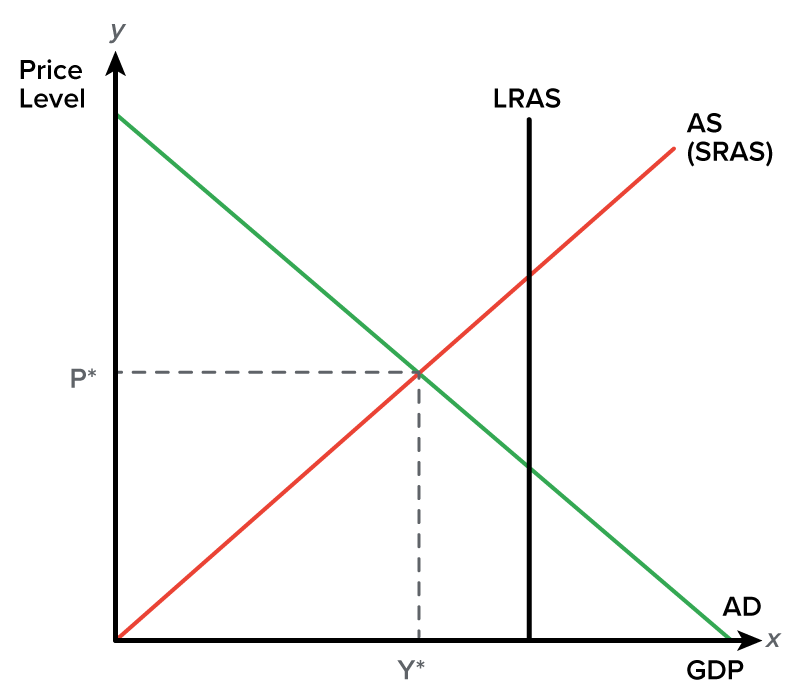
The following graph shows the economy in recession. People need to demand goods and services to bring the economy to LRAS or full employment.

A line graph of an economy in recession. The x-axis represents GDP, and the y-axis represents the price level. The graph shows three lines: the downward-sloping A D or aggregate demand line from left to right, the upward-sloping A S or short-run aggregate supply or S R A S line from left to right, and the vertical L R A S or long-run aggregate supply ascending from a point on the x-axis. A dashed line from the point P* on the y-axis extends until the point of intersection of A D and A S. Another dashed line from the point Y* rises vertically upward until the point of intersection of A D and A S. The intersection of A D and A S at the point (P*, Y*) occurs to the left of L R A S.

Fiscal policy, as mentioned, directly attempts to create demand by spending money to develop programs, jobs, and so on.

Monetary policy works by increasing the money supply and encouraging people to spend money and take out loans.

Either way, the end result is an increase in aggregate demand, as you can see below, taking the economy to full employment, reducing the unemployment rate, and utilizing all of the resources.
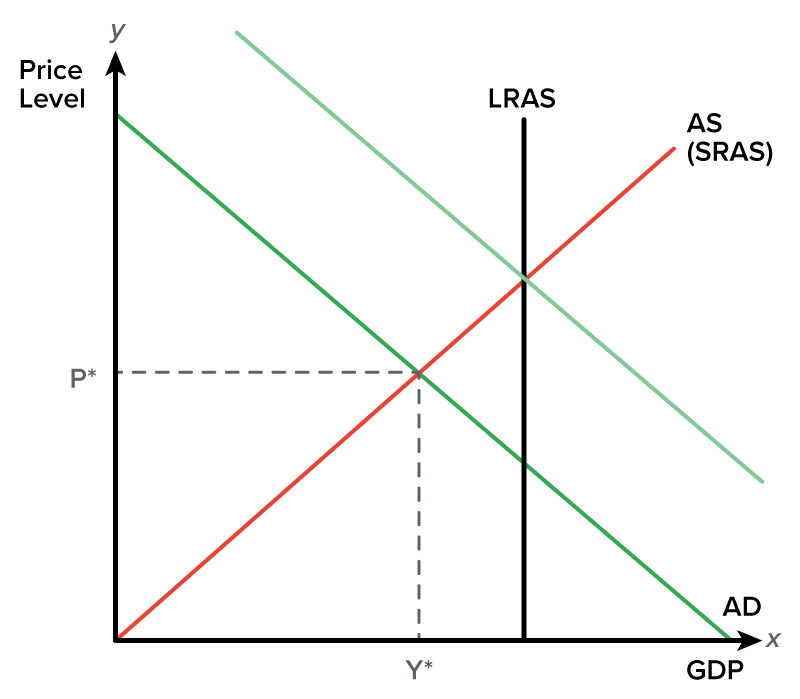
A line graph depicting the macroeconomic concept of an increase in aggregate demand or A D. The x-axis represents GDP, and the y-axis is labeled price level. The graph shows four lines: the downward-sloping A D or aggregate demand line from left to right; the upward-sloping A S or short-run aggregate supply or S R A S line from left to right, rising from the origin; the vertical L R A S or long-run aggregate supply ascending from a point on the x-axis; and a line parallel to the line A D intersecting with A S on L R A S. A dashed line from the point P* on the y-axis extends until the point of intersection of A D and A S. Another dashed line from the point Y* rises vertically upward until the point of intersection of A D and A S. The intersection of A D and A S at the point (P*, Y*) occurs to the left of L R A S.

big idea
The result of expansionary policy is an increase in aggregate demand.

term to know
Expansionary Policy
Either monetary or fiscal policy that is enacted to stimulate economic growth (as measured by the GDP growth rate).

2a. Multiplier Effect

Either fiscal or monetary policy will have a multiplier effect, which is the sum total impact of a policy action on the economy.

The money multiplier is equal to the ratio of the reserve requirement, which is 1 divided by R, where R is the reserve requirement, such that a given reserve requirement will result in a net multiple of the original increase, where we have to multiply by the change in loanable funds.

formula to know
Multiplier Effect
M u l t i p l i e r equals 1 divided by R

big idea
Every dollar the government or Federal Reserve injects into the economy will have a multiplied effect on aggregate demand.

So, if a bank can make one more loan as a result of a policy, this will create more loans.

With fiscal policy, if even one more person receives a paycheck as a result of a new government program, that person will spend money in businesses. This impacts other people, who then go out and spend more money and so forth.

You can imagine how much more this multiplies on a larger scale in the overall economy whenever expansionary policy is implemented.

term to know
Multiplier Effect
The sum total impact of a policy action on the economy; the money multiplier is equal to the ratio of the reserve requirement, 1/r, such that a given reserve requirement will result in a net multiple of the original increase equal to “x the change in loanable funds.”

2b. Overstimulation

This is a situation where policymakers use “excessive fiscal or monetary policies” to get the economy back to equilibrium.

What happens if we stimulate aggregate demand too much with expansionary policy? Well, if the impact on aggregate demand is too much, it can actually push equilibrium temporarily past the LRAS curve.
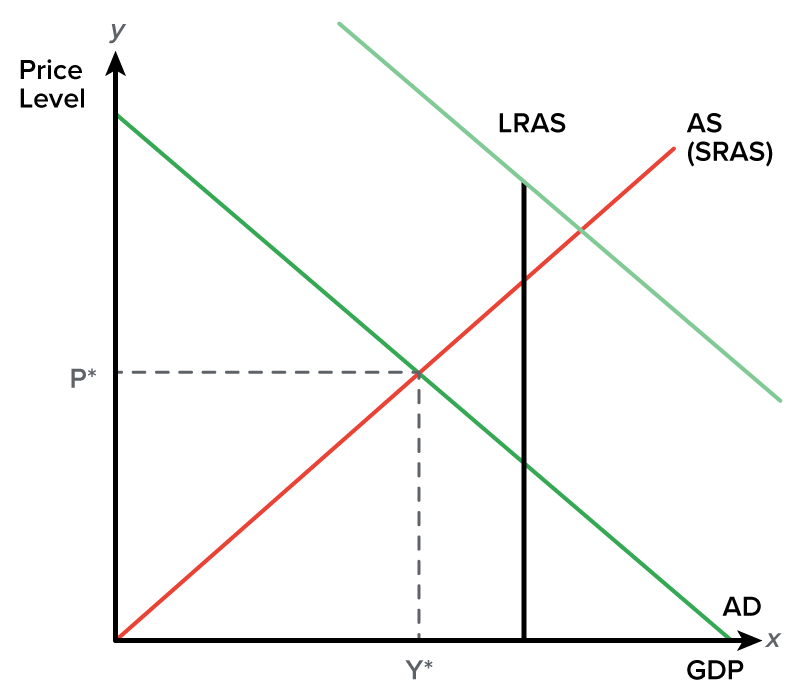
A macroeconomic graph with a leftward shift, denoting a significant impact on aggregate demand. The x-axis represents GDP, and the y-axis is labeled ‘Price Level’. The graph shows four lines: the downward-sloping A D or aggregate demand line from left to right; the upward-sloping A S or short-run aggregate supply or S R A S line from left to right, rising from the origin; the vertical L R A S or long-run aggregate supply ascending from a point on the x-axis; and a line parallel to the line A D intersecting with A S at a point beyond the vertical line L R A S. A dashed line from the point P* on the y-axis extends until the point of intersection of A D and A S. Another dashed line from the point Y* rises vertically upward until the point of intersection of A D and A S. The intersection of A D and A S at the point (P*, Y*) occurs to the left of L R A S.

When that happens, notice how prices go up—and the prices going up include input prices.

When suppliers or producers experience increased prices, the SRAS can shift to the left, bringing the economy back to equilibrium, but now at higher prices.

The end result would be an increase in prices or inflation.

It is important to understand that these policies can be used to stimulate aggregate demand to stabilize the economy and move it toward equilibrium. However, overstimulating aggregate demand will not achieve long-run economic growth. Remember that the LRAS curve represents our economy’s ability to produce when all resources are utilized. Unless resources change to shift this curve, we will only create inflation by overstimulating aggregate demand beyond the LRAS.


3. Contractionary Policy

Now, let’s look at the opposite situation where inflation is the concern. In this case, the government or the Fed needs to slow down the economy through contractionary policy, which is either monetary or fiscal policy that is enacted to slow economic growth, as measured by the GDP growth rate.

Contractionary Policy
Monetary Fiscal
Decrease the money supply/entice people to keep money in banks Encourage less spending in the economy
1. Raise the RRR
2. Raise interest rates
3. Sell securities
1. Decrease government spending
2. Raise taxes

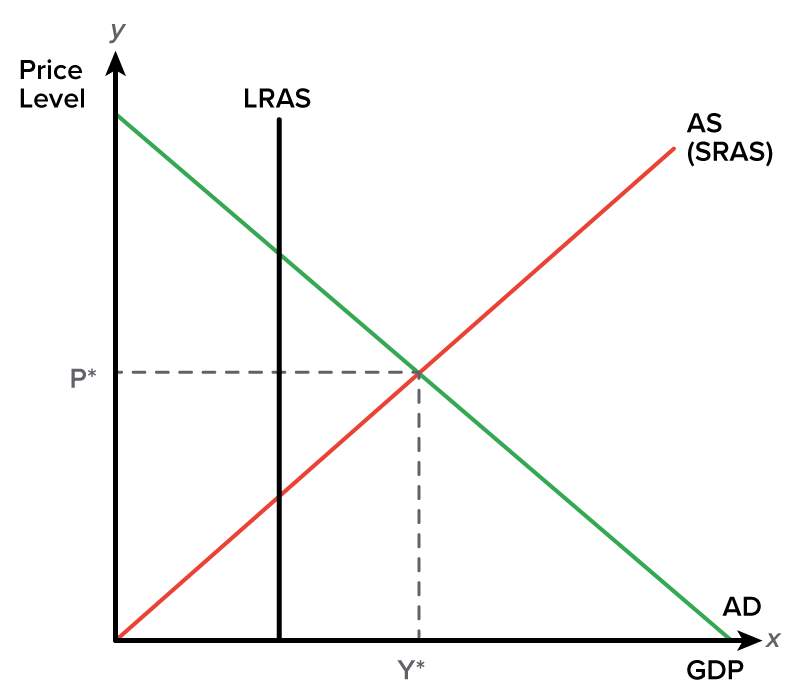
When the economy is overheated, we are temporarily past our LRAS, and inflation becomes the concern. In this case, we actually need people demanding fewer goods and services.

A line graph depicting a decrease in aggregate demand. The x-axis represents GDP, and the y-axis is labeled ‘Price Level’. The graph shows three lines: the downward-sloping A D or aggregate demand line from left to right; the upward-sloping A S or short-run aggregate supply or S R A S line from left to right, rising from the origin; and the vertical L R A S or long-run aggregate supply ascending from a point on the x-axis. A dashed line from the point P* on the y-axis extends until the point of intersection of A D and A S. Another dashed line from the point Y* rises vertically upward until the point of intersection of A D and A S. The intersection of A D and A S at the point (P*, Y*) occurs to the right of L R A S.

Fiscal policy decreases demand by cutting spending, while monetary policy works by decreasing the money supply, again encouraging people to save money and take out fewer loans.

Either way, the end result is a decrease in aggregate demand.

big idea
Contractionary policy results in a decrease in aggregate demand.

term to know
Contractionary Policy
Either monetary or fiscal policy that is enacted to slow economic growth (as measured by the GDP growth rate).


4. Phillips Curve

As you have seen in these graphs, theoretically, there is a direct relationship between real GDP growth and the price level.

As aggregate demand is stimulated and increases, the economy grows and unemployment falls, pushing prices up.

As aggregate demand decreases, the economy contracts. By decreasing aggregate demand, the attempt is to push prices down. The trade-off is increased unemployment.

This is what the Phillips curve illustrates. It is a graphical depiction of this inverse relationship between inflation and unemployment. Intuitively, higher employment or lower unemployment is consistent with a strong economy and demand. As demand increases beyond short-run supply capabilities or resource constraints, inflation begins to increase.
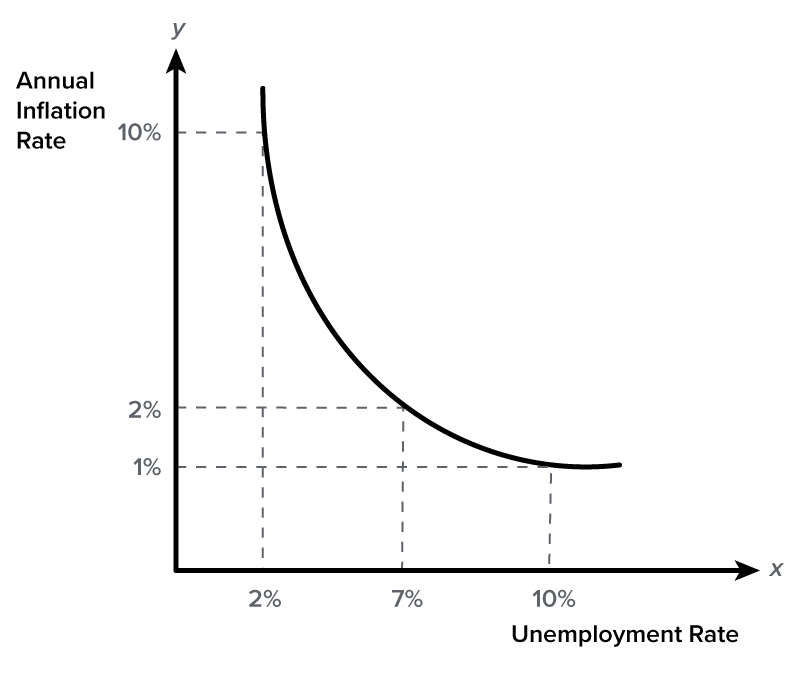
A line graph depicting the Phillips Curve, which denotes the inverse relationship between the unemployment rate and the annual inflation rate. The x-axis represents the unemployment rate, labeled with the values 2%, 7%, and 10%. The y-axis represents the annual inflation rate, marked at 1%, 2%, and 10%. A smooth, downward-sloping curve starts high on the left, at 10% inflation and 2% unemployment, and curves downward and to the right, ending at a point where inflation is around 1% and unemployment is at 10%. Dashed grid lines highlight the data points on both axes, reinforcing the trend that as unemployment increases, inflation decreases.

You can see the axes are annual inflation rate and unemployment rate. There is a trade-off between the two because they are inversely related.

When unemployment is low, we tend to have high inflation because of high demand. When unemployment rises, we have lower inflation.

big idea
↓ Unemployment = ↑ Inflation
↓ Inflation = ↑ Unemployment

If unemployment exceeds 10%, the government or Fed can enact expansionary policy. You can see that at a 10% unemployment rate, inflation is quite low.

Since inflation is not the concern, the government or Fed can enact some type of expansionary policy, which will lower unemployment. However, there will be a slight increase in prices or inflation.

Now, if inflation exceeds 10%, which is extremely high, the government or the Fed can enact contractionary policy, since employment is significantly below full employment.

There could be lower inflation, but the trade-off is a slightly higher unemployment rate as demand in the economy starts to fall.

Very low levels of unemployment (less than 5%) are generally unsustainable and can create bubbles, such as the housing bubble in the early 2000s. In this case, the government or the Fed will want to cool down the economy by enacting contractionary policies.

term to know
Phillips Curve
The graphical depiction of the inverse relationship between inflation and unemployment; intuitively, higher employment (lower unemployment) is consistent with a strong economy and demand; as demand increases beyond short-run supply capabilities or resource constraints, inflation begins to increase.

4a. Stagflation

Critics of this model sometimes point to the 1970s, when our economy experienced very high rates of inflation at the same time as high unemployment. This is known as stagflation.

We would not be able to explain this with the simplified model above, because there were times in the 1970s when inflation was well over 10%, which was coupled with an unemployment rate of over 8%.

This would place us on a point well outside of the curve. We cannot simply move along this simplified Phillips curve and find that combination of unemployment and inflation.

Therefore, we will need to suggest that the Phillips curve could move over time, resulting in a much higher Phillips curve as in this example graph.
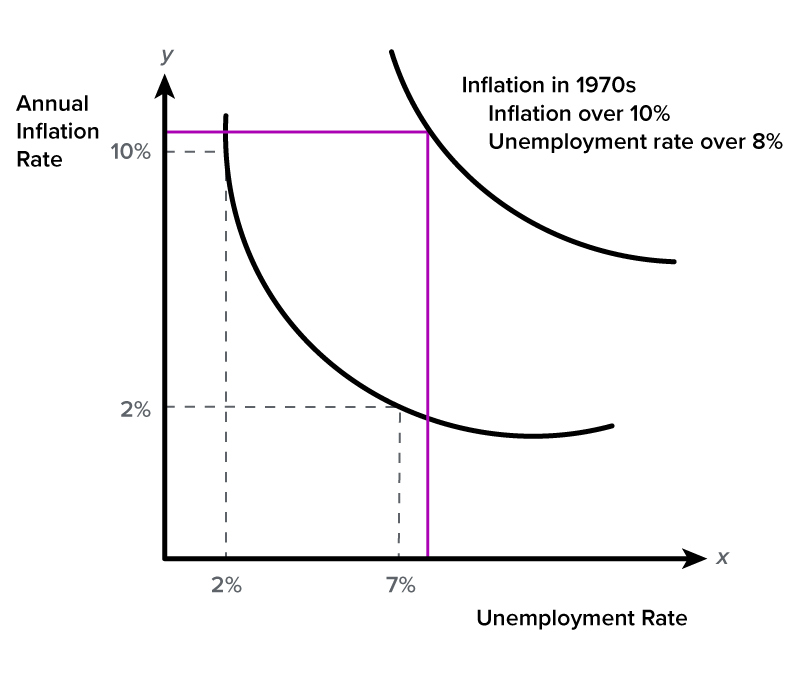
A line graph depicting stagflation using two Phillips curves, showing a shift upward during the 1970s. The x-axis represents the unemployment rate, labeled at 2% and 7%, while the y-axis represents the annual inflation rate, labeled at 2% and 10%. The two Phillips curves are a standard downward-sloping curve and a second, higher curve representing conditions during the 1970s. the upper curve illustrates a situation where both inflation and unemployment were high simultaneously. A vertical line rises from the x-axis beyond 7 %, intersects the lower curve, and meets the upper curve at a point that corresponds to a value above 10% on the y-axis. The text annotated on the graph reads, ‘Inflation in 1970s’, ‘Inflation over 10%’, and ‘Unemployment rate over 8%’.

Stagflation, then, is defined as the situation where both unemployment and inflation are high, contrary to the Phillips curve. It occurs when policy actions fail to boost economic growth and the economy instead becomes stuck in this seemingly impassable position.

term to know
Stagflation
The situation where both unemployment and inflation are high, contrary to the Phillips curve; stagflation occurs when policy actions fail to boost economic growth and the economy instead becomes stuck in a seemingly impassable position.

summary
Today, we compared the tools of fiscal policy versus monetary policy to explore how they both work to stabilize or stimulate the economy through aggregate demand. We learned that expansionary policy works by increasing aggregate demand using the multiplier effect. However, the overstimulation of aggregate demand can lead to inflation. We also learned that contractionary policy works by decreasing aggregate demand. Lastly, we learned that the Phillips curve illustrates the direct relationship between real GDP growth and the price level, showing an inverse relationship between inflation and unemployment. We noted that when both unemployment and inflation are high, this is known as stagflation, which suggests a higher, shifted Phillips curve.

Source: THIS TUTORIAL WAS AUTHORED BY KATE ESKRA FOR SOPHIA LEARNING. PLEASE SEE OUR TERMS OF USE.


Terms to Know
Contractionary Policy

Either monetary or fiscal policy that is enacted to slow economic growth (as measured by the GDP growth rate).

Expansionary Policy

Either monetary or fiscal policy that is enacted to stimulate economic growth (as measured by the GDP growth rate).

Fiscal Policy

Policy typically set by a central government authority, whereby government spending and taxation are adjusted to stabilize economic activity.

Monetary Policy

Policy typically set by a central banking authority, whereby money-supply access and the resulting cost of access to money (interest rate) is varied to help stabilize economic activity.

Multiplier Effect

The sum total impact of a policy action on the economy; the money multiplier is equal to the ratio of the reserve requirement, 1/r, such that a given reserve requirement will result in a net multiple of the original increase equal to “x the change in loanable funds.”

Phillips Curve

The graphical depiction of the inverse relationship between inflation and unemployment; intuitively, higher employment (lower unemployment) is consistent with a strong economy and demand; as demand increases beyond short-run supply capabilities or resource constraints, inflation begins to increase.

Stagflation

The situation where both unemployment and inflation are high, contrary to the Phillips curve; stagflation occurs when policy actions fail to boost economic growth and the economy instead becomes stuck in a seemingly impassable position.

Formulas to Know
Multiplier Effect

M u l t i p l i e r equals 1 divided by R