Use Sophia to knock out your gen-ed requirements quickly and affordably. Learn more
×

Microscopic Anatomy of the Kidney

Author: Sophia

what's covered
In this lesson, you will learn about the structure and function of the nephron, which is the functional unit of the kidney. Specifically, this lesson will cover:

Table of Contents

before you start
The renal structures that conduct the essential work of the kidney cannot be seen by the naked eye. Only a light or electron microscope can reveal these structures. Even then, serial sections and computer reconstruction are necessary to give us a comprehensive view of the functional anatomy of the nephron and its associated blood vessels.

1. Nephrons: The Functional Unit

Nephrons take a simple filtrate of the blood and modify it into urine. Many changes take place in the different parts of the nephron before urine is created for disposal. The term “forming urine” will be used hereafter to describe the filtrate as it is modified into true urine.

The principle task of the nephron population is to balance the plasma to homeostatic set points and excrete potential toxins in the urine. They do this by accomplishing three principle functions—filtration, reabsorption, and secretion—that will be explored further in future lessons.

Nephrons also have additional secondary functions that exert control in three areas: blood pressure (via production of renin), red blood cell production (via the hormone erythropoietin, EPO), and calcium absorption (via conversion of calcidiol into calcitriol, the active form of vitamin D).

1a. Renal Corpuscle

As discussed in a previous lesson, the renal corpuscle consists of a tuft of capillaries called the glomerulus that is largely surrounded by Bowman’s (glomerular) capsule. The glomerulus is a high-pressure capillary bed between afferent and efferent arterioles. Bowman’s capsule surrounds the glomerulus to form a lumen and captures and directs this filtrate to the proximal convoluted tubule (PCT).

The outermost part of Bowman’s capsule, the parietal layer, is a simple squamous epithelium. It transitions into the glomerular capillaries in an intimate embrace to form the visceral layer of the capsule. Here, the cells are not squamous, but uniquely shaped cells (podocytes) extending finger-like arms (pedicels) to cover the glomerular capillaries. These projections interdigitate to form filtration slits, leaving small gaps between the digits to form a sieve.
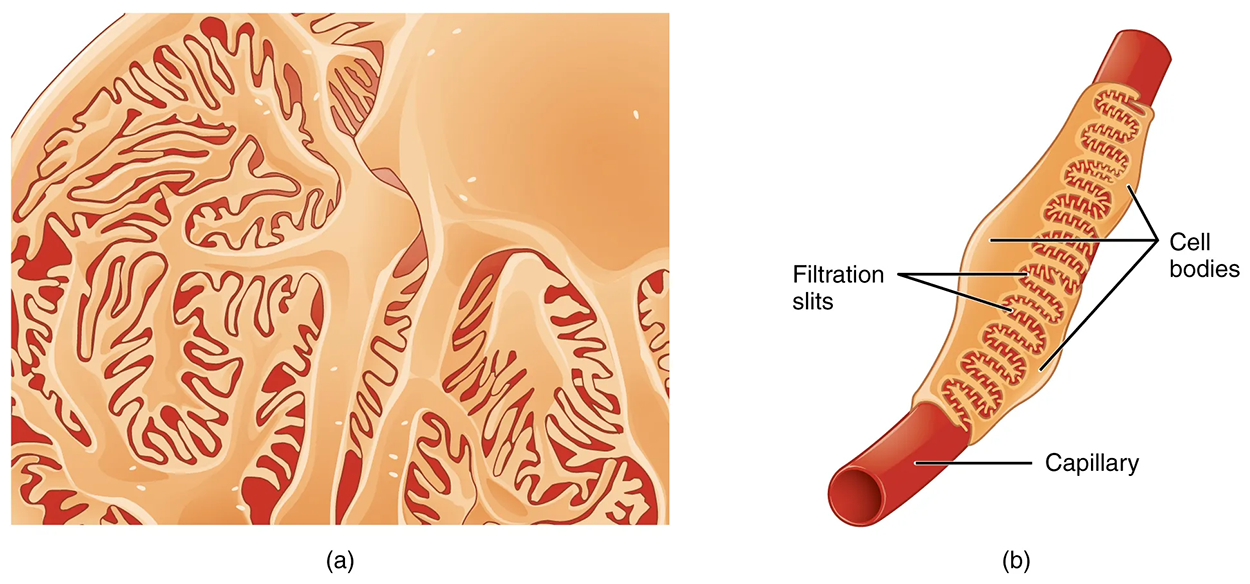
The left panel of this figure shows an image of a podocyte. The right panel shows a tube-like structure that illustrates the filtration slits and the cell bodies.
Podocytes - Podocytes interdigitate with structures called pedicels and filter substances in a way similar to fenestrations. In (a), the large cell body can be seen at the top right corner, with branches extending from the cell body. The smallest finger-like extensions are the pedicels. Pedicels on one podocyte always interdigitate with the pedicels of another podocyte. (b) This capillary has three podocytes wrapped around it.

As blood passes through the glomerulus, 10% to 20% of the plasma filters between these sieve-like fingers to be captured by Bowman’s capsule and funneled to the PCT. Where the fenestrae (windows) in the glomerular capillaries match the spaces between the podocyte “fingers,” the only thing separating the capillary lumen and the lumen of Bowman’s capsule is their shared basement membrane. These three features comprise what is known as the filtration membrane. This membrane permits very rapid movement of filtrate from capillary to capsule through pores that are only 70 nm in diameter.
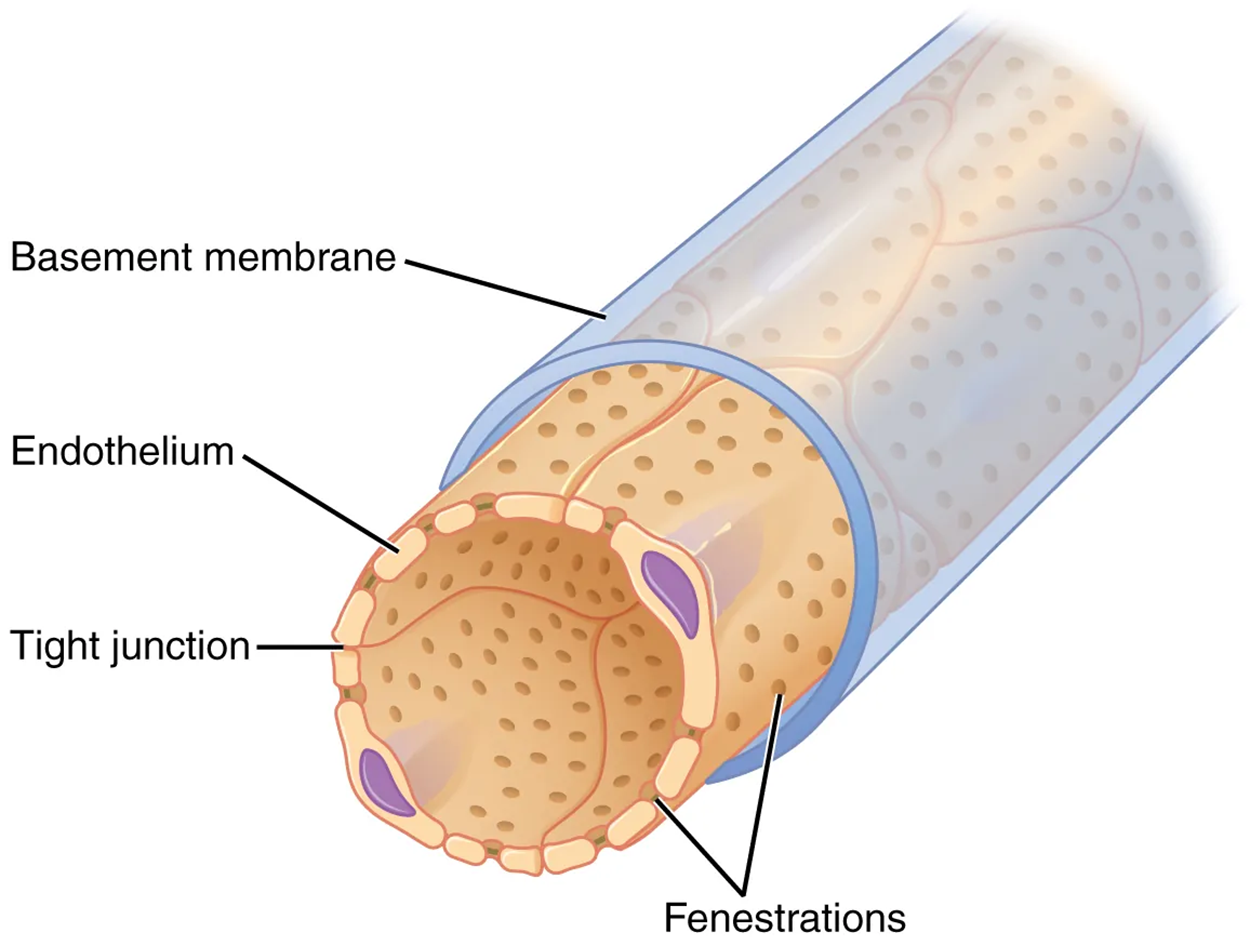
The top panel of this figure shows a tube-like structure with the basement membrane and other parts labeled.
Fenestrated Capillary - Fenestrations allow many substances to diffuse from the blood based primarily on size.

key concept
The fenestrations prevent filtration of blood cells or large proteins but allow most other constituents through. These substances cross readily if they are less than 4 nm in size and most pass freely up to 8 nm in size. An additional factor affecting the ability of substances to cross this barrier is their electric charge. The proteins associated with these pores are negatively charged, so they tend to repel negatively charged substances and allow positively charged substances to pass more readily.

The basement membrane prevents the filtration of medium-to-large proteins such as globulins. There are also mesangial cells in the filtration membrane that can contract to help regulate the rate of filtration of the glomerulus. Overall, filtration is regulated by fenestrations in capillary endothelial cells, podocytes with filtration slits, membrane charge, and the basement membrane between capillary cells. The result is the creation of a filtrate that does not contain cells or large proteins and has a slight predominance of positively charged substances.

Lying just outside Bowman’s capsule and the glomerulus is the juxtaglomerular apparatus (JGA). At the juncture where the afferent and efferent arterioles enter and leave Bowman’s capsule, the initial part of the distal convoluted tubule (DCT) comes into direct contact with the arterioles. The wall of the DCT at that point forms a part of the JGA known as the macula densa. This cluster of cuboidal epithelial cells monitors the composition of fluid flowing through the DCT. In response to the concentration of Na⁺ in the fluid flowing past them, these cells release paracrine signals. They also have a single, nonmotile cilium that responds to the rate of fluid movement in the tubule. The paracrine signals released in response to changes in flow rate and Na⁺ concentration are adenosine triphosphate (ATP) and adenosine.
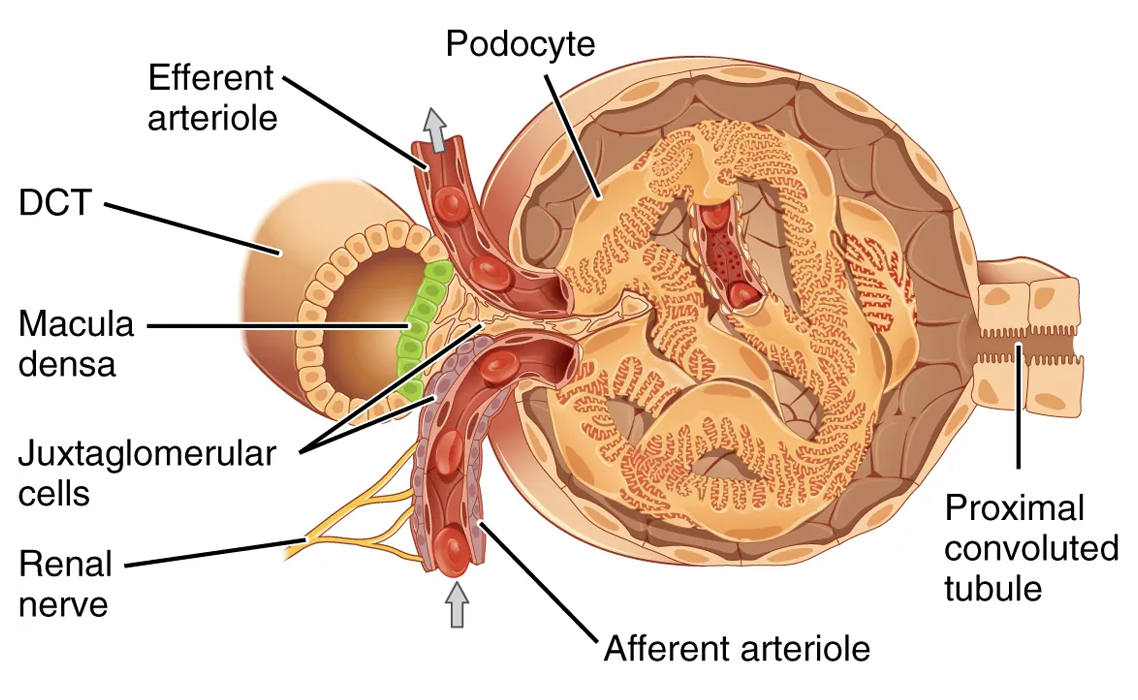

This image shows the cross section of the juxtaglomerular apparatus. The major parts are labeled.
Juxtaglomerular Apparatus (JGA) - The JGA allows specialized cells to monitor the composition of the fluid in the DCT and adjust the glomerular filtration rate.

A second cell type in this apparatus is the juxtaglomerular cell. This is a modified, smooth muscle cell lining the afferent arteriole that can contract or relax in response to ATP or adenosine released by the macula densa. Such contraction and relaxation regulate blood flow to the glomerulus.

key concept
Recall that osmolarity refers to solute concentration expressed as the number of solutes per liter of fluid. If the osmolarity of the filtrate is too high (hyperosmotic), the juxtaglomerular cells will contract, decreasing the glomerular filtration rate (GFR) so less plasma is filtered, leading to less urine formation and greater retention of fluid. This will ultimately decrease blood osmolarity toward the physiologic norm. If the osmolarity of the filtrate is too low, the juxtaglomerular cells will relax, increasing the GFR and enhancing the loss of water to the urine, causing blood osmolarity to rise. In other words, when blood osmolarity goes up, filtration and urine formation decrease, and water is retained. When blood osmolarity goes down, filtration and urine formation increase, and water is lost by way of the urine.

The net result of these opposing actions is to keep the rate of filtration relatively constant. A second function of the macula densa cells is to regulate renin release from the juxtaglomerular cells of the afferent arteriole. Active renin is a protein comprised of 304 amino acids that cleave several amino acids from angiotensinogen to produce angiotensin I. Angiotensin I is not biologically active until converted to angiotensin II by angiotensin-converting enzyme (ACE) from the lungs. Angiotensin II is a systemic vasoconstrictor that helps to regulate blood pressure by increasing it. Angiotensin II also stimulates the release of the steroid hormone aldosterone from the adrenal cortex. Aldosterone stimulates Na⁺ reabsorption by the kidney, which also results in water retention and increased blood pressure.
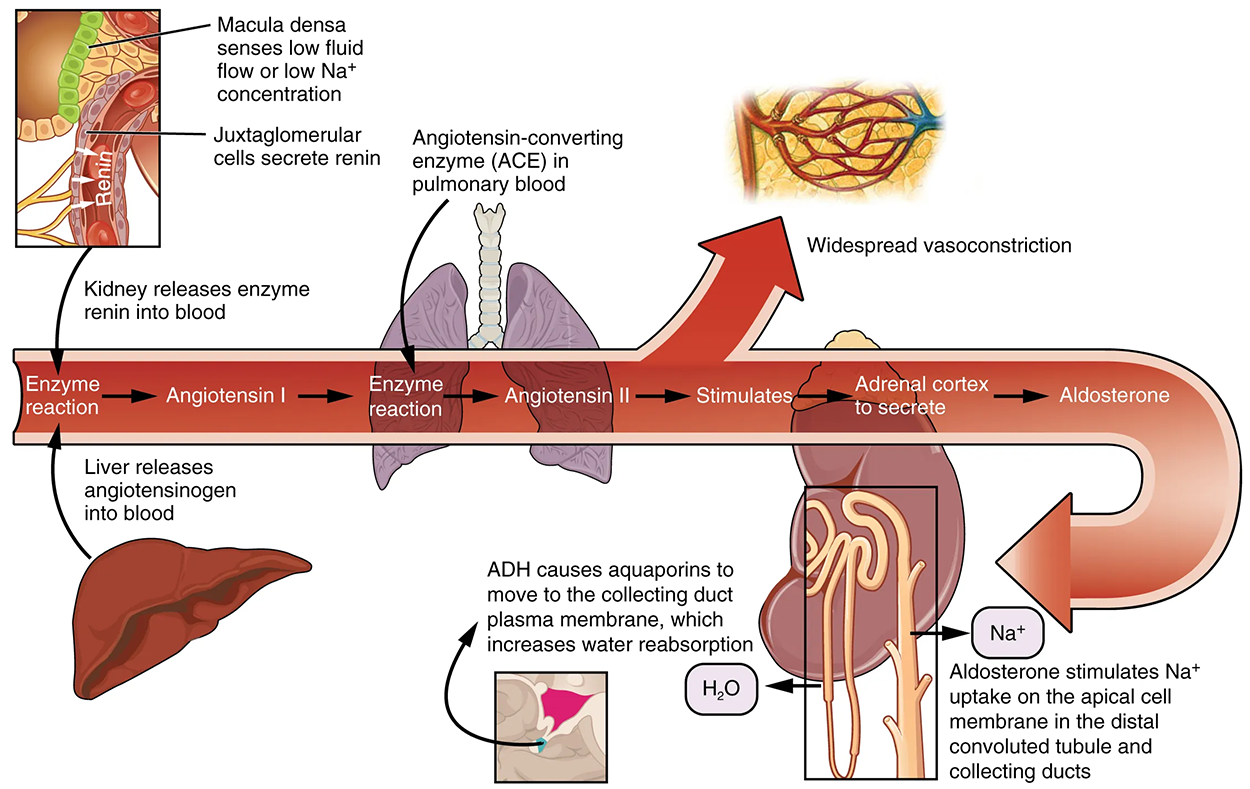
This diagram shows the pathway of action of the renin-aldosterone-angiotensin system. An arrow in the center of the image shows the sequence of events that take place, and branching off from this arrow are indications of where in the body these events take place.
Conversion of Angiotensin I to Angiotensin II - The enzyme renin converts the pro-enzyme angiotensin I; the lung-derived enzyme ACE converts angiotensin I into active angiotensin II.

1b. Proximal Convoluted Tubule (PCT)

Filtered fluid collected by Bowman’s capsule enters into the PCT. It is called convoluted due to its tortuous, or twisting, path. Simple cuboidal cells form this tubule with prominent microvilli on the luminal surface, forming a brush border. These microvilli create a large surface area to maximize the absorption and secretion of solutes (such as Na⁺, Cl⁻, and glucose) and water, the most essential function of this portion of the nephron. These cells actively transport ions across their basolateral membranes, so they possess a high concentration of mitochondria in order to produce sufficient ATP.

1c. Loop of Henle

The descending and ascending portions of the loop of Henle (sometimes referred to as the nephron loop) are just continuations of the same tubule. They run adjacent and parallel to each other after having made a hairpin turn at the deepest point of their descent. The descending loop of Henle consists of an initial short, thick portion and a long, thin portion, whereas the ascending loop consists of an initial short, thin portion followed by a long, thick portion. The descending thick portion consists of simple cuboidal epithelium similar to that of the PCT. The descending and ascending thin portions consist of simple squamous epithelium. As you will see later, these are important differences, since different portions of the loop have different permeabilities for solutes and water. The ascending thick portion consists of simple cuboidal epithelium similar to the DCT.

1d. Distal Convoluted Tubule (DCT)

The DCT, like the PCT, is very tortuous and formed by simple cuboidal epithelium, but it is shorter than the PCT. These cells are not as active as those in the PCT; thus, there are fewer microvilli on the apical surface and some reabsorption takes place here as well. However, these cells must also pump ions against their concentration gradient, so you will find large numbers of mitochondria, although fewer than in the PCT.

1e. Collecting Ducts

The collecting ducts are continuous with the nephron but not technically part of it. In fact, each duct collects filtrate from several nephrons for final modification. Collecting ducts merge as they descend deeper in the medulla to form about 30 terminal ducts, which empty at a papilla.

They are lined with simple squamous epithelium with receptors for antidiuretic hormone (ADH). When stimulated by ADH, these cells will insert aquaporin channel proteins into their membranes, which as their name suggests, allow water to pass from the duct lumen through the cells and into the interstitial spaces to be recovered by the vasa recta. This process allows for the recovery of large amounts of water from the filtrate back into the blood.

In the absence of ADH, these channels are not inserted, resulting in the excretion of water in the form of dilute urine. Most, if not all, cells of the body contain aquaporin molecules, whose channels are so small that only water can pass. At least 10 types of aquaporins are known in humans, and six of those are found in the kidney. The function of all aquaporins is to allow the movement of water across the lipid-rich, hydrophobic cell membrane.
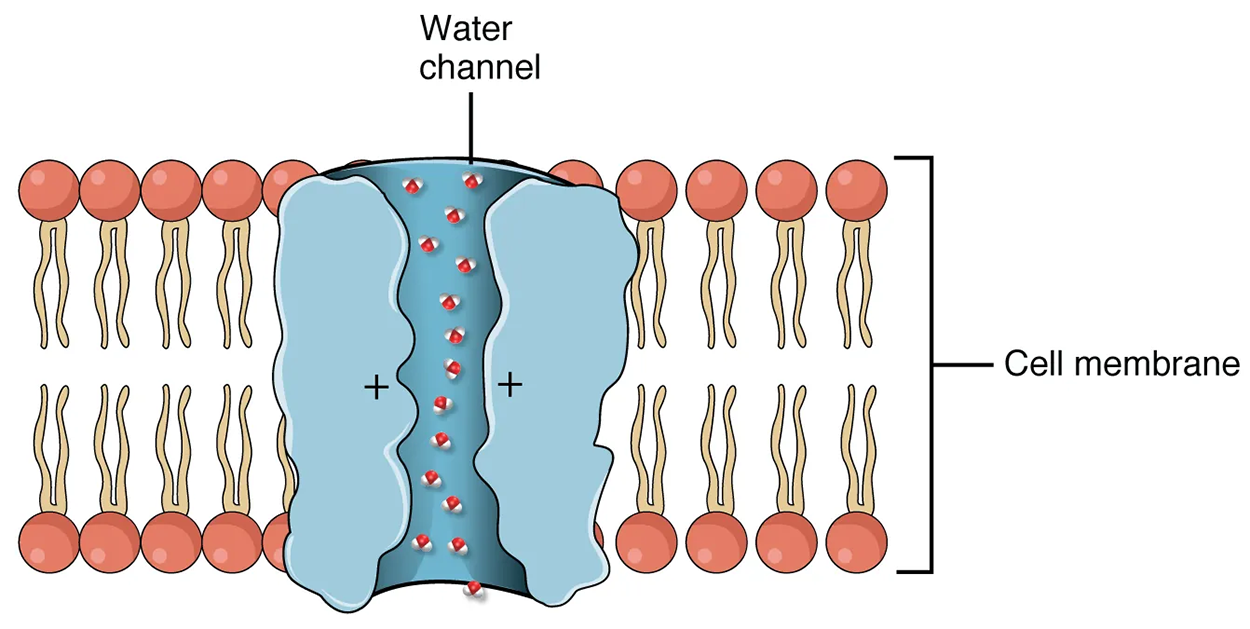
This figure shows an aquaporin water channel in the bilayer membrane with water molecules passing through.
Aquaporin Water Channel - Positive charges inside the channel prevent the leakage of electrolytes across the cell membrane, while allowing water to move due to osmosis.

Term Pronunciation Table

Term Pronunciation Audio File
Renin re·nin
Podocytes pod·o·cytes
Pedicels ped·i·cels
Mesangial mes·an·gi·al
Juxtaglomerular Apparatus jux·ta·glo·mer·u·lar ap·pa·ra·tus
Macula Densa mac·u·la den·sa
Angiotensinogen an·gio·ten·sin·o·gen
Angiotensin an·gio·ten·sin
Aquaporin aqua·por·in

terms to know
Renin
The enzyme produced by juxtaglomerular cells in response to decreased blood pressure or sympathetic nervous activity; catalyzes the conversion of angiotensinogen into angiotensin I.
Podocytes
Cells forming finger-like processes that form the visceral layer of Bowman’s capsule; pedicels of the podocytes interdigitate to form a filtration membrane.
Pedicels
Finger-like projections of podocytes surrounding glomerular capillaries that interdigitate to form a filtration membrane.
Filtration Slits
Formed by pedicels of podocytes; substances filter between the pedicels based on size.
Fenestrations
Small windows through a cell, allowing rapid filtration based on size; formed in such a way as to allow substances to cross through a cell without mixing with cell contents.
Mesangial
Contractile cells found in the glomerulus; can contract or relax to regulate filtration rate.
Juxtaglomerular Apparatus (JGA)
Located at the juncture of the DCT and the afferent and efferent arterioles of the glomerulus; plays a role in the regulation of renal blood flow and GFR.
Macula Densa
The cells found in the part of the DCT forming the JGA; they sense Na⁺ concentration in the forming urine.
Juxtaglomerular Cell
Modified smooth muscle cells of the afferent arteriole; secretes renin in response to a drop in blood pressure.
Angiotensinogen
An inactive protein in the circulation produced by the liver; precursor of angiotensin I; must be modified by the enzymes renin and ACE to be activated.
Angiotensin I
A protein produced by the enzymatic action of renin on angiotensinogen; inactive precursor of angiotensin II.
Angiotensin-Converting Enzyme (ACE)
The enzyme produced by the lungs that catalyzes the reaction of inactive angiotensin I into active angiotensin II.
Angiotensin II
The protein produced by the enzymatic action of ACE on inactive angiotensin I; actively causes vasoconstriction and stimulates aldosterone release by the adrenal cortex.
Aquaporin
Protein-forming water channels through the lipid bilayer of the cell; allows water to cross; activation in the collecting ducts is under the control of ADH.

summary
In this lesson, you learned about the anatomy of the kidney at the microscopic level, specifically the nephron. First, you reviewed that nephrons are the functional unit of the kidney. You then explored how the renal corpuscle includes the glomerulus and the surrounding Bowman’s (glomerular) capsule. You examined the proximal convoluted tubule (PCT), which is the region where solutes are primarily absorbed and secreted, and the loop of Henle and distal convoluted tubule (DCT), which are also responsible for absorption but have different water and solute permeabilities. Finally, you explored the collecting ducts, which are not technically part of the nephron but are continuous with and collect filtrate from the nephrons.

Source: THIS TUTORIAL HAS BEEN ADAPTED FROM OPENSTAX "ANATOMY AND PHYSIOLOGY 2E" ACCESS FOR FREE AT OPENSTAX.ORG/DETAILS/BOOKS/ANATOMY-AND-PHYSIOLOGY-2E. LICENSE: CREATIVE COMMONS ATTRIBUTION 4.0 INTERNATIONAL


Terms to Know
Angiotensin I

A protein produced by the enzymatic action of renin on angiotensinogen; inactive precursor of angiotensin II.

Angiotensin II

The protein produced by the enzymatic action of ACE on inactive angiotensin I; actively causes vasoconstriction and stimulates aldosterone release by the adrenal cortex.

Angiotensin-Converting Enzyme (ACE)

The enzyme produced by the lungs that catalyzes the reaction of inactive angiotensin I into active angiotensin II.

Angiotensinogen

An inactive protein in the circulation produced by the liver; precursor of angiotensin I; must be modified by the enzymes renin and ACE to be activated.

Aquaporin

Protein-forming water channels through the lipid bilayer of the cell; allows water to cross; activation in the collecting ducts is under the control of ADH.

Fenestrations

Small windows through a cell, allowing rapid filtration based on size; formed in such a way as to allow substances to cross through a cell without mixing with cell contents.

Filtration Slits

Formed by pedicels of podocytes; substances filter between the pedicels based on size.

Juxtaglomerular Apparatus (JGA)

Located at the juncture of the DCT and the afferent and efferent arterioles of the glomerulus; plays a role in the regulation of renal blood flow and GFR.

Juxtaglomerular Cell

Modified smooth muscle cells of the afferent arteriole; secretes renin in response to a drop in blood pressure.

Macula Densa

The cells found in the part of the DCT forming the JGA; they sense Na+
concentration in the forming urine.

Mesangial

Contractile cells found in the glomerulus; can contract or relax to regulate filtration rate.

Pedicels

Finger-like projections of podocytes surrounding glomerular capillaries that interdigitate to form a filtration membrane.

Podocytes

Cells forming finger-like processes that form the visceral layer of Bowman’s capsule; pedicels of the podocytes interdigitate to form a filtration membrane.

Renin

The enzyme produced by juxtaglomerular cells in response to decreased blood pressure or sympathetic nervous activity; catalyzes the conversion of angiotensinogen into angiotensin I.
