Use Sophia to knock out your gen-ed requirements quickly and affordably. Learn more
×

Membrane Potential

Author: Sophia

what's covered
In this lesson, you will learn how certain cells become electrically active and create membrane potentials. Specifically, this lesson will cover:

Table of Contents

1. Electrically Active Cell Membranes

Most cells in the body make use of charged particles, ions, to build up a charge across the cell membrane.

recall
This was shown to be a part of how muscle cells work.

For skeletal muscles to contract, based on excitation–contraction coupling, input from a neuron is required. Both of the cells make use of the cell membrane to regulate ion movement between the extracellular fluid and cytosol.

recall
The cell membrane is primarily responsible for regulating what can cross the membrane and what stays on only one side.

The cell membrane is a phospholipid bilayer, so only substances that can pass directly through the hydrophobic core can diffuse through unaided. Charged particles, which are hydrophilic by definition, cannot pass through the cell membrane without assistance. Transmembrane proteins, specifically channel proteins, make this possible. Several passive transport channels, as well as active transport pumps, are necessary to generate a transmembrane potential and an electrochemical signal. Of special interest is the carrier protein referred to as the sodium-potassium pump that moves sodium ions (Na⁺) out of a cell and potassium ions (K⁺) into a cell, thus regulating ion concentration on both sides of the cell membrane.
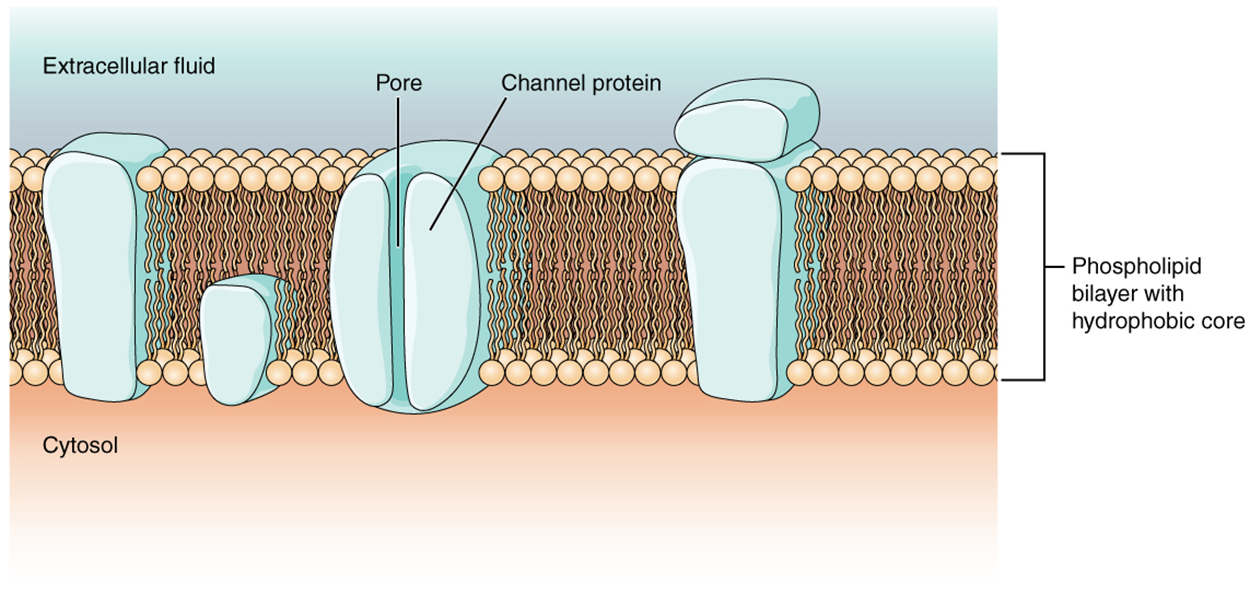
This diagram shows a cross-section of a cell membrane. The cell membrane proteins are large, blocky objects. Peripheral proteins are not embedded in the phospholipid bilayer. The peripheral protein shown here is attached to the outside surface of another protein on the extracellular fluid side. Integral proteins are embedded between the phospholipids of the cell membrane. The transmembrane integral protein extends through both phospholipids layers. The opposite ends of this protein project into the cytosol and the extracellular fluid. A second, smaller integral protein only extends into the inner phospholipid layer. Its opposite end projects into the cytosol. This second protein is, therefore, not a transmembrane protein. The channel protein is cylinder shaped with a hollow internal tube labeled the pore. The sides of the channel protein can bulge inward to close the pore.
Cell Membrane and Transmembrane Proteins - The cell membrane is composed of a phospholipid bilayer and has many transmembrane proteins, including different types of channel proteins that serve as ion channels.

key concept
The sodium-potassium pump requires energy in the form of adenosine triphosphate (ATP). On either side of a resting neuron, the concentration of Na⁺ is higher outside the cell than inside, and the concentration of K⁺ is higher inside the cell than outside. That means that this pump is moving the ions against the concentration gradients for sodium and potassium, which is why it requires energy. In fact, the pump basically maintains those concentration gradients.

Ion channels are pores that allow specific charged particles to cross the membrane in response to an existing concentration gradient. Each ion channel is a protein formed by a unique sequence of amino acids. The amino acids that are present along the pore and the size of the pore will determine the type of ion that channel allows through. Channels for cations (positive ions) will have negatively charged side chains in the pore. Channels for anions (negative ions) will have positively charged side chains in the pore. Smaller pores cannot allow larger ions through while larger pores do not allow smaller ions (associated with water) through. Some ion channels are selective for charge but not necessarily for size, and thus are called a nonspecific ion channel.

Ion channels do not always freely allow ions to diffuse across the membrane. Some are opened by certain events, meaning the channels are gated. So another way that channels can be categorized is on the basis of how they are gated. Although these classes of ion channels are found primarily in the cells of nervous or muscular tissue, they also can be found in the cells of epithelial and connective tissues.

A ligand-gated channel, also known as a chemically-gated channel, opens because a signaling molecule, a ligand (chemical), binds to the extracellular region of the channel.
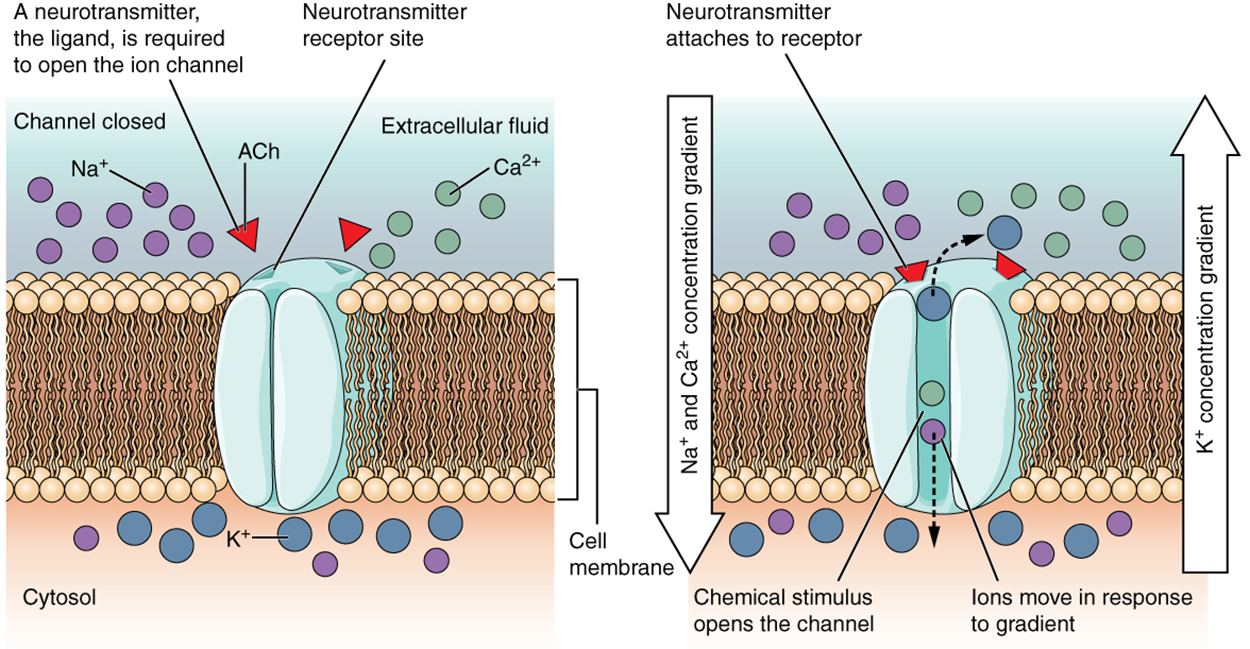
These two diagrams each show a channel protein embedded in the cell membrane. In the left diagram, there is a large number of sodium ions (NA plus) and calcium ions (CA two plus) in the extracellular fluid. Within the cytosol, there is a large number of potassium ions (K plus) but only a few sodium ions. In this diagram, the channel is closed. Two ACH molecules are floating in the extracellular fluid. Their label indicates that a neurotransmitter, a ligand, is required to open the ion channel. The neurotransmitter receptor site on the extracellular fluid side of the channel protein matches the shape of the ACH molecules. In the right diagram, the two ACH molecules attach to the neurotransmitter receptor sites on the channel protein. This opens the channel and the sodium and calcium ions diffuse through the channel and into the cytosol, down their concentration gradient. The potassium ions also diffuse through the channel in the opposite direction down their concentration gradient (out of the cell and into the extracellular fluid).
Ligand-Gated Channels - When the ligand, in this case the neurotransmitter acetylcholine, binds to a specific location on the extracellular surface of the channel protein, the pore opens to allow select ions through. The ions, in this case, are cations of sodium, calcium, and potassium.

A mechanically gated channel opens because of a physical distortion of the cell membrane. Many channels associated with the sense of touch are mechanically gated. For example, as pressure is applied to the skin, these channels open and allow ions to enter the cell.
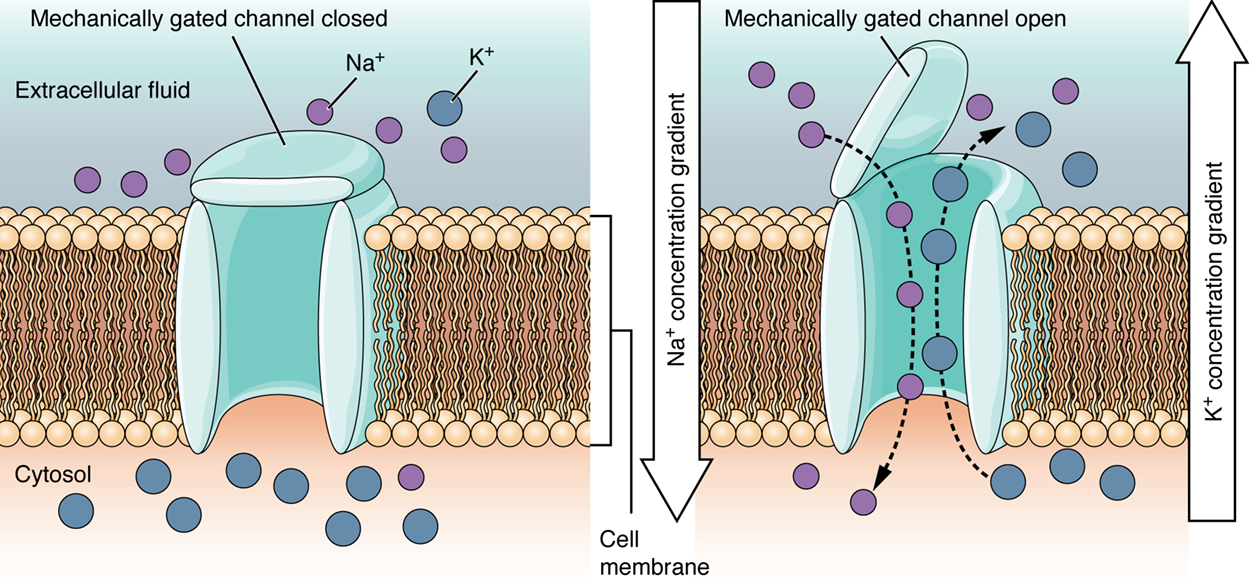
These two diagrams each show a channel protein embedded in the cell membrane. In the left diagram, there are a large number of sodium ions in the extracellular fluid, but only a few sodium ions in the cytosol. There is a large number of calcium ions in the cytosol but only a few calcium ions in the extracellular fluid. In this diagram, the channel is closed, as the extracellular side has a lid, somewhat resembling that on a trash can, that is closed over the channel opening. In the right diagram, the mechanically gated channel is open. This allows the sodium ions to flow from the extracellular fluid into the cell, down their concentration gradient. At the same time, the calcium ions are moving from the cytosol into the extracellular fluid, down their concentration gradient.
Mechanically Gated Channels - When a mechanical change occurs in the surrounding tissue, such as pressure or touch, the channel is physically opened. Thermoreceptors work on a similar principle. When the local tissue temperature changes, the protein reacts by physically opening the channel.

A voltage-gated channel is a channel that responds to changes in the electrical properties of the membrane in which it is embedded. Normally, the inner portion of the membrane is at a negative voltage. When that voltage becomes less negative, the channel begins to allow ions to cross the membrane.
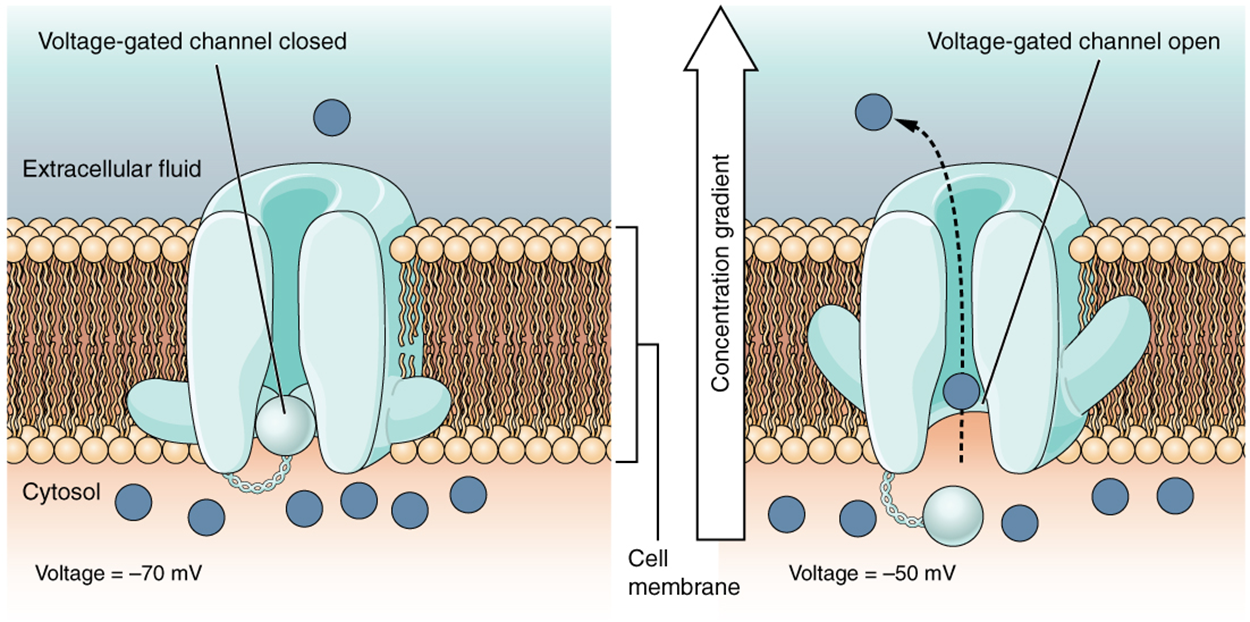
This is a two-part diagram. Both diagrams show a voltage-gated channel embedded in the lipid membrane bilayer. The channel contains a sphere-shaped gate that is attached to a filament. In the first diagram, there are several ions in the cytosol but only one ion in the extracellular fluid. The voltage across the membrane is currently minus seventy millivolts and the voltage-gated channel is closed. In the second diagram, the voltage in the cytosol is minus fifty millivolts. This voltage change has caused the voltage-gated channel to open, as the small sphere is no longer occluding the channel. One of the ions is moving through the channel, down its concentration gradient, and out into the extracellular fluid.
Voltage-Gated Channels - Voltage-gated channels open when the transmembrane voltage changes around them. Amino acids in the structure of the protein are sensitive to charge and cause the pore to open to the selected ion.

A leakage channel is randomly gated, meaning that it opens and closes at random, hence the reference to leaking. There is no actual event that opens the channel; instead, it has an intrinsic rate of switching between the open and closed states.
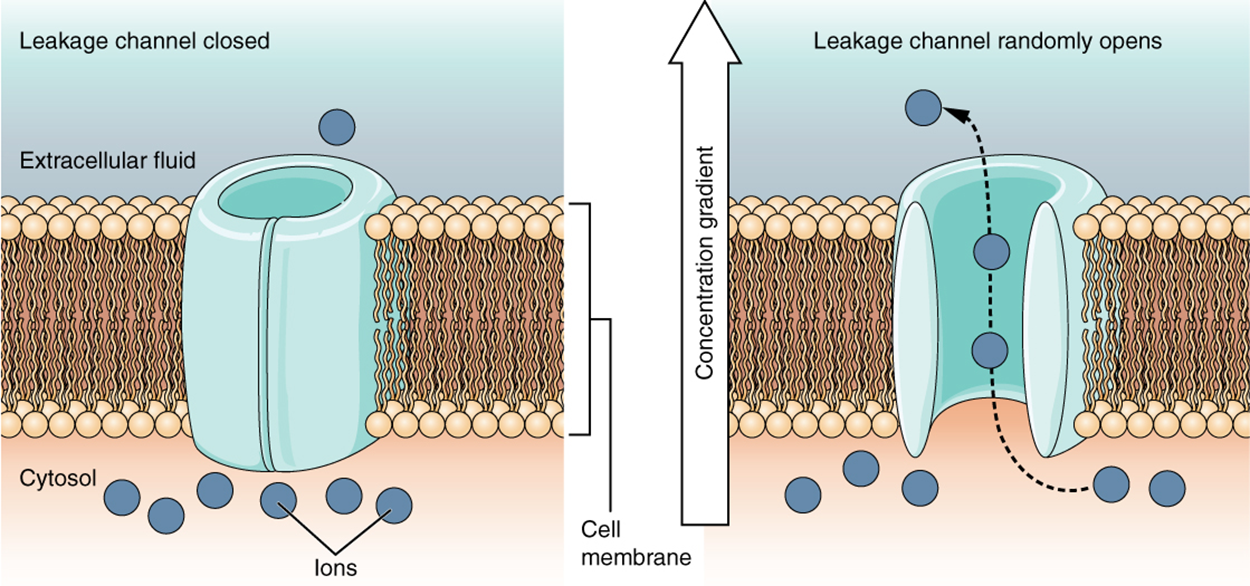
This is a two-part diagram. Both diagrams show a leakage channel embedded in the lipid membrane bilayer. The leakage channel is cylindrical with a large, central opening. In the first diagram, there are several ions in the cytosol but only one ion in the extracellular fluid. No ions are moving through the leakage channel because the channel is closed. In the second diagram, the leakage channel randomly opens, allowing two ions to travel through the channel, down their concentration gradient, and out into the extracellular fluid.
Leakage Channels - In certain situations, ions need to move across the membrane randomly. The particular electrical properties of certain cells are modified by the presence of this type of channel.

terms to know
Nonspecific Ion Channel
An ion channel that is specific to charge but not size.
Ligand-Gated Channel
A membrane channel that opens once a specific signaling molecule binds to it.
Mechanically-Gated Channel
A membrane channel that opens because of physical distortion of the cell membrane.
Voltage-Gated Channel
A membrane channel that responds to changes in the electrical properties of the membrane.
Leakage Channel
A membrane channel that is randomly gated, opening and closing randomly.

2. The Membrane Potential

The electrical state of the cell membrane can have several variations. These are all variations in the membrane potential. Recall that a membrane potential is a difference in electrical charge across a cell membrane. This charge is based on a differential distribution of charge across the cell membrane, measured in millivolts (mV). The standard is to compare the inside of the cell relative to the outside, so the membrane potential is a value representing the charge on the intracellular side of the membrane based on the outside being zero, relatively speaking. As shown in the image below, there is an overall positive charge on the outside of the cell membrane and an overall negative charge on the inside. Therefore, the membrane potential (inside relative to outside) is negative. If the indicated charges were swapped (outside was negative and inside was positive), then the membrane potential would be positive.
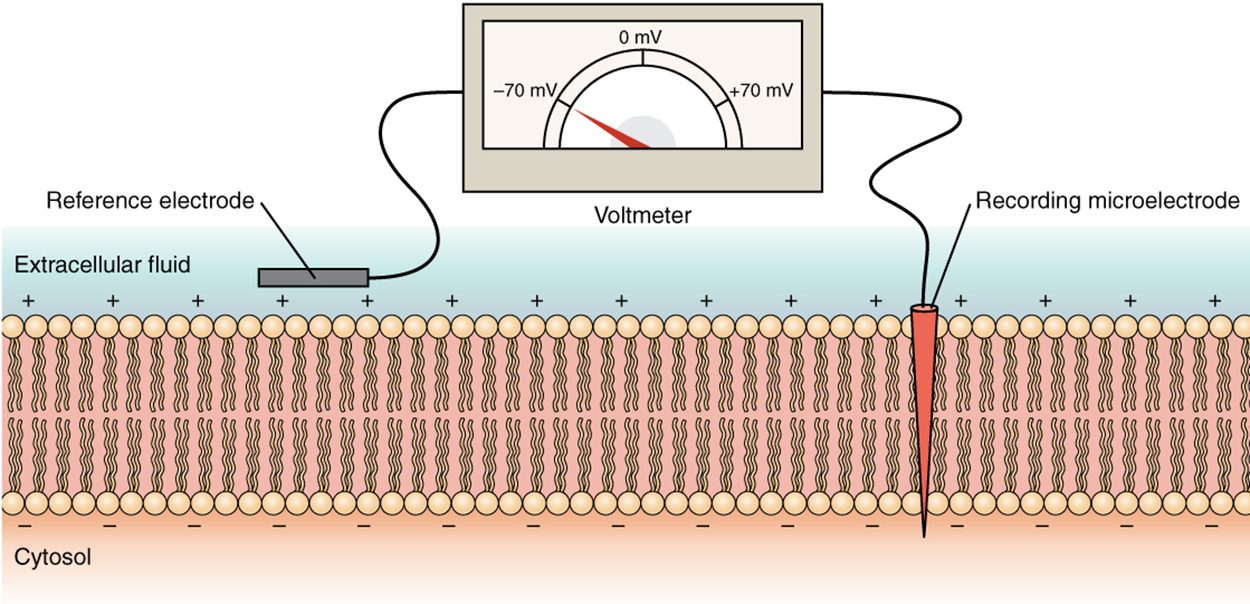
This diagram shows a cross-section of a cell membrane. The extracellular fluid side of the cell membrane is positively charged while the cytosol side of the membrane is negatively charged. There is a microelectrode embedded in the cell membrane. The microelectrode is attached to a voltmeter, which also has a reference electrode on the extracellular fluid side. The readout of the voltmeter is negative 70 millivolts.
Measuring Charge across a Membrane with a Voltmeter - A recording electrode is inserted into the cell and a reference electrode is outside the cell. By comparing the charge measured by these two electrodes, the transmembrane voltage is determined. It is conventional to express that value for the cytosol relative to the outside.

The concentration of ions in extracellular and intracellular fluids is largely balanced, with a net neutral charge. However, a slight difference in charge occurs right at the membrane surface, both internally and externally. It is the difference in this very limited region that has all the power in neurons (and muscle cells) to generate electrical signals.

watch
View the following video for more information on this topic.


key concept
Before electrical signals can be generated and propagated, the cell must first find itself at rest. When the cell is at rest and the ion channels are closed (except for leakage channels which randomly open), ions are distributed across the membrane in a very predictable way.

  • The concentration of Na⁺ outside the cell is greater than the concentration inside.
  • The concentration of K⁺ inside the cell is greater than outside.
  • The cytosol contains a high concentration of anions (negative ions), in the form of phosphate ions and negatively charged proteins.
With the ions distributed across the membrane at these concentrations, the difference in charge during steady-state conditions is described as the resting membrane potential. The exact value measured for the resting membrane potential varies between cells, -70 mV is the most commonly used value for neurons (skeletal muscle cells are -85 mV).

hint
Here’s one way to remember which ion—sodium (Na⁺) or potassium (K⁺) is found in greater concentration inside or outside the cell membrane at rest. When people come knocking on the door, most people are more likely to allow their kin (relatives) in and keep strangers out.

  • Potassium comes knocking, should you let them in? Okay (K, potassium)
    • Potassium’s chemical symbol is the letter K (i.e., okay).
    • Kin, come in (K In, potassium in)
  • Sodium comes knocking, should you let them in? Nah! (Na, sodium)
    • Sodium’s chemical symbol is the letters Na (i.e., nah!)

term to know
Resting Membrane Potential
The difference in charge across a cell membrane during steady state conditions.

summary
In this lesson, you learned about the components of electrically active cell membranes. You then learned how these electrically active cells generate a membrane potential.

Source: THIS TUTORIAL HAS BEEN ADAPTED FROM OPENSTAX “ANATOMY AND PHYSIOLOGY 2E.” ACCESS FOR FREE AT HTTPS://OPENSTAX.ORG/DETAILS/BOOKS/ANATOMY-AND-PHYSIOLOGY-2E. LICENSE: CC ATTRIBUTION 4.0 INTERNATIONAL.


Terms to Know
Leakage Channel

A membrane channel that is randomly gated, opening and closing randomly.

Ligand-Gated Channel

A membrane channel that opens once a specific signaling molecule binds to it.

Mechanically-Gated Channel

A membrane channel that opens because of physical distortion of the cell membrane.

Nonspecific Ion Channel

An ion channel that is specific to charge but not size.

Resting Membrane Potential

The difference in charge across a cell membrane during steady state conditions.

Voltage-Gated Channel

A membrane channel that responds to changes in the electrical properties of the membrane.
