Table of Contents |
According to the American Marketing Association (AMA), marketing research “is the function that links the consumer, customer, and public to the marketer through information.” Marketing research presents information gained through various sources as a resource for managers to make data-driven business decisions. Additionally, the AMA states that “marketing research specifies the information required to address these issues, designs the method for collecting information, manages and implements the data collection process, analyzes the results, and communicates the findings and their implications.”
Marketing information is essential for a company or organization to stay competitive and also meet the customer’s needs. For example, LEGO used marketing research to gather information not only about how children use its product but also about how parents felt about opportunities for their children. Universities and colleges use information gathered through marketing research to build next year’s recruitment materials by asking students their perceptions of the previous year’s items. Additionally, a fast-food restaurant might conduct an analysis of the time of day each of its items are more likely to be purchased. Obvious to most, coffee would probably be an item more likely ordered earlier in the day. Other items might not be as evident but could require different preparation times. By accounting for when each of these items is most likely to be ordered, the restaurant can plan its inventory and schedule of employees more efficiently.
There are seven steps to marketing research: define the problem, develop the research plan, select the data collection method, design the sample, collect the data, analyze and interpret the data, and prepare the research report.
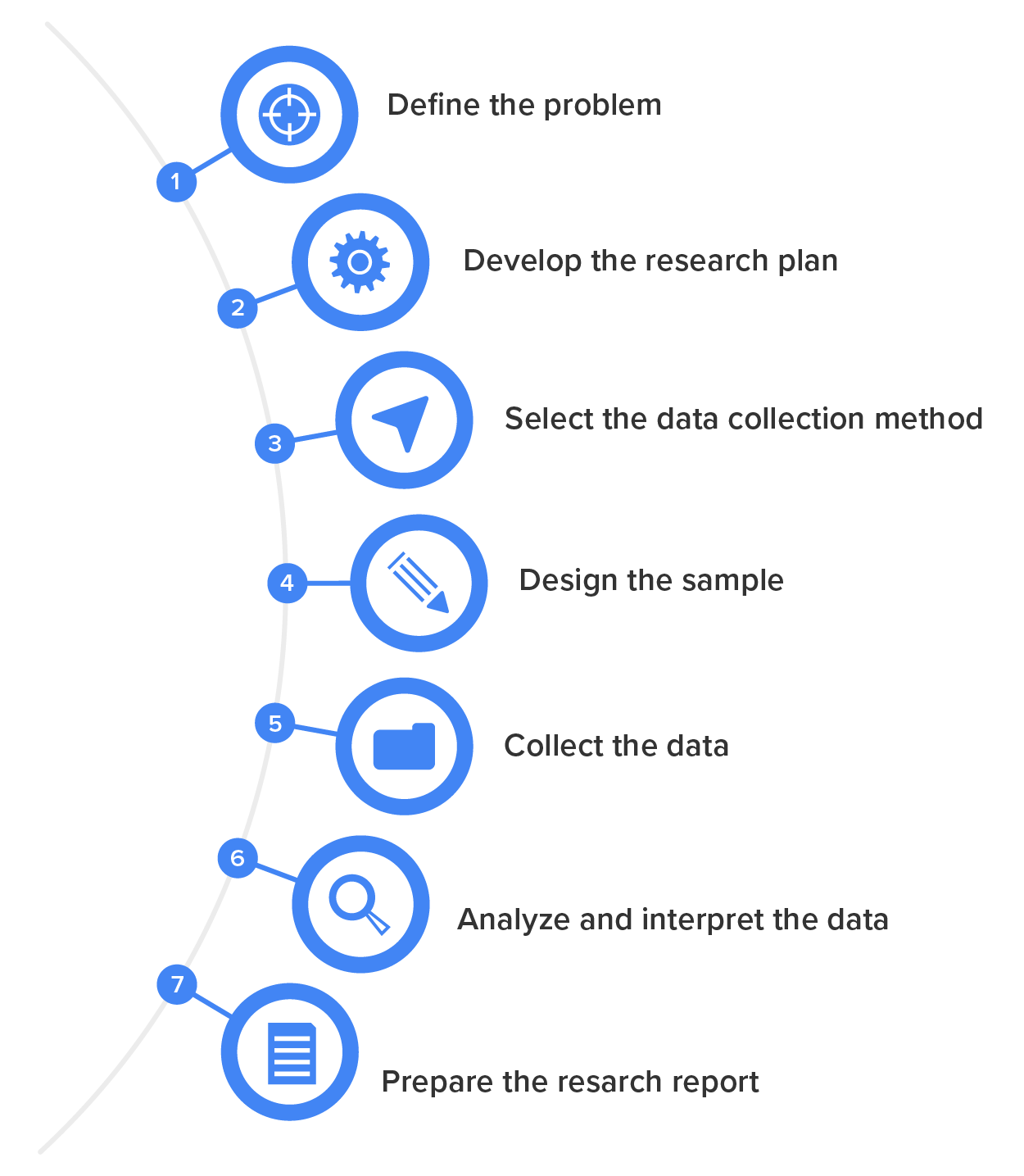
The first step, defining the problem, is often a realization that more information is needed in order to make a data-driven decision. Problem definition is the realization that there is an issue that needs to be addressed. An entrepreneur may be interested in opening a small business but must first define the problem that is to be investigated. A marketing research problem in this example is to discover the needs of the community and also identify a potentially successful business venture.
IN CONTEXT
Many times, researchers define a research question or objectives in this first step. Objectives of this research study could include: Identify a new business that would be successful in the community in question, determine the size and composition of a target market for the business venture, and collect any relevant primary and secondary data that would support such a venture. At this point, the definition of the problem may be, “Why are cat owners not buying our new cat toy subscription service?” Additionally, during this first step we would want to investigate our target population for research. This is similar to a target market, as it is the group that comprises the population of interest for the study. In order to have a successful research outcome, the researcher should start with an understanding of the problem in the current situational environment.
Step 2 is to develop the research plan. What type of research is necessary to meet the established objectives of the first step? How will this data be collected? Additionally, what is the time frame of the research and budget to consider? If you must have information in the next week, a different plan would be implemented than in a situation where several months were allowed. These are issues that a researcher should address in order to meet the needs identified.
Research is often classified as coming from one of two types of data: primary and secondary. Primary data is unique information that is collected by the specific researcher with the current project in mind. This type of research doesn’t currently exist until it is pulled together for the project.
Examples of primary data collection include:
Secondary data comes in many forms and includes:
Data collection is the systematic gathering of information that addresses the identified problem. What is the best method to do that? Picking the right method of collecting data requires that the researcher understand the target population and the design picked in the previous step.
Although you might want to include every possible person who matches your target market in your research, it’s often not a feasible option, nor is it of value. If you did decide to include everyone, you would be completing a census of the population. Getting everyone to participate would be time-consuming and highly expensive, so instead, marketers use a sample, whereby a portion of the whole is included in the research. It’s similar to the samples you might receive at the grocery store or ice cream shop; it isn’t a full serving, but it does give you a good taste of what the whole would be like.
Researchers identify parameters for their studies, called sample frames. A sample frame for one study may be college students who live on campus; for another study, it may be retired people in Dallas, Texas, or small-business owners who have fewer than 10 employees. The individual entities within the sampling frame would be considered a sampling unit. A sampling unit is each individual respondent that would be considered as matching the sample frame established by the research. If a researcher wants businesses to participate in a study, then businesses would be the sampling unit in that case. The number of sampling units included in the research is the sample size. Many calculations can be conducted to indicate what the correct size of the sample should be. Issues to consider are the size of the population, the confidence level that the data represents the entire population, the ease of accessing the units in the frame, and the budget allocated for the research.
Once all the plans have been established, the list of questions or information needs should be created, and the group of participants identified. Then it is time to start collecting data. Data collection is the process of gathering information from a variety of sources that will satisfy the research objectives defined in Step 1. Data collection can be as simple as sending out an email with a survey link enclosed or as complex as an experiment with hundreds of consumers. The method of collection directly influences the length of this process. Conducting personal interviews or completing an experiment, as previously mentioned, can add weeks or months to the research process, whereas sending out an electronic survey may allow a researcher to collect the necessary data in a few days.
Once the data has been collected, the process of analyzing it may begin. Data analysis is the distillation of the information into a more understandable and actionable format. The analysis itself can take many forms, from the use of basic statistics to a more comprehensive data visualization process. First, let’s discuss some basic statistics that can be used to represent data. The first is the mean of quantitative data. A mean is often defined as the arithmetic average of values. Understanding the mean can help to determine, with one number, the weight of a particular value. Another commonly used statistic is median. The median is often referred to as the middle number. To generate a median, all the numeric answers are placed in order, and the middle number is the median. Median is a common statistic when identifying the income level of a specific geographic region. Mode is another statistic that is used to represent data of all types, as it can be used with quantitative or qualitative data and represents the most frequent answer. Additionally, researchers use other analyses to represent the data rather than to present the entirety of each response.
The marketing research process concludes by sharing the generated data and makes recommendations for future actions. What starts as simple data must be interpreted into an analysis. All information gathered should be conveyed in order to make decisions for future marketing actions. One item that is often part of the final step is to discuss areas that may have been missed with the current project or any area of further study identified while completing it.
Source: THIS TUTORIAL HAS BEEN ADAPTED FROM OPEN STAX’S PRINCIPLES OF MARKETING COURSE. ACCESS FOR FREE AT https://openstax.org/details/books/principles-marketing. LICENSE: CREATIVE COMMONS ATTRIBUTION 4.0 INTERNATIONAL.



