Table of Contents |
Let’s examine how the firm in a perfectly competitive market interacts with the market in the short run. We will first examine the relationship of the firm to the market, and then review the profitability status of the firm in the short run, before examining the long run outcomes.
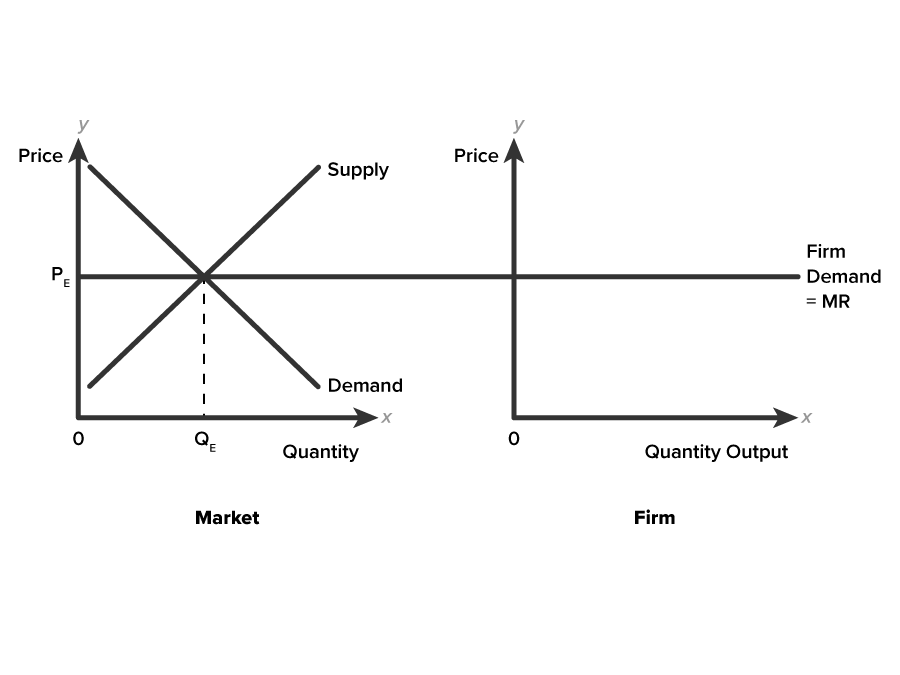
In a perfectly competitive market, a firm is known as a price taker with a horizontal demand curve at the market-determined price. Market demand refers to the total amount of some good or service that all consumers are willing and able to purchase at each price. Market supply refers to the total amount of some good or service that all firms are willing and able to offer for sale at each price.
Equilibrium in the market occurs where the market supply and market demand curves intersect. At this market-determined price, the market clears. There is neither surplus nor shortage of the product.
In the diagram below, the graph on the left represents the market, and the graph on the right represents an individual firm. All firms in a perfectly competitive market look the same with a horizontal demand curve. The market sets the price ( ). The firm is able to sell all it wants at the market price. The firm’s demand curve is horizontal at the equilibrium price. Demand for its product is perfectly elastic. Since the firm sells every unit for the same price, marginal revenue–the added revenue for an added unit sold–is the same as the price (P = MR).
If a perfectly competitive firm is restricted to charging only the market price, is it even possible to make a profit?
In the short run, the perfectly competitive firm will seek the quantity of output where profits are highest or, if profits are not possible, where losses are lowest. Margins tell the firm what to do. And the best any firm can do is to follow the profit-maximizing rule, equating MR = MC to determine price and quantity output.
When the perfectly competitive firm chooses the quantity to produce, then this quantity of output—along with the market price for output—will determine the firm’s total revenue, total costs, and ultimately the level of profit.
Suppose that Lilac Express, a small laundry cleaning company, operates in the perfectly competitive uniform cleaning service industry. To determine profitability the firm requires two pieces of information: selling price per unit and average costs per unit. The market price for cleaning uniform shirts is $5 per unit, and the average per unit cost is $5.
Let’s examine a scenario of perfect competition. The graph below illustrates Lilac Express’s current situation. The market price is $5 per unit. The firm’s marginal revenue curve (MR) is horizontal at $5 per unit. To profit-maximize, the firm will, first, locate where MR crosses MC. The firm is using marginal cost pricing (P = MC) for its product. In the graph, follow the dashed line down from where MR = MC to the horizontal axis, the quantity of output. The profit-maximizing quantity of output for the firm is 500 units.
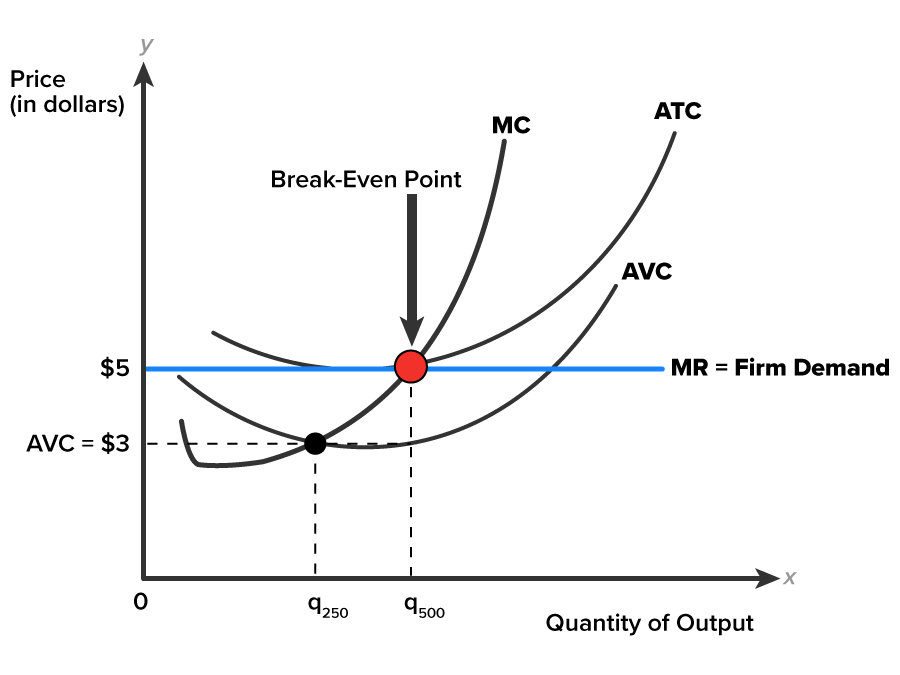
Averages will now tell the firm how well it’s doing in the short run. The firm’s average total cost (ATC) curve is tangent at the MR = MC point in the graph. The firm breaks even. The firm produces 500 units of output, and receives $5 per unit of revenue, and the average total curve is also tangent to the MR = MC point. Cost per unit is also $5 per unit. Profit per unit is equal to P - ATC = $5 - $5 = $0. With a market price of $5 per unit, the average total cost, which includes both average fixed and average variable costs for the 500 units of output, is fully covered.
The firm is earning normal profit. As you have learned, normal profit is the compensation for taking an investment risk, which is equal to the opportunity cost of the entrepreneur’s next-best employment option. Normal profit implies that a fair rate of return on the investment in the business, an implicit cost, has been achieved. Recall that economic profit is total revenue (TR) minus total cost (TC), where implicit and explicit cost and revenue are all included. At the break-even point, the firm is earning normal profit or zero economic profit, which means nothing more than a fair return on investment.
Will firms in a perfectly competitive market ever do better or worse than normal profit? Changes in the non-price factors of demand and supply are disturbances to a market in equilibrium. If a non-price factor of demand changes and causes the curve to shift, then the product price will adjust upward or downward in response. This will affect a firm’s short-run profitability.
Suppose that shoppers go on a uniform shirt buying frenzy—preferences change favorably for uniform shirts. All those uniform shirts will need to be cleaned. This change in consumer preference will shift the market demand curve rightward in the graph from equilibrium Point 1 (indicated by the 1 where the demand curve intersects the supply) to a new equilibrium Point 2 (indicated by the 2 where the new demand curve ( ) intersects the supply curve). The increase in demand has raised the equilibrium price from to a higher
  . Since the firm is a price taker, the firm’s horizontal demand curve and its marginal revenue per unit also increases to
  in the diagram.
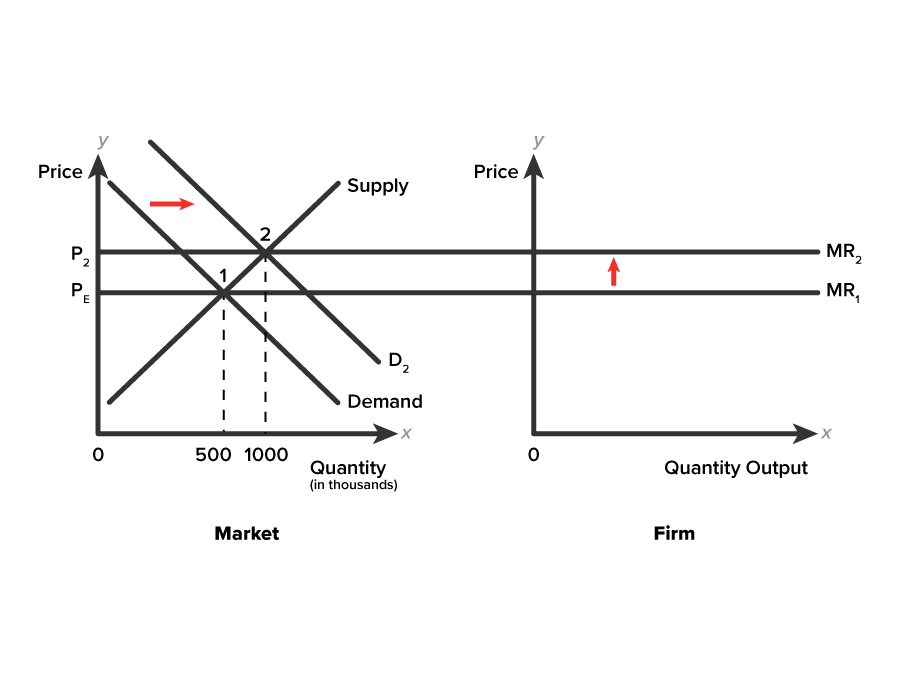
When market demand increases, the price rises and shifts the firm’s demand—it’s marginal revenue curve up. The firm may now have an opportunity to earn more than normal profit. To determine if this is the case, the firm will again profit-maximize or loss-minimize by equating MR = MC and producing the associated level of output.
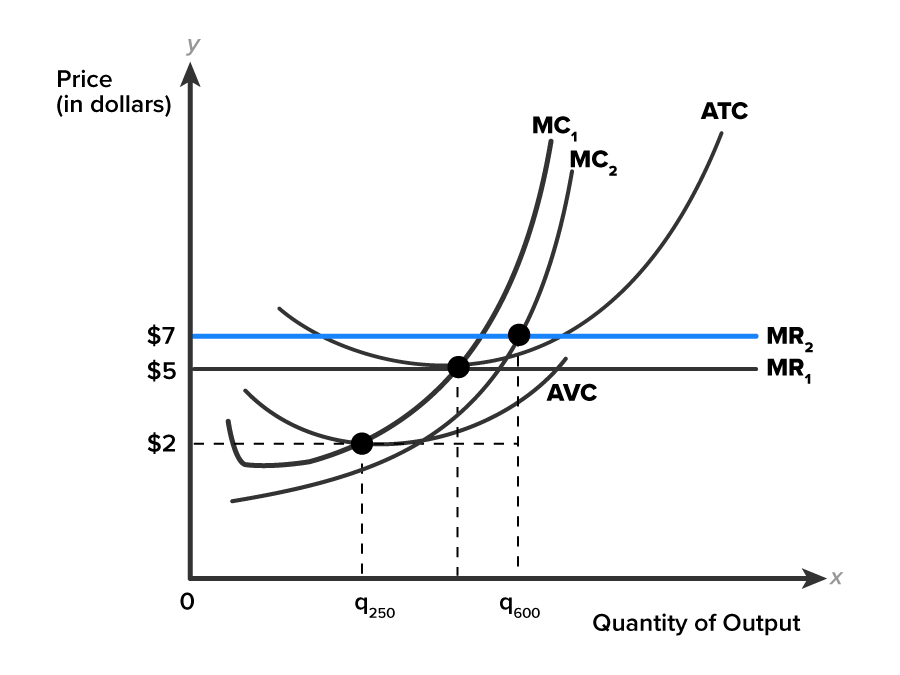
In the graph below, the profit-maximizing level of output is now 600 units with the higher price of $7 per unit.
Follow the dashed line down from where crosses  to the horizontal axis of quantity of output. At a higher selling price, the firm increases its output from 500 to 600 units. The firm is acting predictably according to the law of supply. The price of $7 per unit is greater than the ATC of $6 per unit, as shown in the graph for the 600 units. The area in the graph between a price of $7 and an ATC of $6, times 600 units, indicates the size of the profit. When
  , then the firm is earning more than normal profit. It is earning positive economic profit, and the return on investment is greater than its implicit costs. Positive economic profit is profit that exceeds normal profit. With a market price of $7 per unit, the average per unit cost for 600 units of output is more than the fixed and variable costs.
In a perfectly competitive market, every firm's demand curve looks the same, as they are selling an identical product at the same market-determined price. Suppose that market demand is 500,000 cleaned uniform shirts per month, and every firm sells 500 units each month. Do we know how many individual firms are in this market? Yes. You can determine the number of individual firms in the market by dividing the quantity of market demand by the quantity produced by the firm: 500,000 / 500 = 1000 individual firms.
When market price increases, individual firms earn positive economic profit, and more firms will seek to enter this market. Why? Because the rate of return on investment in this market exceeds other investment opportunities. Entry and exit from a perfectly competitive market is costless. When the economic profits shrink due to the entry of new firms, so will the number of firms in the market. This adjustment in the number of firms in response to short-run profits will lead to all remaining firms earning zero economic profit in the long run.
Suppose instead, the desire to wear uniform shirts fades. Market demand would decrease, shifting the demand curve leftward. With a decrease in demand market price will fall.
Since the firm is a price taker, its marginal revenue (MR) per unit also decreases. To evaluate how the firm’s short-run profitability has been affected, locate where MR crosses MC in the graph. MR = MC at $4 per unit. Now follow the dashed line down to the horizontal axis quantity output. The firm will produce the profit-maximizing level of output of 400 units. The price for 400 units of quantity is $4 per unit, but the ATC curve is above the MR line. The yellow rectangle in the graph identifies where each firm produces 400 units, receives $4 per unit, and experiences average cost per unit of $5. Clearly,  and the firm is experiencing economic losses. An economic loss occurs when the selling price is less than the average total cost of the product.
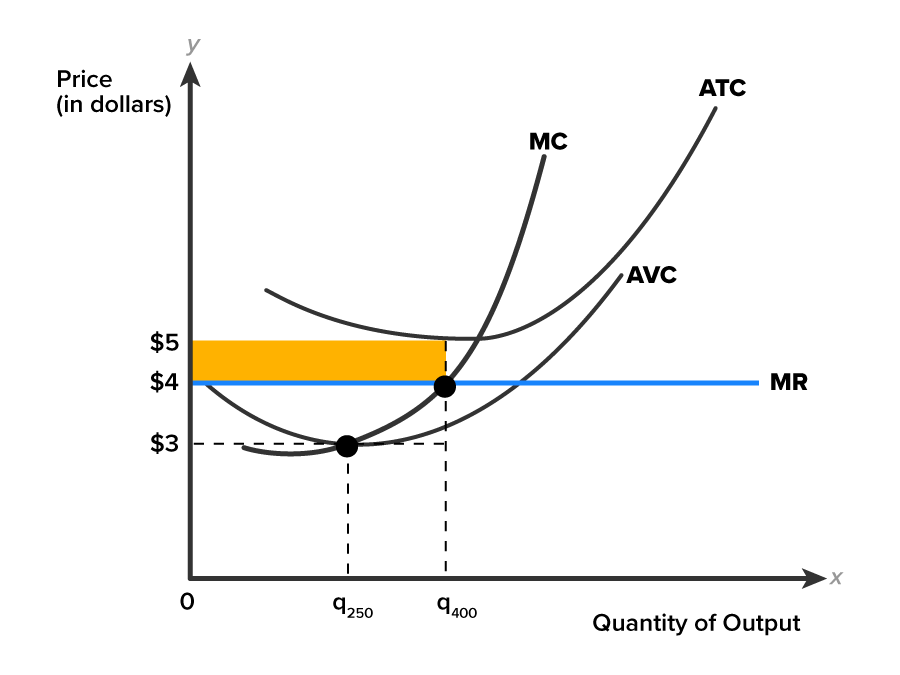
How much economic loss is the firm experiencing? Let’s do the math. The firm is producing 400 units, the average cost per unit is $5, and the price is $4 per unit. The firm will lose $1 on each of the 400 units. Losses total $400 dollars. What should the firm do? Can it keep experiencing losses month after month?
Since the firm is in the short run, it has both fixed and variable costs. By continuing to operate where MR = MC, losses will be minimized. Sales revenue will cover the variable cost but not all fixed costs. By continuing to operate, losses will be minimized but not eliminated.
In time the market could change for the better and improve the firm’s short-run profit situation. On the other hand, the market could get worse. When a firm’s sales revenue cannot cover its average variable cost (P < AVC), it should consider shutting down temporarily until market conditions improve.
In the long run, positive economic profits will attract new investment, and new firms will enter the market if there are no barriers. This process of increasing overall market production in response to a sustained pattern of greater than normal profits is called entry. Economic losses will cause existing firms to exit the market in the long run. This process of reducing overall market production in response to a sustained pattern of losses in the long run is called exit. This adjustment process of entry and exit of firms in response to profits will continue until all remaining firms earn zero economic profit. This is equilibrium in the long run.
Ultimately, perfectly competitive market adjustments stop when no new firms want to enter the market, and existing firms do not want to leave the market. The market will have attained its long-run equilibrium. This action of new firms entering and existing firms exiting drives long-run profits down to zero economic or normal profit. Firms operate at the minimum of the ATC curve where MC intersects ATC from the bottom. This indicates that the firm’s production is at capacity. If a firm is at the capacity output, then it is producing the maximum possible output given its available resources.
In the short run, however, firms cannot change the quantity of fixed inputs, while in the long run, the firm can adjust all factors of production. In the long run a firm’s objective is to decide whether to invest in itself or not. When a perfectly competitive firm earns normal profits over the short run, it is receiving a fair return on its investment. In the long run the firm may decide to retain its current size and location. Or, the firm can decide to change the scale of its operation by becoming larger or smaller. In the long run a firm that has been experiencing losses exits the market in search of better investment opportunities elsewhere. Even a savings account earns a small positive monetary return.
Source: THIS TUTORIAL HAS BEEN ADAPTED FROM OPENSTAX “PRINCIPLES OF ECONOMICS 2E”. ACCESS FOR FREE AT https://openstax.org/books/principles-economics-2e/pages/1-introduction. LICENSE: CC ATTRIBUTION 4.0 INTERNATIONAL.




