Table of Contents |
Let’s turn our attention to examining how the firm interacts with the market in the short run in an oligopoly market. We will first examine the relationship of the firm to the market, then review the profitability status of the firm in the short run, before examining the long run outcomes.
In an oligopoly market, dominant firms hold a relatively large share of the overall market total, similar to a monopolist, and are price setters with downward-sloping demand curves.
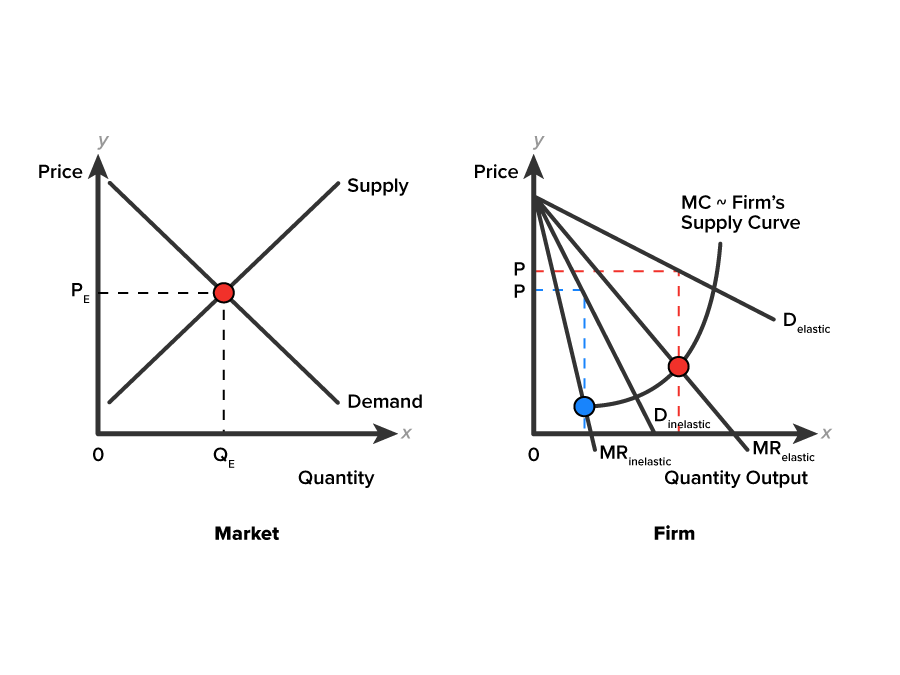
In the diagram below, the left panel represents the market, and the right panel represents an oligopoly firm. Equilibrium in the market occurs where market supply and market demand curves intersect. At the market-determined price, the market clears. There is neither surplus nor shortage of the product. A firm’s short-run supply curve (S) begins on the MC curve at or above where price equals AVC (not shown in graph), which is the shutdown point, and continues upward along the MC curve.
Oligopolists respond to rivals in one of two ways, either by engaging in cooperative behavior or by engaging in non-cooperative behavior. An oligopolist’s demand curve cannot be defined until we know how firms in the market interact with one another. Because all firms profit-maximize at MR = MC, how oligopolists interact affects both the price and quantity of output. In the graph, notice that the profit-maximizing price is lower, and the quantity of output is greater, when the demand curve is relatively elastic compared to when it is relatively inelastic. Price elasticity is a measure of the responsiveness of buyers to a change in the product’s price. When buyers are responsive to a 1% price increase, then quantity demanded falls by more than 1%.
Cooperative Behavior Among Oligopolists
Suppose that an oligopolist’s demand is relatively inelastic to a price cut. If one oligopolist decides to produce more and cut its price, the other firms in the market will likewise match any price cuts—and therefore, a lower price brings very little increase in quantity sold. Therefore, if oligopolists always match price cuts by other firms in the market, but do not match price increases, then none of the oligopolists will have a strong incentive to change prices, since the potential gains to rival firms are minimal. This strategy can work as a silent form of cooperation, and as a way to discipline the behavior of rival firms. This strategy successfully manages to hold down output, increase the price, and share a monopoly level of profits, even without any legally enforceable agreement.
If oligopolists compete hard, they may end up acting very much like perfect competitors, driving down costs and leading to zero economic profits for all firms in the long run. If oligopolists collude with each other, they may effectively act as a shared monopoly, and succeed in pushing up prices and earning consistently high levels of profit even in the long run.
When oligopoly firms in a particular industry decide what quantity to produce, and what price to charge, they act as if they are a shared monopoly. By acting together, oligopolistic firms can hold down market output by assigning output quotas to members, charging a higher price, and dividing the profit among themselves. When firms act together in this way to reduce output and keep prices high, it is called collusion. A group of firms that have a formal agreement to collude to produce the monopoly output, and sell at the monopoly price is called a cartel. While collusion is illegal in the U.S., it is legal in some other countries.
EXAMPLE
You may be familiar with the oil cartel known as The Organization of the Petroleum Exporting Countries (OPEC). OPEC is composed of thirteen member countries. Each member country has a substantial net export of crude petroleum. OPEC’s mission statement is “to coordinate and unify the petroleum policies of its member countries and ensure the stabilization of oil markets in order to secure an efficient, economic and regular supply of petroleum to consumers, a steady income to producers, and a fair return on capital for those investing in the petroleum industry.” Members signed international agreements to act as a monopoly, hold down output, and keep prices high, so that all the countries can make high profits from oil exports.The potential to cheat on a formal agreement is strong even when oligopolists recognize that they benefit more from being part of a group acting like a monopoly. If a few oligopolists give in to the temptation to cheat on the agreement, and start producing more than their assigned quota, then the market price will fall. To prevent cheating on formal agreements, violators are often punished. Violators of OPEC’s quota agreements can expect to have reduced quotas in the next round of negotiation.
In oligopoly markets firms may engage in cooperative behavior to improve market outcomes. The U.S. Department of Justice, however, will bring antitrust action against any firms that engage in explicit collusion and violate fair business practices. As long as firms do not explicitly consult with one another, however, other types of strategic cooperative interactions are permissible. One such strategy is known as price leadership, in which one firm takes the lead in setting a higher price and waits for rivals to follow suit. If no rivals follow, then the firm reverts to the old price.
EXAMPLE
American Airlines, Delta Air Lines, Southwest Airlines, United Airlines control 80% of the market for domestic air travel. These firms have used price leadership quite successfully. Suppose that Delta Air Lines makes a public announcement that the cost of jet fuel has risen significantly, and its intention is to offset some of that cost by raising ticket prices by 25%. A few days later ticket prices rise for all airlines. This is an example of price leadership.Non-Cooperative Behavior Among Oligopolists
Alternatively, oligopolies can respond to rivals in non-cooperative ways. Economists use game theory to model and analyze oligopolists’ non-cooperative behavior. Game theory is a branch of mathematics that analyzes situations in which players must make decisions and then receive payoffs based on what other players decide to do.
One famous problem from game theory is the prisoner’s dilemma paradox. The prisoner’s dilemma scenario involves the arrest of two members of the same gang by the authorities. The best solution for both gang members is to collude on a story to offer the police. Collusion would protect both gang members. Unfortunately, each gang member is placed in a different interrogation room before they are allowed to create a story. Each gang member then has two options: confess before his partner confesses to get a more lenient sentence, acting in his own best interest, or gamble that the other gang member will remain silent, and cooperate by being silent as well. If neither gang member confesses, then both walk free from charges. So, what would be the best outcome? The best outcome for both gang members would be if they both agree to not confess. But remember: the two are placed in separate interrogation rooms! In the prisoner’s dilemma, the gains from cooperation are larger than the rewards from pursuing self-interest.
Consider the following example of the prisoner’s dilemma applied to an oligopoly market. An oligopoly market with only two firms is known as a duopoly. Jets Gas and Kash Convenience are rival retail gasoline stations on the opposite sides of Main Street. If Jets Gas and Kash Convenience act together, both receive $1000 in profit. The choices and payoff from different decisions are outlined in the payoff matrix table below. A payoff matrix is a table displaying the strategies of one player listed in rows and those of the other player in columns. Cells display the payoffs earned for choosing different responses. As in the prisoner’s dilemma, gains from cooperating are larger than the rewards from pursuing self-interest. Here we assume it is illegal for Jets Gas and Kash Convenience to collude. What is the best strategy in this game?
|
Jets Gas Charge High Price |
Jets Gas Charge Low Price |
|
|
Kash Convenience Charge High Price |
+$500 +$500 |
+$250 +$1000 |
|
Kash Convenience Charge Low Price |
+$1000 +$250 |
+$0 +$0 |
Collusion is the best outcome for both players in this game, because collusion would ensure that both Jets Gas & Kash Convenience earn $500 in profit when they charge the high price. But collusion is illegal!
What is the best strategy for Jets Gas, to charge a high price or charge a low one? Can Jets Gas trust that Kash Convenience will charge the low price if Jets Gas charges a high price? Does Kash Convenience have a dominant strategy? A dominant strategy is the choice that results in the highest payoff for Kash Convenience, regardless of what Jets Gas does.
Oligopoly firms behave like firms in perfectly competitive, monopolistically competitive, and monopoly market environments in that they seek to maximize profit. In the short run, the firm will seek the quantity of output along their downward-sloping demand curve where profits are highest, or, if profits are not possible, where losses are lowest. Margins tell the firm what to do. Should the firm’s production level be higher or lower than it currently is to maximize profits? The best any firm can do is follow the profit-maximizing rule, equating MR = MC. According to the graph below, an oligopolist will produce the profit-maximizing output level of  , and charge price
  . Once the quantity of output is selected, the price is known. The firm’s total revenue, total cost, and level of profits are determined.
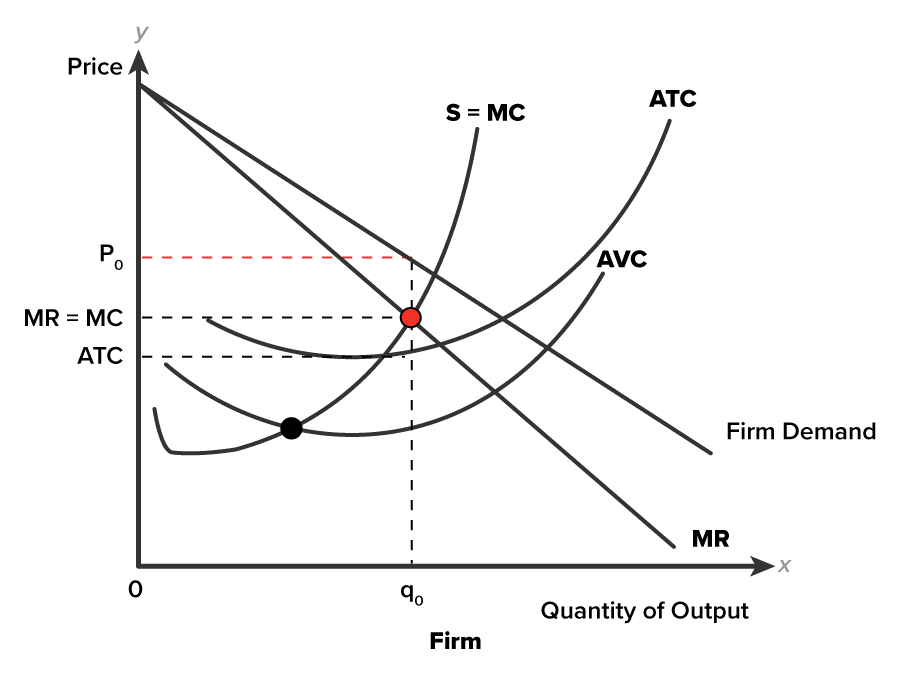
Averages tell the firm how well it is doing. In the graph above, the ATC curve lies below the demand and marginal revenue curves. Locate ATC along the dashed line for MR = MC. Trace that ATC point across to the vertical axis. In the graph notice the rectangular area formed by the dashed lines, between price and ATC and between zero and on the horizontal axis. This area is referred to as the profit box.
To calculate the area of the rectangle, use the formula: base * height. The area of this rectangle represents the value of short-run positive economic profits. Positive economic profit is profit that exceeds normal profit.

Many real-world oligopolies go through periods of cooperation and competition due to changes in the legal environment, political pressures, and the decisions of their top executives. If oligopolies could sustain cooperation with each other on output and pricing, they could earn profits as if they were a single monopoly. However, each firm in an oligopoly has an incentive to produce more and grab a bigger share of the overall market. When firms start behaving in this way, the market outcome in terms of prices and quantity can be similar to that of a highly competitive market.
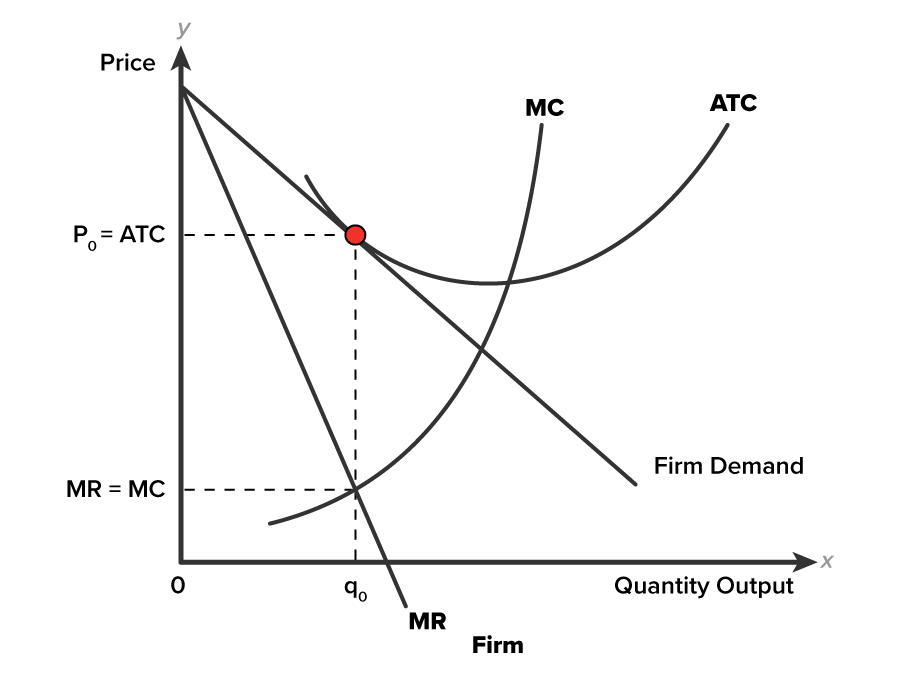
Let’s determine the profitability situation given the urge to cheat by a few oligopolists. According to the graph below, our oligopolist will produce the profit-maximizing output level of , and charge price PO. If the firm subtracts price per unit and average cost per unit ( ), then multiplies that numeric value by the units, the dollar value of profits will be known. In the graph, the difference between price and ATC is zero. The firm is earning zero economic profit in the short run! Again, zero economic profit does not mean zero profit. Zero economic profit is the same as normal profit. When a firm earns normal profit or zero economic profit, the owners are compensated with a rate of return on their investment equal to their opportunity cost.
In the short run, positive economic profits typically attract new investment and new firms will enter the market, if there are no barriers. New firms enter the industry in response to greater than normal profits and overall market production will increase. Or if there are losses, then firms exit the market in the long run and overall market production decreases. This long-run process of adjustment stops when no new firms want to enter, and no existing firms want to exit the market. At this point the market will have attained its long-run equilibrium. The action of entry and exit will drive profits to zero.
However, in the case of an oligopoly, positive economic profits will not attract minimal new investment from sources outside the oligopoly market, because significant barriers prevent new firms from entering the market. In long run equilibrium, positive profits are likely to persist.
Oligopolies, like monopolies and monopolistic competitors with downward-sloping demand curves, are less efficient than perfectly competitive firms.
Perfectly competitive firms operate at the minimum point of their ATC curve, where the MC curve intersects if from the bottom. This indicates that the firm’s production is at capacity, or the maximum possible output given its available resources.
An oligopolist has the ability to operate at capacity output, producing a larger possible output given its available resources. If an oligopolist chooses to under-utilize its capacity it is known as having excess capacity. Because oligopolists do not produce at the minimum of the ATC curve, the oligopoly firm is productively inefficient. The oligopolist chooses to restrict output to maintain a high price by restricting output.
All firms profit-maximize at MR = MC. The selling price for a perfectly competitive firm is equal to marginal cost (P = MC). And buyers purchase the product at the lowest possible price. Perfectly competitive firms are allocatively efficient, producing at an output level where the price (P) equals the marginal cost (MC) of production.
For an oligopolist firm with a downward-sloping demand curve, this means P > MR and P > MC. Because oligopolists charge a selling price above marginal cost (P > MC), oligopolists are allocatively inefficient. Buyers will suffer because the price (P) is a measure of how much buyers value the good, and the marginal cost (MC) is a measure of what an extra unit costs society to produce. If P > MC, then the marginal benefit to society (as measured by P) is greater than the marginal cost to society of producing additional units, and a greater quantity should be produced.
Oligopolists are not productively efficient, because they do not produce at the minimum of the average cost curve. Oligopolists are not allocatively efficient, because they do not produce at the quantity where P = MC.
As a result, an oligopolist produces less, at a higher average cost, and charges a higher price than would a combination of firms in a perfectly competitive industry. Of all market types, oligopolists have the greatest ability for innovation because short-run profits can persist into the long run. Perfect competitors and monopolistic competitors earn zero economic profits in the long run, while monopolists need not fear entry of new competitors because of their protected status.
Source: THIS TUTORIAL HAS BEEN ADAPTED FROM OPENSTAX “PRINCIPLES OF ECONOMICS 2E”. ACCESS FOR FREE AT https://openstax.org/books/principles-economics-2e/pages/1-introduction. LICENSE: CC ATTRIBUTION 4.0 INTERNATIONAL.
REFERENCES
Organization of the Petroleum Exporting Countries. (n.d.). Our Mission. OPEC. Retrieved July 26, 2022, from
www.opec.org/opec_web/en/about_us/23.htm
The United States Department of Justice. (2021, September 21). United States District Court for the District of Massachusetts Case 1:21-cv-11558. The United States Department of Justice. Retrieved August 1, 2022, from
www.justice.gov/opa/press-release/file/1434621/download




