Table of Contents |
Let’s turn our attention to examining how the firm interacts with a monopolistically competitive market in the short run. We will first examine the relationship of the firm to the market, then review the profitability status of the firm in the short run, before examining the long run outcomes.
In a monopolistically competitive market a firm holds a relatively small share of the overall market total, unlike a single firm acting as a monopolist. Monopolistic competitors are price setters with downward-sloping demand curves, unlike firms in a perfectly competitive environment, which are price takers with horizontal demand curves.
In the diagram below, the left panel represents the market, and the right panel represents an individual firm. Equilibrium in the market occurs where market supply and market demand curves intersect. At the market-determined price, the market clears. There is neither surplus nor shortage of the product.
In the diagram, the market sets its price ( ) where supply and demand meet, but all firms in a monopolistically competitive market make pricing and output decisions independent of the market. The firm’s demand curve is downward-sloping, so selling an additional unit of product requires a lower price. Marginal revenue curve lies below the firm demand curve. Firms pursue a marginal cost pricing strategy. Firms use advertising and marketing efforts to increase the inelasticity of product demand. The more vertical a firm’s demand curve, the more inelastic product demand. The firm is profit maximizing, and will determine the profit-maximizing quantity at MR = MC. As a price-setting firm, market supply and demand do not determine the product’s selling price. Rather, the firm sets the price in a manner that maximizes profits. Therefore, the price will exceed marginal revenue (P > MR).
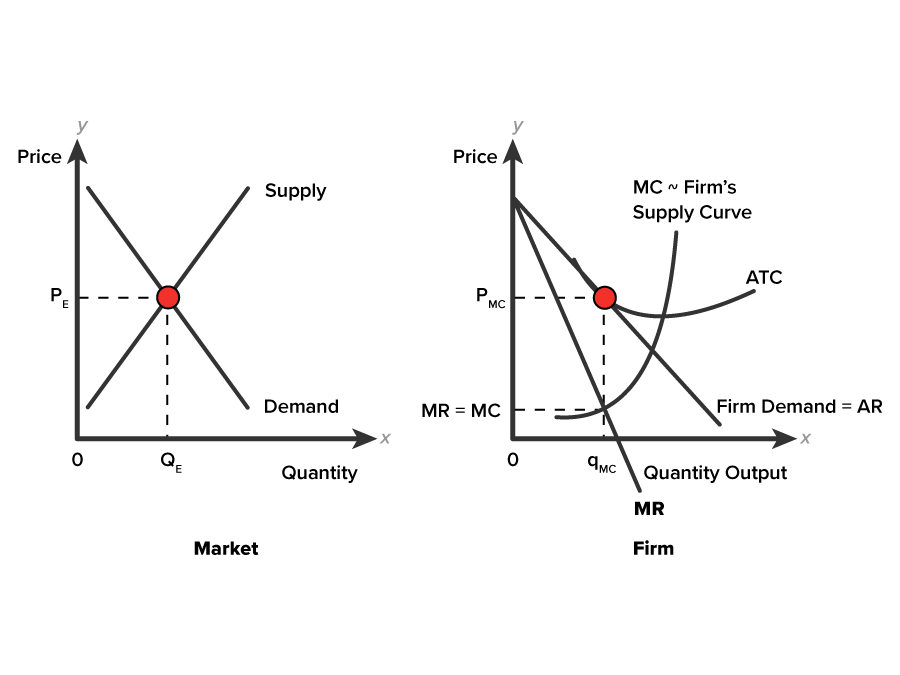
In a monopolistically competitive market a firm is known as a price setter, because the seller has some influence over determining the product price along a downward-sloping demand curve, due to product differentiation and the cultivation of customer loyalty.
Suppose that Tropical Grower ‘n Grocer is a small retail store specializing in citrus fruits located in a middle-sized Southern community. Its biggest moneymaker is a sun-ripened papaya, which is grown in the store’s greenhouses. The data in the table reflects the firm’s pricing, revenue, and cost situation. The firm sets the price for each quantity of papaya sold (column 1). The price is measured in dollars per papaya (column 2).
|
Quantity (in Units) (1) |
Price (in Dollars) (2) |
Total Revenue (P * Q) (3) |
Marginal Revenue (Change in TR / Change in Q) (4) |
Average Revenue (TR/Q) (5) |
Total Cost (FC + VC) (6) |
Marginal Cost (Change in TC / Change in Q) (7) |
Average Cost (TC/Q) (8) |
Total Profit (TR-TC) (9) |
|---|---|---|---|---|---|---|---|---|
| 0 | - | - | - | - | - | - | - | - |
| 10 | $25 | $250 | $25 | $25 | $130 | $13 | $13 | |
| 20 | $23 | $460 | $21 | $23 | $280 | $15 | $14 | |
| 30 | $21 | $630 | $17 | $21 | $450 | $17 | $15 | |
| 40 | $18 | $720 | $9 | $18 | $640 | $19 | $16 | |
| 50 | $15 | $750 | $3 | $15 | $850 | $21 | $17 | |
| 60 | $12 | $720 | -$3 | $12 | $1,100 | $25 | $18 | |
| 70 | $9 | $630 | -$9 | $9 | $1,400 | $30 | $20 | |
| 80 | $7 | $560 | -$7 | $7 | $1,750 | $35 | $22 |
Market demand is composed of the sum of all firms' demand, at each possible price. Like the monopolist, monopolistic competitors have downward-sloping demand curves, adhering to the law of demand. As the price falls, buyers purchase larger quantities. In the table this inverse relationship is shown in column 1 (quantity) and column 2 (price).
Because of this inverse relationship, total revenue (column 3) will not be increasing by the same dollar amount every single time, which also means marginal revenue (column 4) will not be equal to the price. Price (column 2) is greater than marginal revenue (column 4) (P > MR), except in the first row.
Notice in the table that price, marginal revenue, and average revenue decline as the quantity of output increases. Also, notice that price and average revenue (column 5) have the same numeric values at each level of output. Both decline as the quantity produced increases. Recall that average revenue represents the firm’s demand curve.
The total cost (column 6) is the sum of fixed plus variable costs. Total cost rises as quantity of output increases. It costs more to produce more. While fixed costs will be unchanged, the variable costs associated with variable inputs, like labor and raw materials, will rise as production increases. In the table, marginal cost (column 7) rises as the quantity of output increases, as does average total cost. We would typically expect a J-shaped curve for marginal cost, and a U shape for the ATC curve.
We can visualize these relationships by plotting quantity output on the horizontal x-axis, and price on the vertical y-axis. At the quantity of ten papayas sold, the values for marginal revenue and average revenue are identical. The marginal revenue curve (blue) lies below the average revenue curve (green). Recall that the average revenue curve is the firm’s demand curve.
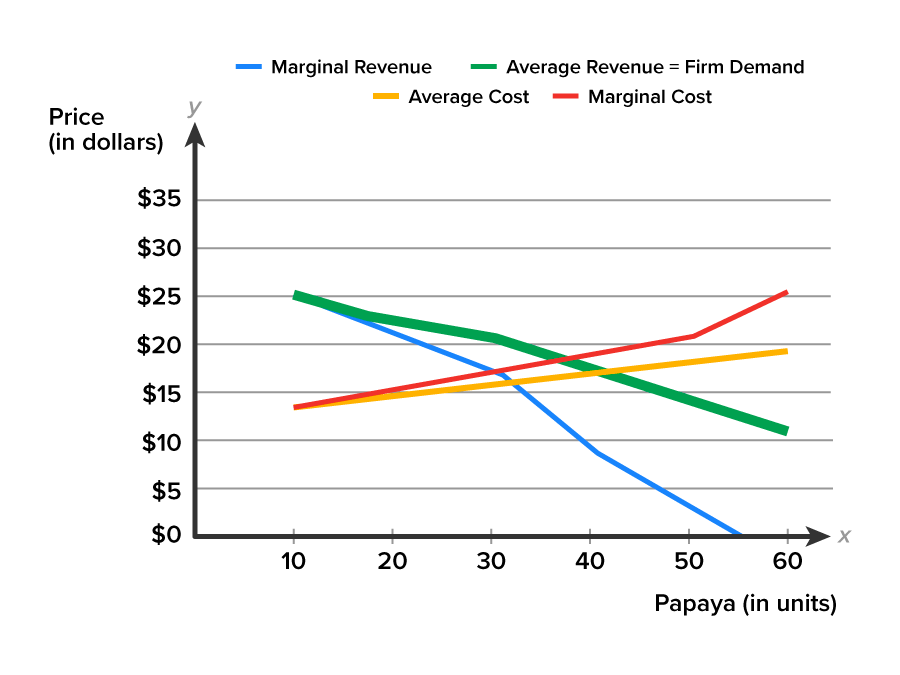
Recall that the firm’s short-run supply curve begins on the MC curve (red) at or above where price equals AVC—this is the firm’s shutdown point, and continues upward along the MC curve.
Tropical Grower ‘n Grocer is a firm operating in a monopolistically competitive environment, and is a profit-maximizer that sets its own product price along its downward-sloping demand curve. How’s the firm doing? We have two ways of determining profitability. Every firm, whether a price taker or a price setter in any market, maximizes profit by choosing the level of output where MR = MC.
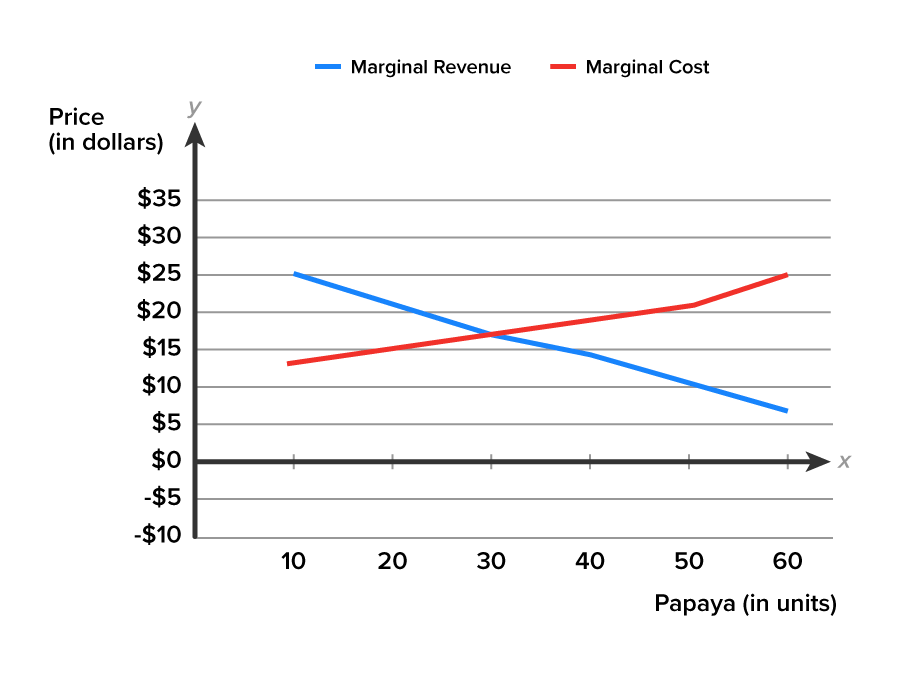
Our second method of determining if a firm’s profits are maximized, or loss is minimized, is when the distance between TR and TC is the largest. Scan down through the total profit column in the table (column 9). Notice that total profits increased to $180, then decreased until reaching -$1,190 for the quantity of 80 papayas sold at $7 each. The largest total profit occurs at $180. While Total Profit is the same for both 20 and 30 units, the marginal revenue is greater than marginal cost at 20 units. When MR > MC, the firm should increase its output until MR = MC, which occurs at the quantity of 30 papayas sold at a price of $21 each.
|
Quantity (in Units) (1) |
Price (in Dollars) (2) |
Total Revenue (P * Q) (3) |
Marginal Revenue (Change in TR / Change in Q) (4) |
Average Revenue (TR/Q) (5) |
Total Cost (FC + VC) (6) |
Marginal Cost (Change in TC / Change in Q) (7) |
Average Cost (TC/Q) (8) |
Total Profit (TR-TC) (9) |
|---|---|---|---|---|---|---|---|---|
| 0 | ||||||||
| 10 | $25 | $250 | $25 | $25 | $130 | $13 | $13 | $120 |
| 20 | $23 | $460 | $21 | $23 | $280 | $15 | $14 | $180 |
| 30 | $21 | $630 | $17 | $21 | $450 | $17 | $15 | $180 |
| 40 | $18 | $720 | $9 | $18 | $640 | $19 | $16 | $80 |
| 50 | $15 | $750 | $3 | $15 | $850 | $21 | $17 | -$100 |
| 60 | $12 | $720 | -$3 | $12 | $1,100 | $25 | $18 | -$380 |
| 70 | $9 | $630 | -$9 | $9 | $1,400 | $30 | $20 | -$770 |
| 80 | $7 | $560 | -$7 | $7 | $1,750 | $35 | $22 | -$1,190 |
In the short run, a price-setting firm will seek the quantity of output along its downward-sloping demand curve where profits are highest or, if profits are not possible, where losses are minimized. Margins tell the firm what to do. Should production be higher or lower than it is currently? The best any firm can do is to follow the profit-maximizing rule, equating MR = MC. Once the quantity of output has been selected, the price is known. The firm’s total revenue, total cost, and level of profits are determined.
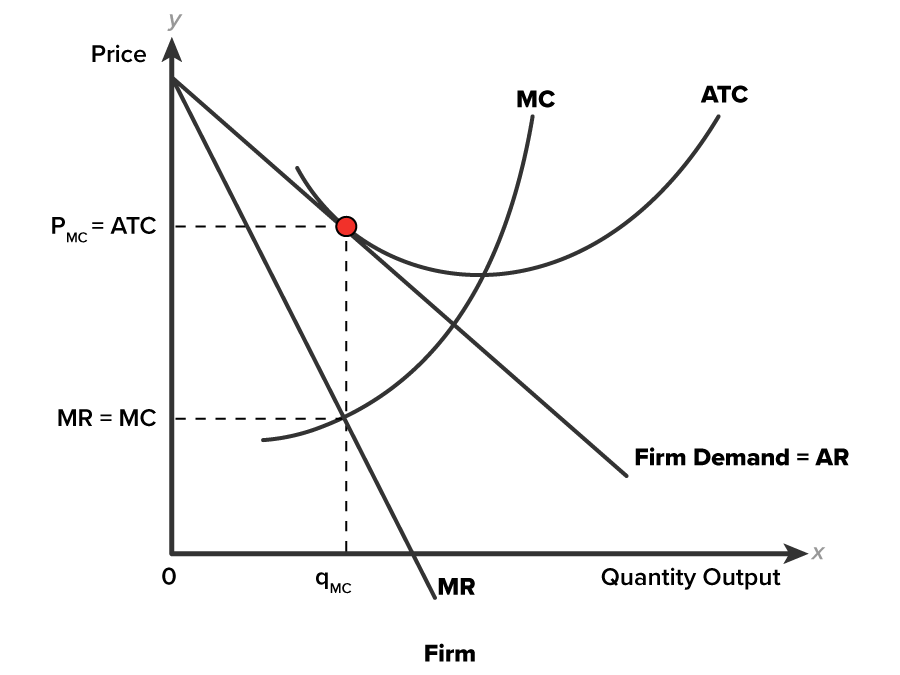
Let’s determine the profitability situation using the graph below. If the firm subtracts price per unit and average cost per unit ( ), then multiplies that numeric value by the
  units, the dollar value of profits will be known. In the graph, the difference between price and ATC is zero. The firm is earning short-run zero economic profit, but that does not mean no profit. Zero economic profit is the same as normal profit. By earning a normal profit, the owners are being compensated a rate of return on their investment equal to their opportunity cost.
Suppose that fungus developed on the leaves of some of the papaya trees when the lighting system failed during a severe storm. The owners were able to identify and treat many of the trees, but harvest remained low for some time, resulting in a decrease in quantity of output.
By definition, a monopolistic competitor is a price setter selling a product that, while not identical, is similar to competitors' products. If a customer senses the price is out-of-range, then the customer will consider similar fruit sold by other stores.
The graph below illustrates Tropical Grower ‘n Grocer’s current situation. The demand curve and marginal revenue curve (MR) are downward-sloping. To profit-maximize, the firm will locate where MR crosses MC. In the graph, follow the dashed line down from where MR = MC to the horizontal quantity of output axis. The profit-maximizing quantity of output for the firm is identified as units. Next, follow the dashed line up to the demand curve, then cross back over to the vertical price axis. The selling price is identified as  .
.
Averages tell the firm how well it is doing. In the graph below, the ATC curve lies above the demand. Follow the dashed line for MR = MC up to ATC. Trace that ATC point across to the vertical axis of Price. In the graph notice the rectangular area formed by the dashed lines between price and ATC. This area represents the size of the losses.
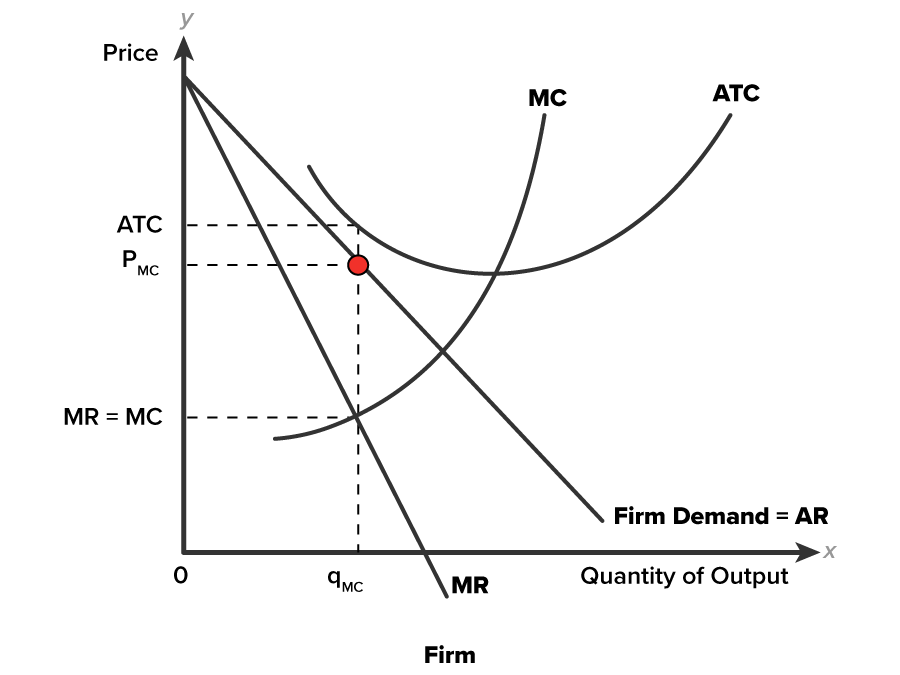
To calculate the area of that rectangle we can use the formula: base * height. If we had actual numbers and calculated the area of this rectangle, we would know the dollar value of the short-run economic loss for this firm. Clearly, the fungus problem reduced the profitability of Tropical Grower ‘n Grocer. Will this business be able to return to profitability, or will further losses push the firm out of business?

In the short run, positive economic profits will attract new investment, and new firms will enter the market, if there are no barriers. New firms enter the industry in response to greater than normal profits. This process of increasing overall market production in response to a sustained pattern of above normal profit is called entry. Economic losses will cause existing firms to exit the market in the long run. This long-run process of reducing overall market production in response to a sustained pattern of losses is called exit. This adjustment process of entry and exit of firms in response to profits will continue, until all remaining firms earn zero economic profit. This is equilibrium in the long run.
In the long run, economic losses will lead existing firms to exit the market, which will result in increased demand for all remaining firms, and consequently, lower losses. Firms exit up to the point where there are no more losses in this market. The demand curve will touch the average cost curve, and zero economic profits will be earned—until the next short-run disturbance occurs.
If positive economic profits exist in a monopolistically competitive market, the profits will attract new investment from sources outside the market because of relatively low barriers to entry. Like firms in a perfectly competitive environment, positive economic profits will not persist. Long-run profits will be driven to normal profits.
As more firms enter the market, the quantity demanded at a given price for any particular firm will decline, and the firm’s demand curve will shift to the left. As an individual firm’s demand curve shifts to the left, its marginal revenue curve will also shift to the left. The shift in marginal revenue will change the profit-maximizing quantity that the firm chooses to produce, since marginal revenue will then equal marginal cost at a lower quantity of output.
A monopoly and monopolistic competitors are less efficient than perfectly competitive firms. Perfectly competitive firms operate at the minimum point of their ATC curve, where the MC curve intersects it from the bottom. This indicates that the firm’s production is at capacity, or the maximum possible output given its available resources.
A monopolistic competitor has the ability to operate at the capacity output, producing a larger possible output given its available resources, but chooses to under-utilize its capacity. This is known as having excess capacity. Because monopolistic competitors do not produce at the minimum of the ATC curve, the firm is productively inefficient.
All firms profit-maximize at MR = MC. The selling price for a perfectly competitive firm is equal to marginal cost (P = MC). And buyers purchase the product at the lowest possible price. Perfectly competitive firms are allocatively efficient, producing at an output level where the price (P) equals the marginal cost (MC) of production.
For a monopolistic competitor with a downward-sloping demand curve, this means P > MR and P > MC. Because monopolistic competitors charge a selling price above marginal cost (P > MC), monopolistic competitors are allocatively inefficient. Buyers will suffer because the price (P) is a measure of how much buyers value the good, and the marginal cost (MC) is a measure of what an extra unit cost society to produce. If P > MC, then the marginal benefit to society (as measured by P) is greater than the marginal cost to society of producing additional units, and a greater quantity should be produced.
Monopolists and monopolistic competitors are not productively efficient, because they do not produce at the minimum of the average cost curve. Monopolists and monopolistic competitors are not allocatively efficient, because they do not produce at the quantity where P = MC.
Source: THIS TUTORIAL HAS BEEN ADAPTED FROM OPENSTAX “PRINCIPLES OF ECONOMICS 2E”. ACCESS FOR FREE AT https://openstax.org/books/principles-economics-2e/pages/1-introduction. LICENSE: CC ATTRIBUTION 4.0 INTERNATIONAL.




