Table of Contents |
Time is fragmented. Managers have acknowledged from antiquity that they never seem to have enough time to get all those things done that need to be done. In the latter years of the twentieth century, however, a new phenomenon arose: demand for time from those in leadership roles increased, while the number of hours in a day remained constant. Increased work hours was one reaction to such demand, but managers quickly discovered that the day had just 24 hours and that working more of them produced diminishing marginal returns. According to one researcher, “Managers are overburdened with obligations yet cannot easily delegate their tasks. As a result, they are driven to overwork and forced to do many tasks superficially. Brevity, fragmentation, and verbal communication characterize their work” (Mintzberg, 1990, p. 167).
Values compete and the various roles are in tension. Managers clearly cannot satisfy everyone. Employees want more time to do their jobs, while customers want products and services delivered quickly and at high-quality levels. Supervisors want more money to spend on equipment, training, and product development; shareholders want returns on investment maximized. A manager caught in the middle cannot deliver to each of these people what each most wants, and decisions are often based on the urgency of the need and the proximity of the problem.
The job is overloaded. In recent years, many North American and global businesses were reorganized to make them more efficient, nimble, and competitive. For the most part, this reorganization meant decentralizing many processes along with the wholesale elimination of middle management layers. Many managers who survived such downsizing found that their number of direct reports had doubled.
Today, high-speed information technology and remarkably efficient telecommunication systems mean that many managers have as many as 20 or 30 people reporting to them directly.
The entrepreneur role is gaining importance. Managers must increasingly be aware of threats and opportunities in their environment. Threats include technological breakthroughs on the part of competitors, obsolescence in a manager’s organization, and dramatically shortened product cycles. Opportunities might include product or service niches that are underserved, out-of-cycle hiring opportunities, mergers, purchases, or upgrades in equipment, space, or other assets. Managers who are carefully attuned to the marketplace and competitive environment will look for opportunities to gain an advantage.
The leader role is also gaining importance. Managers must be more sophisticated as strategists and mentors. A manager’s job involves much more than simple caretaking in a division of a large organization. Unless organizations are able to attract, train, motivate, retain, and promote good people, they cannot possibly hope to gain advantage over the competition. Thus, as leaders, managers must constantly act as mentors to those in the organization with promise and potential. When organizations lose a highly capable worker, all else in their world will come to a halt until they can replace that worker.
An important question often raised about managers is: What responsibilities do managers have in organizations? According to our definition, managers are involved in planning, organizing, leading, and controlling. Managers have described their responsibilities that can be aggregated into nine major types of activity. These include:
Although each manager may have a diverse set of responsibilities, including those mentioned above, the amount of time spent on each activity and the importance of that activity will vary considerably. The two most salient perceptions of a manager are (1) the manager’s level in the organizational hierarchy and (2) the type of department or function for which he is responsible. Let us briefly consider each of these.
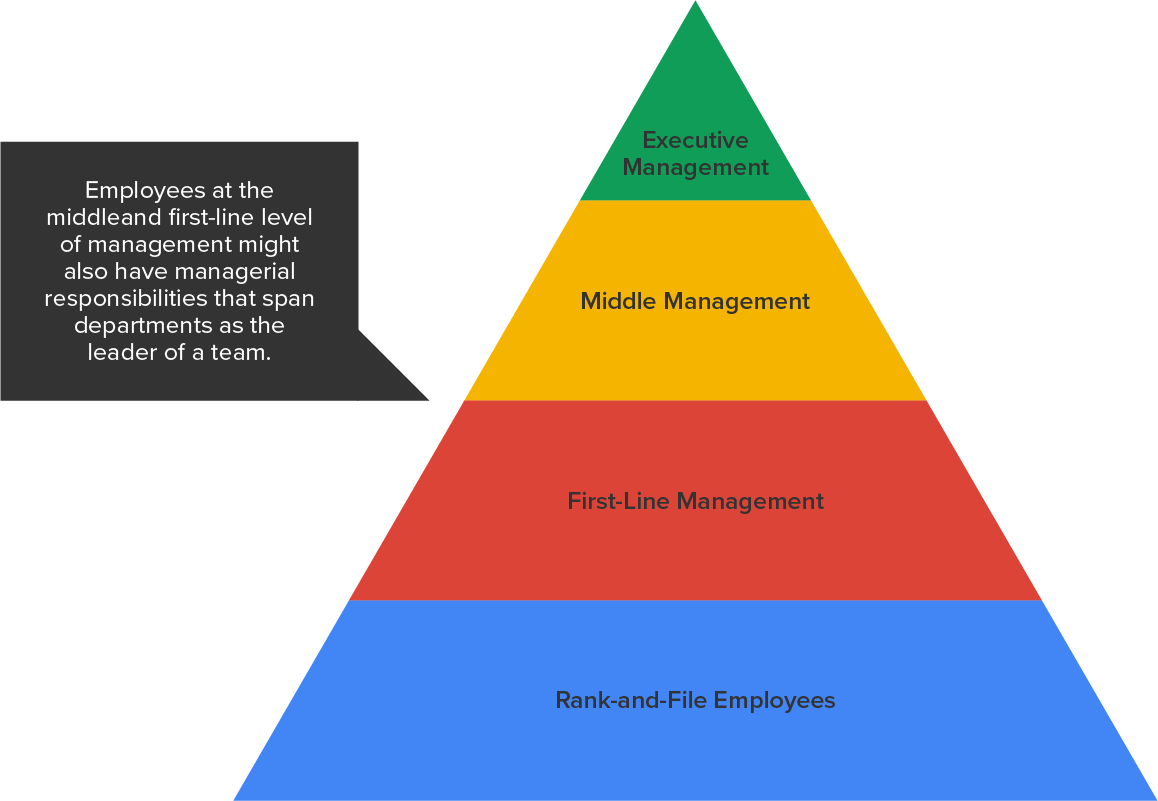
We can distinguish three general levels of management: executives, middle management, and first-line management. Executive managers are at the top of the hierarchy and are responsible for the entire organization, especially its strategic direction. Middle managers, who are at the middle of the hierarchy, are responsible for major departments and may supervise other lower-level managers. Finally, first-line managers supervise rank-and-file employees and carry out day-to-day activities within departments (Katz, 1974).
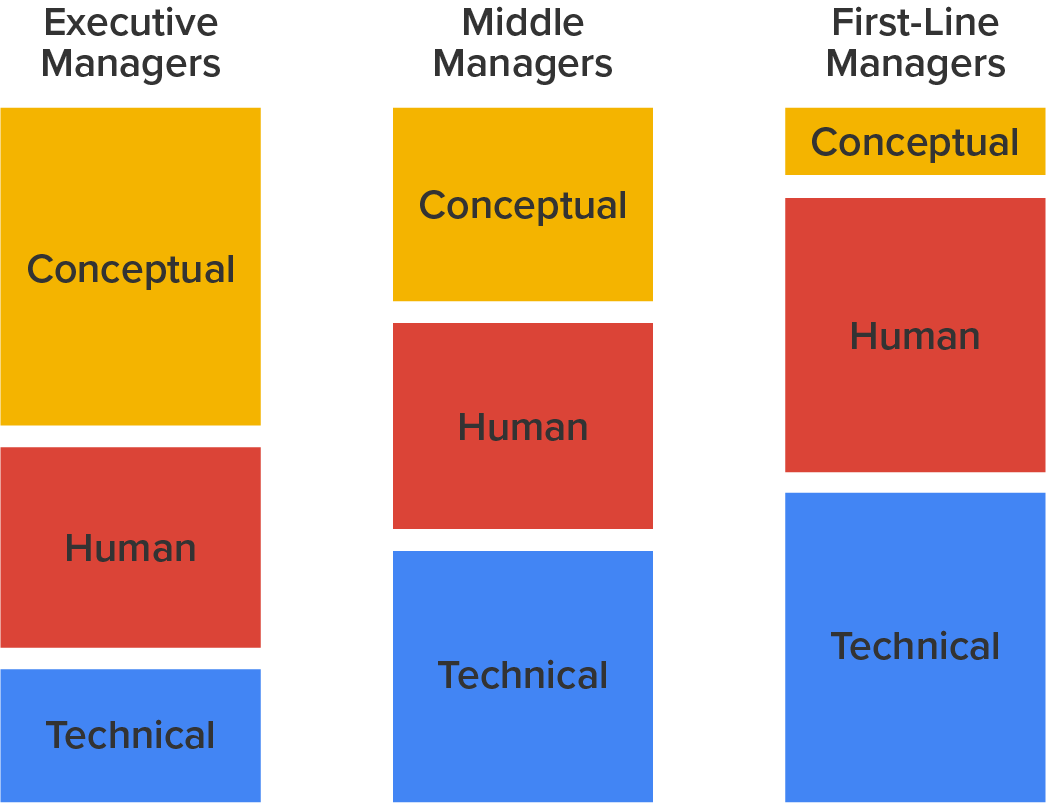
We can distinguish three types of managerial skills:
In addition to the level in the hierarchy, managerial responsibilities also differ with respect to the type of department or function. There are differences found for quality assurance, manufacturing, marketing, accounting and finance, and human resource management departments, among others.
The emphasis on and intensity of managerial activities varies considerably by the department the manager is assigned to.
At a personal level, knowing that the mix of conceptual, human, and technical skills changes over time and that different functional areas require different levels of specific management activities can serve at least two important functions. First, if you choose to become a manager, knowing that the mix of skills changes over time can help you avoid a common complaint that often young employees want to think and act like a CEO before they have mastered being a first-line supervisor. Second, knowing the different mix of management activities by functional area can facilitate your selection of an area or areas that best match your skills and interests.
Source: THIS TUTORIAL HAS BEEN ADAPTED FROM OPENSTAX "PRINCIPLES OF MANAGEMENT". ACCESS FOR FREE AT openstax.org/books/principles-management/pages/1-introduction. LICENSE: CREATIVE COMMONS ATTRIBUTION 4.0 INTERNATIONAL. Accessed by June 2021.
REFERENCES
Katz, R.L. (1974, September-October). Skills of an effective administrator. Harvard Business Review, 52(5), 90-102. hbr.org/1974/09/skills-of-an-effective-administrator
Mintzberg, H. (1990, March-April). The manager’s job: Folklore and fact. Harvard Business Review, 68(2), 166–168. hbr.org/1990/03/the-managers-job-folklore-and-fact



