Use Sophia to knock out your gen-ed requirements quickly and affordably. Learn more
×

Macroscopic Anatomy of the Kidney

Author: Sophia

what's covered
In this lesson, you will learn about different external and internal structures of the kidney and how they function. Specifically, this lesson will cover:

Table of Contents

1. External Anatomy

The kidneys lie on either side of the spine in the retroperitoneal space between the parietal peritoneum and the posterior abdominal wall, well protected by muscle, fat, and ribs. They are roughly the size of your fist, and the male kidney is typically a bit larger than the female kidney. The kidneys are well vascularized, receiving about 25% of the cardiac output at rest.

The left kidney is located at about the T12 to L3 vertebrae, whereas the right is lower due to slight displacement by the liver. Upper portions of the kidneys are somewhat protected by the eleventh and twelfth ribs. Each kidney weighs about 125–175 g in males and 115–155 g in females. They are about 11–14 cm in length, 6 cm wide, and 4 cm thick, and are directly covered by a fibrous capsule, the renal capsule, which is composed of dense, irregular connective tissue that helps the kidney hold their shape and protect them. This capsule is covered by a shock-absorbing layer of adipose tissue called the renal fat pad, which in turn is encompassed by a tough renal fascia. The fascia and, to a lesser extent, the overlying peritoneum serve to firmly anchor the kidneys to the posterior abdominal wall in a retroperitoneal position.
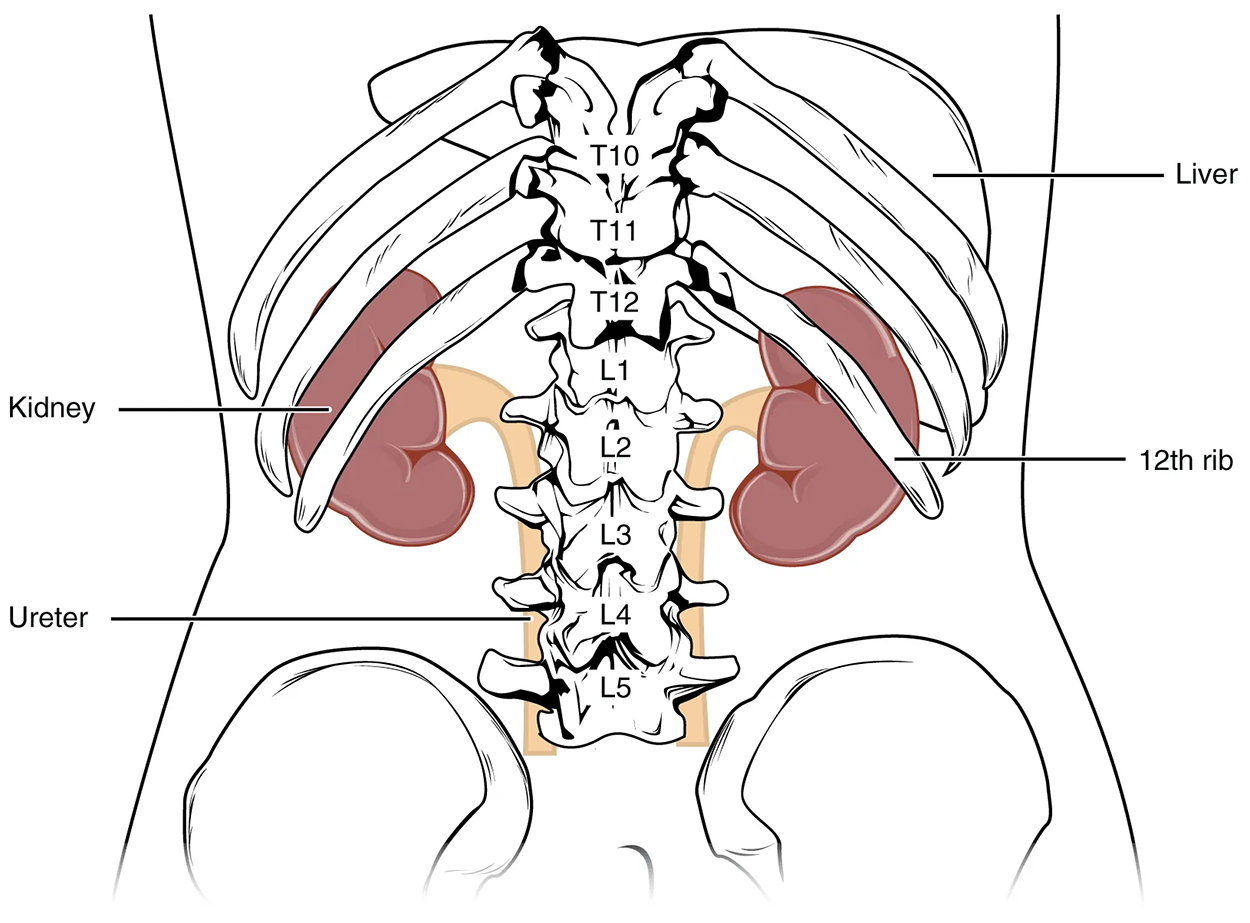

This image shows a human torso and shows the location of the kidneys within the torso.
Kidneys - The kidneys are slightly protected by the ribs and are surrounded by fat for protection (not shown).

On the superior aspect of each kidney lies the adrenal gland. The adrenal cortex directly influences renal function through the production of the hormone aldosterone to stimulate sodium reabsorption.

term to know
Kidneys
A pair of organs that filter waste from the blood, produce urine, and control levels of different substances in the body.
Renal Fat Pad
Adipose tissue between the renal fascia and the renal capsule that provides protective cushioning to the kidney.


2. Internal Anatomy

A frontal section through the kidney reveals an outer region called the renal cortex, which contains most of the nephrons, and an inner region called the renal medulla. The renal columns are connective tissue extensions that radiate downward from the cortex through the medulla to separate the most characteristic features of the medulla, the renal pyramids and renal papillae. The papillae are bundles of collecting ducts that transport urine made by nephrons to the calyces of the kidney for excretion. The renal columns also divide the kidney into 6–8 lobes and provide a supportive framework for vessels that enter and exit the cortex. The pyramids and renal columns taken together constitute the kidney lobes. You will learn more about the nephrons, vessels, and cortex of the kidney in a future lesson.
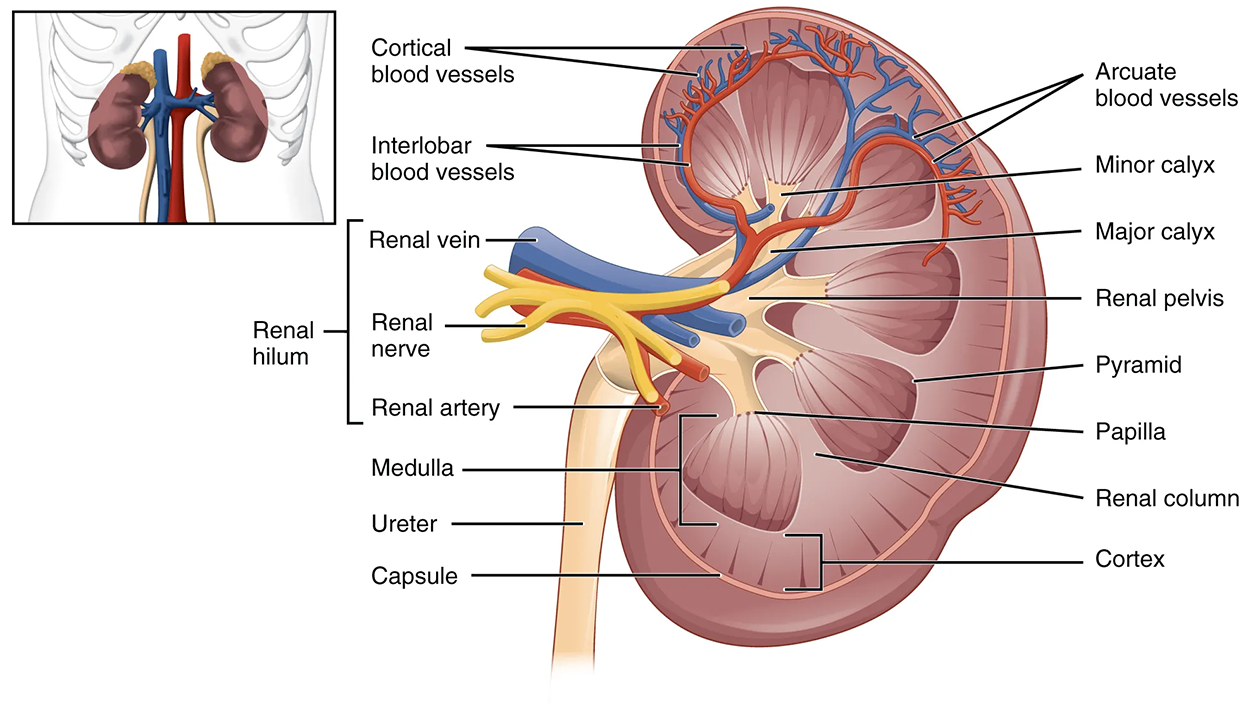
The left panel of this figure shows the location of the kidneys in the abdomen. The right panel shows the cross-section of the kidney.
Left Kidney

2a. Renal Hilum

The renal hilum is the entry and exit site for structures servicing the kidneys: vessels, nerves, lymphatics, and ureters. The medial-facing hila are tucked into the sweeping convex outline of the cortex. Emerging from the hilum is the renal pelvis, which is formed from the major and minor calyces in the kidney and is located in the renal sinus, which is a cavity that extends behind the renal hilum and includes the renal pelvis, blood vessels, nerves, and fat. The smooth muscle in the renal pelvis funnels urine via peristalsis into the ureter. The renal arteries form directly from the descending aorta, whereas the renal veins return cleansed blood directly to the inferior vena cava. The artery, vein, and renal pelvis are arranged in an anterior-to-posterior order.

Term Pronunciation Table

Term Pronunciation Audio File
Calyces ca·ly·ces

terms to know
Renal Cortex
The outer part of kidney containing all of the nephrons; some nephrons have loops of Henle extending into the medulla.
Renal Medulla
The inner region of the kidney containing the renal pyramids.
Renal Columns
Extensions of the renal cortex into the renal medulla; separates the renal pyramids; contains blood vessels and connective tissues.
Renal Pyramids
Six to eight cone-shaped tissues in the medulla of the kidney containing collecting ducts and the loops of Henle of juxtamedullary nephrons.
Renal Papillae
The medullary area of the renal pyramids where collecting ducts empty urine into the minor calyces.
Calyces
Cup-like structures that receive urine from the collecting ducts where it passes on to the renal pelvis and ureter (singular, calyx).
Renal Hilum
The recessed medial area of the kidney through which the renal artery, renal vein, ureters, lymphatics, and nerves pass.
Renal Pelvis
A large cavity formed from the major and minor calyces that collects urine.
Renal Sinus
A cavity that extends behind the renal hilum and includes the renal pelvis, blood vessels, nerves, and fat.

summary
In this lesson, you learned about the structures and functions of different parts of the kidney. First, you examined the external anatomy of the kidney. You then learned about the internal anatomy of the kidney, and you explored the renal hilum, which is the area of the kidney through which the renal artery, renal vein, ureters, lymphatics, and nerves pass.

Source: THIS TUTORIAL HAS BEEN ADAPTED FROM OPENSTAX "ANATOMY AND PHYSIOLOGY 2E" ACCESS FOR FREE AT OPENSTAX.ORG/DETAILS/BOOKS/ANATOMY-AND-PHYSIOLOGY-2E. LICENSE: CREATIVE COMMONS ATTRIBUTION 4.0 INTERNATIONAL


Terms to Know
Calyces

Cup-like structures that receive urine from the collecting ducts where it passes on to the renal pelvis and ureter (singular, calyx).

Kidneys

A pair of organs that filter waste from the blood, produce urine, and control levels of different substances in the body.

Renal Columns

Extensions of the renal cortex into the renal medulla; separates the renal pyramids; contains blood vessels and connective tissues.

Renal Cortex

The outer part of kidney containing all of the nephrons; some nephrons have loops of Henle extending into the medulla.

Renal Fat Pad

Adipose tissue between the renal fascia and the renal capsule that provides protective cushioning to the kidney.

Renal Hilum

The recessed medial area of the kidney through which the renal artery, renal vein, ureters, lymphatics, and nerves pass.

Renal Medulla

The inner region of the kidney containing the renal pyramids.

Renal Papillae

The medullary area of the renal pyramids where collecting ducts empty urine into the minor calyces.

Renal Pelvis

A large cavity formed from the major and minor calyces that collects urine.

Renal Pyramids

Six to eight cone-shaped tissues in the medulla of the kidney containing collecting ducts and the loops of Henle of juxtamedullary nephrons.

Renal Sinus

A cavity that extends behind the renal hilum and includes the renal pelvis, blood vessels, nerves, and fat.
