Table of Contents |
In Unit 2 you learned that there are three types of industries: constant cost industries, increasing cost industries, and decreasing cost industries. You also learned that as a specific industry expands its scale of production, costs may fall, rise or remain the same. In this challenge you examined the relationship of the firm to the market, and learned how firms in different market environments respond to short-run disturbances. When a market experiences a short-run disturbance caused by a change in demand or supply, market price is affected. In the long run, market price will be the same, lower, or higher depending upon the type of industry costs. Next you will link together what you learned about the type of industry cost to interpret the nature of the long-run supply curve for various industries.
Recall that a constant cost industry is one in which long-run average cost of production does not change as the scale of production rises or falls. Costs remain constant. Businesses that produce goods and services in perfectly competitive markets are examples of constant cost industries.
Assume the market for hand sanitizer is perfectly competitive. In the diagram below, the market is in equilibrium at point (1), where the equilibrium price is  and the equilibrium quantity is
  . Firms in this market are earning normal profits, that is, the price per unit is equal to the average cost per unit. A short-run disturbance from either the demand-side or supply-side of the market will push the market out of equilibrium, and cause changes for both the market and the firm.
Suppose that consumer preferences rise for hand sanitizer. Consumer preference is a non-price factor of demand. An increase in consumer preference will increase market demand for hand sanitizer. When demand increases, the demand curve for the product shifts rightward and raises the equilibrium price. In the diagram below, notice that: demand shifts right from point (1) to point (2), the equilibrium price rises from to  , and the equilibrium quantity increases from
  to
to  .
.
For existing firms in the hand sanitizer market, a higher selling price from to causes firms to increase the quantity of output from  to
to  . Remember the law of supply? Increased prices cause firms to increase the quantity supplied.
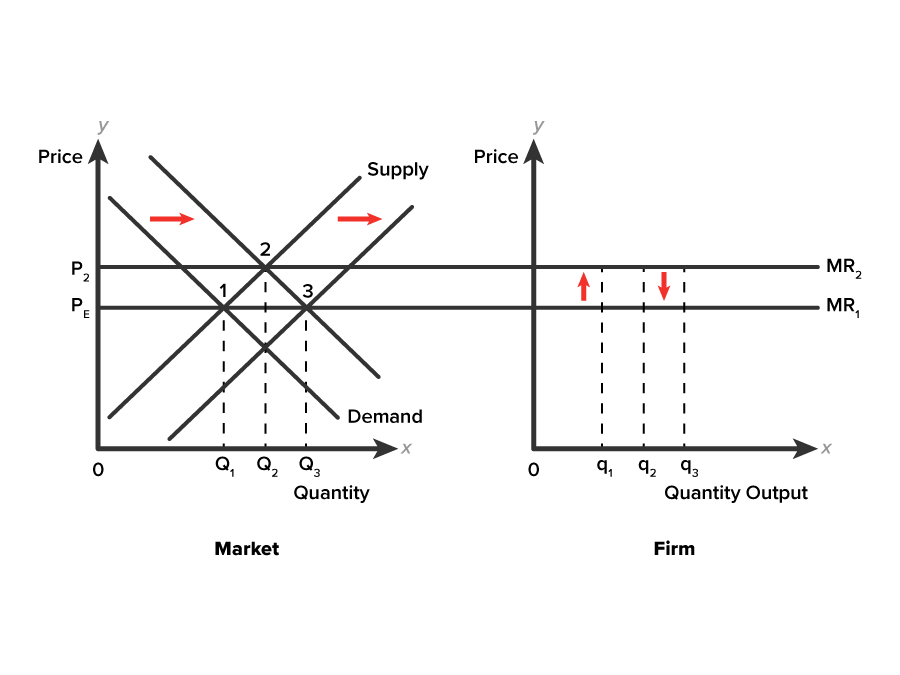
Because the market was in short-run equilibrium before the disturbance, firms were earning normal or break-even profits. The new price () will exceed the ATC for firms. Existing firms will now be earning short-run economic profit. Because the rate of return on investment in this market exceeds normal profits, new competitors will be drawn into the hand sanitizer market. New competitors will increase the number of total sellers in the market. The number of sellers is a non-price factor of supply. When supply increases, the supply curve for the product shifts rightward from point (2) to point (3). In the diagram, the equilibrium price falls from to and the equilibrium quantity rises from to  .
.
For existing firms and new competitors in the hand sanitizer market, a lower selling price from to causes firms to decrease the quantity of output from to . Remember the law of supply? Decreased prices cause firms to decrease the quantity supplied.
Firms were earning short-run economic profit before the shift in supply. When the price returns to , all firms will be earning long-run zero economic profit (P = ATC). The rate of return on investment is equal to normal profits in the hand sanitizer market.
Once the market fully adjusts from the disturbance, it will be in long-run equilibrium, where the market price returns to with a higher market quantity supplied at . For firms, price equals long run ATC, and profits return to normal.
But will this always be the case? Not necessarily.
Whether price equilibrium is the same as before the disturbance, or is higher or lower than the original price, depends on long-run costs in the industry. We learned about the long-run average cost curve in Unit 2.
The long-run cost curve is U-shaped. We learned that on the left-hand side of the long-run cost curve, costs are high but falling as the quantity of output increases. In this case, the market price will be lower than its original value. In the middle of the long-run cost curve, costs are relatively constant as the quantity of output increases. In this case, the market price will be the same as its original value. And on the left-hand side of the long-run cost curve, costs are rising as the quantity of output increases. In this case, the market price will be higher than its original value. In each case, the price will be equal to the ATC, and each firm will earn long-run zero economic profits.
In the graph of the hand sanitizer market, the equilibrium price is . The rightward shift of demand from point (1) to point (2) raised the price to . The higher price and short-run profit opportunity attracted new firms into the industry. The supply curve shifted rightward from point (2) to point (3) and the price returned to . The market began in equilibrium at , and returns to equilibrium at .
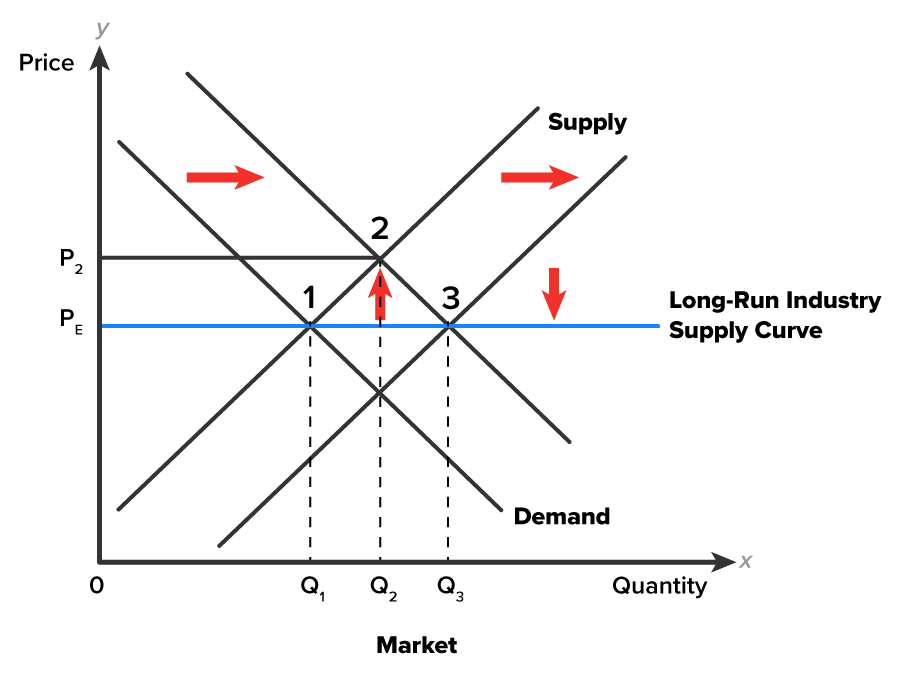
The industry’s long-run supply is plotted from equilibrium price to equilibrium price . The industry’s long-run supply for this market is horizontal at . From to firms in this industry are earning zero economic profit, that is, the market price per unit is equal to the average cost per unit.
The long-run average cost of production did not change as the scale of operation changed from to . Costs remained constant. When inputs (i.e. capital and labor) increase, outputs likewise increase in the same proportion. This phenomenon is known as constant returns to scale. This type of industry is classified as a constant cost industry. While perfectly competitive industries are constant cost industries, not all industries are classified as constant cost.
Recall that a decreasing cost industry is one in which long-run average cost of production falls as the scale of production rises. Netflix and Pandora are examples of decreasing cost industries, as they produce goods and services for the commercial software industry. Businesses in the commercial software industry often experience lower per unit costs, as the number of subscriptions for their product grows.
Let’s examine how an increase in demand, a short-run disturbance, affects the long-run cost for this industry. Suppose in the graph that the market is in equilibrium at point (1) where the equilibrium price is , and the equilibrium quantity is . Firms in this market are earning normal profits, that is, the price per unit is equal to the average cost per unit. A short-run disturbance from either the demand-side or supply-side of the market will push the market out-of-equilibrium, and cause changes for both the market and the firm.
Suppose that consumer income rises. Consumer income is a non-price factor of demand. An increase in consumer income will increase market demand for downloadable subscription music. When demand increases, the demand curve for the product shifts rightward and raises the equilibrium price. In the graph, demand shifts right from point (1) to point (2). The equilibrium price rises from to , and the equilibrium quantity increases from to .
For existing firms in the subscription music industry, a higher selling price from to causes firms to increase the quantity of output. Remember the law of supply? Increased prices cause firms to increase the quantity supplied.
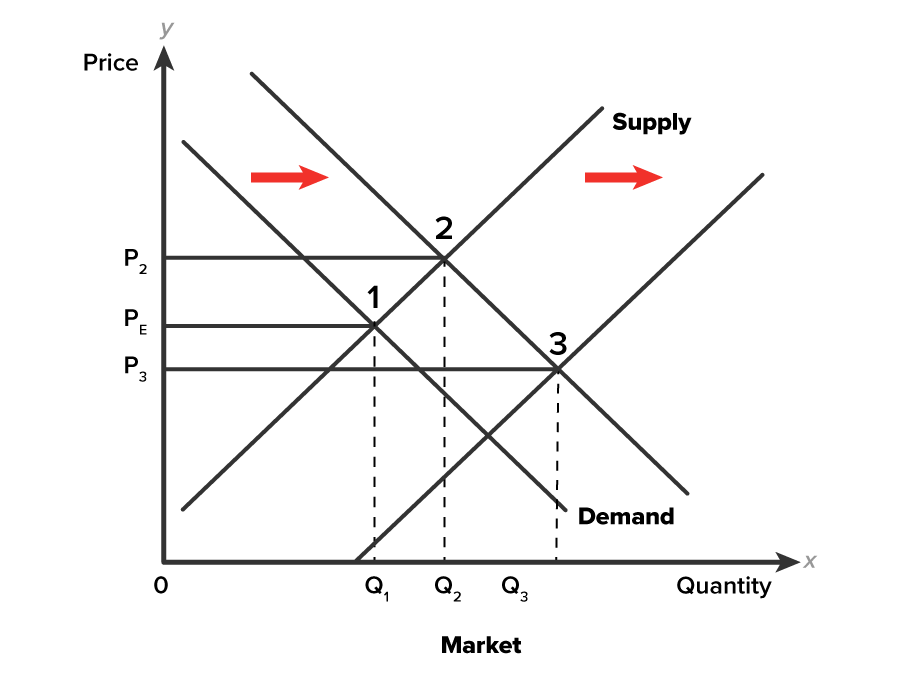
Assume the market was in short-run equilibrium before the disturbance, and firms were earning normal or break-even profits. The new price () will exceed the ATC for firms. Existing firms will now be earning short-run economic profit. Because the rate of return on investment in this market exceeds normal profits, new competitors will be drawn into the downloadable subscription music market. New competitors will increase the number of total sellers in the market. The number of sellers is a non-price factor of supply. When supply increases, the supply curve for the product shifts rightward from point (2) to point (3). In the graph, the equilibrium price falls from to  , and the equilibrium quantity rises from to . More output is being produced at a price below the original price ().

For existing firms and new competitors in the downloadable subscription music market, a lower selling price from to causes firms to decrease the quantity of output. Remember the law of supply? Decreased prices cause firms to decrease the quantity supplied.
Firms were assumed to be earning short-run economic profit before the shift in supply. Suppose that the downloadable subscription music market is a monopolistically competitive market. When the price drops to firms earn zero economic profit (P = ATC).
Once the market fully adjusts from the disturbance, it will be in the long-run equilibrium, where the new market price is with a higher market quantity supplied of . In the graph of the downloadable subscription music market, the new equilibrium is lower than the original price .
The industry’s long-run supply is plotted from equilibrium price to equilibrium price . The industry’s long-run supply for this market is downward-sloping from to .
The long-run average cost of production decreased as the scale of operation increased from to . Costs declined. When an industry experiences a reduction in its average cost of production because of an increase in production or output, this phenomenon is known as economies of scale.
Why might an industry experience economies of scale? One reason might be that initial fixed costs are high, but as production increases the high fixed cost is spread over an increasingly larger amount of output. This seems reasonable for the downloadable subscription music industry, which is a decreasing cost industry. Adding another subscriber is virtually without cost for the firm.
Recall that the long-run cost curve is U-shaped. On the left-hand side of the long-run cost curve, costs are high and falling as the quantity of output increases. In this case, the market price will be lower than its original value. An increase in the quantity produced leads to a decrease in the long-run average total costs.
Recall that an increasing cost industry is one in which long-run average cost of production rises as the scale of production rises. Industries involved with producing primary goods—such as oil and gas, timber, and precious metals—tend to experience rising per unit costs as output increases. The diamond mining industry is one in which digging becomes more expensive the deeper into the ground a firm searches for diamonds. To search for new fields requires a significant upfront investment. Firms in these areas of production are examples of increasing cost industries.
Let’s examine how an increase in demand, which is a short-run disturbance, affects the long-run costs for this industry. Suppose in the graph that the market is in equilibrium at point (1) where the equilibrium price is , and the equilibrium quantity is . Firms in this market are earning normal profits, that is, the price per unit is equal to the average cost per unit. A short-run disturbance from either the demand-side or supply-side of the market will push the market out-of-equilibrium, and cause changes for both the market and the firm.
Suppose that consumer income rises. Consumer income is a non-price factor of demand. An increase in consumer income will increase market demand for downloadable subscription music. When demand increases, the demand curve for the product shifts rightward and raises the equilibrium price. In the graph, demand shifts right from point (1) to point (2). The equilibrium price rises from to , and the equilibrium quantity increases from to .
For example, existing firms in the diamond mining industry, a higher selling price from to incentivizes firms to increase the quantity of output. Remember the law of supply? Increased prices cause firms to increase the quantity supplied.
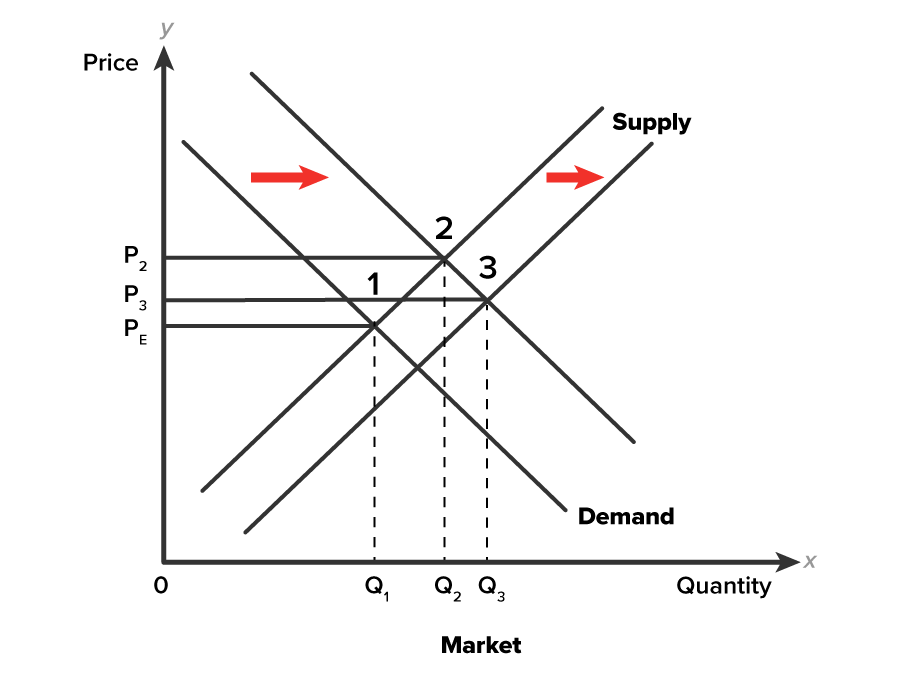
Assume the market was in short-run equilibrium before the disturbance, and firms were earning normal or break-even profits. The new price () will exceed the ATC for firms. Existing firms will now be earning short-run economic profit. Because the rate of return on investment in this market exceeds normal profits, new competitors will be drawn into the diamond mining market. New competitors will increase the number of total sellers in the market. The number of sellers is a non-price factor of supply. When supply increases, the supply curve for the product shifts rightward from point (2) to point (3). In the graph, the equilibrium price falls from to , and the equilibrium quantity rises from to . More output is being produced at a price above the original price ().
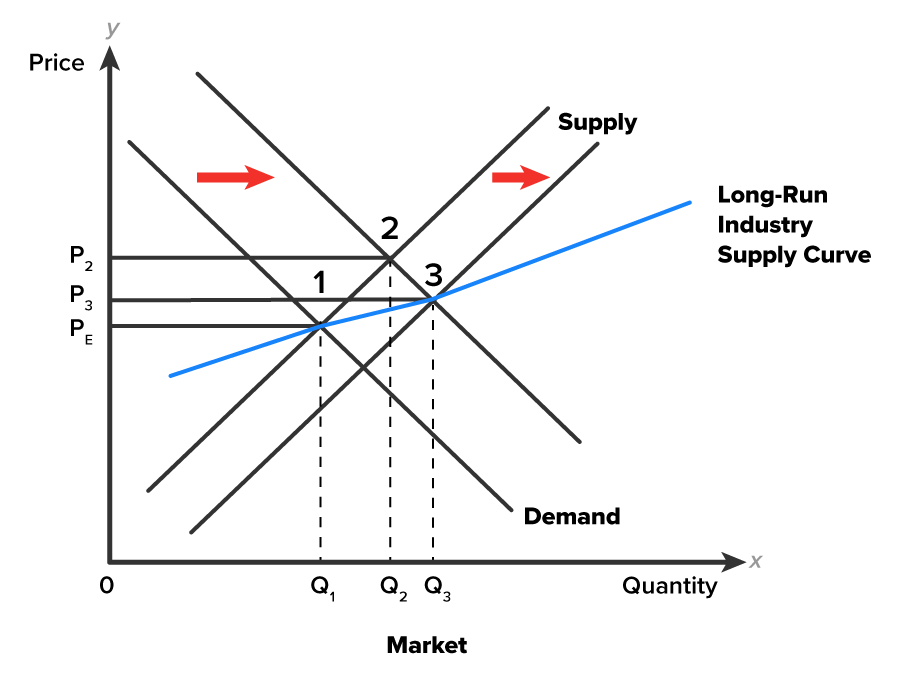
For existing firms and new competitors in the diamond mining market, a lower selling price from to causes firms to decrease the quantity of output. Remember the law of supply? Decreased prices cause firms to decrease the quantity supplied.
Firms were assumed to be earning short-run economic profit before the shift in supply. Suppose that the diamond mining market is an oligopoly market. When the price drops to firms earn short-run economic profit (P > ATC).
Once the market fully adjusts from the disturbance, it will be in long-run equilibrium, where the new market price is with a higher market quantity supplied of . In the graph of the diamond mining market, the new equilibrium is higher than the original price .
The industry’s long-run supply is plotted from equilibrium price to equilibrium price . The industry’s long-run supply for this market is upward-sloping from to .
The long-run average cost of production increased as the scale of operation increased from to . This phenomenon is known as diseconomies of scale. Why might an industry experience diseconomies of scale? One reason might be that when more competitors enter the market, demand for scarce resources rises or the fixed cost of physical capital investment increases. This seems reasonable for the diamond mining market, which is an increasing cost industry. Locating another diamond mine and setting up operations can be costly for the firm.
Recall that the illustrated long-run cost curve was U-shaped. On the left-hand side of the long-run cost curve, costs are rising as the scale of the operation increases. In this case, the market price will be higher than its original value. An increase in the quantity produced leads to an increase in the long-run average total costs.
Source: THIS TUTORIAL WAS AUTHORED BY SOPHIA LEARNING. PLEASE SEE OUR TERMS OF USE.



