In this lesson, you’ll explore how to lead with cultural humility and inclusivity to build stronger, more effective teams. You’ll learn what psychological safety looks like in action, how to recognize and address implicit bias and power dynamics, and how inclusive leadership practices can create environments where everyone feels heard, respected, and empowered. Through real-world examples and practical activities, you’ll develop the tools to foster equity, trust, and belonging in diverse team settings. Specifically, it will cover:
Psychological safety—the belief that one can speak up, make mistakes, or offer dissent without fear of humiliation or retribution—is the foundation of diverse and high-performing teams. When paired with intentional efforts to build diversity, leaders create inclusive environments where all team members feel valued and heard.
Key characteristics of psychologically safe teams include:
Open dialogue and feedback loops
Shared vulnerability and learning from failure
Respectful disagreement and curiosity
Consistent leader modeling of humility and listening
Strategies to build psychological safety include:
Begin meetings with open-ended check-ins
Reward speaking up, especially around errors or dissent
Address microaggressions promptly and respectfully
Conduct anonymous team climate surveys
2. Key Drivers of Inclusive and Culturally Humble Leadership
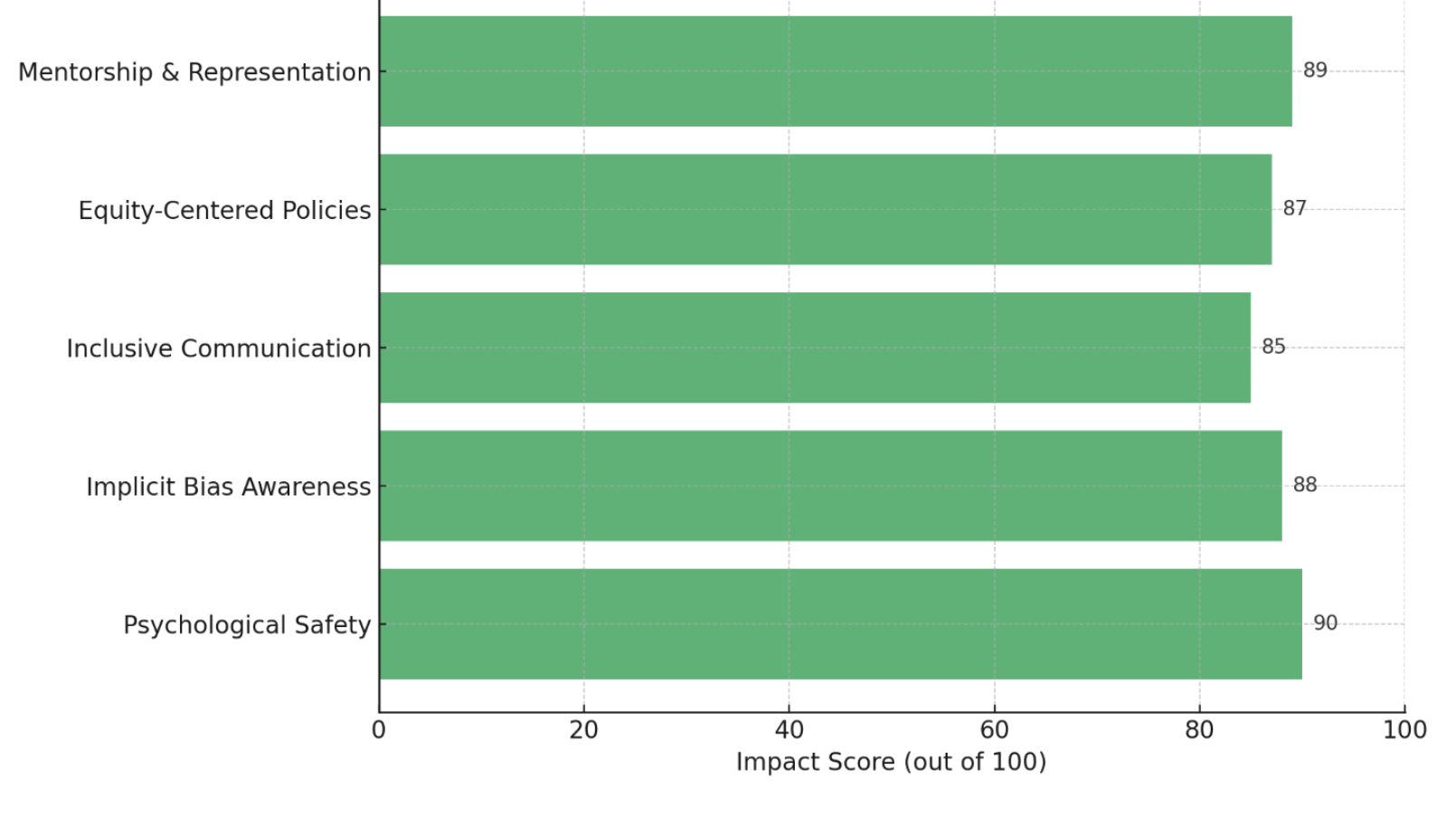
The key drivers of inclusive and culturally humble leadership include psychological safety, mentorship and representation, implicit bias awareness, equity-centered policies, and inclusive communication. These elements work together to create environments where individuals feel respected, valued, and empowered to contribute fully. Focusing on these drivers helps leaders build trust, foster collaboration, and ensure that all voices are heard and included in decision-making processes.
Key Drivers of Inclusive and Culturally Humble Leadership
EXAMPLE
In a multi-lingual hospital unit, a nurse manager starts weekly safety huddles by asking, “What’s one thing that made your job harder this week?” This fosters openness, surfaces barriers, and affirms team voices.
try it
Activity: Team Audit for Safety and Inclusion
Directions:
1. Assess your team using prompts:
Does every member feel safe to speak?
Do meetings represent all voices?
What systems might unintentionally exclude some?
2. Choose one inclusive practice to implement this week.
3. Address Implicit Bias and Power Dynamics
Implicit biases are unconscious attitudes that affect understanding, actions, and decisions. Left unchecked, they can reinforce inequities in patient care, team dynamics, and hiring. Culturally humble leaders continuously examine their own assumptions and actively work to redistribute power.
Here is a Power and Bias Flowchart visual, illustrating how unexamined power and implicit bias can lead to exclusionary outcomes—and how intentional leadership can reverse this pattern through awareness and equitable practice:
Unexamined Power → Decisions made without critique of influence or hierarchy
Implicit Bias → Unconscious beliefs affect perception and judgment
Exclusionary Outcomes → Certain voices are silenced or sidelined
Awareness & Accountability → Bias and power are named and addressed
Equitable Practice → Systems are reshaped to include all perspectives
This flowchart supports the development of equity-focused, culturally humble leadership.
3a. Common Forms of Bias in Healthcare
Affinity bias (favoring those who resemble oneself)
Confirmation bias (favoring evidence that supports preconceptions)
Attribution bias (misjudging actions based on stereotypes)
Power Dynamics may also appear in:
Who speaks vs. who is interrupted
Who receives mentorship or advancement opportunities
Whose discomfort is centered during conflict resolution
3b. Steps for Identifying and Mitigating Bias
Self-Awareness – Take implicit bias assessments (e.g., Harvard IAT)
Feedback Loops – Encourage diverse perspectives and challenge groupthink
Equity Audits – Analyze outcomes across demographics (e.g., who is promoted, heard, burdened)
Interruptive Practices – Speak up when bias or inequity appears in real-time
EXAMPLE
A unit director notices that feedback is consistently harsher for new nurses of color. She reviews documentation and finds subjective comments. A new standard is implemented for bias-free performance evaluations and co-review processes.
try it
Activity: Power Mapping Exercise
Directions:
1. List all voices in your team or department.
2. Ask: Who holds formal power? Who influences informally? Whose perspectives are missing in key decisions?
3. Write one action to rebalance decision-making power.
4. Foster Equity Through Inclusive Leadership Practices
Inclusive leadership goes beyond representation. It requires intentional behaviors and systems that ensure every person—regardless of background—has access to opportunity, recognition, and voice. Equity acknowledges that different individuals need different support to thrive.
Key inclusive leadership behaviors:
Assume difference: Don’t expect others to adapt to the dominant culture
Share credit and responsibility
Use inclusive language and communication styles
Offer flexible accommodations and growth pathways
4a. From Diversity to Belonging
Diversity = who is at the table
Inclusion = who gets to speak
Equity = who has what they need to thrive
Belonging = who feels valued for being themselves
key concept
Inclusive leaders foster all four.
4b. Inclusive Leadership Practices
Rotate team leadership or spokesperson roles
Celebrate diverse holidays and perspectives
Create mentorship pipelines for underrepresented staff
Set measurable equity goals and share progress transparently
EXAMPLE
An executive team sets a quarterly review of salary equity by gender and race. Results are shared with transparency, and inequities are addressed. The process becomes institutionalized in HR.
try it
Activity: Inclusive Leadership Self-Check
Directions:
1. Rate yourself on a scale of 1–5:
I actively seek feedback from diverse voices
I hold myself and others accountable for inclusive practices
I intervene when exclusion is happening
I learn continuously about systems of oppression and privilege
2. Identify one area to improve and one you feel confident in.
big idea
Leading with cultural humility and inclusivity is not a one-time training—it's a lifelong practice of self-reflection, accountability, and intentional system change. By cultivating psychological safety, addressing bias, and advancing equity-focused leadership behaviors, leaders create resilient, diverse teams that elevate both human dignity and performance.
Support
If you are struggling with a concept or terminology in the course, you may contact [email protected] for assistance.
If you are having technical issues, please contact [email protected].