Table of Contents |
Leadership, the third key management function, is the process of guiding and motivating others toward the achievement of organizational goals. A leader can be anyone in an organization, regardless of position, able to influence others to act or follow, often by their own choice. Managers are designated leaders according to the organizational structure but may need to use negative consequences or coercion to achieve change. In the organization structure, top managers use leadership skills to set, share, and gain support for the company’s direction and strategy—its mission, vision, and values. Effective leadership is about influencing, motivating, and guiding others to reach the organization’s objectives. This involves:
To be effective leaders, managers must be able to influence others’ behaviors. This ability to influence others to behave in a particular way is called power. Researchers have identified five primary sources, or bases, of power:
IN CONTEXT: Types of Power in a Coffee Shop
As you review the table, consider what types of power might have the most impact on employees and what types of power current or past managers have used, and determine what was the most effective.
Type of Power Example in a Coffee Shop Legitimate power:
Power that comes from a formal position or role
The owner sets employee schedules and job duties because they are in charge.Reward power:
Power based on the ability to give rewards
The owner gives a bonus or extra day off to the barista who upsells the most pastries.Coercive power:
Power based on the ability to punish or discipline
The owner warns that repeated lateness will lead to reduced shifts or termination.Expert power:
Power from having knowledge or skills others value
The owner teaches staff how to make the perfect espresso based on years of barista training.Referent power:
Power from being admired or respected
Employees look up to the owner because they are kind, passionate, and lead by example.
Have you ever thought about the way people manage? A management style is the way a manager plans, organizes, makes decisions, delegates tasks, and supervises employees. There are literally hundreds of theories on the various ways people manage others, so let’s take a look at one of the main theories.
The autocratic management style is highly directive, with the manager making decisions independently and expecting employees to follow instructions without offering input. This approach is often summed up as “do it my way” and is characterized by a clear top-down structure. One advantage of this approach is that decision-making is swift and unambiguous since authority rests solely with the manager. However, it can also discourage employee engagement and lead to dissatisfaction among those who prefer collaboration or autonomy in their work.
In contrast, the democratic style encourages participation by involving employees in the decision-making process. It’s essentially a “let’s decide together” approach, where managers seek input from team members before arriving at a conclusion. A key benefit of the democratic style is that it fosters a sense of inclusion and empowerment across the organization. On the downside, this collaborative process can be time consuming, often slowing down decisions due to the need for consensus and discussion.
The free-rein or laissez-faire style allows employees significant autonomy, with minimal managerial supervision. Managers who use this approach trust their teams to take initiative and work independently. This method empowers individuals to think outside the box and contribute original ideas, which can be highly beneficial to the organization. However, without clear oversight, it may lead to inconsistent performance or missed deadlines, especially if team members lack structure or accountability.
The contingency style is more fluid, adapting the management approach based on the needs of a specific situation. Rather than committing to one style, managers assess the circumstances—such as team readiness, project urgency, or organizational change—and apply the most effective strategy accordingly. This flexibility can be very effective, as it allows leaders to respond appropriately to shifting demands. However, if not communicated clearly, the variability in management style may confuse employees, who may be unsure of what to expect or how much input they are allowed.
Let’s look at how each of these styles might play out with our coffee shop owner:
IN CONTEXT: Management Styles in a Coffee Shop
As you review the table, consider what style you prefer to work under.
Management Style Example in a Coffee Shop Autocratic:
The manager makes decisions independently and expects compliance.
The owner sets strict rules for how drinks must be made and does not allow baristas to make changes or offer suggestions.Democratic:
The manager includes employees in decision-making.
The owner holds regular staff meetings to get input on new menu items or promotional ideas.Free-rein (laissez-faire):
The manager offers minimal supervision and allows employees autonomy.
Baristas are trusted to design seasonal drinks or manage their own schedules within reason.Contingency:
The manager adjusts their style based on the situation.
During a busy holiday rush, the owner uses an autocratic style to maintain efficiency but returns to a more democratic style during slower periods to brainstorm new ideas with the team.
Organizations and people frequently transition between these styles as needed.
EXAMPLE
A company might begin a project with a free-rein approach to encourage creative brainstorming, move to a democratic model for planning and coordination, and then adopt a more autocratic style when tight deadlines require quick, decisive action.The effectiveness of any management style ultimately depends on its alignment with organizational goals, team dynamics, and the ability of leadership to clearly communicate expectations.
When leaders are effective, they have an understanding of what motivates people and what makes them “tick.” Everyone is motivated by something different. A key element to consider when looking at how a leader can motivate people to meet company goals is the idea of intrinsic or extrinsic motivation. Intrinsic motivation comes from within the individual. It refers to doing something because it is personally rewarding or fulfilling. People who are intrinsically motivated engage in an activity for the enjoyment, interest, or personal challenge it provides.
EXAMPLE
A barista who loves experimenting with latte art may stay late to perfect their designs simply because they find it fun and satisfying.Extrinsic motivation, on the other hand, comes from outside the individual. It involves performing a task to earn a reward or avoid punishment.
EXAMPLE
A barista might focus on making drinks quickly to receive a performance bonus or avoid criticism from their manager.Like with leadership styles, there are literally hundreds of motivation theories. Let’s take a look at some of those theories. As you read through these theories, consider what elements might be considered intrinsic or extrinsic methods of motivation, and consider what motivates you at work.
The two-factor theory, posited by Frederick Herzberg in Pittsburgh, is a theory of motivation that argues that both workplace hygiene and motivation have an impact on worker satisfaction. Hygiene factors, in this case, refer to factors such as workers’ supervisors, their pay, the security of their jobs, working conditions, company policies, and interpersonal relationships.
The motivational factors are things like achievement or recognition. Sometimes, it is simply the satisfaction of doing the job itself, or the responsibility that goes along with doing that job, that motivated workers. Or it can be the advancement or growth within the company that motivates the employer and increases employee satisfaction.
Maslow’s hierarchy of needs is a theory of motivation that argues that humans must meet their most basic needs before meeting complex ones. This model was developed by a man named Abraham Maslow. Maslow’s hierarchy of needs takes the form of a five-level pyramid of needs, which range from physiological needs all the way up to something called self-actualization.
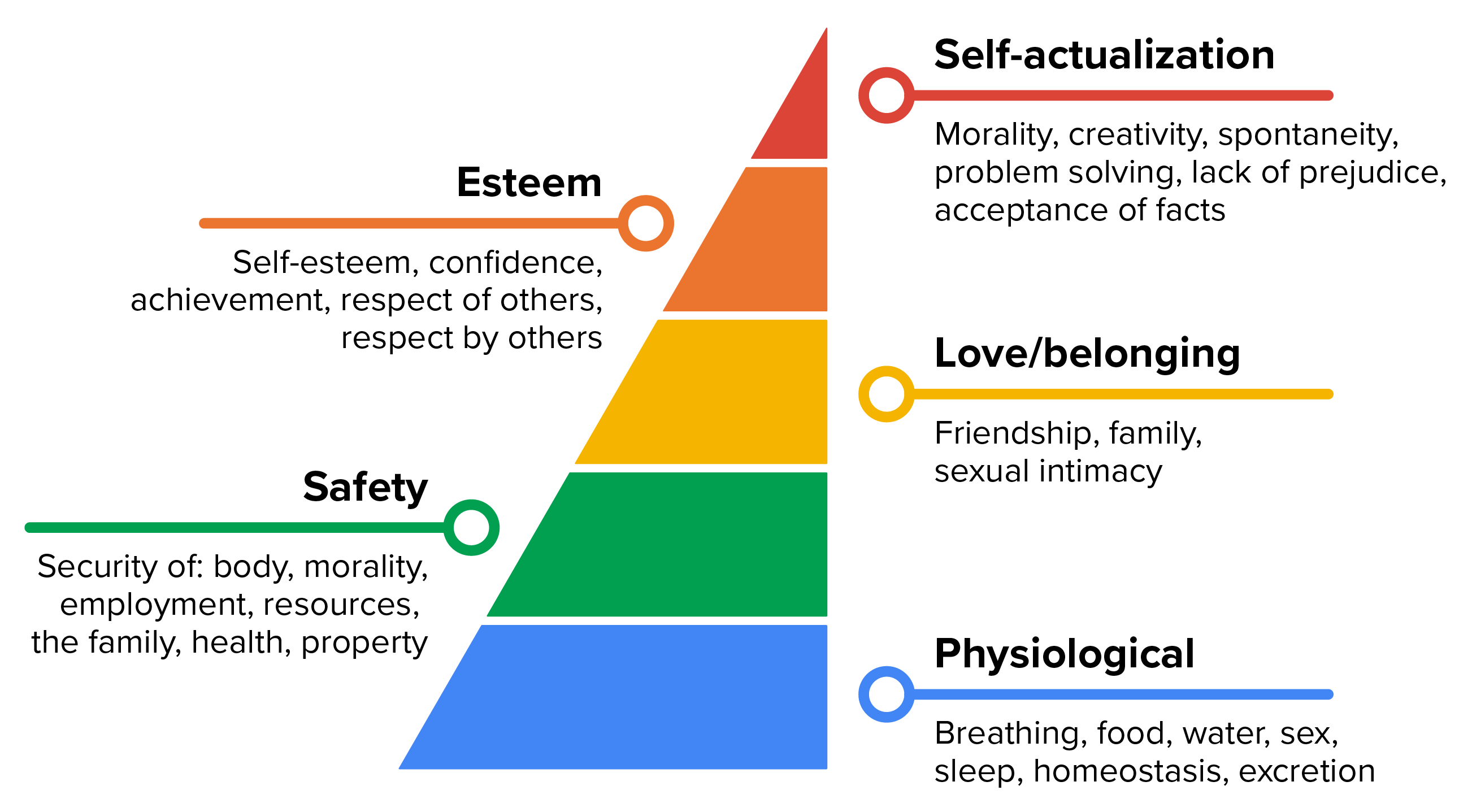
The five levels within the pyramid include the physiological needs as mentioned before, security needs, social needs for love and belonging, a need for esteem or recognition, and, finally, self-actualization at the top of the pyramid. Once all of the needs below have been satisfied, a person can become self-actualized.
Expectancy theory is a theory of motivation that argues that individuals will work harder if they believe that what they expect and want are actually attainable. The idea here is that people are motivated to get rewards that they believe are achievable.
If you look at the process below, you’ll notice that effort comes first, and effort leads to performance, which, in turn, leads to outcome. That outcome is something that people expect—and want—to actually happen. This, according to expectancy theory, is what leads to motivation.
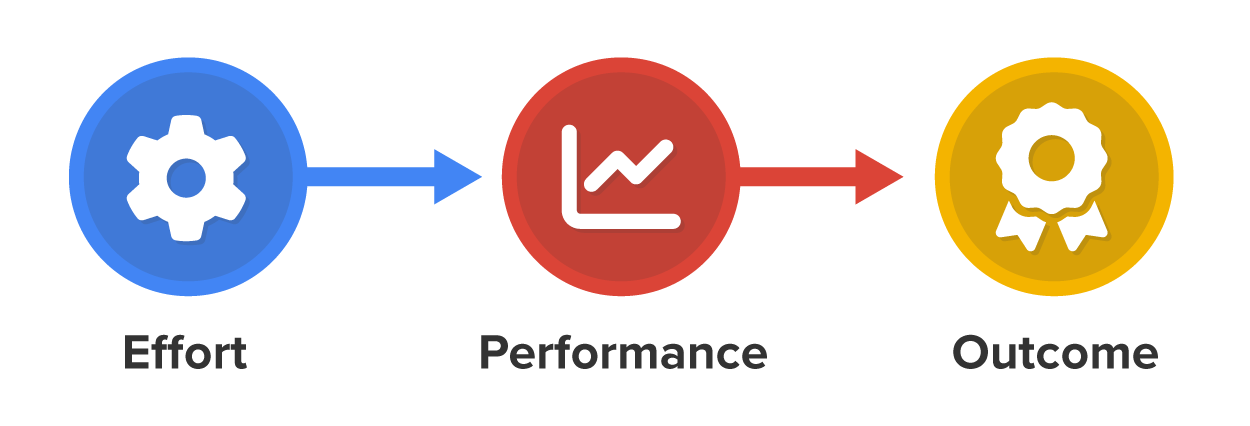
This can be useful when leading people because an organization can set attainable goals and rewards for its employees for that effort, performance, and outcome.
The equity theory is a theory of motivation that argues that employees will work more consistently and generally enjoy their job more if they believe that all employees are being treated in the same manner.
It’s important that people don’t feel like they’re getting the short end of the stick or a raw deal. If they believe they’ve been treated unfairly, their motivation goes down, because they feel like someone else is getting a better deal than they are. This is based—on the employees’ behalf, at least—on a comparison with their coworkers, relative to the inputs that they put in and the outputs that they receive. Human resources needs to make sure that all the benefits and pay are equitable across the employee base.
Empowerment means giving employees increased autonomy and discretion to make their own decisions, as well as control over the resources needed to implement those decisions. While this isn’t a motivation theory in itself, it is a powerful tool to motivate people. When decision-making power is shared at all levels of the organization, employees feel a greater sense of ownership in, and responsibility for, organizational outcomes. Some companies implement a method of motivation called management by objectives (MBO). This is a strategic management approach in which managers and employees work together to set, monitor, and achieve specific goals within a defined time frame, and it can be a powerful empowerment tool.
EXAMPLE
In a coffee shop setting, a manager might work with a team member to set a goal of increasing customer satisfaction scores by 10% over the next quarter. Together, they might create a plan to improve order accuracy, speed of service, and friendly customer interactions.MBO encourages communication, clarity, motivation, and alignment between personal performance and company success.
Let’s summarize these theories of motivation that you’ve learned in this lesson:
Source: THIS CONTENT HAS BEEN ADAPTED FROM RICE UNIVERSITY’S “'''INTRODUCTION TO BUSINESS'''”. ACCESS FOR FREE AT OpenStax. LICENSE: CREATIVE COMMONS ATTRIBUTION 4.0 INTERNATIONAL.



