Table of Contents |
A labor union is an organization that represents workers and works with management over bargaining topics such as wages, hours, and working conditions. Unions are an integral part of operations management in many industries. Operations workers in production facilities, factories, airlines, transportation services, and even restaurants are often unionized, and those that are not may be trying to organize. Understanding the impact of labor unions on leadership and management is an important consideration when running effective operations. Operations executives will often need to enter collective bargaining with union representatives.
Tens of thousands of American firms are unionized, and millions of U.S. workers belong to unions. Historically, the mining, manufacturing, construction, and transportation industries have been significantly unionized, but in recent years, service-based firms, including health care organizations, have been unionized.
The labor relations process that produces a union-management relationship consists of three phases:
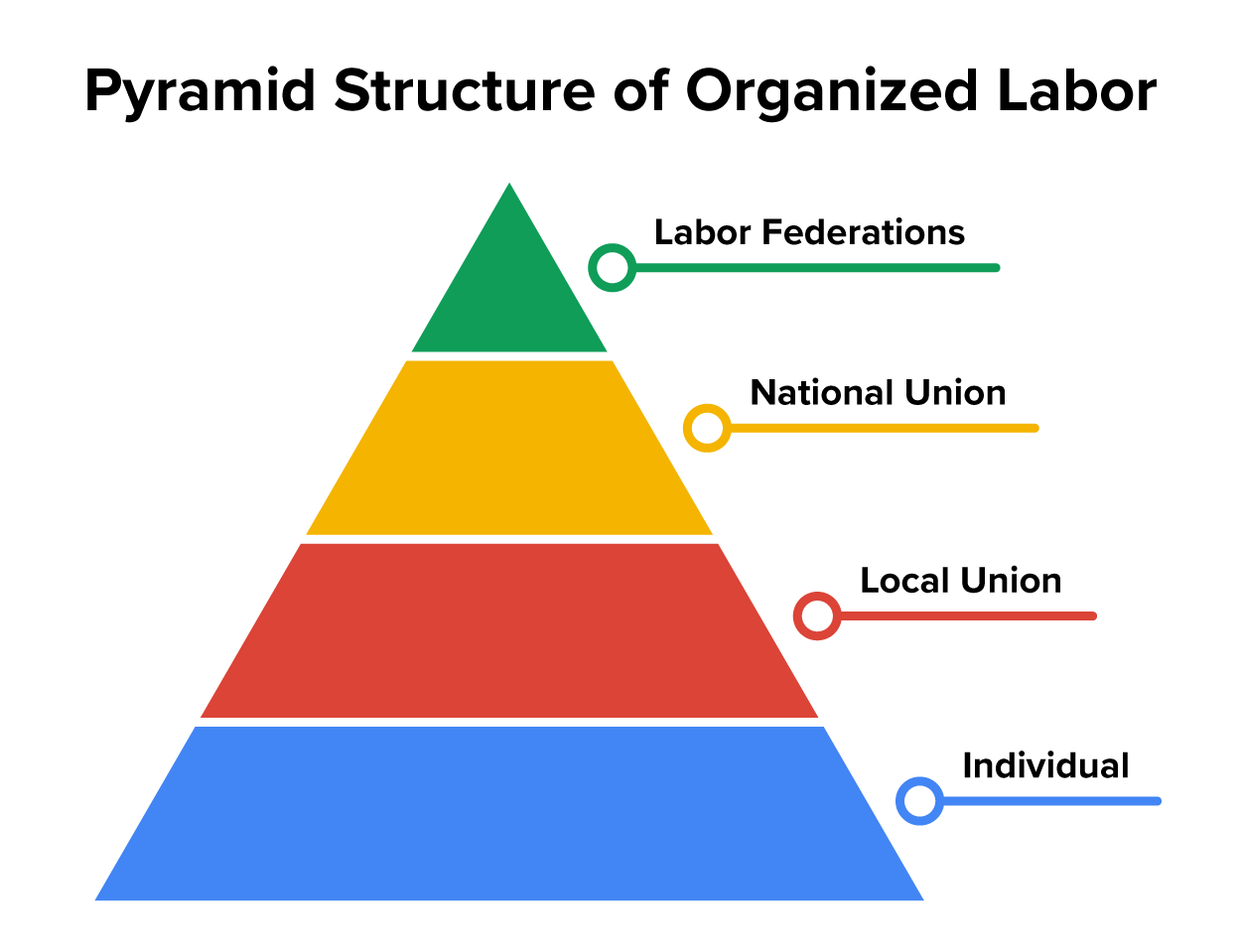
As described above, nonunion workers become unionized through an organizing campaign. The campaign is started either from within, by unhappy employees, or from outside, by a union that has picked the employer for an organizing drive. Once workers and the union have made contact, a union organizer tries to convince all the workers to sign authorization cards. These cards prove the worker’s interest in having the union represent them. In most cases, employers resist this card-signing campaign by speaking out against unions in letters, posters, and employee assemblies. However, it is illegal for employers to interfere directly with the card-signing campaign or to coerce employees into not joining the union.
Once the union gets signed authorization cards from at least 30% of the employees, it can ask the National Labor Relations Board (NLRB) for a union certification election. The NLRB enforces the National Labor Relations Act, which allows workers to unionize. This election, by secret ballot, determines whether the workers want to be represented by the union. The NLRB posts an election notice and defines the bargaining unit—employees who are eligible to vote and who will be represented by a certain union if it is certified. Supervisors and managers cannot vote. The union and the employer then engage in a pre-election campaign conducted through speeches, memos, and meetings. Both try to convince workers to vote in their favor. The table below lists benefits usually emphasized by the union during a campaign and common arguments employers make to convince employees a union is unnecessary.
The election itself is conducted by the NLRB. If a majority vote for the union, the NLRB certifies the union as the exclusive bargaining agent for all employees who had been designated as eligible voters. The employer then must bargain with the union over wages, hours, and other employment terms.
In some situations, after one year, if the union and employer don’t reach an agreement, the workers petition for a decertification election, which is similar to the certification election but allows workers to vote out the union. Decertification elections are also held when workers become dissatisfied with a union that has represented them for a longer time.
The reasons usually given for supporting unions include:
A labor agreement, or union contract, is created through collective bargaining. Typically, both management and union negotiation teams are made up of a few people. One person on each side is the chief spokesperson. Bargaining begins with union and management negotiators setting a list of contract issues that will be discussed. Much of the bargaining over specific details takes place through face-to-face meetings and the exchange of written proposals. Demands, proposals, and counterproposals are exchanged during several rounds of bargaining. The resulting contract must be approved by top management and ratified by the union members. Once both sides approve, the contract is a legally binding agreement that typically covers such issues as union security, management rights, wages, benefits, and job security.
When the two groups cannot reach an agreement, unions may authorize a strike, meaning that workers vote to stop working until a new contract is reached, putting pressure on management to make further concessions. Strikes are usually backed by public relations battles to win public approval. Some unionized groups, like police officers, are not allowed to strike because of public safety. While some strikes are quickly resolved, within days or weeks, others have dragged on for months or even years. Sometimes strikes end with the union reps accepting the last proposal they rejected, if workers vote to end the strike and return to work. The company is then perceived as “winning” but may face long-term damage to their reputation.
A union wants all employees to be union members. This can be accomplished by negotiating a union security clause. The most common union security arrangement is the union shop, or closed shop, whereby nonunion workers can be hired by the firm but then must join the union within 30 or 60 days. An agency shop does not require employees to join the union, but to remain employees, workers must pay the union a fee (known as the agency fee) to cover the union’s expenses in representing them. The union must fairly represent all workers, including those in the bargaining unit who do not become members.
Under the Taft-Hartley Act of 1947, a state can make all forms of union security illegal by enacting a “right-to-work" law. In the 28 states that have these laws, meaning employees can work at a unionized company without having to join the union, this arrangement is commonly known as an open shop. Workers don’t have to join the union or pay dues or fees to the union. This often leads to the demise of the union.
When a company becomes unionized, management loses some of its decision-making abilities. But management still has certain rights that can be negotiated in collective bargaining. One way to resist union involvement in management matters is to put a management rights clause in the labor agreement. Most union contracts have one. A typical clause gives the employer all rights to manage the business except as specified in the contract. For instance, if the contract does not specify the criteria for promotions, with a management rights clause, managers will have the right to use any criteria they wish. Another way to preserve management rights is to list areas that are not subject to collective bargaining. This list might secure management’s right to schedule work hours; hire and fire workers; set production standards; determine the number of supervisors in each department; and promote, demote, and transfer workers.
Much bargaining effort focuses on wage adjustments and changes in benefits. Once agreed to, they remain in effect for the length of the contract. In addition to requests for wage increases, unions usually lobby for better benefits. In some industries, such as steel and auto manufacturing, benefits are 40% of the total cost of compensation. Benefits may include higher wages for overtime work, holiday work, and less desirable shifts; insurance programs (life, health and hospitalization, dental care); payment for certain nonwork time (rest periods, vacations, holiday, sick time); pensions; and income-maintenance plans. Supplementary unemployment benefits (income-maintenance) found in the auto industry are provided by the employer and are in addition to state unemployment compensation given to laid-off workers. The unemployment compensation from the state and supplementary unemployment pay from the employer together maintain as much as 80% of an employee’s normal pay.
EXAMPLE
In some cases, negotiations stall and strikes occur over working conditions, not pay or benefits. In 2022, in Minnesota, nurses staged a 3-day strike that was primarily about conditions that affected their patients; it was resolved in part by extending more power to nurses in managerial decision making.Wage adjustments, cost-of-living increases, supplementary unemployment pay, and certain other benefits give employees under union contracts some financial security. But most financial security is directly related to job security—the assurance, to some degree, that workers will keep their jobs. Of course, job security depends primarily on the continued success and financial well-being of the company.
Seniority, the length of an employee’s continuous service with a firm, is discussed in about 90% of all labor contracts. Seniority is a factor in job security; usually, unions want the workers with the most seniority to have the most job security. This is one of the reasons workers oppose unions, because it limits raises and promotions to what the union contract dictates, with few or no allowances to merit-based pay or promotion.
A labor union can impact several aspects of the operations manager’s job. First, few people rise through the ranks without beginning at “the ground level,” meaning operations executives may have been in the union before they rose to management, and thus understand the perspectives of union workers.
In terms of managing costs, collective bargaining agreements (CBA) that require pay increases need to be considered and included in production budgets. In terms of scheduling, understanding the union contracts on hours worked, overtime, and other aspects will help the operations manager schedule organization needs while meeting the contract requirements.
Often, collective bargaining agreements also address safety and health, so while of course it is important to maintain safety standards, all elements regarding safety in the CBA should be addressed by the operations manager. The operations manager should also consider union contracts, and the possibility of union strikes, slowdowns, and public relations issues to keep the facilities and business running effectively.
In short, an operations manager should try to cultivate a positive relationship with union representatives and hear their concerns, and this may be easier to do if the manager was formerly in the union. An adversarial position—such as responding to public criticism by union members with criticism of the workers—is more likely to result in work slowdowns and a dysfunctional environment.
Source: This tutorial has been adapted from OPENSTAX “INTRODUCTION TO BUSINESS”. ACCESS FOR FREE AT OPENSTAX.ORG/BOOKS/INTRODUCTION-BUSINESS/PAGES/1-INTRODUCTION. License: Creative Commons Attribution 4.0 International.



