Table of Contents |
You have likely heard of Don Quixote. The full title of this massive work of fiction is El ingenioso hidalgo don Quixote de la Mancha, and it was written by Miguel de Cervantes Saavedra. The first volume of this magnum opus was published in 1605, and the second volume was published in 1615. It is thought by many to have been the first novel ever written, and is widely regarded as one of the most important books of all time.
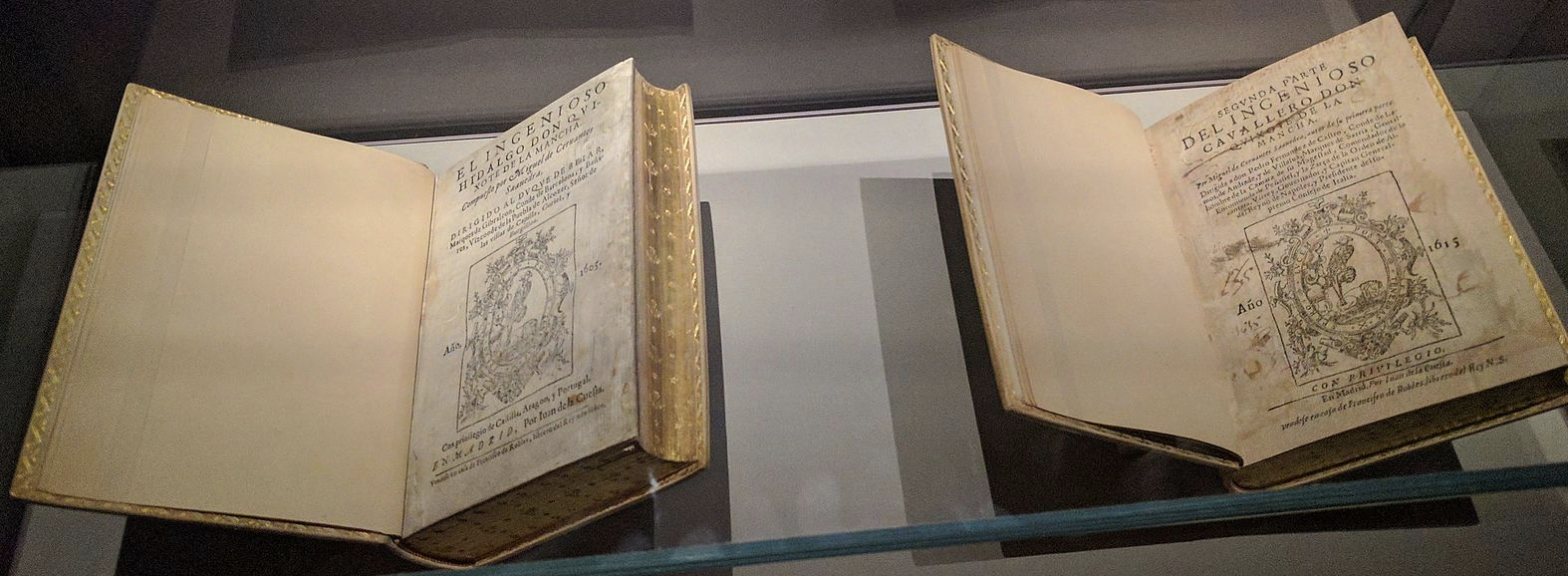
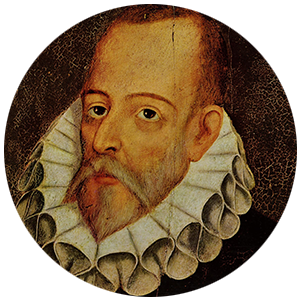 Miguel de Cervantes Saavedra was born in 1547 in Alacalá de Henares, and died in 1616 in Madrid. His family was thought to be of converso origin (converts to Catholicism of Jewish ancestry). His father, Rodrigo de Cervantes, was a "barber surgeon," a barber who cared for soldiers during and after battle. Little is known about his mother, Leonor de Cortinas, but she could read and write, and she supported her seven children while her husband was in prison for debt. The family moved often in search of work, and they had luck living in Seville during its economic boom. It is thought that Cervantes attended the Jesuit college in Seville.
In this lesson, you will read one of the stories from Don Quixote, called El loco de Sevilla, which illustrates how the preterite and imperfect are used in storytelling. It is not necessary for you to be familiar with the full work in order to understand and appreciate this excerpt as an isolated story. The story is contextualized in this lesson, meaning that you will be given tools to aid you in comprehension. This will keep you focused on the story without interrupting your reading to look up the meaning of unfamiliar words.
First, you will engage with preparatory activities in this Antes de leer section. You will learn more about Seville, Spain, where the story takes place. You will also learn about the author, Cervantes, and the work itself, Don Quixote. In addition to this background information, you will engage in activities to review relevant grammatical concepts that you have learned previously. These will help enhance your understanding of the story.
While reading the story in the section called El texto, you will be aided by a glossary so that you can see Spanish synonyms for unfamiliar words. You will find a PDF of those terms with Spanish synonyms at the end of the lesson. Please download that document, and use it for reference instead of looking up the unfamiliar words. That will keep you focused on the target language while you are reading. You will encounter many verbs in tenses that you have learned, but you will also see verbs in tenses that you have not yet learned. There is an additional verb reference PDF at the end of the lesson, which will provide the meaning as well as the name of the tense. You will also see an image when a character in the story speaks, which will help to identify who is saying what. Other than in dialogue, the story uses third-person narration.
Finally, you will have the chance to test your knowledge in the Después de leer section. You will practice new vocabulary, review the uses and forms of the preterite and the imperfect, and answer comprehension questions.
Not only does the story that you are about to read from Don Quixote take place in Seville, many other works of Miguel de Cervantes Saavedra also have Seville as their backdrop. Seville is the capital of Andalucía. The year 1492 was pivotal to Seville, and to Spain in general, as it was the year Granada was reclaimed from the Moors, and it was the year when Christopher Columbus (Cristóbal Colón in Spanish) discovered a whole new world. Seville’s Golden Age was spurred by its exclusive trade with America, and its population jumped from 40,000 to 150,000. The city received the following labels: Puerto y Puerta de las Indias (Port and Gateway to the Indies), la gran Babilonia de España (Babylon of Spain), and la Nueva Roma (New Rome).
Now take a look at this map of Sevilla, España. Below the map, click on the plus signs to read more about various places on the map and to see pictures of them.
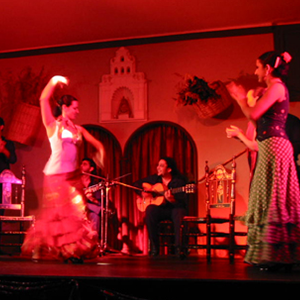 Flamenco is an art that was born in the South of Spain. Many think of it only as a dance, but it also has other forms, such as guitar music and song. Traditional flamenco is spontaneous in nature rather than rehearsed or choreographed. Its roots are complex and span many time periods and cultures. The Roma people, who originally hailed from India, may have brought rhythms with them that became part of flamenco. Also, the Moors (various ethnic groups originally from North Africa) heavily influenced this art form during the time of Muslim Spain.
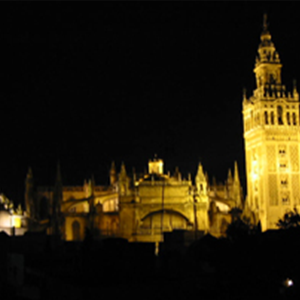 The Cathedral of Seville, the third largest cathedral in the world, was not the first building at this location. There is a foundation from Roman times, and a Visigothic temple was constructed on top of it. Next came the Arab mosque, built by the Moors who dominated southern Spain from 711 until 1492 (the end of Spain’s reconquest of Andalucía, which had been ruled by the Visigoths and Moors). At the time of the Reconquista, the main structure that we see today was begun; its construction lasted five centuries.
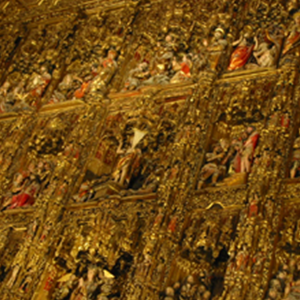 The main altar has as its backdrop gilded wooden carvings of 1,000 biblical figures. There are many beautiful side rooms separate from the nave, including a chapel house with an oval dome. The highlight of this cathedral is the tomb of Christopher Columbus.
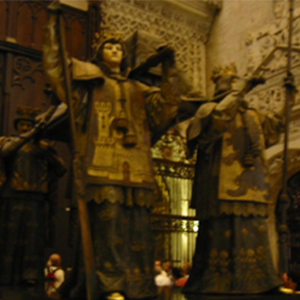 Rather than being housed below the cathedral, it is held aloft by four larger-than-life figures, representing the four kingdoms of Spain during the time of Columbus: Castile, Leon, Aragón, and Navarre. Due to the fact that he continued traveling across the Atlantic posthumously, there is doubt as to whether Columbus’s body is actually in this tomb or in Santo Domingo in the Dominican Republic.
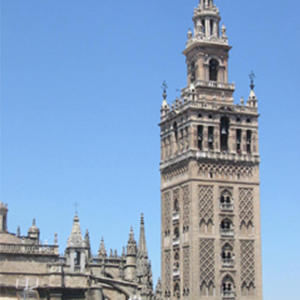 The Giralda, the bell tower of the cathedral, is the old minaret that survived the mosque previously occupying the site. The top portion was added to hold the bells, which ring often. If you visit, the climb to the top of the tower is very easy due to ramps. These were not designed to be mobility friendly per se, but rather used by guards who rode horses all the way to the top. This highest point in the city’s skyline provides a nice lookout. In its day, it was the tallest tower in the world. Also preserved from the original mosque is the beautiful and peaceful courtyard of orange trees (Patio de los Naranjos).
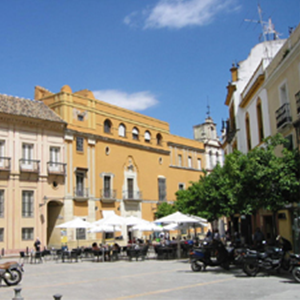 This beautiful neighborhood of white-washed homes is of Arab and Jewish origin. It is located in the historic center of the city. The white helps to keep the heat at bay, and the narrow winding streets provide shade and air currents. It is known for its patios full of beautiful flowers and plants.
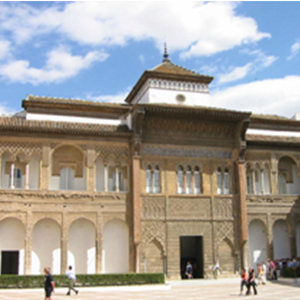 Seville’s Alcázar is a fortified hilltop palace complex with courtyards and fountains. The original building likely dates to 884 (a defense against a Norman invasion). The Nasrid King Mohamed V had important artisans from Toledo and Granada build a palace surrounding two patios in the late 1200s or early 1300s. Construction continued during the reconquest of 1248, but only ruins remain. During the reign of Alfonso X, el palacio Gótico (the Gothic Palace) was built. It was the Mudéjar Palace of Don Pedro I of Castille. After the discovery of America, la Casa de la Contratación (the House of Commerce) was located in the Alcázar.
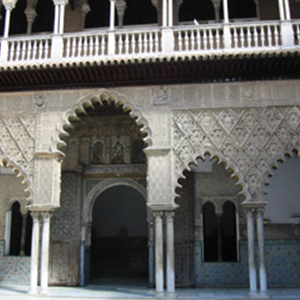 The architecture of the palace has a heavy Arab influence, because some Arabs chose to pledge allegiance to the conquering Christians rather than suffer the fate of their Moorish masters. Their immense architectural knowledge was employed by the Christian kings, whose palace reflects the geometric and floral designs of their builders. The whole palace is blanketed by beautiful tile work. This style of architecture was called Mudéjar, because this was the Spanish name for Arab residents who chose to stay in Spain.
 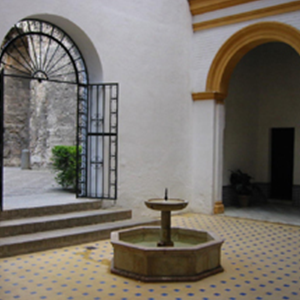 Though they built for Christian kings, the kings evidently did not read Arabic, as there is script in many places praising Allah, and proclaiming the Islamic faith above any other. The thin columns connected by arches and the abundance of water in the motif is symbolic of the desert oases surrounded by palms in North Africa.
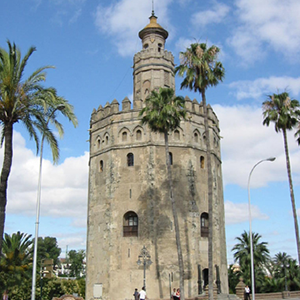 Along the Guadalquivir, you will see the Torre del Oro (Tower of Gold). It was built as a watchtower by the Moors in the 13th century. It used to shimmer as the sunlight danced across its original gold tiles. After serving as a watchtower, it became a gold warehouse, a Christian temple, the Headquarters of the Admiralty, and now serves as the Museo Marítimo (Maritime Museum).
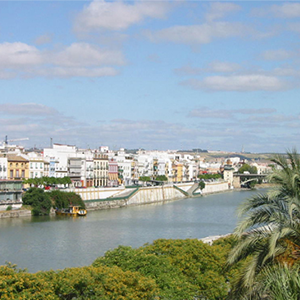 The Guadalquivir is Andalucía’s most important river. As a medium of trade, many important cities across multiple civilizations have developed alongside it. It was full of ships during its Golden Age when Seville enjoyed exclusive trade with America.
In the story El loco de Sevilla, you will notice the frequent use of ser and estar. While this is a concept from Spanish I, now is a great time to briefly review the reasons to use each one. The following summary is simplified, as you are merely reviewing these two verbs. Recall that there are adjectives that can be used with either verb, and that the verb choice can change the meaning of what is being communicated.
| soy | es | estoy | está |
In the story El loco de Sevilla, you will also notice the frequent use of the preterite and the imperfect tenses. You just completed Lesson 3.2.2 on the uses of those two past tenses. Remember that the preterite tense is used in order to refer to single completed events or actions. You can envision preterite verbs as points in time, with each point representing a single completed action.
The imperfect tense is used to express repeated or habitual actions in the past, and to express actions that were in progress in the past but not yet completed. There are several other reasons to use the imperfect tense, such as to express time, states of being, and age. You can envision the imperfect as a line through time where there is no reference to a starting or ending point.
Before you read the story, first take a moment to read through the list of characters. As you do, keep in mind that this story was written in the early 1600s by a man who had spent many years in captivity. Calling someone “crazy” (loco) at that time, before most mental illnesses had been identified, was very common and socially acceptable. Today, we might use the word “crazy” in situations that are more casual and less clinical. However, it is no longer considered an appropriate term to use to refer to someone who suffers from mental illness, nor are we suggesting so by including this story in this lesson.
| Audio |
Character (English Translation) |
Picture |
|---|---|---|
|
|
el licenciado (university graduate (the main character in the story is a licenciado) |

|
|
|
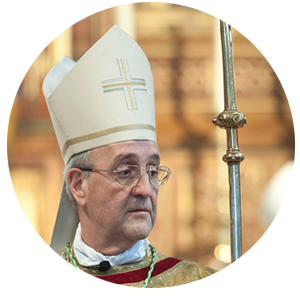
el arzobispo (the archbishop) |
|
|
|
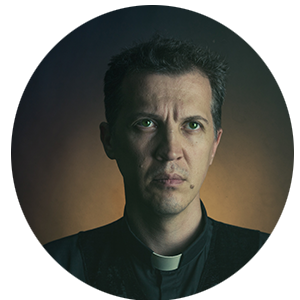
el capellán (the chaplain) |
|
|
|
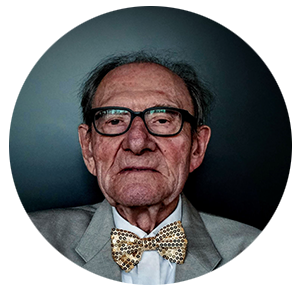
el rector (the director) |
|
|
|
un loco furioso (a furious, crazy man) |

|
|
|
otro loco (another crazy man) |

|
Below is the text of the story. Note that the underlined words have synonyms or explanations in the PDF glossaries that are provided at the end of this lesson. It is recommended that you download the glossaries and keep them available for easy reference as you read the story.
EL LOCO DE SEVILLA
En el manicomio de Sevilla, había un licenciado a quien sus parientes habían puesto por estar loco. Después de estar allí varios años, el hombre decidió que estaba cuerdo, y le escribió al arzobispo rogándole que le dejara salir del manicomio porque sus parientes lo tenían allí sólo para gozar de una parte de su abundante fortuna.
El arzobispo, después de recibir varias cartas discretas del licenciado, envió a un capellán a conversar con el loco para determinar si estaba completamente cuerdo antes de ponerlo en libertad. Después de hablar un buen rato con el loco, el capellán decidió que el licenciado estaba bien de la cabeza porque en su conversación no le había dicho nada disparatado. En su opinión, el rector del manicomio retenía al licenciado para no dejar de recibir los regalos que le hacían los parientes que deseaban su dinero. Convencido de las malas intenciones del rector y de los parientes, el capellán tomó la decisión de llevar al licenciado a que al arzobispo lo viera.
Al enterarse de los planes del capellán, el rector le aconsejó pensar bien lo que iba a hacer porque el licenciado no estaba curado, pero el capellán no le hizo caso. Después de vestirse con su ropa de cuerdo, el licenciado le rogó al capellán que le dejara despedirse de los otros locos. Éste consintió, y se acercaron a una jaula que encerraba a un loco furioso:
“Hermano, me voy a mi casa. Dios, por su infinita bondad y misericordia, me ha curado de mi locura. Ya que el poder de Dios no tiene límite, tenga confianza en Él para que también le devuelva su juicio. Le mandaré regalos de comida porque creo que nuestra locura resulta de los estómagos vacíos y de los cerebros llenos de aire”.
Otro loco escuchó estas palabras del licenciado y preguntó quién se iba del manicomio sano y cuerdo. El licenciado curado contestó:
“¡Cuidado! Que no le engañe Satanás”, respondió el loco. “Quédese aquí para no tener que volver en el futuro”.
Al oír esto, nuestro licenciado se volvió al capellán y le contestó:“No sería bueno enojar al señor Júpiter”, respondió el capellán. “Es mejor que usted se quede aquí por ahora, y luego, en un momento más oportuno, volveremos por usted”.
El capellán, medio avergonzado, en seguida les mandó desnudar al licenciado y meterlo de nuevo en su celda.
Now that you have read the story, you will practice using some of the vocabulary that you have learned. You will also review the preterite and imperfect tenses once more to determine why each one was used in a particular context in the story.
The Challenge questions for this lesson will be multiple-choice reading comprehension questions. You will also need to reference this lesson later, as one of the end-of-unit Touchstones will instruct you to answer additional questions about this story, and to write your own summary of it.
One benefit of reading in another language is learning new vocabulary. Let’s see how well you remember what these words from the story mean.
| capellán | jaula | misericordia |
| castigaban | pecó | avergonzado |
| vacío | juicio | había engañado (had tricked) |
This story was a perfect example of how both the preterite and imperfect are used in narration. You will sometimes see both in the same sentence.
Source: THIS TUTORIAL WAS AUTHORED BY SOPHIA LEARNING. PLEASE SEE OUR TERMS OF USE



