Recall that an articulation, also known as a joint, is any place where adjacent bones or bone and cartilage come together (articulate with each other) to form a connection. Joints are classified based on both their structure and function.
Structural classifications of joints consider whether the adjacent bones are strongly anchored to each other by fibrous connective tissue or cartilage, or whether the adjacent bones articulate with each other within a fluid-filled space called a joint cavity.
Functional classifications describe the degree of movement available between the bones, ranging from immobile, to slightly mobile, to freely moveable joints. The amount of movement available at a particular joint of the body is related to the functional requirements for that joint. Thus, immobile or slightly moveable joints serve to protect internal organs, give stability to the body, and allow for limited body movement. In contrast, freely moveable joints allow for much more extensive movements of the body and limbs.
2. Structural Classification of Joints
The structural classification of joints is based on what material and/or tissue the articulating surfaces of the adjacent bones are connected by—fibrous connective tissue, cartilage, osseous tissue, or fluid. These differences are used to divide the joints of the body into four structural classifications:
A fibrous joint is where the adjacent bones are united by fibrous connective tissue.
At a cartilaginous joint, the bones are joined by hyaline cartilage or fibrocartilage.
At a bony joint, the bones are united by osseous tissue.
At a synovial joint, the articulating surfaces of the bones are not directly connected, but instead come into contact with each other within a joint cavity that is filled with a lubricating fluid. Synovial joints allow for free movement between the bones and are the most common joints of the body. You will learn more about these joints later in this lesson.
terms to know
Fibrous Joint
An articulation where adjacent bones are united by fibrous connective tissue.
Cartilaginous Joint
An articulation where adjacent bones are united by hyaline fibrocartilage.
Bony Joint
An articulation where adjacent bones are united by osseous tissue.
Synovial Joint
An articulation where bones come into contact with each other within a joint cavity filled with a lubricating fluid.
3. Functional Classification of Joints
The functional classification of joints is determined by the amount of mobility found between the adjacent bones. Joints, therefore, belong to one of three functional classes based on the term “arthroun,” which means to fasten by a joint.
A synarthrosis is an immobile or nearly immobile joint.
An amphiarthrosis is a slightly moveable joint.
A diarthrosis is a freely moveable joint.
Depending on their location, fibrous joints may be functionally classified as a synarthrosis (immobile joint) or an amphiarthrosis (slightly mobile joint). Cartilaginous joints are also functionally classified as either a synarthrosis or an amphiarthrosis joint. Bony joints are classified as a synarthrosis joint, while synovial joints are classified as a diarthrosis joint.
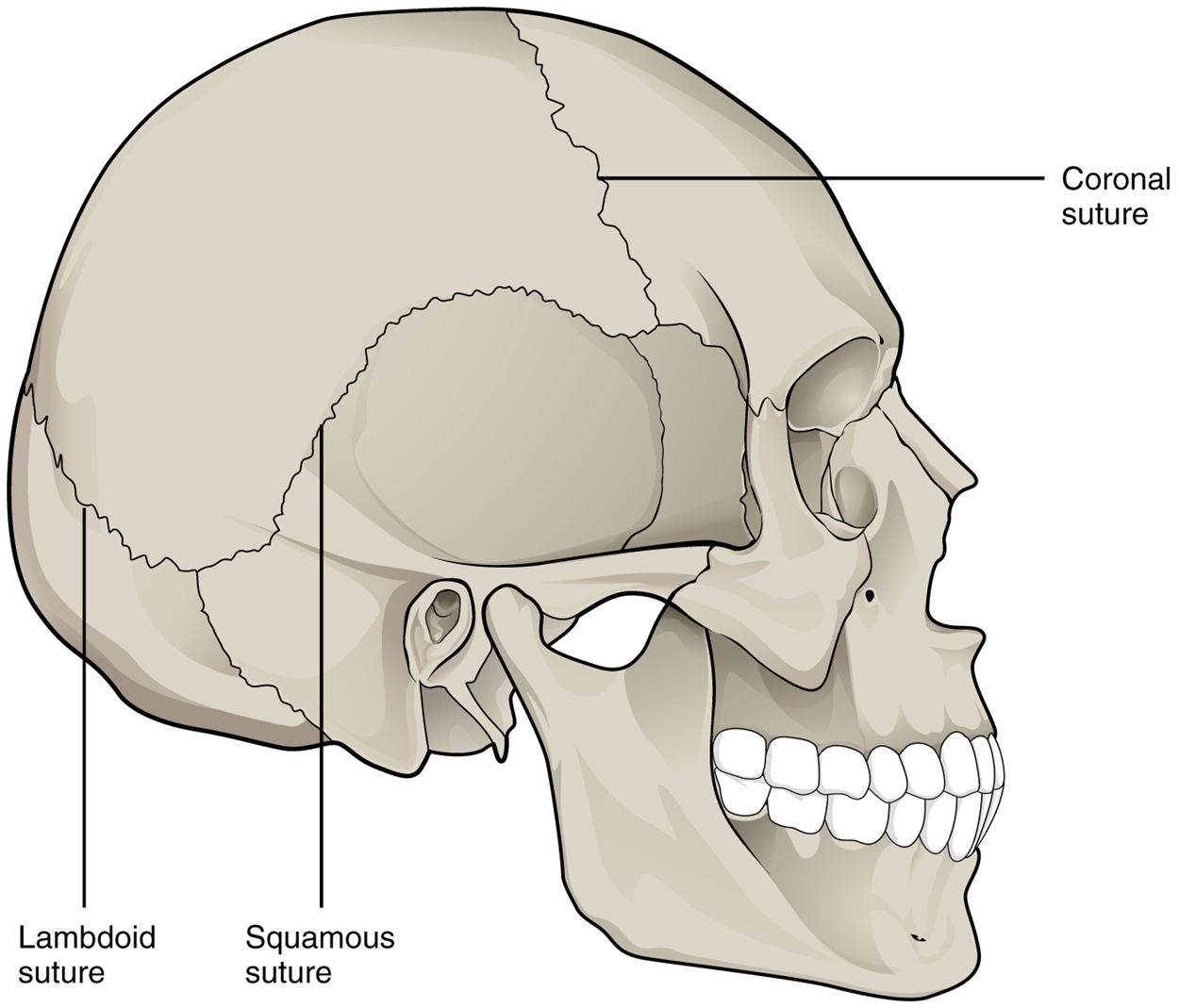
Examples of a synarthrosis include the sutures (see image below), the fibrous joints between the bones of the skull that surround and protect the brain, and the manubriosternal joint, which is the cartilaginous joint that unites the manubrium (the upper part of the sternum) and body of the sternum for protection of the heart.
Suture Joints of Skull—The suture joints of the skull are an example of a synarthrosis, an immobile or essentially immobile joint.
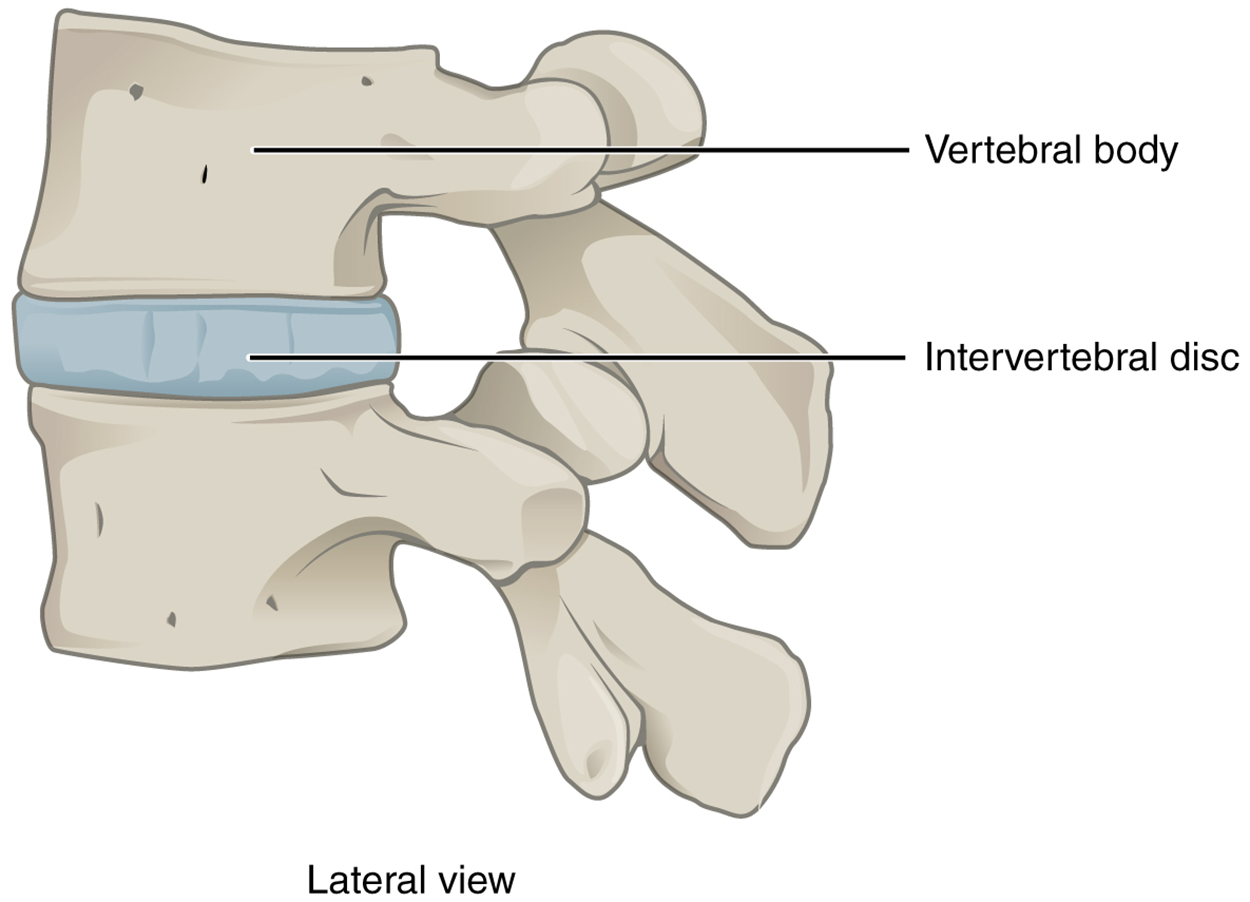
An example of an amphiarthrosis joint is the cartilaginous joint that unite the bodies of adjacent vertebrae. Filling the gap between the vertebrae is a thick pad of fibrocartilage (a tough and strong tissue) called an intervertebral disc. Each intervertebral disc (see the image below) strongly unites the vertebrae but still allows for a limited amount of movement between them. However, the small movements available between adjacent vertebrae can sum together along the length of the vertebral column to provide for large ranges of body movements.
Intervertebral Disc—An intervertebral disc unites the bodies of adjacent vertebrae within the vertebral column. Each disc allows for limited movement between the vertebrae and thus functionally forms an amphiarthrosis type of joint. Intervertebral discs are made of fibrocartilage and thereby structurally form a symphysis type of cartilaginous joint.
A freely mobile joint is classified as a diarthrosis (plural, diarthroses). These types of joints include all synovial joints of the body, which provide the majority of body movements. Most diarthrotic joints are found in the appendicular skeleton and thus give the limbs a wide range of motion.
These joints are divided into three categories based on the number of axes of motion provided by each. An axis in anatomy is described as the movements in reference to three anatomical planes, which are hypothetical flat surfaces that cut through the body that describe structure locations and movement directions. Thus, diarthroses are classified as uniaxial (for movement in one plane), biaxial (for movement in two planes), or multiaxial joints (for movement in all three anatomical planes).
EXAMPLE
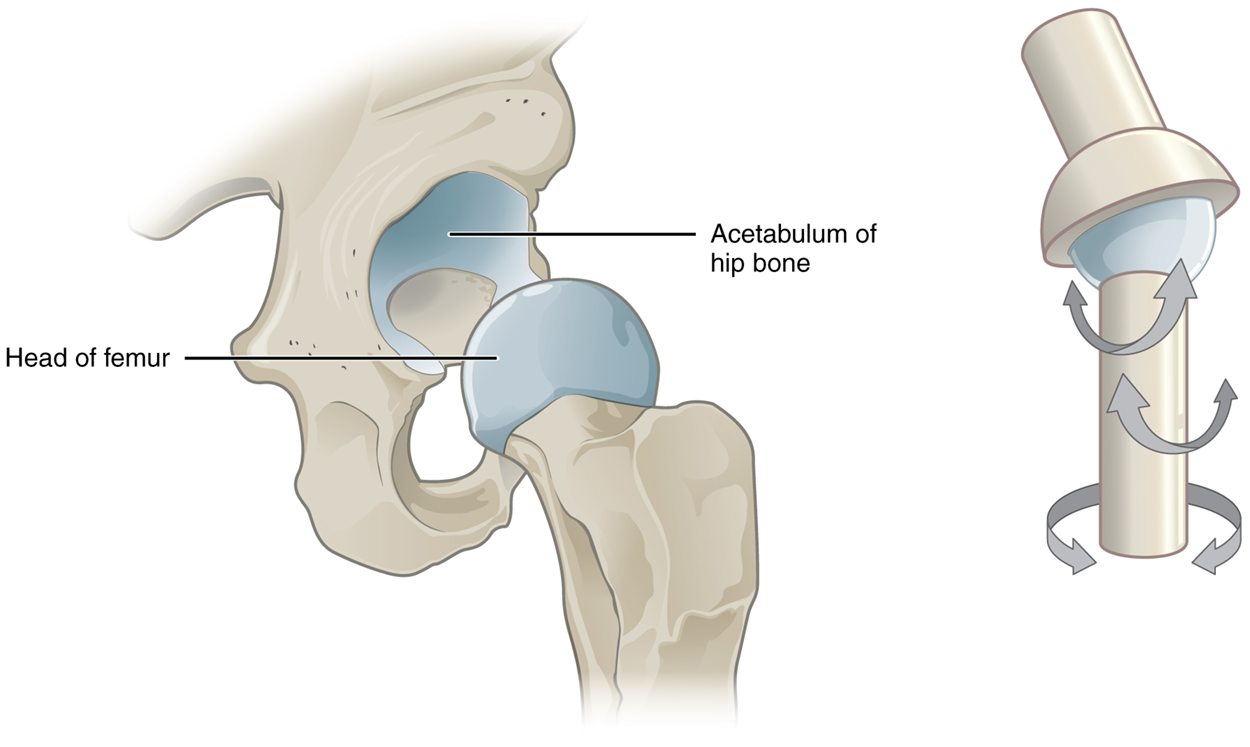
A diarthrosis joint is the hip joint, shown below.
Multiaxial Joint—A multiaxial joint, such as the hip joint, allows for three types of movement: anterior–posterior, medial–lateral, and rotational.
terms to know
Synarthrosis
An immobile or nearly immobile joint.
Amphiarthrosis
A slightly moveable joint.
Diarthrosis
A freely moveable joint.
Uniaxial Joint
An articulation that allows for a motion in only one plane.
Biaxial Joint
An articulation that allows for a motion in two planes.
Multiaxial Joint
An articulation that allows for a motion in all three planes.
4. Structural Features of Synovial Joints
Synovial joints are the most common type of joint in the body. A key structural characteristic of a synovial joint that is not seen at fibrous, cartilaginous, or bony joints is the presence of a joint cavity. This fluid-filled space is the site at which the articulating surfaces of the bones contact each other. Also, unlike fibrous, cartilaginous, or bony joints, the articulating bone surfaces at a synovial joint are not directly connected to each other with fibrous connective tissue, cartilage, or bone tissue. This gives the bones of a synovial joint the ability to move smoothly against each other, allowing for increased joint mobility.
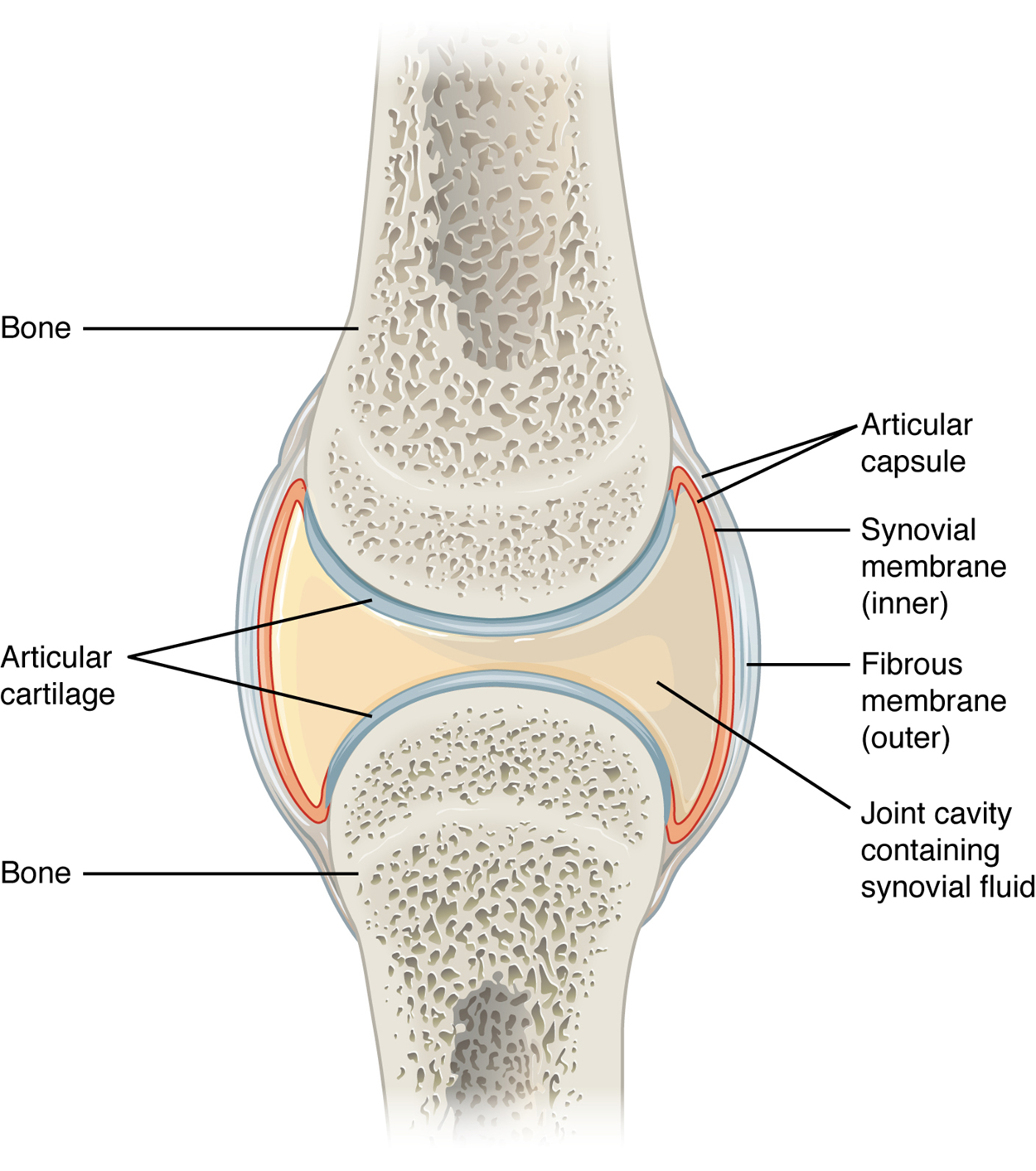
Synovial Joints—Synovial joints allow for smooth movements between the adjacent bones. The joint is surrounded by an articular capsule that defines a joint cavity filled with synovial fluid. The articulating surfaces of the bones are covered by a thin layer of articular cartilage. Ligaments support the joint by holding the bones together and resisting excess or abnormal joint motions.
Synovial joints are characterized by the presence of a joint cavity. This cavity is enclosed by the articular capsule, a fibrous connective tissue structure that encapsulates a joint, attaching to each bone just outside the area of the bone’s articulating (joint) surface.
Friction between the bones at a synovial joint is prevented by the presence of the articular cartilage, a thin layer of hyaline cartilage that covers the entire articulating (joint) surface of each bone. Recall that cartilage, like your earlobe or anterior portion of your nose, is quite flexible.
think about it
The articular cartilage acts like a Teflon® coating over the bone surface, allowing the articulating bones to move smoothly against each other without damaging the underlying bone tissue.
Lining the inner surface of the articular capsule is a thin synovial membrane. Recall that a synovial membrane is a connective tissue membrane. The cells of this membrane secrete synovial fluid (synovia, a thick fluid), which is a thick, slimy fluid that provides lubrication to further reduce friction between the bones of the joint. This fluid also provides nourishment to the articular cartilage, which does not contain blood vessels. The ability of the bones to move smoothly against each other within the joint cavity, and the freedom of joint movement this provides, means that each synovial joint is functionally classified as a diarthrosis.
Outside of their articulating surfaces, the bones are connected together by ligaments, which are strong bands of fibrous connective tissue. These strengthen and support the joint by anchoring the bones together and preventing their separation. Ligaments allow for normal movements at a joint but limit the range of these motions, thus preventing excessive or abnormal joint movements.
At many synovial joints, additional support is provided by the muscles and their tendons that act across the joint. A tendon is the dense regular connective tissue structure that attaches a muscle to bone. As forces acting on a joint increase, the body will automatically increase the overall strength of contraction of the muscles crossing that joint, thus allowing the muscle and its tendon to serve as a “dynamic ligament” to resist forces and support the joint. This type of indirect support by muscles is very important at the shoulder joint, for example, where the ligaments are relatively weak.
terms to know
Synovial Fluid
A thick, slimy fluid produced by a synovial membrane which provides lubrication to a joint.
Tendon
The connective tissue structure that connects a muscle to a bone.
4a. Additional Structures Associated With Synovial Joints
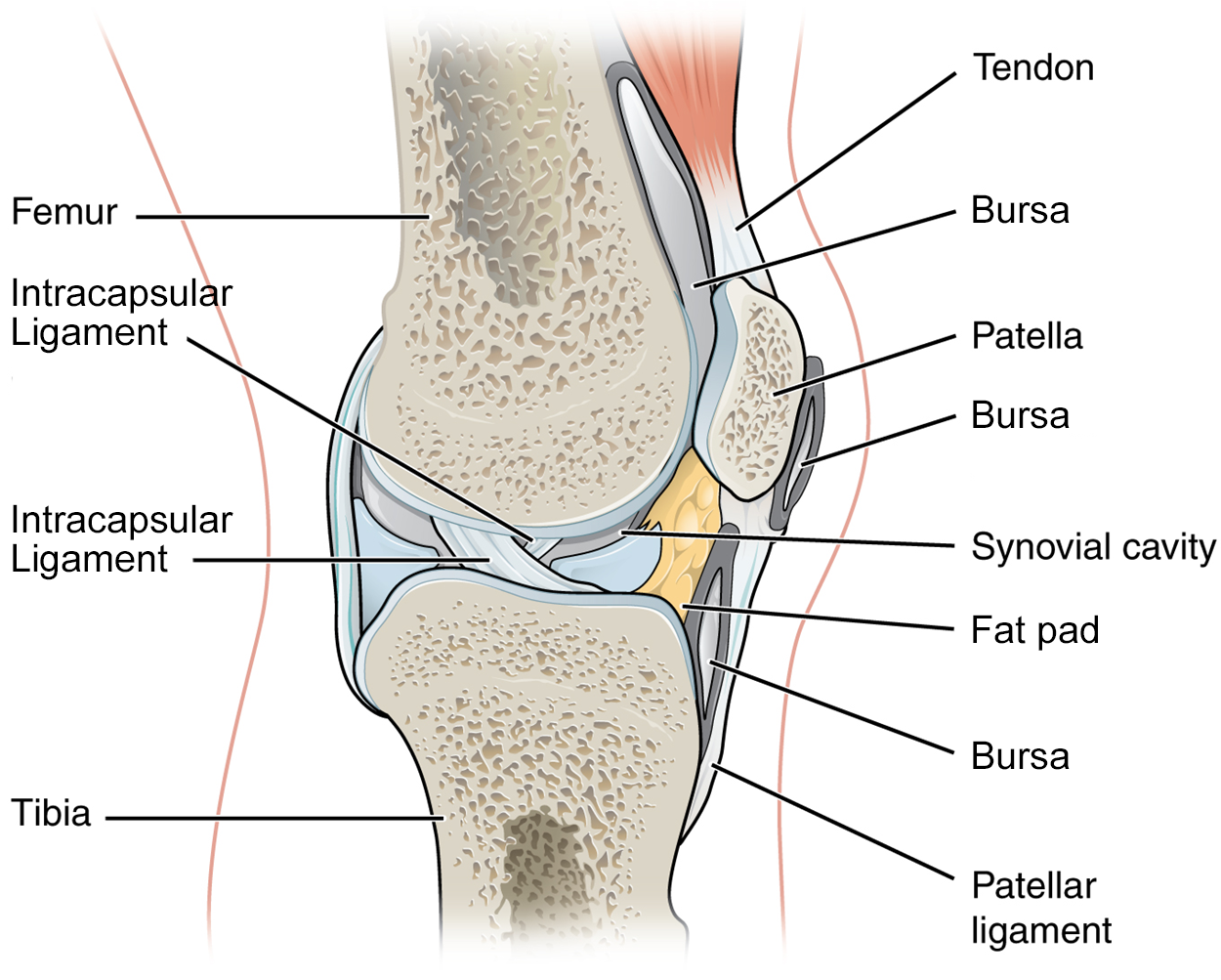
A few synovial joints of the body have a fibrocartilage structure located between the articulating bones. This is called an articular disc, which is generally small and oval-shaped, or a meniscus, which is larger and C-shaped. These structures can serve several functions, depending on the specific joint. In some places, an articular disc may act to strongly unite the bones of the joint to each other, such as the articular discs found at the sternoclavicular joint or between the distal ends of the radius and ulna bones. At other synovial joints, the disc can provide shock absorption and cushioning between the bones, which is the function of each meniscus within the knee joint. Finally, an articular disc can serve to smooth the movements between the articulating bones, as seen at the temporomandibular joint. Some synovial joints also have a fat pad, which can serve as a cushion between the bones.
Additional structures located outside of a synovial joint serve to prevent friction between the bones of the joint and the overlying muscle tendons or skin. A bursa (plural, bursae) is a thin connective tissue sac filled with lubricating liquid. They are located in regions where skin, ligaments, muscles, or muscle tendons can rub against each other, usually near a body joint. Bursae reduce friction by separating the adjacent structures, preventing them from rubbing directly against each other.
Bursae—Bursae are fluid-filled sacs that serve to prevent friction between skin, muscle, or tendon with an underlying bone. Three major bursae and a fat pad are part of the complex joint that unites the femur and tibia of the leg.
A tendon sheath is similar in structure to a bursa, but smaller. It is a connective tissue sac that surrounds a muscle tendon at places where the tendon crosses a joint. It contains a lubricating fluid that allows for smooth motions of the tendon during muscle contraction and joint movements.
IN CONTEXT Bursitis
Bursitis is the inflammation of a bursa near a joint. This will cause pain, swelling, or tenderness of the bursa and surrounding area, and may also result in joint stiffness. Bursitis is most commonly associated with the bursae found at or near the shoulder, hip, knee, or elbow joints.
Bursitis can be either acute (lasting only a few days) or chronic. It can arise from muscle overuse, trauma, excessive or prolonged pressure on the skin, rheumatoid arthritis, gout, or infection of the joint. Repeated acute episodes of bursitis can result in a chronic condition.
terms to know
Articular Disc
A small and oval-shaped fibrocartilage structure located between the articulating bones.
Meniscus
A large, C-shaped fibrocartilage structure located between the articulating bones.
Bursa
A thin connective tissue sac filled with lubricating liquid.
Tendon Sheath
A connective tissue sac that surrounds a muscle tendon at places where the tendon crosses a joint.
4b. Types of Synovial Joints
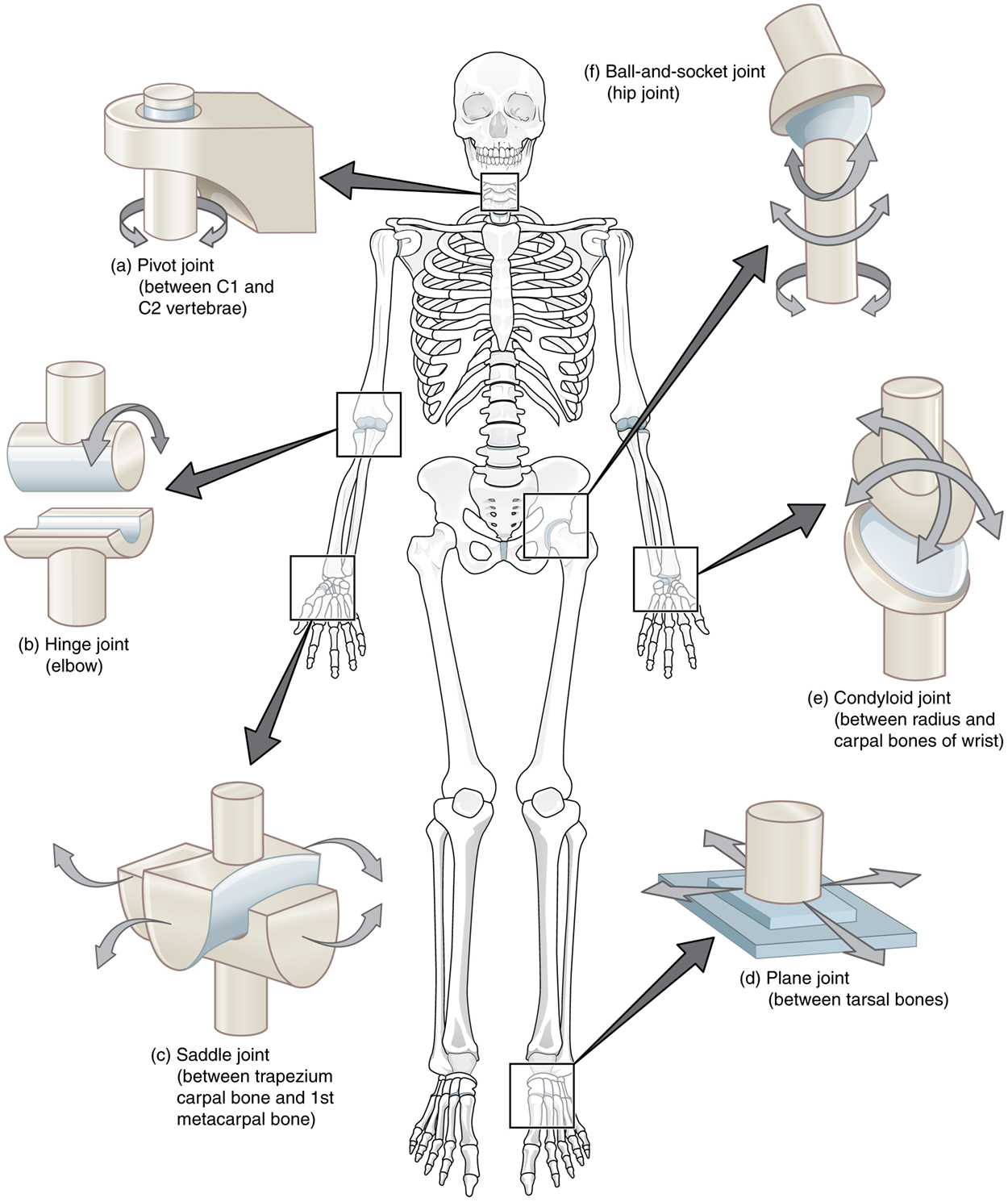
Synovial joints are subdivided based on the shapes of the articulating surfaces of the bones that form each joint. The six types of synovial joints are:
Pivot
Hinge
Condyloid
Saddle
Plane
Ball-and-Socket
Types of Synovial Joints—The six types of synovial joints allow the body to move in a variety of ways. (a) Pivot joints allow for rotation around an axis, such as between the first and second cervical vertebrae, which allows for side-to-side rotation of the head. (b) The hinge joint of the elbow works like a door hinge. (c) The articulation between the trapezium carpal bone and the first metacarpal bone at the base of the thumb is a saddle joint. (d) Plane joints, such as those between the tarsal bones of the foot, allow for limited gliding movements between bones. (e) The radiocarpal joint of the wrist is a condyloid joint. (f) The hip and shoulder joints are the only ball-and-socket joints of the body.
At a pivot joint, a rounded portion of a bone is enclosed within a ring formed partially by the articulation with another bone and partially by a ligament. The bone rotates within this ring. Since the rotation is around a single axis, pivot joints are functionally classified as a uniaxial diarthrosis type of joint.
In a hinge joint, the convex end of one bone articulates with the concave end of the adjoining bone. This type of joint allows only for bending and straightening motions along a single axis, and thus hinge joints are functionally classified as uniaxial joints.
At a condyloid joint (ellipsoid joint), the shallow depression at the end of one bone articulates with a rounded structure from an adjacent bone or bones. Functionally, condyloid joints are biaxial joints that allow for two planes of movement.
At a saddle joint, both of the articulating surfaces for the bones have a saddle shape, which is concave in one direction and convex in the other. This allows the two bones to fit together like a rider sitting on a saddle. Saddle joints are functionally classified as biaxial joints.
At a plane joint (gliding joint), the articulating surfaces of the bones are flat or slightly curved and of approximately the same size, which allows the bones to slide against each other. The motion at this type of joint is usually small and tightly constrained by surrounding ligaments. Based only on their shape, plane joints can allow multiple movements, including rotation. Thus, plane joints can be functionally classified as a multiaxial joint. However, not all of these movements are available to every plane joint due to limitations placed on it by ligaments or neighboring bones. Thus, depending upon the specific joint of the body, a plane joint may exhibit only a single type of movement or several movements.
The joint with the greatest range of motion is the ball-and-socket joint. At these joints, the rounded head of one bone (the ball) fits into the concave articulation (the socket) of the adjacent bone. The hip joint and the glenohumeral (shoulder) joint are the only ball-and-socket joints of the body. Ball-and-socket joints are functionally classified as multiaxial joints.
IN CONTEXT Aging and the Joints
Arthritis is a common disorder of synovial joints that involves inflammation of the joint. This often results in significant joint pain, along with swelling, stiffness, and reduced joint mobility. There are more than 100 different forms of arthritis. Arthritis may arise from aging, damage to the articular cartilage, autoimmune diseases, bacterial or viral infections, or unknown (probably genetic) causes.
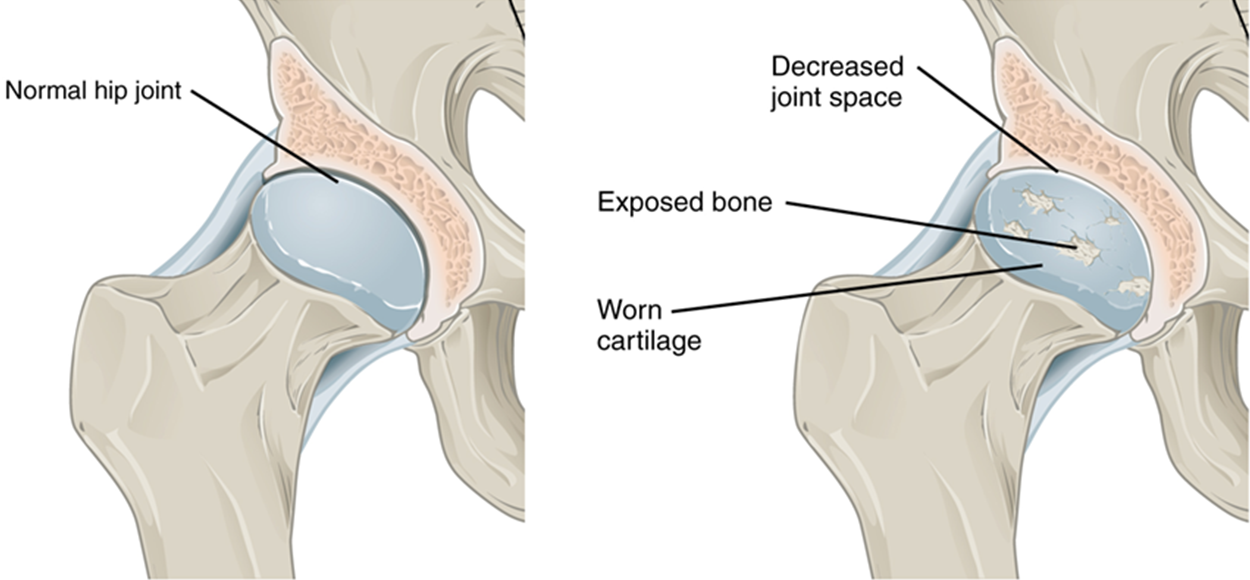
The most common type of arthritis is osteoarthritis, which is associated with aging and “wear and tear” of the articular cartilage. Risk factors that may lead to osteoarthritis later in life include injury to a joint; jobs that involve physical labor; sports with running, twisting, or throwing actions; and being overweight. These factors put stress on the articular cartilage that covers the surfaces of bones at synovial joints, causing the cartilage to gradually become thinner.
As the articular cartilage layer wears down, more pressure is placed on the bones. The joint responds by increasing production of the lubricating synovial fluid, but this can lead to swelling of the joint cavity, causing pain and joint stiffness as the articular capsule is stretched. The bone tissue underlying the damaged articular cartilage also responds by thickening, producing irregularities and causing the articulating surface of the bone to become rough or bumpy. Joint movement then results in pain and inflammation.
Gout is a form of arthritis that results from the deposition of uric acid crystals within a body joint. Usually, only one or a few joints are affected, such as the big toe, knee, or ankle. The attack may only last a few days but may return to the same or another joint. Gout occurs when the body makes too much uric acid or the kidneys do not properly excrete it. A diet with excessive fructose has been implicated in raising the chances of a susceptible individual developing gout.
Autoimmune diseases, including rheumatoid arthritis, scleroderma, or systemic lupus erythematosus, produce arthritis because the immune system of the body attacks the body joints.
In rheumatoid arthritis, the joint capsule and synovial membrane become inflamed. As the disease progresses, the articular cartilage is severely damaged or destroyed, resulting in joint deformation, loss of movement, and severe disability. The most commonly involved joints are the hands, feet, and cervical spine with corresponding joints on both sides of the body usually affected, though not always to the same extent. Rheumatoid arthritis is also associated with lung fibrosis, vasculitis (inflammation of blood vessels), coronary heart disease, and premature mortality.
Osteoarthritis—Osteoarthritis of a synovial joint results from aging or prolonged joint wear and tear. These cause erosion and loss of the articular cartilage covering the surfaces of the bones, resulting in inflammation that causes joint stiffness and pain.
terms to know
Pivot Joint
A joint in which a rounded portion of one bone is enclosed within a ring formed partially by the articulation with another bone and partially by a ligament.
Hinge Joint
A joint in which the convex end of one bone articulates with the concave end of the adjoining bone.
Condyloid Joint
A joint in which the shallow depression at the end of one bone articulates with a rounded structure from an adjacent bone or bones.
Saddle Joint
A joint in which both of the articulating surfaces for the bones have a saddle shape.
Plane Joint
A joint in which the articulating surfaces of the bones are flat or slightly curved and of approximately the same size, which allows the bones to slide against each other.
Ball-and-Socket Joint
A joint in which the rounded head of one bone (the ball) fits into the concave articulation (the socket) of the adjacent bone.
summary
In this lesson, you learned about the role of joints in your body and how to classify them based on their structure and function. You first explored the structural classification of joints, which include fibrous joints, cartilaginous joints, bony joints, and synovial joints. You then examined the functional classification of joints, which include synarthrosis (immobile or nearly immobile), amphiarthrosis (slightly movable), and diarthrosis (freely moveable) joints. You then learned about one of the structural features of synovial joints, which are the most common type of joint in the body. You also explored additional structures associated with synovial joints as well as types of synovial joints, which include pivot, hinge, condyloid, saddle, plane, and ball-and-socket joints.
A small and oval-shaped fibrocartilage structure located between the articulating bones.
Ball-and-Socket Joint
A joint in which the rounded head of one bone (the ball) fits into the concave articulation (the socket) of the adjacent bone.
Biaxial Joint
An articulation that allows for a motion in two planes.
Bony Joint
An articulation where adjacent bones are united by osseous tissue.
Bursa
A thin connective tissue sac filled with lubricating liquid.
Cartilaginous Joint
An articulation where adjacent bones are united by hyaline fibrocartilage.
Condyloid Joint
A joint in which the shallow depression at the end of one bone articulates with a rounded structure from an adjacent bone or bones.
Diarthrosis
A freely moveable joint.
Fibrous Joint
An articulation where adjacent bones are united by fibrous connective tissue.
Hinge Joint
A joint in which the convex end of one bone articulates with the concave end of the adjoining bone.
Meniscus
A large, C-shaped fibrocartilage structure located between the articulating bones.
Multiaxial Joint
An articulation that allows for a motion in all three planes.
Pivot Joint
A joint in which a rounded portion of one bone is enclosed within a ring formed partially by the articulation with another bone and partially by a ligament.
Plane Joint
A joint in which the articulating surfaces of the bones are flat or slightly curved and of approximately the same size, which allows the bones to slide against each other.
Saddle Joint
A joint in which both of the articulating surfaces for the bones have a saddle shape.
Synarthrosis
An immobile or nearly immobile joint.
Synovial Fluid
A thick, slimy fluid produced by a synovial membrane which provides lubrication to a joint.
Synovial Joint
An articulation where bones come into contact with each other within a joint cavity filled with a lubricating fluid.
Tendon
The connective tissue structure that connects a muscle to a bone.
Tendon Sheath
A connective tissue sac that surrounds a muscle tendon at places where the tendon crosses a joint.
Uniaxial Joint
An articulation that allows for a motion in only one plane.