In this lesson, you will learn details and insights on how to embark on a successful job search. Specifically, this lesson will cover:
1. Understanding How Employers Hire
It may seem like employers looking to hire for an open role have an easy job: they simply need to hire the candidate that they believe is the most qualified. In reality, employers dedicate a considerable amount of time to planning the interview process and coordinating a search committee. Candidates are chosen for more than just their qualifications. So if hiring isn’t as straightforward as it seems, what exactly does the process look like?
1a. A "Safe Bet"
The hiring process starts with an employer envisioning their ideal candidate. In general, employers like hiring "safe bets." Employers want a candidate who will be successful on the job. However, they're also trying to avoid two major concerns:
- 1. The Seemingly Ideal Worker. When employers hire someone who interviews well and appears to be the ideal candidate, their first perceptions are not always the whole story. Sometimes after accepting the position, the candidate doesn't perform well on the job because of a lack of experience or skill.
IN CONTEXT
 Marisol was hired by a large Italian restaurant as a server. For many years, she had helped out at her family’s restaurant in her hometown by taking orders and bussing tables. The manager thought she’d be a great fit because of the positive energy she exuded during her interview. However, when Marisol started her position she quickly realized the larger restaurant with a more complex kitchen and more demanding patrons was very different from the casual, laid-back restaurant she grew up with. She was quickly overwhelmed by her new position and quit within a week of starting.
- 2. The Dissatisfied High-Performer. Sometimes the person hired is a great fit and seems to flourish on the job. For this high-performing worker, most tasks and responsibilities are effortless. However, due to the lack of challenges and engagement, this new employee experiences low job satisfaction and leaves the role after only a short stint with the employer.
IN CONTEXT
 Samir worked for several years in a fast-paced retail sales environment, where he was always on his feet and busy. When he decided to go back to school, he realized he needed a less stressful job, and applied for several data entry positions he found online. His intelligence and computer skills impressed the company he interviewed with, so he was hired quickly. However, once he started the new position he quickly realized the repetitive work and the quiet office environment made it difficult for him to stay focused. Because of the poor match, he left the new position within a month.
In the case of both Marisol and Samir, candidates were hired who were not a good match for the job in either skill or personality. Unfortunately, this means that the employers are back where they started, after having wasted a significant amount of resources.
To improve their success rate, employers and hiring managers look to:
- Hire an employee from within the organization (an internal candidate). Companies take fewer risks by hiring internally because they have a better record of a candidate’s job performance.
- Look for recommendations from people they know and trust. Because employers often hire based on recommendations, effective networking can produce a significant advantage when you are searching for a new job role.
- Select a recruiting firm or temporary agency to find qualified candidates. These types of agencies do the difficult work of vetting candidates prior to presenting them to a company for a job opening.
-
While it is ultimately the employer’s responsibility to find a qualified candidate for a job, the applicant also has a responsibility to ensure that they present themselves honestly and know what their own goals, wants, and needs are for their job search. What do you think Marisol and Samir could have done to prevent their dissatisfaction with their new jobs? How can you avoid similar pitfalls?
1b. Becoming a "Safe Bet"
This inside look into the hiring process helps us realize the importance of becoming a "safe bet" to an employer, rather than applying to whatever positions we are interested in. Understanding the priorities of employers can help you improve your job search and make it more effective. Employers want to feel confident that a candidate is ready to invest their time and grow into the role.
-
Hiring managers may receive hundreds of applications for one job. That’s why marketing yourself well and using effective job search strategies are so important to your successful search.
During your search you should be matching yourself with jobs that align with your goals, interests, and future career plans. The jobs that you select and get hired for will ultimately build your resume. If employers can see a collection of roles that align with skills and experience in a relevant industry, they will interpret this as a commitment to big-picture planning.
2. Conducting a Successful Job Search
2a. Strategies
The most effective job search uses a variety of strategies, some of which are listed in this tutorial. When you use defined strategies, you can evaluate the results of your job search and make changes that will improve your level of success. So, what strategies might job seekers find useful in their search?
|
Strategy
|
Description
|
|
Clarify Your Goal
|
In order to market yourself well, you need a clear understanding of what you want that translates into a specific job. Most people think a job search starts with writing a resume or CV, but it actually starts with clarifying your goals to better communicate with employers.
|
|
Leverage Your Network
|
Because most jobs are found through networking, inform everyone in your network of your targeted job and the type of organizations where you would like to work. People in your network may not have a job for you, but asking them for information and recommendations can be helpful.
|
|
Write Professional Communications
|
Knowing when and how to communicate throughout networking and the job search process can feel a little unclear. Learn how to communicate clearly and concisely to leave a good impression on anyone you interact with.
|
|
Research Employers
|
Employers often cite a lack of research into their company as the biggest error an applicant can make in the job search. Strong applicants understand a company’s mission, its general operations, and how the role they’re applying to fits into that system through research.
|
|
Prepare to Apply
|
Make sure your application materials, such as your resume/CV and cover letter, are tailored to the job you’re applying for and effectively promote your relevant skills and experience. This is also the time to update your LinkedIn profile, polish your portfolio, and practice interviewing.
|
|
Browse Jobs
|
Use the resources available to you to browse for jobs. You may choose to target specific companies by reviewing their websites for career opportunities. Search engines such as Google, or job databases like Indeed allow you to search jobs by keyword (job title, job type, location, or other details). Your university, local library or community center may also offer career services.
|
|
Follow a Job Search Cycle
|
The most successful job seekers are those who make their search a full-time job. Landing your next position should be your business and not just a hobby. By using a dedicated and structured approach, you can make sure you keep a continual flow of leads and opportunities in the pipeline. Prepare to market yourself, and set daily and weekly goals for meetings, follow-up, and phone calls.
|
-
- Resume
- A formal document that lists a candidate’s qualifications for a job, including their employment and educational history.
- CV
- Also referred to as curriculum vitae; a comprehensive list of a person’s academic credentials. This term is sometimes used interchangeably with the term resume, although usually a resume is more specifically tailored to a job being sought.
- Cover Letter
- A formal business letter sent along with a resume or CV that introduces a job candidate and expresses their interest in an open position.
2b. Job Search Cycle
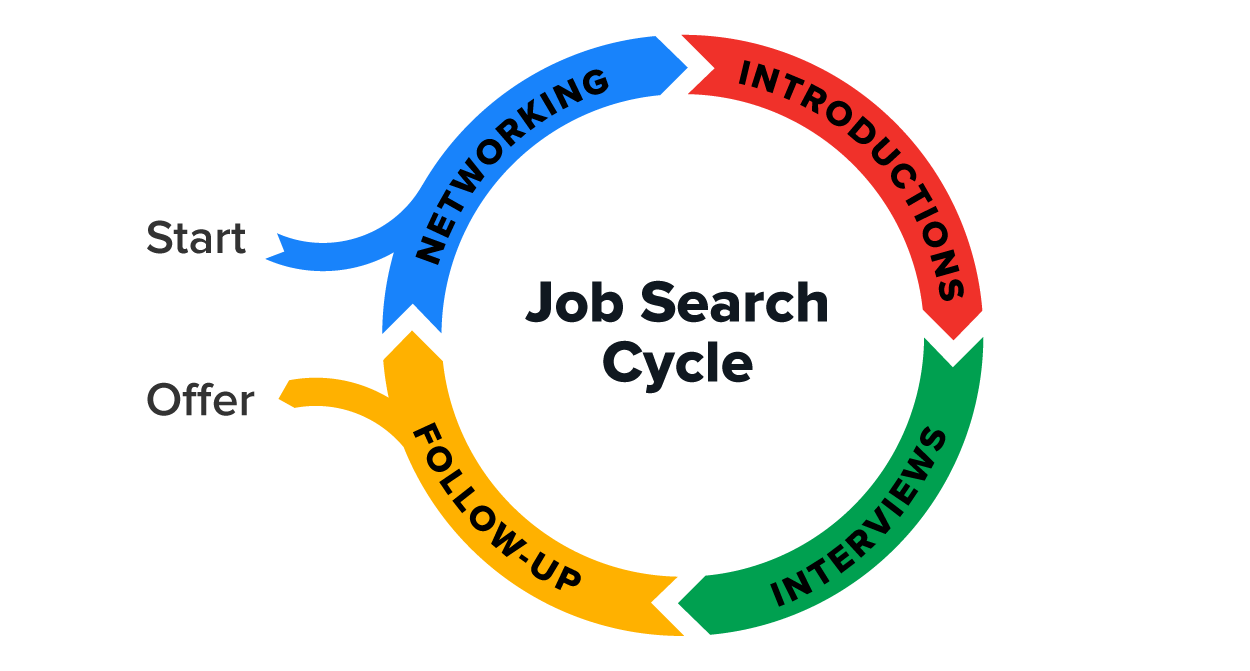
The Job Search Cycle is a process by which anyone at any level of career readiness can make progress and enhance their ability to secure a job. The steps involved require maximum effort and close attention to detail.
-
-
Networking. Networking helps you meet new people and uncover opportunities for growth and advancement in your career. As you connect with other professionals, you want to consider how you can be an asset to them. Your networking will be the main source for your job leads and career information.
-
Introductions. The contacts that you receive from networking will only develop into relationships if you take the time to interact with your new contacts. Schedule meetings to interview professionals that have influence within your industry or work for companies you have an interest in.
-
Interviews. You need to be able to shine during interviews, which are your opportunity to show an employer the person behind a resume of accomplishments and experience. Although it can be nerve-wracking for many, an interview is really just a conversation and an opportunity to see whether there is a good fit for you as well as the company. If you end up having an interview as a result of a networking contact, be sure that you make your contact proud that they referred you!
-
Follow-up. As you continually target new opportunities, remember to also follow up on existing ones, especially after you interview for a position. The day after your interview, send an email to the individuals who interviewed you to thank them for the opportunity and check in on any next steps. Follow-up can also be useful when you are waiting to schedule a meeting or hear from a contact about a company or job. However, don’t give up if you don’t hear back. Focus on moving forward, and keep in mind that there will always be competition. You're not meant to get every job that you pursue, but your consistency will be rewarded over time.
-
Job Offers. Be prepared for job offers. You want to make sure you have a plan and a detailed idea of the type of job offer you're looking to secure. Your hard work throughout this process should leave you more than satisfied. If you are unsatisfied with your first offer or want more options, repeat the process until you find the fit.
When utilizing such a process for your job search, be mindful of a few important insights:
-
The Importance of Completion. The cycle must be completed to realize its full potential. All four components of the cycle are equally important. Forgetting to enable just one of the four components could render the others meaningless. For instance, if you complete your networking, make introductions with the right people, and then have a successful interview, you could still lose an opportunity if you don’t follow up.
-
Practice Makes Perfect. The process is ongoing and only gets stronger with time. Practicing these four components will help you improve your skills in networking and communication, which are valuable even outside of your job search. We'll discuss these components in greater detail during a later tutorial.
-
Be Persistent. Les Brown, a famous motivational speaker, once said, "It isn’t over until I win!" An attitude of persistence is required to be successful. Work the Job Search Cycle until you get the job offer that you’re looking for. Remember, though, that everyone starts at a different place in their career journey, and the road to a successful job offer may take longer for some people. Even the most effective networker takes time to develop relationships. Stay on course and work the process until you see results.
In this lesson, you learned about job hunting by considering the hiring process from the perspective of the employer and the candidate. You learned how employers hire and why they look for a "safe bet" candidate to fill an open position. A "safe bet" is a candidate who is a good fit for a specific job opening and seems likely to succeed on the job. It is important to become a "safe bet" because employers will prioritize hiring candidates who present themselves as a good match. You also learned how to conduct a successful job search by learning strategies and following a defined process known as the job search cycle, which will help you to ensure you are fully focused on your job search and considering all viable options.



