Table of Contents |
Job descriptions are important tools in Human Resources. They provide a clear summary of the duties, responsibilities, and qualifications required for a specific role within an organization. By outlining what is expected from an employee, job descriptions help ensure that both the employer and the employee have a mutual understanding of the job’s requirements.
A well-crafted job description typically includes several main components. These components often stem from a thorough job analysis and include job specifications. The main elements of a job description are the job title, which gives a brief idea of the role; a summary of the job, which provides an overview of the position; and a detailed list of duties and responsibilities, which outlines the specific tasks the employee will perform. Additionally, job descriptions include qualifications and skills required for the job, such as education, experience, and any special skills or certifications needed.
Job descriptions serve multiple purposes within an organization. They are used in the hiring process to attract suitable candidates by clearly stating what the job entails and what qualifications are necessary. This helps in screening applicants and selecting the best fit for the role. During the interview process, job descriptions guide the questions and topics discussed, ensuring that the interview focuses on the relevant skills and experiences.
Beyond hiring, job descriptions are important for performance management. They provide a benchmark against which an employee’s performance can be measured. By comparing an employee’s actual performance with the duties and responsibilities outlined in the job description, managers can identify areas of strength and areas needing improvement. This helps in setting goals, providing feedback, and planning professional development.
Job descriptions also play a vital role in legal compliance. They help ensure that hiring practices are fair and non-discriminatory by clearly stating the qualifications and requirements for a job. This transparency helps protect the organization from potential legal issues related to employment practices.
When formatting a job description, it’s important to include several key components. Each section should be clearly labeled and organized to provide a comprehensive overview of the job. Below is a table explaining these components and what they entail:
| Key Components of Job Descriptions | |
|---|---|
| Component | Description |
| Job Title | The name of the position, providing a brief idea of the role. |
| Job Summary | An overview of the position, highlighting the main purpose and scope of the job. |
| Duties and Responsibilities | A detailed list of tasks and responsibilities the employee will perform. |
| Reporting Relationships | Information on who the employee reports to and who reports to them. |
| Working Conditions | Details about the work environment, including location, hours, and any special conditions. |
| Job Specifications | The qualifications and skills required for the job, such as education and experience. |
| Physical Requirements | Any physical demands of the job, such as lifting, standing, or other physical activities. |
| Legal Requirements | Any legal or regulatory requirements related to the job, ensuring compliance with laws. |
When creating a job description, ensure that each section is clearly defined and easy to read. Use bullet points for lists of duties and responsibilities to enhance readability. Consistent formatting helps in maintaining clarity and professionalism, making the job description a useful tool for various HR functions.
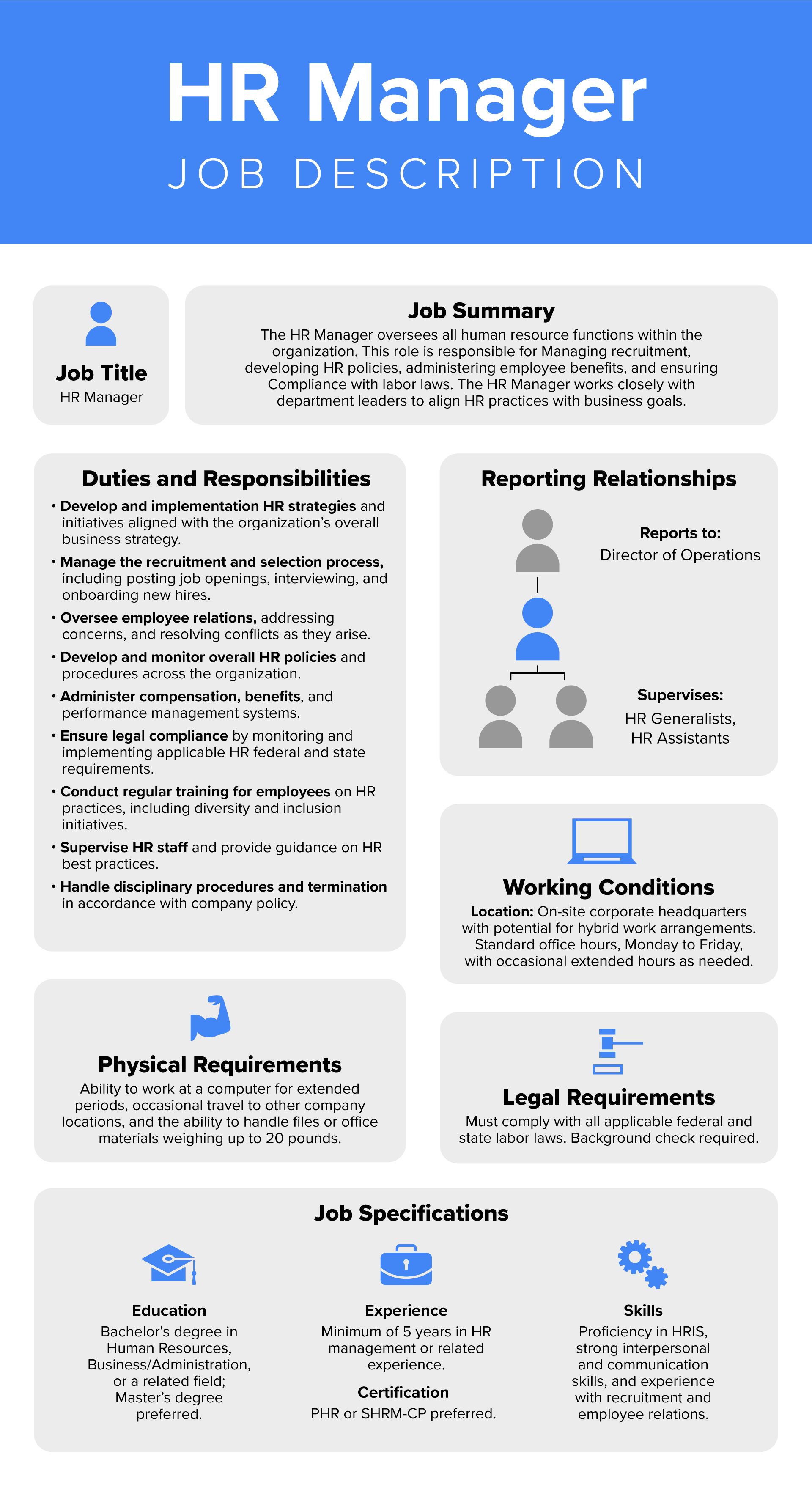
When crafting job descriptions, it’s important to focus on clarity, inclusivity, and accuracy. Effective job descriptions not only attract the right candidates but also set clear expectations and ensure compliance with legal standards. The table below outlines key concepts and best practices for writing job descriptions, helping you create documents that are precise, inclusive, and regularly updated to reflect the evolving nature of roles within your organization.
| Best Practices for Job Descriptions | |
|---|---|
| Concept | Description |
| Clarity and Specificity | Use precise terms to describe duties and responsibilities, avoiding vague language. |
| Avoid Bias and Discriminatory Language | Use inclusive language and avoid terms that imply a preference for a particular group. |
| Write for the Role, Not the Person | Focus on the tasks and qualifications needed for the job, not the characteristics of an ideal candidate. |
| Update Regularly | Review and update job descriptions regularly to reflect changes in the role or organization. |
| Use Action-Oriented Language | Start each duty or responsibility with an action verb to clearly convey tasks. |
| Include Essential and Non-Essential Functions | Distinguish between primary duties and additional tasks to comply with ADA. |
| Highlight Opportunities for Growth | Mention opportunities for advancement or professional development within the role. |
| Be Honest and Realistic | Provide an accurate portrayal of the job, including any challenges, to set realistic expectations. |
Source: This Tutorial has been adapted from "Human Resources Management" by Lumen Learning. Access for free at courses.lumenlearning.com/wm-humanresourcesmgmt/. License: CC BY: Attribution.



