Table of Contents |
Jerome Seymour Bruner (1915–2016) was a distinguished American psychologist and educator whose work profoundly influenced the development of cognitive psychology and educational theory. He earned his Ph.D. in psychology from Harvard University in 1941 and later held academic positions at Harvard, Oxford University, and New York University. Bruner’s early research focused on perception—the process by which individuals interpret and make sense of sensory information—and cognition—the mental processes involved in acquiring knowledge and understanding, including thinking, memory, and problem solving. His later work shifted toward understanding how people learn and how education systems can be designed to support intellectual development.
IN CONTEXT
Bruner was a central figure in the cognitive revolution of the 1950s and 1960s, which challenged the dominance of behaviorism in psychology. He emphasized the importance of internal mental processes—the complex operations within the mind that include thinking, reasoning, remembering, and interpreting information—and the active role of learners in constructing knowledge. His theories laid the groundwork for constructivist approaches to education, advocating for instructional methods that promote exploration, inquiry, and problem solving.
In educational contexts, Bruner argued that learning should be structured to enable students to build on prior knowledge. He believed that any subject could be taught effectively to any child, provided it was presented in a developmentally appropriate manner. His ideas contributed to significant reforms in curriculum design and teaching strategies, particularly in early childhood education and cognitive development.
Bruner’s contributions to educational theory are encapsulated in several seminal texts:

"Scaffolding is a process that enables a child or novice to solve a problem, carry out a task, or achieve a goal which would be beyond his unassisted efforts."
Jerome Bruner’s theories have shaped modern educational practices by emphasizing how learners construct knowledge through structured experiences. Among his most influential ideas are the spiral curriculum, the modes of representation, and scaffolding—each offering a framework for designing instruction that supports cognitive development and meaningful learning. The following sections explore these foundational concepts and their implications for teaching and learning.
One of Jerome Bruner’s most influential contributions to education is the concept of the spiral curriculum. This approach involves revisiting key ideas and concepts multiple times throughout a learner’s education, each time at a deeper and more complex level. Bruner argued that any subject can be taught effectively to any child at any stage of development, as long as it is structured appropriately. The spiral curriculum:
Bruner identified three fundamental ways in which learners represent and internalize knowledge. These modes of representation reflect the developmental stages of cognition and inform how instruction should be designed:
Bruner introduced the concept of scaffolding to describe the temporary support provided by teachers or more knowledgeable peers to help learners accomplish tasks they cannot yet perform independently. Scaffolding involves:
Discovery learning is an instructional approach developed by Jerome Bruner that emphasizes the learner’s active role in acquiring knowledge. Rather than being presented with facts and procedures directly, students are encouraged to explore, ask questions, and solve problems to uncover concepts and relationships on their own. This method fosters more profound understanding and retention by engaging learners in the cognitive processes of inquiry and reasoning.
IN CONTEXT
Traditional instruction typically involves a teacher-centered approach where information is transmitted directly to students through lectures, demonstrations, or rote memorization. In contrast, discovery learning is learner-centered and constructivist. It prioritizes:
While direct instruction can be efficient for conveying specific facts or procedures, discovery learning aims to develop critical thinking, creativity, and transferable problem-solving skills.
- Active Engagement over Passive Reception
Learners are encouraged to explore, experiment, and interact with materials and ideas. Instead of simply listening or memorizing, they participate in hands-on tasks, ask questions, and seek answers through investigation.- Process over Product
The focus is on how students arrive at understanding rather than just the final answer or outcome. Emphasis is placed on inquiry, exploration, and the steps taken to solve problems, which helps develop critical thinking and problem-solving skills.- Understanding over Memorization
Students are guided to make meaningful connections and grasp underlying concepts rather than just recalling facts. This deep learning approach fosters long-term retention and the ability to apply knowledge in new contexts.
In discovery learning, students are not passive recipients of information but active constructors of knowledge, by doing the following activities:
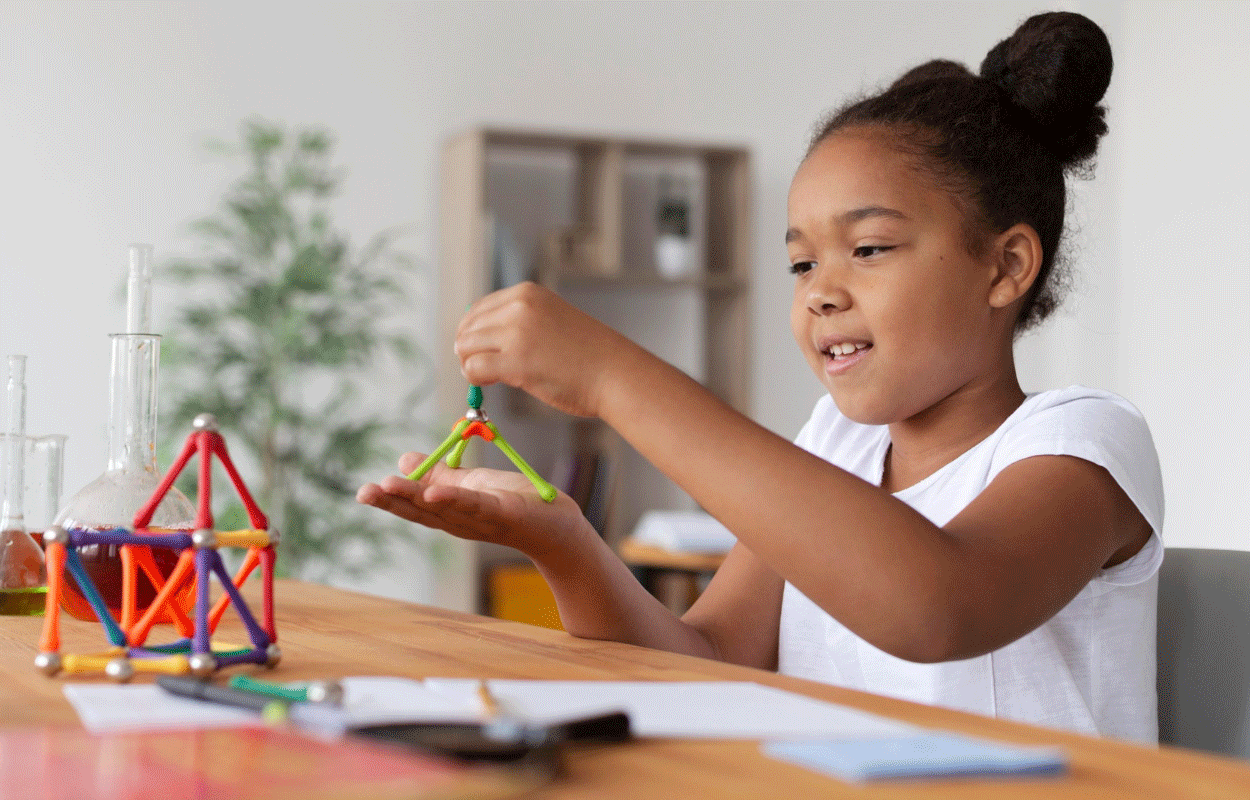 Bruner emphasized that learners build new knowledge upon existing cognitive structures—the mental frameworks or organized patterns of thought that help individuals interpret and integrate new information. Therefore, prior knowledge plays a crucial role in discovery learning. Teachers must assess what students already know and design tasks that connect new concepts to familiar ones. Scaffolding is a key instructional strategy in this approach. It involves providing temporary support—such as guiding questions, hints, or models—that helps students progress through challenging tasks. As learners gain competence, the support is gradually removed, promoting independence and mastery.
Discovery learning is a flexible instructional approach that can be adapted across educational levels to promote active engagement, inquiry, and deeper understanding. At each stage—elementary, middle, and high school—students take on the role of explorers and problem-solvers, while teachers act as facilitators who guide and support the learning process. The chart below illustrates examples of discovery learning activities tailored to each level, along with the corresponding roles of learners and teachers in fostering meaningful educational experiences.
The chart below illustrates how discovery learning is implemented across different educational levels and highlights modern applications that leverage technology and innovative pedagogical models. It connects traditional hands-on activities with contemporary tools and approaches, offering a comprehensive view of how learners and teachers engage in active, inquiry-based learning.
| Educational Level | Example of Discovery Learning Activity | Learner Role | Teacher Role | Modern Applications |
|---|---|---|---|---|
| Elementary Level | Students explore plant growth by planting seeds and observing changes over time | Engage in hands-on exploration, make observations, and record findings | Provide materials, guide observations, and ask prompting questions | Interactive science apps, virtual plant growth simulations, digital journals for recording observations |
| Middle School Level | Students investigate the water cycle through simulations and data collection | Form hypotheses, conduct experiments, analyze results | Facilitate inquiry, support data interpretation, encourage discussion | Online simulations of water cycle, data visualization tools, collaborative platforms for sharing findings |
| High School Level | Students design and conduct a physics experiment to explore Newton’s laws | Design procedures, test theories, present conclusions | Challenge thinking, provide feedback, scaffold complex concepts | Virtual labs for physics, coding environments for modeling forces, AR/VR experiences for immersive experimentation |
Discovery learning is an instructional approach that emphasizes student-driven exploration and active engagement in constructing knowledge. While it offers significant benefits—such as fostering deeper understanding and promoting critical thinking—it also presents challenges that educators must address. The following chart organizes key aspects of discovery learning into three categories: criticism, limitations, and legacy. This structure provides a clear reference for understanding its practical concerns, boundaries, and enduring influence on modern educational practices. This chart consolidates key concerns (criticism), practical boundaries (limitations), and enduring influence (legacy) of discovery learning based on the provided sections.
| Aspect | Key Points | Notes/Examples |
|---|---|---|
| Criticism |
|
|
| Limitations |
|
|
| Legacy |
|
|
Source: THIS TUTORIAL WAS AUTHORED BY SOPHIA LEARNING. PLEASE SEE OUR TERMS OF USE.
REFERENCES
Association for Psychological Science. (2016, June 14). How Jerome Bruner Transformed Psychological Science. Retrieved from www.psychologicalscience.org/publications/observer/obsonline/how-jerome-bruner-transformed-psychological-science.html
Bruner, J. S. (1960). The process of education. Harvard University Press.
Bruner, J. S. (1966). Toward a theory of instruction. Harvard University Press.
Collaborative Learning. (n.d.). Bruner and the 21st Century Curriculum. Retrieved from www.collaborativelearning.org/Bruner.pdf
Innovations Academy. (2025, April 11). Inquiry-Based Vs Project-Based Learning, What’s the Difference? Retrieved from innovationsacademy.org/blog/2025/04/inquiry-based-vs-project-based-learning-whats-the-difference/
Learning-Theories.org. (n.d.). Discovery Learning. Retrieved from learning-theories.org/doku.php?id=instructional_design:discovery_learning
McLeod, S. (2024). Jerome Bruner Theory of Cognitive Development. Simply Psychology. Retrieved from www.simplypsychology.org/bruner.html
Simply Psychology. (2024). Jerome Bruner Theory of Cognitive Development. Retrieved from www.simplypsychology.org/bruner.html



