Table of Contents |
The religious prophet Muhammad was born in Arabia in 570 CE in the city of Mecca. His revelations from God are said to have begun in 610 CE. The beginning of Islam is in 622 CE, marked by the migration of Muhammad and his followers to the city of Medina to escape persecution. Muhammad died in 632 CE, but his religion endured and today is the second largest religion in the world after Christianity. During the 8th century, Islam moved into parts of Asia, including Kazakhstan, western China, Indonesia, and Malaysia, and gradually became increasingly important in those regions. By the 15th–16th century, Islam was the dominant religion in these areas.
Adherence to the faith of Islam can be found all over the world today. However, in the late 15th century, the Islamic world covered approximately the area overlaid in blue on the map shown here:
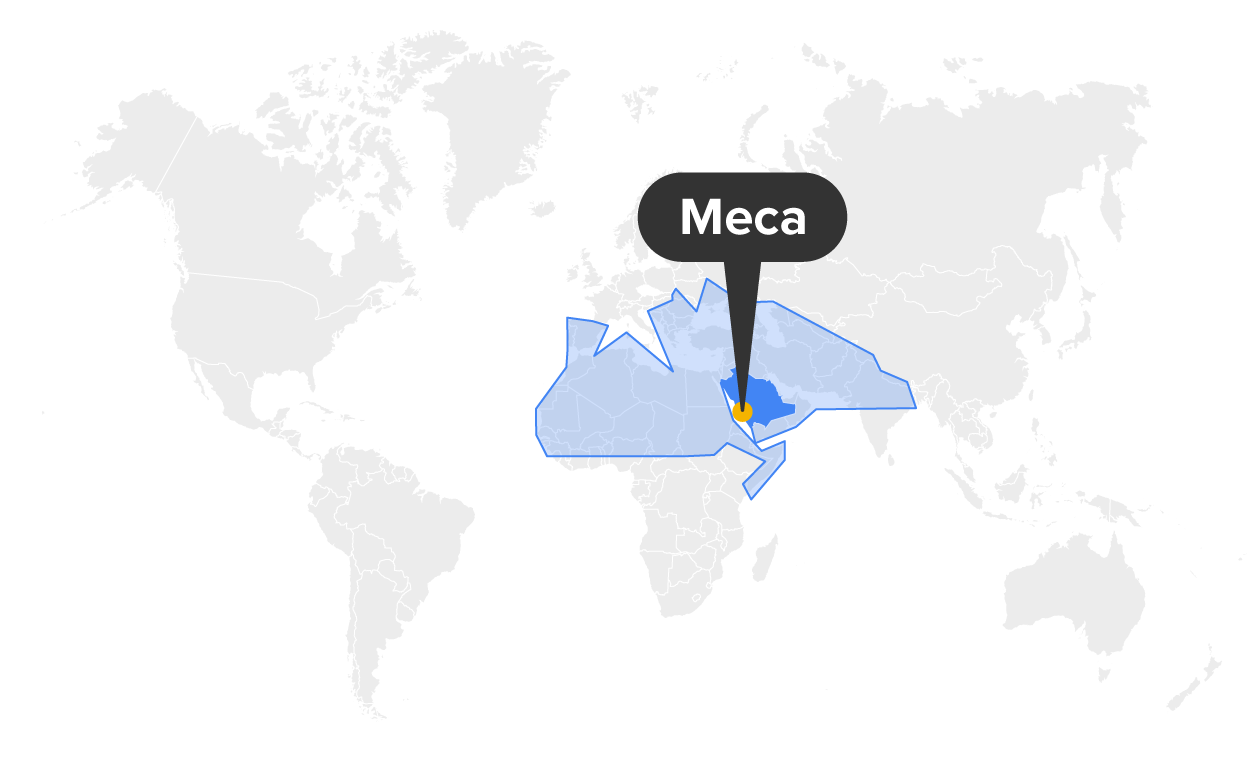
Included in this area, which is considered the Islamic world, are:
Islam was an extremely influential religion, and it remains so today. This religion dictates religious and secular laws for its adherents, and five pillars of Islam make up the basic tenets of the religion:
Eventually, a split developed in Islam between those who believed that only people directly descended from Muhammad should be caliphs (Shi’ite Muslims) and those who recognized caliphs not descended from Muhammad (Sunni Muslims). This split has persisted until today.
The rise of Islam begins with Muhammad, who was born in Arabia in 570 CE. At the time of his birth, this region was predominantly religiously polytheistic. Muslims believe that Muhammad received revelations from God beginning in 610 CE. This is believed to be the same time that he began to preach, gaining a modest following.
When he was persecuted because of his beliefs, he fled the city with his followers, eventually settling north of Mecca in the city of Medina. During this time, his following grew, and he returned eight years later to Mecca with 10,000 soldiers to control the city and convert the people to Islam.
The Koran (or Qur'an) is the sacred text of Islam. It is essentially a codification of the sacred revelations and laws of Islam. The spread of Islam was twofold:
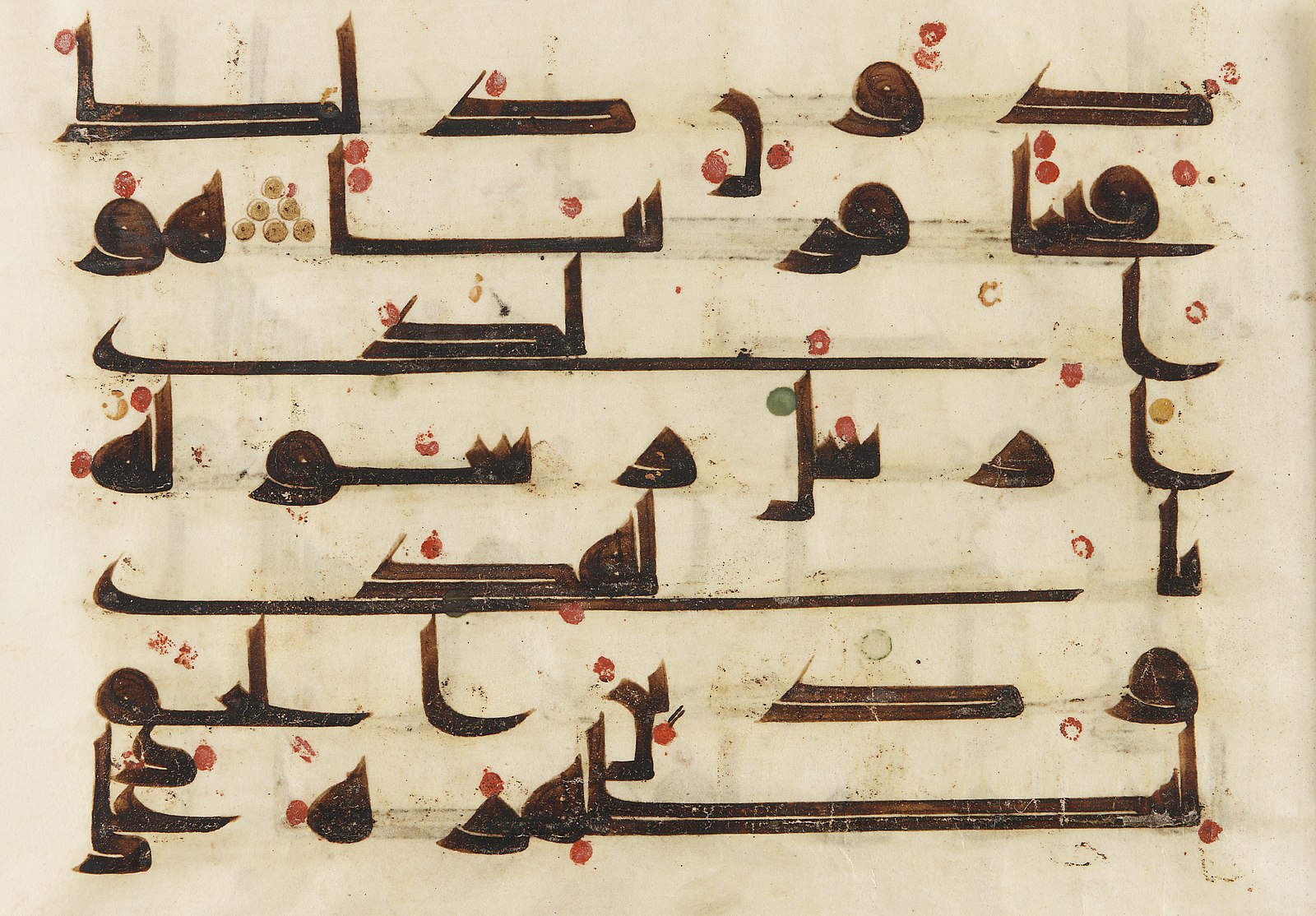
The letters are very big because the pages of the Koran were often meant to be read by a group of people. The letters also have this aesthetic appeal of their own. An important aspect of Islamic art is calligraphy, or fine writing, and the beauty of writing, its visual aspect, and transforming that into an aspect of the work of art in and of itself. Many buildings and artistic objects in the Islamic tradition actually have lettering and inscriptions on them.
The art of Islam is aniconic, meaning there are no icons allowed, a distinct contrast to Christian art. Islamic art is dominated by absolutely beautiful geometric patterns and motifs. You won’t find anything like the Christian iconography or images we’ve already looked at. In fact, images of sentient beings, such as people and animals, are forbidden under certain circumstances, including as part of the interior and exterior decorations of mosques. Small household objects, such as jugs and ewers, might be in the shape of animals. Miniature painting, which consists of small images in manuscripts, does contain images of people and occasionally of Muhammad as instructional illustrations of scenes from his life. In these cases, the face and sometimes the entire body of Muhammad will be left blank, but not always. Since these objects were small, made for private use, and the level of naturalism was low, the risk of idolatry was low. In addition, Shi’ite Muslims allowed slightly more flexibility in the use of images than Sunni did.
Being in proximity to Byzantium undoubtedly influenced the Islamic civilizations. The Christian church’s struggles with the veneration of images would have likely reinforced the original argument in Islam against the use of images.
Below is the Dome of the Rock, which is one of the earliest works of architecture in the Islamic tradition.
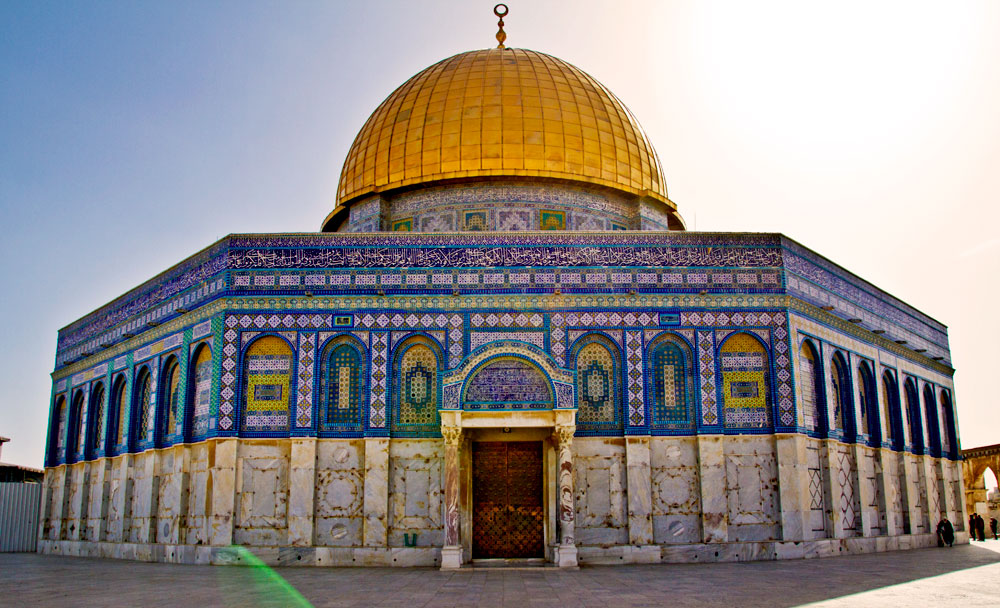
Dome of the Rock
Jerusalem
late 7th century CE
Marble, mosaics, and metal plaques
The Caliph al-Walid wanted to build a mosque at the site of the Temple Mount. This was an area in Jerusalem that was sacred to Christians, Jews, and Muslims as the place where Abraham had attempted to sacrifice his son Isaac, the site where Solomon built the temple that housed the Ark of the Covenant, and the place where Muhammad ascended to heaven during his night journey. This became the location of the earliest surviving work of Muslim architecture, the Dome of the Rock. It is not a mosque, but rather a shrine to house the holy rock where so many sacred events had taken place. Underneath it is a cave and an underground spring, making the location quite auspicious in terms of its natural terrain.
The Dome of the Rock has very elaborate tilework on the exterior. There is also an inscription in Arabic across the top edge of the exterior that cites the Surah Ya-Sin, or the 36th chapter of the Quran. This is the first of many instances of writing being used as a form of imagery in sacred Islamic architecture. On the interior, there are mosaics influenced by the Byzantine tradition. In fact, Byzantine artisans created and installed the tilework. Looking closely, many of the designs incorporate the arabesque, or the curving lines that Islamic art is known for. This is also an example of aniconic art.
Source: THIS TUTORIAL WAS AUTHORED BY SOPHIA LEARNING. PLEASE SEE OUR TERMS OF USE.