Use Sophia to knock out your gen-ed requirements quickly and affordably. Learn more
×

Inverse of a Function

Author: Sophia

what's covered
In this lesson, you will learn how to determine the inverse of a given function. Specifically, this lesson will cover:

Table of Contents

1. Inverse Functions and Notation

In a function, the input variable undergoes one or more operations to yield a specific output value. We can think of this idea as x being the input to f open parentheses x close parentheses comma where the output value is y. We can say that f left parenthesis x right parenthesis equals y.

With inverse functions, the operations performed on the input variable are undone. This means that when y is put into the inverse function, the result will be the x value that produced y in the original function.

We can write this using inverse notation as: f to the power of negative 1 end exponent left parenthesis f left parenthesis x right parenthesis right parenthesis equals x

The above expression is telling us that if the value of a function, f left parenthesis x right parenthesis comma goes into an inverse function, f to the power of short dash 1 end exponent left parenthesis x right parenthesis the result will be the argument of the original function, x.

big idea
We use f to the power of short dash 1 end exponent open parentheses x close parentheses for inverse notation. Do not confuse the -1 as an exponent.


2. Inverse Functions

An inverse function undoes the operations performed on variables of a function.

EXAMPLE

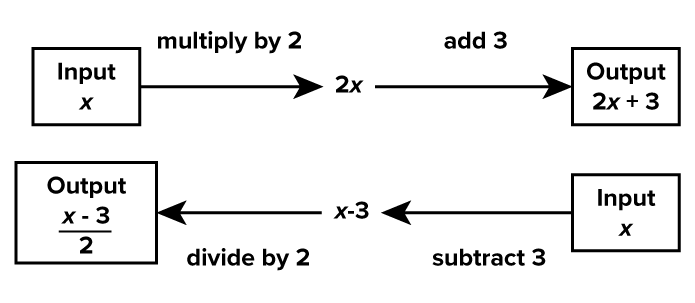
If a number is multiplied by 2, and added by 3, we can write this as the function f left parenthesis x right parenthesis equals 2 x plus 3. The inverse to this function first subtracts 3 from the input value, and then divides by 2, so as to completely undo all operations of the original function. We write this as the inverse function f to the power of negative 1 end exponent left parenthesis x right parenthesis equals fraction numerator x minus 3 over denominator 2 end fraction.

Here is a more visual way to see how the inverse of f left parenthesis x right parenthesis equals 2 x plus 3 is f to the power of negative 1 end exponent left parenthesis x right parenthesis equals fraction numerator x minus 3 over denominator 2 end fraction.

A diagram with two function machines: the top sequence represents the function f(x) equals 2x + 3. It starts on the left with a rectangular box with the label ‘Input x’ within it, followed by an arrow labeled ‘multiply by 2’ pointing to the right toward ‘2x’. After ‘2x’, another arrow labeled ‘add 3’ points toward the right, to a box with the label ‘Output 2x + 3’ within it. The bottom sequence represents the inverse function. It starts on the right with a box with the label ‘Input x’, followed by an arrow labeled ‘subtract 3’ pointing to the left toward ‘x – 3’. From here, another arrow labeled ‘divide by 2’ points toward the left to a box with the label ‘Output (x − 3) / 2’.

big idea
If a function becomes the input of an inverse function, then the output is the argument of the original function. Mathematically, we write this as: f to the power of negative 1 end exponent left parenthesis f left parenthesis x right parenthesis right parenthesis equals x


3. Evaluating an Inverse Graphically

On a graph, the x- and y-coordinates between a function and its inverse are inverted or swapped. This means that for any coordinate, (x, y), of a function, we can find a corresponding coordinate on the graph of its inverse using the coordinates (y, x). This means we locate the x-value on the y-axis, and locate the y-value on the x-axis.

EXAMPLE

Check out the graph of a function and its inverse.
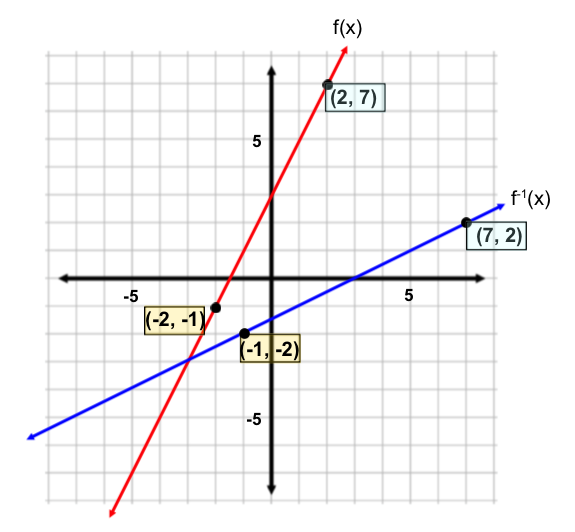
A graph with an x-axis and a y-axis ranging from −7 to 7. The graph consists of a pair of intersecting lines at the point (−3, 3). The first line labeled f(x) slants upward from the third quadrant, passes through the marked points (−2, −1) and (2, 7), and extends into the first quadrant. The second line f−1(x) slants upward from the third quadrant, passes through the marked points (−1, −2) and (7, 2), and extends into the first quadrant.

Points on bold italic f open parentheses bold x close parentheses Points on bold italic f to the power of bold short dash bold 1 end exponent open parentheses bold x close parentheses
(2, 7) (7, 2)
(-2, -1) (-1, -2)


4. Finding the Inverse Algebraically

If we want to find the inverse of a function algebraically, there are two common procedures most people use:

  1. Rewrite the equation, except swap x and y. Then, rewrite the equation so that y is isolated on one side of the equation.
  2. Do the same process, but in reverse order. First, you can rewrite the equation so that x is isolated on one side of the equation. Then, simply swap x and y. The resulting equation will be the defined inverse function.

EXAMPLE

Find the inverse of f left parenthesis x right parenthesis equals square root of 2 x minus 4 end root using the first method where we swap x and y.

f open parentheses x close parentheses equals square root of 2 x minus 4 end root Rewrite the function as y equals
y equals square root of 2 x minus 4 end root Swap x and y
x equals square root of 2 y minus 4 end root Square both sides
x squared equals 2 y minus 4 Add 4 to both sides
x squared plus 4 equals 2 y Divide both sides by 2
1 half x squared plus 2 equals y Our solution for y
f to the power of short dash 1 end exponent open parentheses x close parentheses equals 1 half x squared plus 2 Our solution in inverse notation

EXAMPLE

Find the inverse of f left parenthesis x right parenthesis equals fraction numerator x plus 7 over denominator 3 end fraction.

f open parentheses x close parentheses equals fraction numerator x plus 7 over denominator 3 end fraction Rewrite the function as y equals
y equals fraction numerator x plus 7 over denominator 3 end fraction Swap x and y
x equals fraction numerator y plus 7 over denominator 3 end fraction Multiply both sides by 3
3 x equals y plus 7 Subtract 7 from both sides
3 x minus 7 equals y Our solution for y
f to the power of short dash 1 end exponent open parentheses x close parentheses equals 3 x minus 7 Our solution in inverse notation

hint
Technically, we need to restrict the domain of the inverse function to non-negative values of x. This is because the range of the original function was restricted to non-negative y-values. The domain and range of a function also swap when defining the domain and range of its inverse.

summary
The inverse of a function undoes the operations of the function. We can evaluate an inverse graphically by comparing the coordinate points. All points on the curve of f open parentheses x close parentheses can be described as (x, y). All points on the curve inverse of f open parentheses x close parentheses can be described as (y, x), where x and y are the coordinates of the original function. The inverse can be found algebraically by swapping x and y, and then solving the equation for y.

Source: THIS TUTORIAL HAS BEEN ADAPTED FROM "BEGINNING AND INTERMEDIATE ALGEBRA" BY TYLER WALLACE. ACCESS FOR FREE AT www.wallace.ccfaculty.org/book/book.html. License: Creative Commons Attribution 3.0 Unported License