Use Sophia to knock out your gen-ed requirements quickly and affordably. Learn more
×

Inventory Cost Flow Assumptions

Author: Sophia

what's covered
This lesson will cover inventory cost flow assumptions, by reviewing three inventory valuation methods previously discussed and introducing one additional method. Specifically, this lesson will cover:

Table of Contents

1. FIFO

To review, FIFO is an inventory valuation method, which stands for First In First Out:

First
In
First
Out

Under FIFO, goods are assumed to be sold oldest to newest. Goods that were purchased first are the first to be sold and the newest or latest goods are assumed to remain in inventory.
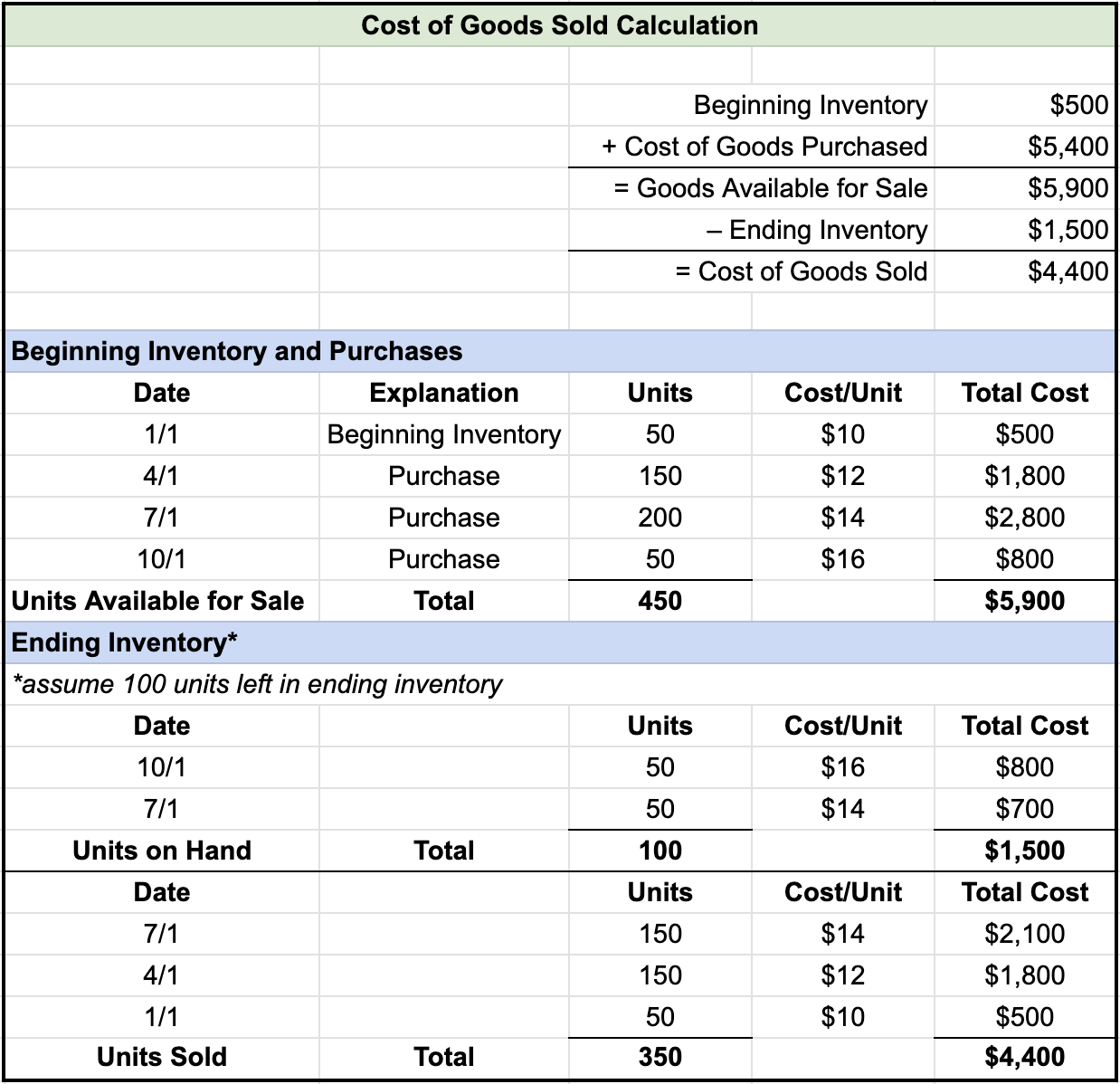
Table titled Cost of Goods Sold Calculation. Beginning inventory $500 plus cost of goods purchased $5400 is equal to goods available for sale $5900 minus ending inventory $1500 is equal to cost of goods sold $4,400.
The calculation for Beginning inventory and purchases shows the following entries under five columns named date, explanation, units, cost/unit, and total cost, respectively:
1/1, Beginning inventory, 50, $10, $500;
4/1, Purchase, 150, $12, $1800;
7/1, Purchase, 200, $14, $2800;
10/1, Purchase, 50, $16, $800;
Total, 450, $5900.
For calculating Ending inventory, assume 100 units are left in ending inventory. The calculation shows the following entries under four columns named date, units, cost/unit, and total cost, respectively:
Take all 50 units from 10/1: 10/1, 50, $16, $800;
Take only 50 of the 200 units from 7/1:
7/1, 50, $14, $700.
Total, 100, $1500. For calculating Units Sold, the calculation shows the following entries under four columns named date, units, cost/unit, and total cost, respectively: Take the remaining 150 units from 7/1: 7/1, 150, $14, $2,100;
Take all 150 units from 4/1:
4/1, 150, $12, $1,800. Take all 50 units
from Beginning Inventory: 1/1, 50, $10, $500. Total, 350, $4,400.
View this spreadsheet in Google Sheets

A benefit to using FIFO is that it resembles the physical flow of goods.

EXAMPLE

Grocery stores or electronic stores, for example, want the inventory that they purchased first--their oldest products--to be sold first. In the case of grocery stores, they want to sell the oldest merchandise first so that their food doesn't spoil.


2. LIFO

LIFO, you may recall, is an inventory valuation method, which stands for Last In First Out:

File:52909-FA149_c.png

Last
In
First
Out

Under LIFO, goods are assumed to be sold newest to oldest, meaning goods that were purchased last or most recently are the first to be sold. The oldest goods, or goods that were purchased first, are assumed to remain in inventory.
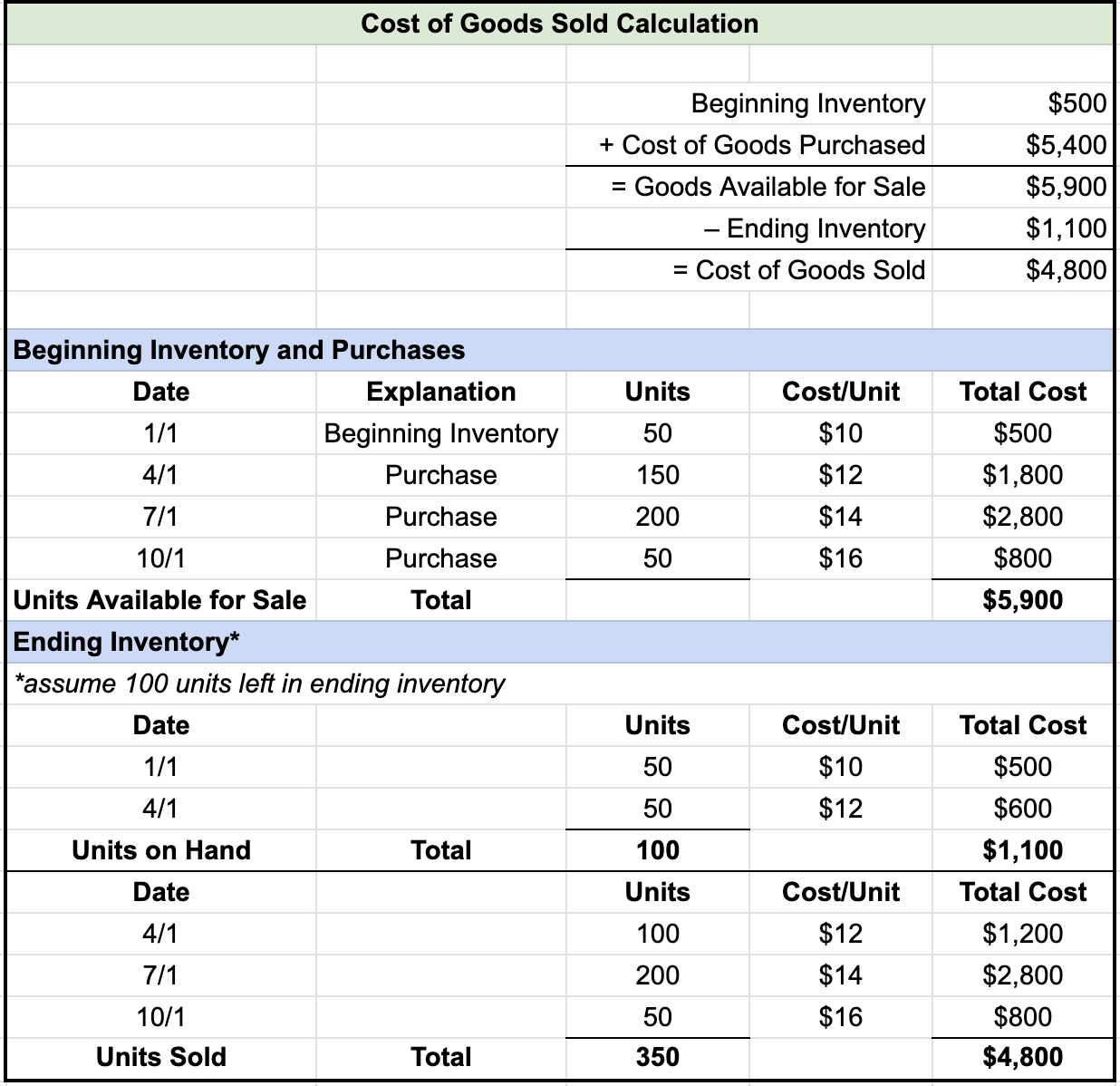
Table titled Cost of Goods Sold Calculation. Beginning inventory $500 plus cost of goods purchased $5400 is equal to goods available for sale $5900 minus ending inventory $1500 is equal to cost of goods sold $4,400.
The calculation for Beginning inventory and purchases shows the following entries under five columns named date, explanation, units, cost/unit, and total cost, respectively:
1/1, Beginning inventory, 50, $10, $500;
4/1, Purchase, 150, $12, $1800;
7/1, Purchase, 200, $14, $2800;
10/1, Purchase, 50, $16, $800;
Total, 450, $5900.
For calculating Ending inventory, assume 100 units are left in ending inventory. The calculation shows the following entries under four columns named date, units, cost/unit, and total cost, respectively:
Take all 50 units from Beginning Inventory: 1/1, 50, $10, $500;
Take only 50 of the 150 units from 4/1:
4/1, 50, $12, $600.
Total, 100, $1100. For calculating Units Sold, the calculation shows the following entries under four columns named date, units, cost/unit, and total cost, respectively: Take the remaining 100 units from 4/1: 4/1, 100, $12, $1,200;
Take all 200 units from 7/1:
7/1, 200, $14, $2,800. Take all 50 units
from 10/1: 10/1, 50, $16, $800. Total, 350, $4,800.
View this spreadsheet in Google Sheets


The argument for using LIFO centers on matching current costs with current revenues. Newer purchases, which represent current costs, are recorded as cost of goods sold, and that expense is matched with current revenues. The LIFO method of inventory valuation is typically used by businesses that experience inflation in their inventory costs.

EXAMPLE

Oil and gas companies, and manufacturers whose costs are tied closely to raw materials are common examples of companies who use the LIFO method. A company that makes aluminum cans will us LIFO to better match costs with revenue as raw material prices fluctuate.


3. Weighted Average Method

The last inventory valuation method to review is the weighted average method, which is based on the average cost per unit. The weighted average method is based on total cost and total units. The total cost of inventory units available for sale is divided by the total units that are available for sale, to provide the average cost per unit.
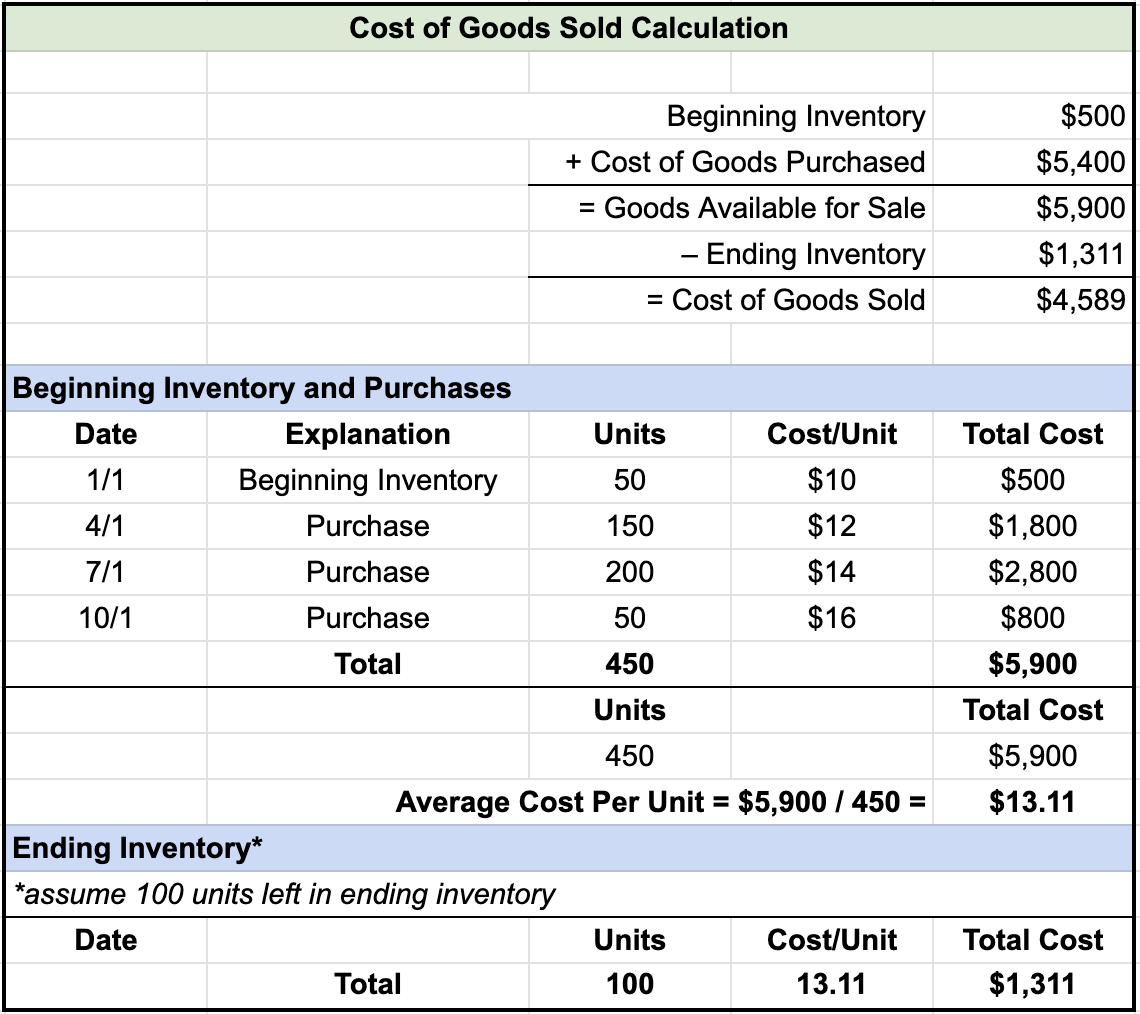
Table titled Cost of Goods Sold Calculation. Beginning inventory $500 plus cost of goods purchased $5400 is equal to goods available for sale $5900 minus ending inventory $1100 is equal to cost of goods sold $4,589.
The calculation for Beginning inventory and purchases shows the following entries under five columns named date, explanation, units, cost/unit, and total cost, respectively:
1/1, Beginning inventory, 50, $10, $500;
4/1, Purchase, 150, $12, $1800;
7/1, Purchase, 200, $14, $2800;
10/1, Purchase, 50, $16, $800;
Total, 450, $5900.
For calculating Ending inventory, first calculate average cost per unit: Divide $5,900 by 450, which equals $13.11. Now assume 100 units are left in ending inventory. Multiply 100 by $13.11 to get $1,311.
View this spreadsheet in Google Sheets


For the weighted average method, there is no concern for the timing of inventory purchases. It doesn't matter if inventory was purchased at the beginning of the period or at the end of the period--it's all based on the average cost per unit.

The argument for using the weighted average method is that inventory is very complex and it can be difficult to determine which exact units you're selling. Are you selling the units you purchased at the beginning of the period, or are you selling the units purchased at the end of the period? As you can see, it can be difficult to monitor and measure the exact flow of your inventory.


4. Specific Identification Method

Now let's introduce one more inventory valuation method known as specific identification method. This method is useful if your inventory is exactly known, if you have a low volume business, and if you are able to specifically identify which items are sold and which remain in inventory.

EXAMPLE

For example, suppose you have a car dealership that only has eight cars. Because you can count the eight cars, you don't need to worry about FIFO, LIFO, or the weighted average method.

The specific identification method is not very common, because, as mentioned, it's only useful if you have this type of low volume business. This inventory method is usually for big-ticket items such as real estate or luxury yachts.

summary
Today we conducted a review of inventory valuation methods: FIFO (First In First Out), LIFO (Last In First Out), and the weighted average method. We also introduced an additional inventory valuation method known as the specific identification method.

Source: THIS TUTORIAL WAS AUTHORED BY EVAN MCLAUGHLIN FOR SOPHIA LEARNING. PLEASE SEE OUR TERMS OF USE.


