Table of Contents |
Variable compensation is a significant part of modern pay strategies. Unlike fixed pay, which is a set amount of money employees receive regularly, variable compensation depends on performance and results. This type of pay can include bonuses, which are additional payments given for achieving specific goals or milestones; commissions, which are earnings based on a percentage of sales made; profit-sharing plans, where employees receive a portion of the company's profits; and stock options, which give employees the right to buy company shares at a set price. The idea is to reward employees for their contributions to the company's success, encouraging them to work harder and achieve more.
Variable compensation is important as it can align employees' goals with the company's objectives, creating a win-win situation.
EXAMPLE
For example, a sales team might receive bonuses for exceeding their quarterly targets. Similarly, a software development team could be awarded stock options for successfully launching a new product. When employees know that their efforts can lead to higher pay, they are more likely to be motivated and engaged in their work. This can lead to increased productivity, better performance, and higher overall company success.In a competitive job market, offering attractive variable pay options can make a company more appealing to potential employees. It shows that the company values performance and is willing to reward it. This can be a deciding factor for high-performing individuals when choosing between job offers.
Moreover, variable compensation can be a flexible tool for companies. It allows them to adjust pay based on the company's financial performance. In good times, companies can afford to pay more in bonuses and other incentives. In tougher times, they can reduce these payments without affecting base salaries. This flexibility can help companies manage their finances more effectively.
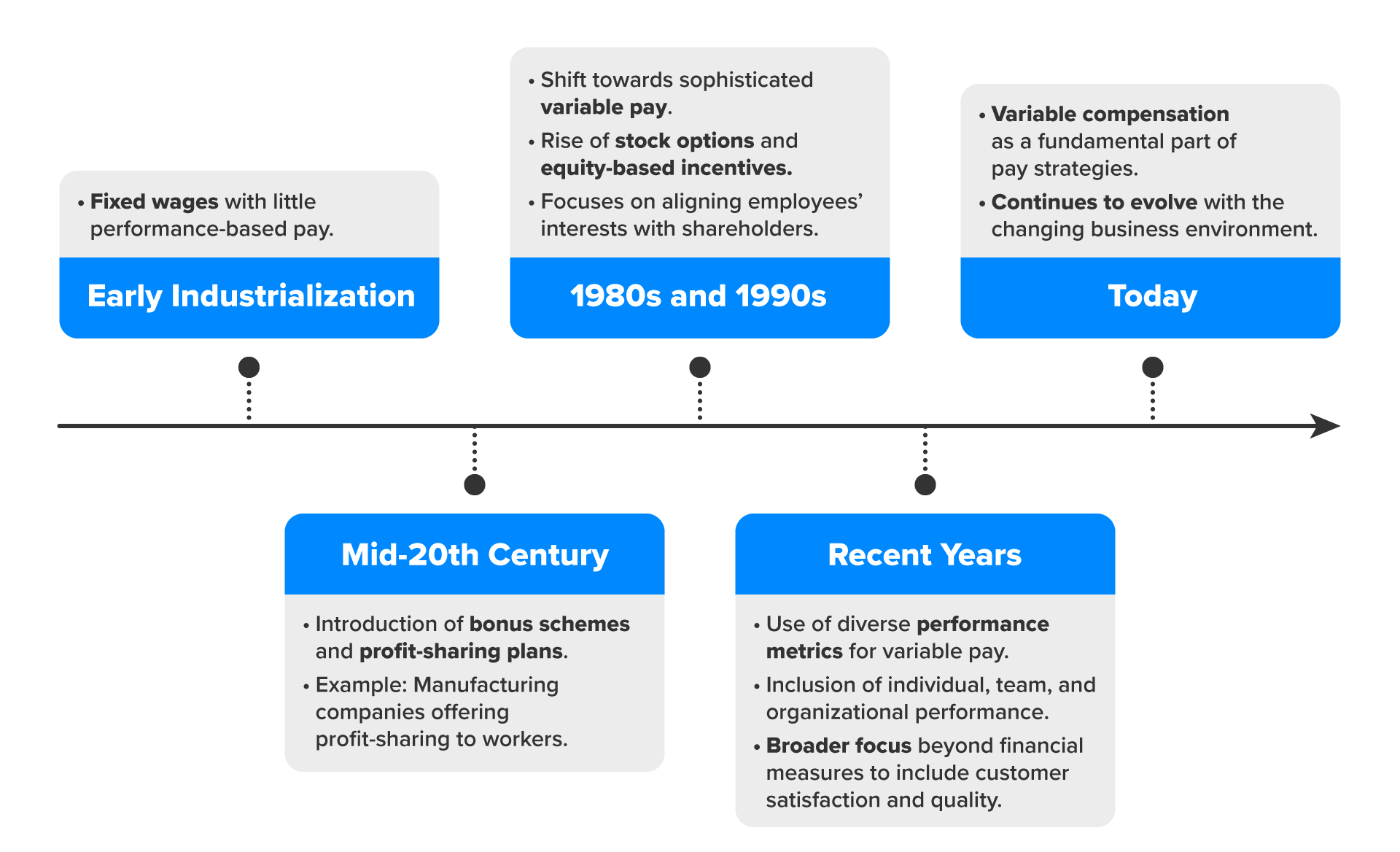
The concept of variable compensation has evolved significantly over time. In the early days of industrialization, most workers received fixed wages with little consideration for performance-based pay. As businesses grew and competition increased, companies began to explore new ways to motivate their employees and improve productivity.
In the mid-20th century, the idea of variable compensation started to gain traction. Companies began to introduce bonus schemes and profit-sharing plans as a way to reward employees for their contributions to the company's success. For example, a manufacturing company might offer profit-sharing to its workers, giving them a percentage of the company's profits at the end of the year. These early forms of variable pay were often simple and straightforward, focusing primarily on financial performance.
The 1980s and 1990s saw a significant shift in compensation strategies. With the rise of the technology sector and the increasing importance of innovation, companies began to experiment with more sophisticated forms of variable pay. Stock options and other equity-based incentives became popular, particularly in high-growth industries. These new forms of compensation were designed to align employees' interests with those of shareholders, encouraging long-term commitment and performance.
In recent years, variable compensation has continued to evolve. Companies now use a wide range of performance metrics to determine variable pay, including individual, team, and organizational performance. The focus has shifted from purely financial measures to include customer satisfaction, quality, and other key performance indicators. This broader approach reflects the growing recognition that employee performance is multi-dimensional and that effective compensation strategies need to address this complexity.
Today, variable compensation is a fundamental part of many companies' pay strategies. It has proven to be an effective tool for motivating employees, driving performance, and achieving business goals. As the business environment continues to change, variable compensation will likely continue to evolve, adapting to new challenges and opportunities.
While the term "scheme" can sometimes imply a dishonest plan, in Human Resources, it is used to describe structured compensation plans. A bonus scheme, or a commission scheme, outlines how employees can earn additional pay based on their performance. These schemes are designed to motivate employees and align their efforts with the company's goals.
Variable compensation is designed to enhance both employee performance and organizational success. The table below outlines the key objectives of variable compensation and the outcomes they aim to achieve.
| Key Objective | Outcome |
|---|---|
| Align Efforts with Strategic Goals | Ensure employees focus on activities that drive business results. |
| Motivate Higher Performance | Provide financial incentives for exceeding targets and contributing effectively. |
| Attract and Retain Top Talent | Make the company more appealing to high-performing individuals. |
| Manage and Control Labor Costs | Align compensation expenses with financial performance. |
| Foster Accountability and Improvement | Encourage ownership of work and continuous improvement. |
IN CONTEXT
Imagine a distribution center, FastTrack Logistics, where employees are motivated through a well-structured variable compensation plan.
Jin, a warehouse associate, is part of a commission scheme where he earns extra money based on the number of packages he processes accurately and efficiently. This motivates him to work quickly while maintaining high standards.
Meanwhile, Aisha, a shift supervisor, benefits from a bonus scheme. She receives additional pay for meeting shift targets and reducing errors. This encourages her to manage her team effectively and prioritize tasks that align with the company's strategic goals.
Lastly, Carlos, a logistics coordinator, is offered stock options as part of his compensation. This equity-based incentive aligns his interests with the company's long-term success, motivating him to contribute to process improvements that drive growth.
Through these variable compensation plans, FastTrack Logistics aligns employee efforts with company objectives, boosts performance, attracts top talent, and maintains financial flexibility.
Source: This Tutorial has been adapted from "Human Resources Management" by Lumen Learning. Access for free at courses.lumenlearning.com/wm-humanresourcesmgmt/. License: CC BY: Attribution



