Use Sophia to knock out your gen-ed requirements quickly and affordably. Learn more
×

Introduction to Slope

Author: Sophia

what's covered
In this lesson, you will learn how to identify the slope of a line perpendicular to a given line. Specifically, this lesson will cover:

Table of Contents

1. The Slope of a Line

As we graph lines, we will want to be able to identify different properties of the lines we graph. One of the most important properties of a line is its slope. Slope is a measure of steepness. A line with a large slope, such as 25, is very steep. A line with a small slope, such as 0.10 is very flat. We will also use slope to describe the direction of the line. A line that goes up from left to right will have a positive slope and a line that goes down from left to right will have a negative slope.

As we measure steepness, we are interested in how fast the line rises compared to how far the line runs. For this reason we will describe slope as the fraction rise over run. Rise would be a vertical change, or a change in the y-values. Run would be a horizontal change, or a change in the x-values. So another way to describe slope would be the fraction fraction numerator change space in space y over denominator change space in space x end fraction.

term to know
Slope
The steepness of a line; found by dividing the change in y-coordinates by the change in x-coordinates from any two points on a line.

1a. Using a Graph

It turns out that if we have a graph, we can draw vertical and horizontal lines from one point to another to make what is called a slope triangle. The sides of the slope triangle give us our slope.

EXAMPLE

Find the slope of the following line.
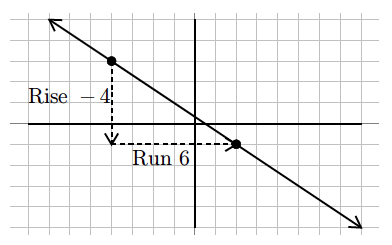
A graph with a line slanting downward from left to right, passing through two marked points. A vertical dashed line labeled ‘Rise −4’ extends downward from the first point and meets the horizontal dashed line labeled ‘Run 6’, which forms a right-angled triangle by connecting to the second point.

To find the slope of this line, we will consider the rise, or vertical change, and the run, or horizontal change. Drawing these lines makes a slope triangle that we can use to count from one point to the next. This graph goes down 4, right 6. This is a rise of -4 and a run or 6. As a fraction it would be, fraction numerator short dash 4 over denominator 6 end fraction. Reduce the fraction to get fraction numerator short dash 2 over denominator 3 end fraction, so the slope is fraction numerator short dash 2 over denominator 3 end fraction.

EXAMPLE

Find the slope of the following line.
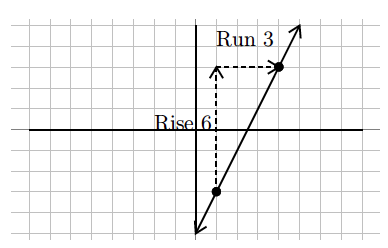
A graph with a line slanting upward from left to right, passing through two marked points. A vertical dashed line labeled ‘Rise 6’ extends upward from one point and meets the horizontal dashed line labeled ‘Run 3’, which forms a right-angled triangle by connecting to the other point.

To find the slope of this line, the rise is up 6, the run is to the right 3. Our slope is then written as a fraction, rise over run, or 6 over 3. This fraction reduces to 2, so the slope is 2.

1b. Using Two Points

We can find the slope of a line through two points without seeing the points on a graph. We can do this using a slope formula. If the rise is the change in y-values, we can calculate this by subtracting the y-values of a point. Similarly, if the run is a change in the x-values, we can calculate this by subtracting the x-values of a point. So we can say the following:

The slope of a line through open parentheses x subscript 1 comma space y subscript 1 close parentheses and open parentheses x subscript 2 comma space y subscript 2 close parentheses is fraction numerator y subscript 2 minus y subscript 1 over denominator x subscript 2 minus x subscript 1 end fraction.

When mathematicians began working with slope, it was called the modular slope. For this reason, we often represent the slope with the variable m. Now we have the following for slope.

formula to know
Slope
m equals fraction numerator y subscript 2 minus y subscript 1 over denominator x subscript 2 minus x subscript 1 end fraction


2. Slopes of Vertical and Horizontal Lines

There are two special lines that have unique slopes that we need to be aware of.

The line below is a horizontal line. For this line, the slope is not steep at all, in fact, it is flat. Therefore it has a zero slope.
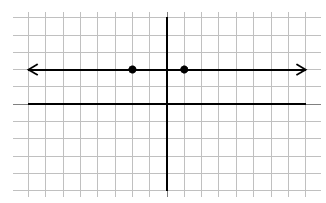
A coordinate graph with an x-axis and a y-axis consisting of several grids, each grid representing a unit. There are two marked points and a horizontal line on the graph. One marked point is in the second quadrant, 2 units above the negative x-axis and 2 units to the left of the y-axis; the other is in the first quadrant, 2 units above the positive x-axis and 1 unit to the right of the y-axis. The line extends from the second quadrant to the first quadrant by passing through the marked points.

big idea
All horizontal lines have a zero slope.

This next line is a vertical line. For this line, the slope can’t get any steeper. It is so steep that there is no number large enough to express how steep it is so this is an undefined slope.
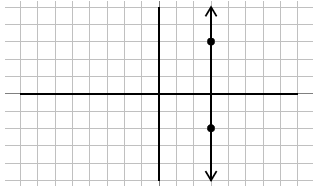
A coordinate graph with an x-axis and a y-axis consisting of several grids, each grid representing a unit. There are two marked points and a vertical line on the graph. One marked point is in the first quadrant, 3 units above the positive x-axis and 3 units to the right of the positive y-axis; the other is in the fourth quadrant, 2 units below the positive x-axis and 3 units to the right of the negative x-axis. The line extends from the first quadrant to the fourth quadrant by passing through the marked points.

big idea
All vertical lines have an undefined slope.

As you can see there is a big difference between having a zero slope and having no slope or an undefined slope. Remember, slope is a measure of steepness.


3. Slopes of Parallel and Perpendicular Lines

There is an interesting connection between the slope of lines that are parallel and the slope of lines that are perpendicular (meet at a right angle).


Type of Line Description Slope Example
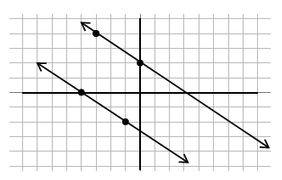
Parallel Lines that never intersect Identical slopes A graph with an x-axis and a y-axis consists of several grids; each grid represents a unit. The graph consists of a pair of parallel lines and four marked points. The first marked point is 4 units above the negative x-axis and 3 units to the left of the positive y-axis, and the second marked point is 2 units above the origin on the positive y-axis. The third marked point is 4 units to the left of the origin on the negative x-axis, and the fourth marked point is 2 units below the negative x-axis and 1 unit to the left of the negative y-axis. The first line slants downward from the second quadrant to the fourth quadrant, connecting the first and second marked points. The second line slants downward from the second quadrant to the fourth quadrant, connecting the third and fourth marked points.
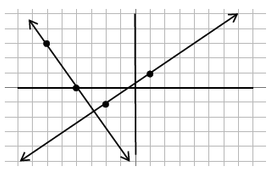
Perpendicular Lines that intersect at a right angle Opposite reciprocal slopes A graph with an x-axis and a y-axis consists of several grids; each grid represents a unit. The graph consists of two intersecting lines and four marked points. The first marked point is 3 units above the negative x-axis and 6 units to the left of the positive y-axis, and the second marked point is 4 units to the left of the origin on the negative x-axis. The third marked point is 1 unit below the negative x-axis and 2 units to the left of the negative y-axis, and the fourth marked point is 1 unit above the positive x-axis and 1 unit to the left of the positive y-axis. The first line slants downward from the second quadrant to the third quadrant, connecting the first and second marked points. The second line slants upward from the third quadrant to the first quadrant, connecting the third and fourth marked points.


As the above graphs illustrate, parallel lines have the same slope, and perpendicular lines have opposite (one positive, one negative). In fact, perpendicular lines have reciprocal (flipped fraction) slopes. We can use these properties to make conclusions about parallel and perpendicular lines.

Let's take a further look at the example above with perpendicular lines.

EXAMPLE
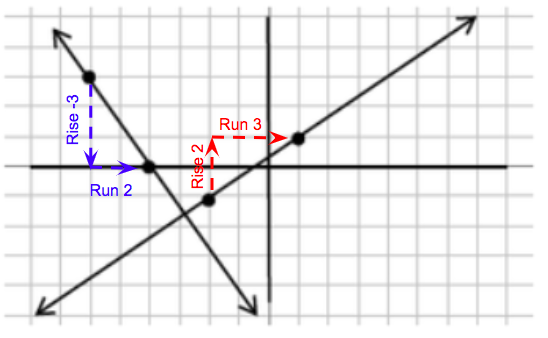

A coordinate graph with an x-axis and a y-axis. The graph consists of two intersecting lines. Consider one small square of the grid as one unit. The first line slants downward from the second quadrant to the third quadrant, passes through the marked points at (−6, 3) and (−4, 0), and extends into the third quadrant. The second line slants upward from the third quadrant, passes through the marked points at (−2, −1) and (1, 1), and extends into the first quadrant. A dashed line labeled ‘Rise 3’ descends vertically from the marked point at (−6, −3) until the point (−6, 0). From this point, the line extends horizontally up to the marked point at (−4, 0) and is labeled ‘Run 2’. Another dashed line labeled ‘Rise 2’ ascends vertically from the marked point at (−2, −1) up to the point (−2, 1). From this point, the line extends horizontally up to the marked point (1, 1) and is labeled ‘Run 3’.

One line has a rise of -3 and a run of 2, so the slope is fraction numerator short dash 3 over denominator 2 end fraction. The other line that is perpendicular has a rise of 2 and a run of 3, so the slope of this line is 2 over 3. These two slopes are opposite reciprocals. They are opposite meaning one slope is positive while the other is negative. The slopes are also reciprocals meaning their fractions are flipped.

big idea
When two lines are parallel, the slopes are the same. When two lines are perpendicular, the slopes are opposite reciprocals.

See how slopes of parallel and perpendicular lines compare in the following table:

Slope of Line 1 Slope of Line 2 Relationship Explanation
5 over 12 short dash 12 over 5 Perpendicular The reciprocal of 5 over 12 is 12 over 5, and then make it negative!
3 3 Parallel Since they both have the same value for the slope, they are parallel lines.
3 over 4 4 over 3 Neither Although the fractions are reciprocals, they are not opposites.
short dash 1 fourth 4 Perpendicular The reciprocal of short dash 1 fourth is short dash 4 over 1, or just 4. Then make it positive!
3 over 17 short dash 19 over 2 Neither Although they are opposites (one positive, one negative), these fractions are not reciprocals.
3 over 8 3 over 8 Parallel Since they both have the same value for the slope, they are parallel lines.

terms to know
Parallel Lines
Lines that never intersect; they have identical slopes.
Perpendicular Lines
Lines that intersect at a right angle; they have opposite reciprocal slopes.

summary
The slope of a line is a measure of how steep it is. When reading a graph from left to right, lines with a negative slope head towards negative infinity on the y-axis and lines with a positive slope head towards positive infinity on the y-axis. The slopes of vertical and horizontal lines are unique. Horizontal lines have a slope of zero and vertical lines have a slope that is undefined. The slopes of parallel and perpendicular lines are special too. Parallel lines have the same slope and perpendicular lines have slopes that are opposite reciprocals of each other.

Source: THIS TUTORIAL HAS BEEN ADAPTED FROM "BEGINNING AND INTERMEDIATE ALGEBRA" BY TYLER WALLACE. ACCESS FOR FREE AT www.wallace.ccfaculty.org/book/book.html. License: Creative Commons Attribution 3.0 Unported License


Terms to Know
Parallel Lines

Lines that never intersect; they have identical slopes.

Perpendicular Lines

Lines that intersect at a right angle; they have opposite reciprocal slopes.

Slope

The steepness of a line; found by dividing the change in y-coordinates by the change in x-coordinates from any two points on a line.

Formulas to Know
Slope

m equals fraction numerator y subscript 2 minus y subscript 1 over denominator x subscript 2 minus x subscript 1 end fraction