Table of Contents |
In this lesson, you will learn terminology related to varied diagnostic and pathology techniques.
Diagnostic techniques are procedures used to detect, confirm, and monitor diseases by analyzing tissues, fluids, and internal structures. These techniques facilitate early detection of diseases and conditions. They also guide treatment decisions by providing detailed anatomical and cellular information. Additionally, they can be used to monitor disease progression and treatment progression in some cases. Diagnostic tests include physical examinations, laboratory testing, imaging, and other testing.
Laboratory tests are procedures that analyze bodily fluids, tissues, and other specimens to detect diseases, monitor conditions, and assess overall health. These are used to facilitate the detection of diseases such as diabetes, infections, and cancer. They are also used to monitor chronic conditions such as kidney disease and thyroid disorders. They can be used to guide treatment decisions. For example, they could be used to select an appropriate chemotherapy or antibiotic regimen.
Types of specimens collected for laboratory analysis include:
- Blood
- Urine
- Saliva
- Sputum
- Tissues (biopsies)
- Cerebrospinal fluid (CSF)
- Amniotic fluid (for fetal health evaluation)
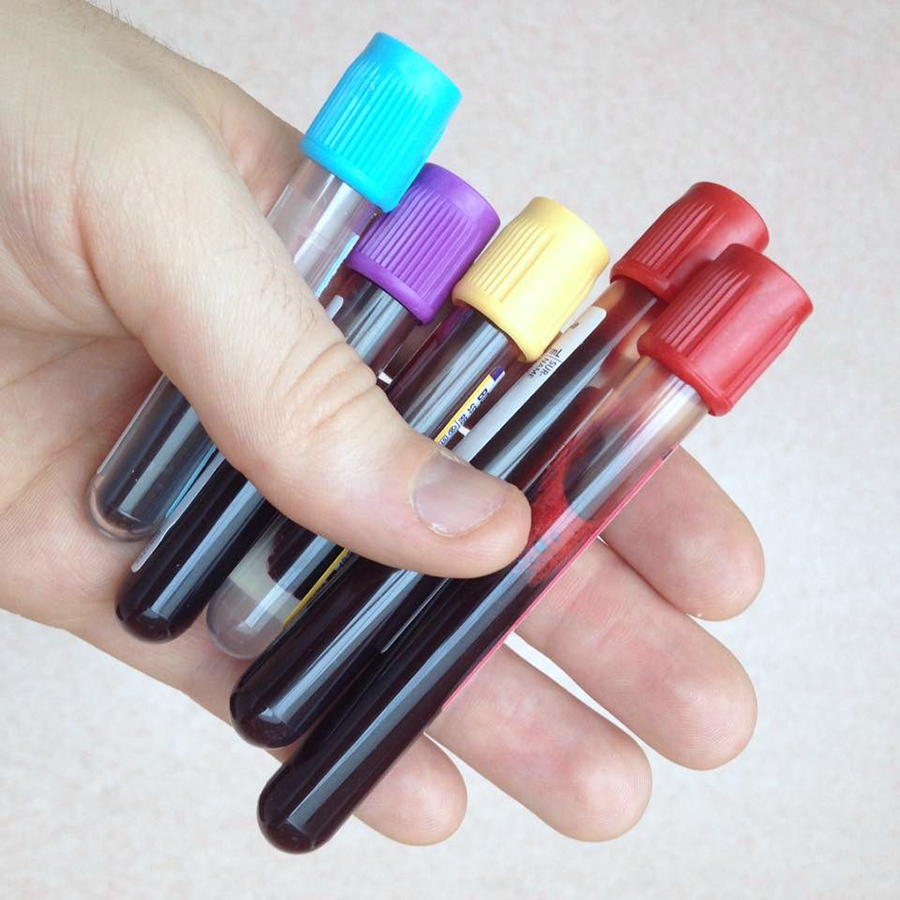
The photo below shows blood samples for blood testing. These color-coded tubes are called vacutainers. They are sterile tubes specifically designed to transport blood samples. Each colored rubber stopper indicates the type of testing needed. The tubes differ in size and help to ensure that the correct quantity of blood is submitted for testing. Additionally, different tubes contain different additives needed for different types of analyses (Bios, n.d.).
Imaging reports are written interpretations of medical imaging studies by radiologists, summarizing findings and clinical significance.
Types of medical imaging include:
- X-ray (radiography) – For bones, lungs, soft tissues (best for dense tissues like bones; Fayad, n.d.).
- Ultrasound (sonography) – For real-time imaging of soft tissues and blood flow.
- Computed tomography (CT or CAT scan) – For detailed cross-sectional imaging.
- Magnetic resonance imaging (MRI) – Especially valuable for soft tissue and brain imaging.
- Positron emission tomography (PET scan) – For functional and metabolic imaging.
Remember that path/o means disease or disorder. So pathology is the study of abnormal conditions. There are many types of pathologists who specialize in different areas. Here are some examples from the American Board of Pathology (n.d.):
- Cytopathology: Specializes in studying cells, such as those in fluids or obtained through fine needle aspiration.
- Dermatopathology: Specializes in skin analysis (e.g., examining biopsies).
- Forensic pathology: Specializes in the analysis of tissues and other samples from deceased individuals (e.g., during autopsies).
- Neuropathology: Specializes in the nervous system.
- Surgical pathology: Specializes in the analysis of surgical samples (e.g., biopsies).
There are other types of pathologists as well, and these specialists often use the types of diagnostic testing (including laboratory testing) described above.
The table below shows common prefixes that you will encounter as you learn about diagnostics and pathology. Remember that many other prefixes are also used, including prefixes that you have already learned.
| Term | Definition | Example | Definition of Example |
|---|---|---|---|
| Echo- | Sound | Echocardiogram | A sonographic imaging test that uses sound waves to produce images of the heart. |
| Hypo- | Low | Hypoechoic | Dark region on an ultrasound due to reduced echo (sound wave reflection) of dense tissue (Healthline, 2018) |
| Hyper- | Excessive | Hyperintensity | Increased brightness on MRI |
| Iso- | Equal, same | Isodense | Same density as surrounding tissues on CT |
| Micro- | Small | Microbiology | The study of microscopic organisms |
Many combining forms that you have already learned are relevant to learning about diagnostic and pathology testing. The table below shows some examples.
| Term | Definition | Example | Definition of Example |
|---|---|---|---|
| Angi/o | Vessel | Angiography | Imaging of blood vessels |
| Bacteri/o | Bacteria | Bacteremia | Bacteria in the blood |
| Calc/i | Calcium | Calcification | Calcium buildup in tissues, such as blood vessels |
| Cyt/o | Cells | Cytology | The study of cells. |
| Dens/o | Dense | Hypodense | Low density area on CT scan (appears dark because more radiation passes through; Radiology at St. Vincent’s University Hospital, n.d.) |
| Electr/o | Electricity | Electrolytes | A charged species, such as sodium |
| Hem/o, hemat/o | Blood | Hematology | The study of the blood |
| Hist/o | Tissues | Histology | The study of tissues |
| Magnet/o | Magnet, magnetism | Magnetic resonance imaging (MRI) | A type of scan that shows detailed images of soft tissues in the body using radio waves and strong magnets; used to diagnose many medical conditions, such as soft tissue abnormalities, tears in ligaments, joint abnormalities, and tumors |
| Scint/i | Spark, scintillation (flash of light) | Scintigraphy | Nuclear medicine imaging using radioactive tracers |
| Sial/o | Saliva | Sialadenitis | Inflammation of a salivary gland or glands (Johns Hopkins Medicine, n.d.) |
| Ur/o, urin/o | Urine | Urinalysis | A test of the urine involving physical, chemical, and microscopic examination to detect disorders or diseases |
In addition to prefixes and combining forms, there are many suffixes that are useful in discussing diagnostic and pathology testing. The table below includes familiar suffixes and a few new suffixes that will be helpful.
| Term | Definition | Example | Definition of Example |
|---|---|---|---|
| -emia | Blood condition | Anemia | Insufficient red blood cells or hemoglobin |
| -graphy | Process of recording | Mammography | Imaging of the breasts |
| -gram | Recording | Electrocardiogram (ECG or EKG) | A recording of heart electrical activity |
| -lysis | Separated, loosening | Hemolysis | Destruction of red blood cells |
| -scope | Instrument for viewing | Microscope | A device used to enlarge specimens for viewing |
| -scopy | Visual examination | Endoscopy | Visualization of the esophagus, stomach, and duodenum (the first part of the intestine) |
Source: THIS TUTORIAL HAS BEEN ADAPTED FROM “CLINICAL NURSING SKILLS” BY Christy Bowen at OpenStax. ACCESS FOR FREE AT https://openstax.org/books/clinical-nursing-skills/pages/1-introduction. LICENSING: CREATIVE COMMONS ATTRIBUTION 4.0 INTERNATIONAL.
REFERENCES
Bios, L. (2025, July 17). What is a Vacutainer? Ucallm. what is a vacutainer
Fayad, D. (n.d.). CT Scan Versus MRI Versus X-Ray What Type of Imaging Do I Need? Johns Hopkins Medicine. CT Scan Versus MRI Versus X-Ray: What Type of Imaging Do I Need? | Johns Hopkins Medicine
What is Pathology? (n.d.). American Board of Pathology. What is Pathology? - American Board of Pathology
Cytology (Cytopathology). (2025, July 22). Cleveland Clinic. Cytology (Cytopathology): What It Is, Types & Procedure
What is a Hypoechoic Mass? (2018, June 25). Healthline. Hypoechoic Mass: In the Liver, Breast, Kidney, and More
Sialadenitis. (n.d.). Johns Hopkins Medicine. Sialadenitis (Salivary Gland Infection): Symptoms & Treatment
Radiological Descriptive Terms. (n.d.). Radiology at St. Vincent’s University Hospital. Radiological Descriptive Terms - Radiology at St. Vincent's University Hospital



