Table of Contents |
Whether you know it or not, we all use arguments all the time. Whenever you offer one or more statements in support of another statement, you are giving reasons for someone to accept a claim. Consider the example of an argument found in everyday speech, and take a look at how we break it down into its parts.
| Argument: Adena’s car broke down, so she will be late. | ||
|---|---|---|
| Premise | Adena’s car broke down | A premise claims to say something true of the world. In other words, it is a factual claim. |
| Conclusion | she will be late | A conclusion claims to say what follows from the premise(s). |
By claiming that the conclusion follows from the premise (indicated by the word “so”), an inferential claim has been made. Some arguments can be less direct.
EXAMPLE
If someone asked you where Ricardo’s pen went, and you said, “His pen was on the table, but Sarah wasn’t writing,” you would be suggesting that since Sarah wasn’t writing, she didn’t take Ricardo’s pen.The conclusion (that Sarah didn’t take the pen) is only implicit in what you said, but you would be asking someone to make that inference in an indirect way.
As we have just seen, an argument will have a premise (or set of premises) that is supposed to support a conclusion. But the premise (or set of premises) may itself be wrong. Consider these two arguments:
(1) Egypt has ancient architecture, so it would be great for sightseeing.
(2) Pigs can fly; therefore, we should restrain them so they don’t get away.
The premise in (1) is clearly true, whereas the premise in (2) is clearly false. Egypt has pyramids and temples from ancient civilizations. However, pigs cannot fly. Whether or not the inference made in each is successful is another question. For now, we just want to look at whether or not the factual claims are true.
It is not always as straightforward to identify whether or not a premise is true.
EXAMPLE
If you said, “They are dangerous; therefore, we should protect ourselves,” you would be making a factual claim (the premise that there are some dangerous people) and an inferential claim (that this gives us reason to protect ourselves).On the contrary, what if they aren’t dangerous? If you ask, “Is it true that they are dangerous?” and it turns out not to really be a fact (perhaps you received bad information), then you wouldn’t have a good reason to draw the conclusion.
Just as factual claims can turn out to be inaccurate, an inferential claim can fail to show that a premise supports a conclusion.
If you want to know whether the inferential claim is successful or not, then you can ask the question, “Assuming all premises were true, would they support the conclusion?” In the context of your friend’s chances in the exams, if we assume that she really does like to have a good time and hates school, do they support the conclusion that she will fail her exams? No, because it is perfectly possible for Amy (or anyone else) to like to have a good time, hate school, and still do well in her exams.
It may not have been obvious to see that the inference doesn’t work in the example provided; this is because we may often associate having a good time with not focusing on other commitments. Sometimes, the quality of an inference is much more obvious.
EXAMPLE
Consider these two arguments: (1) You come from a different country; therefore, you must be up to no good. (2) My home is burning down, so I need to get out.The inference in (1) is clearly incorrect since someone’s country of origin does not, of itself, tell us anything about their intentions. The inference in (2) is clearly correct since humans are injured by fire and must avoid it in order to remain healthy. Remember that a strong inference requires more than just a personal preference or assumption; it needs a clear, proven link that supports the conclusion.
The factual claim and the inferential claim must be evaluated separately if you are going to find out whether or not an argument works.
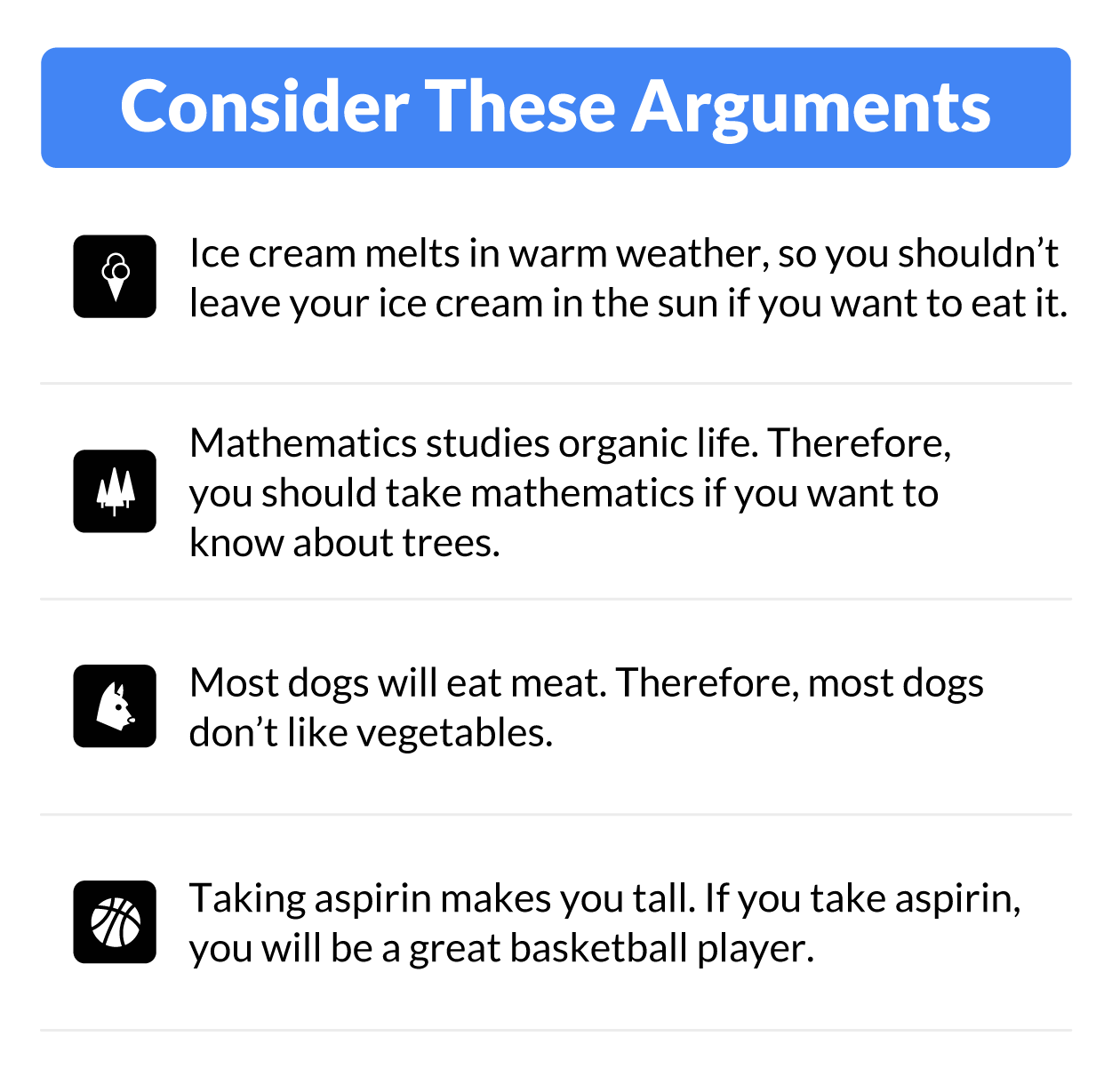 Select each of the following arguments to see how they can be evaluated.
Although we have been stressing that arguments are used very often (perhaps more often than we think), it is important to recognize that many instances of speech and writing are not arguments.
Consider these sentences:
(1) The volcano erupted at 3 a.m.
(2) Beware of slippery surfaces.
Neither of these offers a premise that is supposed to support a conclusion: (1) is a simple report; and (2) is a warning. They are conveying information, but they are not claiming to prove something. In this sense, they are noninferential statements.
Source: This tutorial has been adapted from OpenStax "Introduction to Philosophy." Access for free at OpenStax. License: Creative commons attribution 4.0 international.



