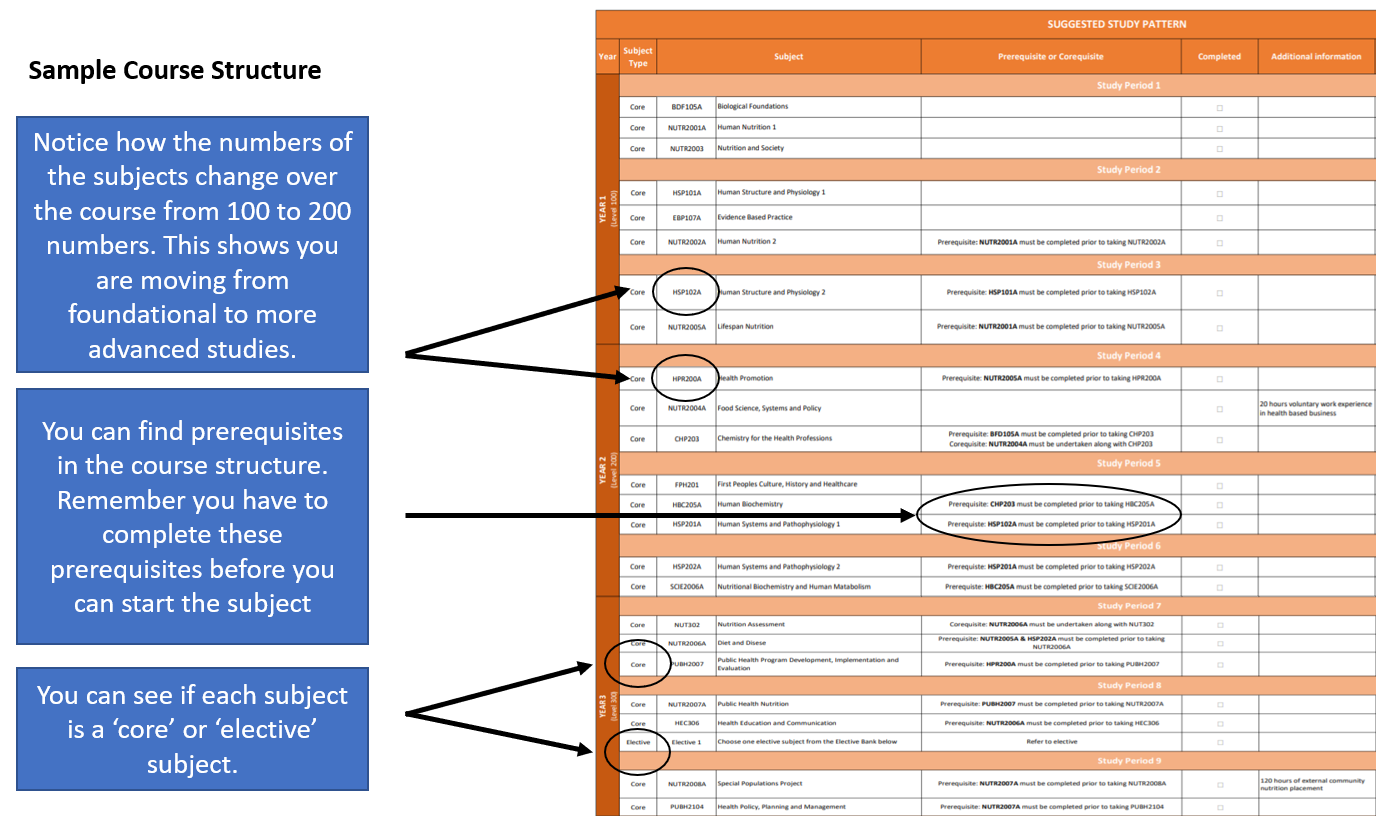
You can find your course structure by going to the Student Hub and clicking on your course page:
You can also click directly into the links below to find out more about your particular course:
When you are reviewing the course structure, you will find subject names sorted and listed with a three or four-letter abbreviation and three or four-digit number.
The numbers are a way of indicating a subject's level of difficulty or the level of experience a student taking the subject should have.
A 100 level subject is a first year subject, while 200 and 300 level subjects would typically be completed in second or third year of study.
EXAMPLE
Consider the subject ECON 101: Introduction to Economics. This would indicate an introductory or first year economics subjectYou'll notice that some subjects are labelled core subjects, and this indicates that these are subjects that everyone studying this course must take.
On the other hand elective subjects are subjects that you have some choice over depending on your own interests and future career plans.
Prerequisites are subjects that must be taken before you can complete another subject.
EXAMPLE
In order to register for a class titled "FILM 501: Advanced Film Seminar," you may need to have taken the prerequisite, "FILM 200: Introduction to Filmmaking."Prerequisites are designed to ensure that students are properly prepared for the challenge of more advanced subjects. They help students to understand the foundations of knowledge they need to complete more advanced study.
Prerequisites are detailed in your course structure, so keep this in mind as you are considering subject selection.