Use Sophia to knock out your gen-ed requirements quickly and affordably. Learn more
×

Internal Rate of Return and Profitability Index

Author: Sophia

before you start
In addition to the net present value method, there are two other commonly used methods of evaluating capital projects that take time value of money into account. They are the internal rate of return and the profitability index. The internal rate of return (IRR) method is based on estimated cash flows and is independent of market interest rates. IRR calculations begin with a net present value of zero and are used to determine what interest rate a company will earn if it undertakes a particular capital investment. The profitability index (PI) helps businesses measure the attractiveness of a capital investment in the terms of payoff per dollar invested.

1. Profitability Index

The profitability index, also called the present value index, is a ratio used to assist decision makers in ranking capital investment proposals. Profitability indexes tell decision makers how much cash inflow will be returned from one dollar of project investment. The profitability index is calculated by dividing the total present value of future cash inflows by the initial cost of an investment. It is often used in conjunction with net present value calculations. As a result, before completing a profitability index, present value calculations of all cash inflows pertaining to the investment must be completed.

Decision makers use probability indexes to compare capital investment options. Sometimes net present value calculations can be misleading, due to different initial costs. By complimenting net present value calculations with profitability indexes, management can feel even more confident about making a decision.

step by step
  1. Determine the profitability index of the proposed capital investment.
  2. Rank which projects should be potentially funded.

EXAMPLE

Star Inc. is considering three different capital investment projects: purchasing a new delivery truck, buying new computer equipment , or purchasing a new floor scrubber. Obviously, these are three materially different types of investments. Star Inc. only has enough money to fund one of the projects. Relevant information about these three options, including previously completed present value and net present value calculations, is presented below:
Delivery Truck Computer Equipment Floor Scrubber
Total present value of cash inflows $107,000 $86,400 $56,400
Amount to be invested 100,000 80,000 60,000
Net Present Value $7,000 $86,400 ($3,600)


1a. Determine the profitability index of the proposed capital investment - Step One

Determine the profitability index of each of the capital investment options by dividing the total present value of each option by its initial cost.

formula to know
Profitability Index
Profitability space Index equals fraction numerator Total space present space value space of space future space cash space inflows over denominator Initial space Cost space of space an space Investment end fraction

EXAMPLE

For Star Inc, we work through each of the potential investment options one by one.


The delivery truck had total present value cash inflows of $107,000 and a cost of $100,000. The ratio of these two produces a profitability index of $1.07 dollars earned per dollar spent to purchase a delivery truck.
1.07 equals fraction numerator $ 107 comma 000 over denominator $ 100 comma 000 end fraction

Computer Equipment had $86,4000 in total present value and a cost of $80,000, meaning that its profitability index is 1.08.
1.08 equals fraction numerator $ 86 comma 400 over denominator $ 80 comma 000 end fraction

The floor scrubber’s profitability index is 0.94, due to $56,400 of present value cash flow divided by $60,000 cost.
0.94 equals fraction numerator $ 56 comma 400 over denominator $ 60 comma 000 end fraction

hint
Remember that the total present value of future cash inflows is calculated by adding together the present value of each of the years under consideration.
Total Present Value of Future Cash Inflows = PV1 + PV2 + PV3 + PV4 + PV5

1b. Rank which projects should be potentially funded - Step Two

Having calculated the profitability index for each option, they can now be ranked. But the ranking of the proposals is not quite as straightforward as "the higher the index, the better."

The profitability index decision rule says that a project will have a profitability index greater than 1.00 when the net present value is positive. Proposals with positive profitability indexes should be ranked, with the highest indexes taking precedence. Proposals with a profitability index of less than 1.00 cannot yield the minimum rate of return because the present value of the projected cash inflows is less than the initial cost. Therefore, proposals with a profitability index under 1.00 should not be considered in the funding decision.

EXAMPLE

Delivery Truck Computer Equipment Floor Scrubber
Total present value of cash inflows $107,000 $86,400 $56,400
Amount to be invested 100,000 80,000 60,000
Net Present Value $7,000 $86,400 ($3,600)
Profitability Index 1.07 1.08 0.94
First, we can eliminate the floor scrubber proposal from consideration, due to the profitability index being less than 1.

The delivery truck has the higher net present value at $7,000 compared to the computer equipment at $86,400, but computer equipment has a higher profitability index at 1.08 compared to the delivery truck at 1.07, suggesting it is a slightly better investment. Computer equipment will return $1.08 present value dollars per dollar invested whereas the delivery truck only returns $1.07.

Another potential consideration, however, is that the purchase cost of the computer equipment is $20,000 more expensive in initial costs than the delivery truck. Management must also consider how that extra $20,000 might be invested elsewhere if the delivery truck proposal was chosen after all.

term to know
Profitability Index
Also called the present value index, is the ratio of present value to cost which is used to assist decision makers in ranking capital investment proposals.


2. Advantages and Disadvantages of the Profitability Index

When businesses use the profitability index PI, their goal is to make the best possible decision that will benefit the company the most. This method allows businesses to use capital rationing to rank (according to the profitability index) and choose the best investment alternative. The profitability index method, like other methods of evaluating capital projects, has some benefits and limitations.

Benefits of the profitability index include:

  • PI is a simple method to calculate and it is widely used across business. There is some comfort in knowing that this is a standard practice in the industry.
  • Time value of money is accounted for in the profitability index. Using the time value of money insures decision makers that they will rate investment dollars today with discounted cash flows.
Limitations of the profitability index are:
  • The discount rate can be difficult to estimate. Recall the discount rate is the amount of interest a company thinks it will be able to earn if it invests in something else.
  • As with many of the capital budgeting methods, there is a possibility of making the incorrect decision. The profitability index, like all other methods of determining future profitability, is not foolproof but is much better than running no calculations at all.

3. Internal Rate of Return

Using the net present value and the profitability index methods, we evaluate potential capital projects using the standard of a minimum desired rate of return, determined by management ahead of time. The internal rate of return method (IRR) works somewhat backward. The internal rate of return starts with the proposed investment’s net cash flows, then works backward to estimate the proposal’s expected rate of return. It does this by finding the rate at which the net present value of the project is zero. In other words, the IRR method identifies the rate a project would need to earn in order to get the net present value to equal zero.

step by step
  1. Determine the present value factor for an annuity of $1.00.
  2. Locate the present value factor in the present value of an annuity table.
  3. Identify the internal rate of return by following the present value factor to the rate on the table.
  4. Decide whether the investment should be funded.

EXAMPLE

Cadance Company makes clothing for kittens. They are evaluating a proposal for a new piece of equipment that helps sew the kitten clothing and have collected the following information:
Cost of new equipment $97,360
Yearly expected cash flows to be received $20,000
Expected useful life 7 years
Minimum desired rate of return 9%


3a. Determine the present value factor for an annuity of $1.00 - Step One

The present value factor is determined by dividing the cost of the new equipment by the yearly expected cash flows.

formula to know
Present Value Factor for an Annuity of $1
In order to calculate the internal rate of return, a present value factor must be determined.
Present space Value space Factor space for space an space Annuity space of space $ 1 equals fraction numerator Cost space of space new space equipment over denominator Yearly space expected space cash space flows end fraction

EXAMPLE

For Cadance Company, the $97,360 cost of the new kitten clothing equipment divided by the $20,000 yearly cash flow yields an annuity of 4.868.

3b. Locate the present value factor in the present value of an annuity table - Step Two

Next, we locate the present value factor in the present value of an annuity of $1 table by cross referencing the expected useful life with the present value factor.
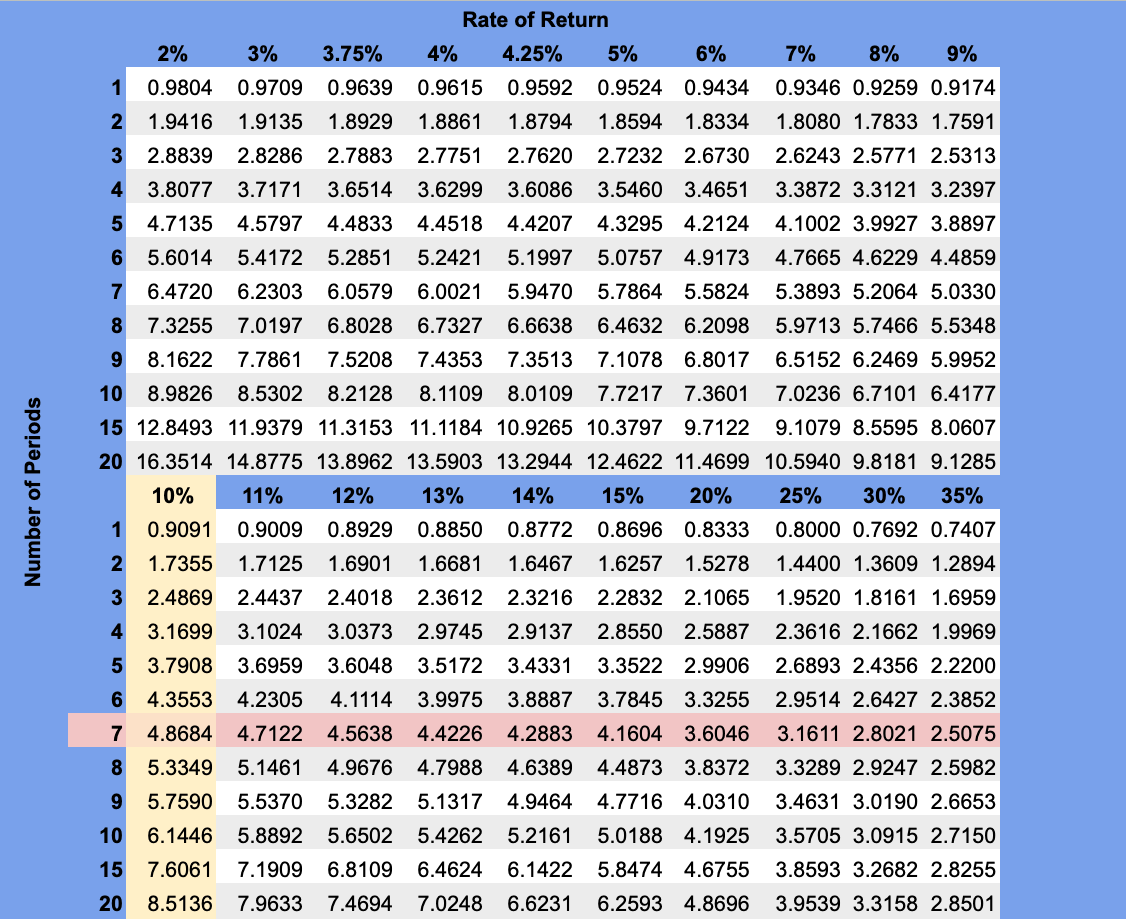
Find the rate of return by looking for the present value factor in row 7 closest to 4.868
Present Value of an Annuity of $1
View this spreadsheet in Google Sheets

EXAMPLE

We have determined the present value factor for Cadance Company to be 4.868. The expected useful life of this investment is 7 years. Slide your finger across the table (at 7 periods) until you arrive at the present value factor (or the closest number to it) identified in step 1, which is 4.8684.


3c. Identify the internal rate of return by following the present value factor to the rate on the table - Step Three

Move your finger up the column to determine the rate of return that corresponds with the present value factor you just found.

EXAMPLE

Here, we find that the closest value in the 7 period row is 4.8684, which lines up with the 10% column. The internal rate of return for this project is 10% This means that the net present value would be zero, if we earned a rate of return of 10% on this project.

3d. Decide whether the investment should be funded - Step Four

Finally, management can now decide whether the project should be funded. This decision can be made by using the standard minimum desired rate of return set by the company and by the internal rate of return decision rule.

The internal rate of return decision rule says that if the internal rate of return equals or exceeds the cost of capital or minimum desired rate of return, a firm should fund the investment. However, if the proposal's internal rate of return is less than the minimum rate, the firm should reject the proposal.

EXAMPLE

Since the minimum desired rate of return is 9% and the internal rate of return is 10%, the project should be funded.

term to know
Internal Rate of Return
Determines the rate of return that causes your net present value of future cash flows to equal zero.


4. Advantages and Disadvantages of the Internal Rate of Return Method

Internal rate of return (IRR) gives a manager a good idea of the return they will earn, due to investing in a capital project. The amount of the return can then be evaluated to determine which projects should be funded. As with any method, the internal rate of return has some advantages and disadvantages.

Advantages of the IRR method Disadvantages of the IRR method
  • The time value of money is accounted for in the internal rate of return, giving decision makers the present values of all cash flows to use in comparison with the cash layout of a potential capital project
  • A project’s internal rate of return is easy to interpret and compare against other project alternatives. Management can easily see which projects have greater returns.
  • The internal rate of return calculation does not take into account the length of the project. Longer term projects tend to be riskier, and that is not accounted for in these calculations.
  • It should not be the sole decision criteria calculation run for mutually exclusive projects.

Mutually exclusive projects are those projects that compete with one another, cannot be funded at the same time, and where management must choose between two options.

term to know
Mutually Exclusive Projects
Project alternatives that compete with one another, cannot be funded at the same time and where management must choose between two options.

summary
In this lesson, we learned about alternate methods to net present value that are also beneficial to business decision makers. The profitability index is a ratio that helps managers rank projects in order of their payoffs. The profitability index ratio calculates how many present value dollars will be returned if a project is funded. Competing projects can then be ranked according to their profitability index for funding consideration.

We also discussed the internal rate of return. The internal rate of return helps managers determine the rate of return if a project were to have $0.00 net present value. In this method, we work backward to determine the rate we would earn, given a series of cash inflows. This is then ranked against a minimum desired rate of return to determine acceptance or rejection of a capital project.

No matter which decision making tool is used, these methods help managers make better, data-driven decisions because having more, quality information creates a better case of whether or not to fund a project, which ultimately will either help or hurt a business.

Source: THIS TUTORIAL HAS BEEN ADAPTED FROM “ACCOUNTING PRINCIPLES: A BUSINESS PERSPECTIVE” BY hermanson, edwards, and maher. ACCESS FOR FREE AT www.solr.bccampus.ca. LICENSE: CREATIVE COMMONS ATTRIBUTION 3.0 UNPORTED.

Terms to Know
Internal Rate of Return

Determines the rate of return that causes your net present value of future cash flows to equal zero.

Mutually Exclusive Projects

Project alternatives that compete with one another, cannot be funded at the same time and where management must make a choice between two options.

Profitability Index

Also called the present value index, is the ratio of present value to cost which is used to assist decision makers in ranking capital investment proposals.

Formulas to Know
Present Value Factor for an Annuity of $1

Present space Value space Factor space for space an space Annuity space of space $ 1 equals fraction numerator Cost space of space new space equipment over denominator Yearly space expected space cash space flows end fraction

Profitability Index

Profitability space Index equals fraction numerator Total space present space value space of space future space cash space inflows over denominator Initial space Cost space of space an space Investment end fraction