Table of Contents |
Recall that skeletal muscles are attached to bones through tendons. When skeletal muscles contract, they pull on a bone and can cause the angle of its synovial joint to change. This action moves the skeleton which is why skeletal muscle is called ‘skeletal.’
The attachment point of the muscle that moves as it pulls on the bone is called the muscle’s insertion. The other end of the muscle is attached to a fixed (stabilized) bone and is called the origin.
During body movements, muscles play various roles—creating, antagonizing, or supporting the movement. In any body movement, the principal muscle involved in its action is called the agonist muscle, or prime mover, of that movement. Many movements can also recruit additional muscles known as synergist or synergist muscles, whose contraction aids the agonist. A fixator or fixator muscle is a muscle that stabilizes the origin of the agonist, keeping it from moving. And lastly, any muscle that opposes the movement performed by an agonist is known as the antagonist or antagonist muscle. Antagonists perform two functions:
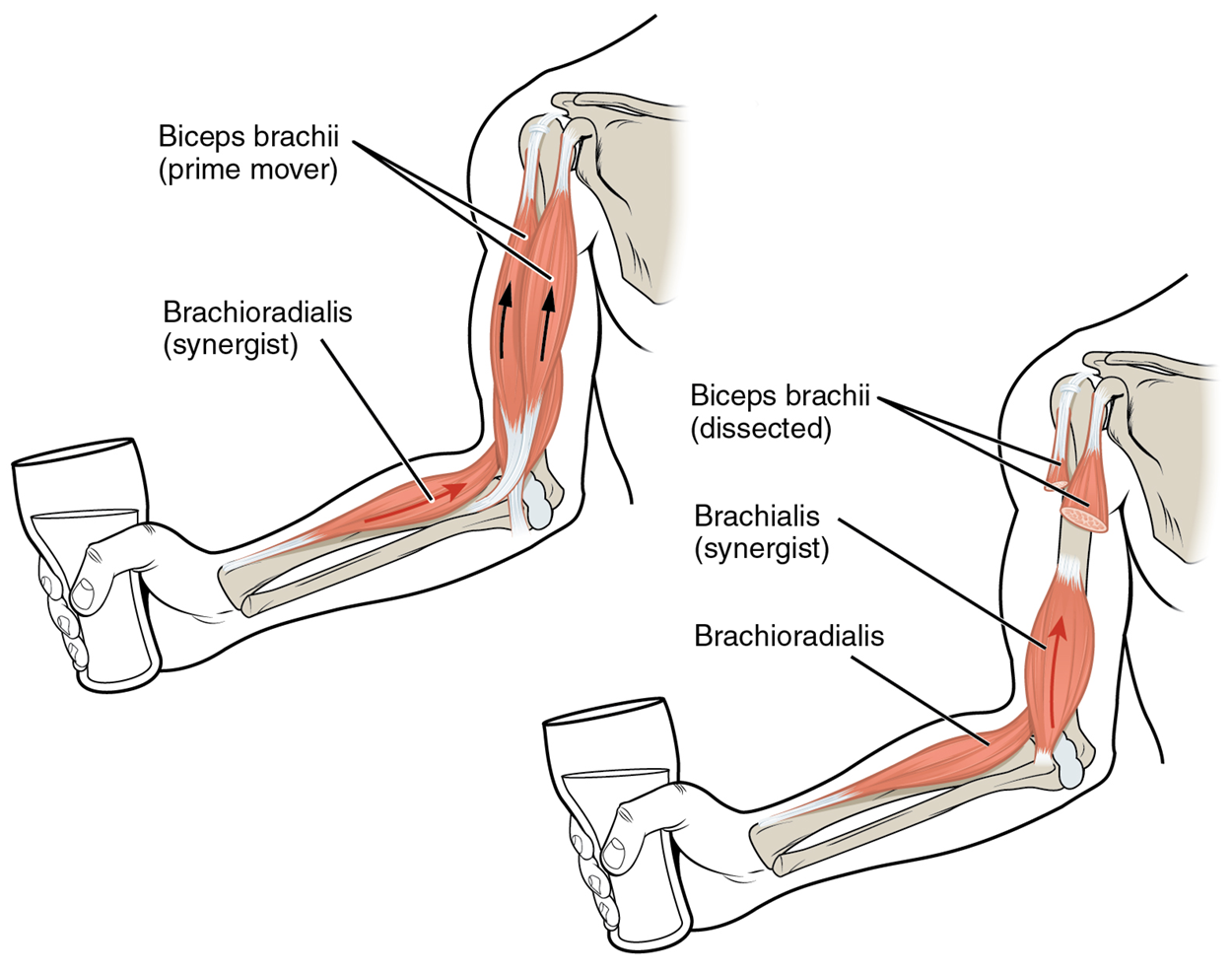
See the table below for a list of some agonists and antagonists. You will become more familiar with the muscle names in future lessons.
| Agonist | Antagonist | Movement |
|---|---|---|
| Biceps brachii: in the anterior compartment of the arm | Triceps brachii: in the posterior compartment of the arm | The biceps brachii flexes the forearm, whereas the triceps brachii extends it. |
| Hamstrings: group of three muscles in the posterior compartment of the thigh | Quadriceps femoris: group of four muscles in the anterior compartment of the thigh | The hamstrings flex the leg, whereas the quadriceps femoris extend it. |
| Flexor digitorum superficialis and flexor digitorum profundus: in the anterior compartment of the forearm | Extensor digitorum: in the posterior compartment of the forearm | The flexor digitorum superficialis and flexor digitorum profundus flex the fingers and the hand at the wrist, whereas the extensor digitorum extends the fingers and the hand at the wrist. |
There are also skeletal muscles that do not pull against the skeleton for movements.
EXAMPLE
There are the muscles that produce facial expressions. The insertions and origins of facial muscles are in the skin, so that certain individual muscles contract to form a smile or frown, form sounds or words, and raise eyebrows. There also are skeletal muscles in the tongue, and the external urinary and anal sphincters that allow for voluntary regulation of urination and defecation, respectively. In addition, the diaphragm contracts and relaxes to change the volume of the pleural cavities but it does not move the skeleton to do this.IN CONTEXT
Everyday Connection: Exercise and Stretching
When exercising, it is important to first warm up the muscles. Stretching pulls on the muscle fibers and it also results in an increased blood flow to the muscles being worked. Without a proper warm-up, it is possible that you may either damage some of the muscle fibers or pull a tendon. A pulled tendon, regardless of location, results in pain, swelling, and diminished function; if it is moderate to severe, the injury could immobilize you for an extended period.
Recall the discussion about muscles crossing joints to create movement. Most of the joints you use during exercise are synovial joints, which have synovial fluid in the joint space between two bones. Exercise and stretching may also have a beneficial effect on synovial joints. Synovial fluid is a thin, but viscous film with the consistency of egg whites. When you first get up and start moving, your joints feel stiff for a number of reasons. After proper stretching and warm-up, the synovial fluid may become less viscous, allowing for better joint function.
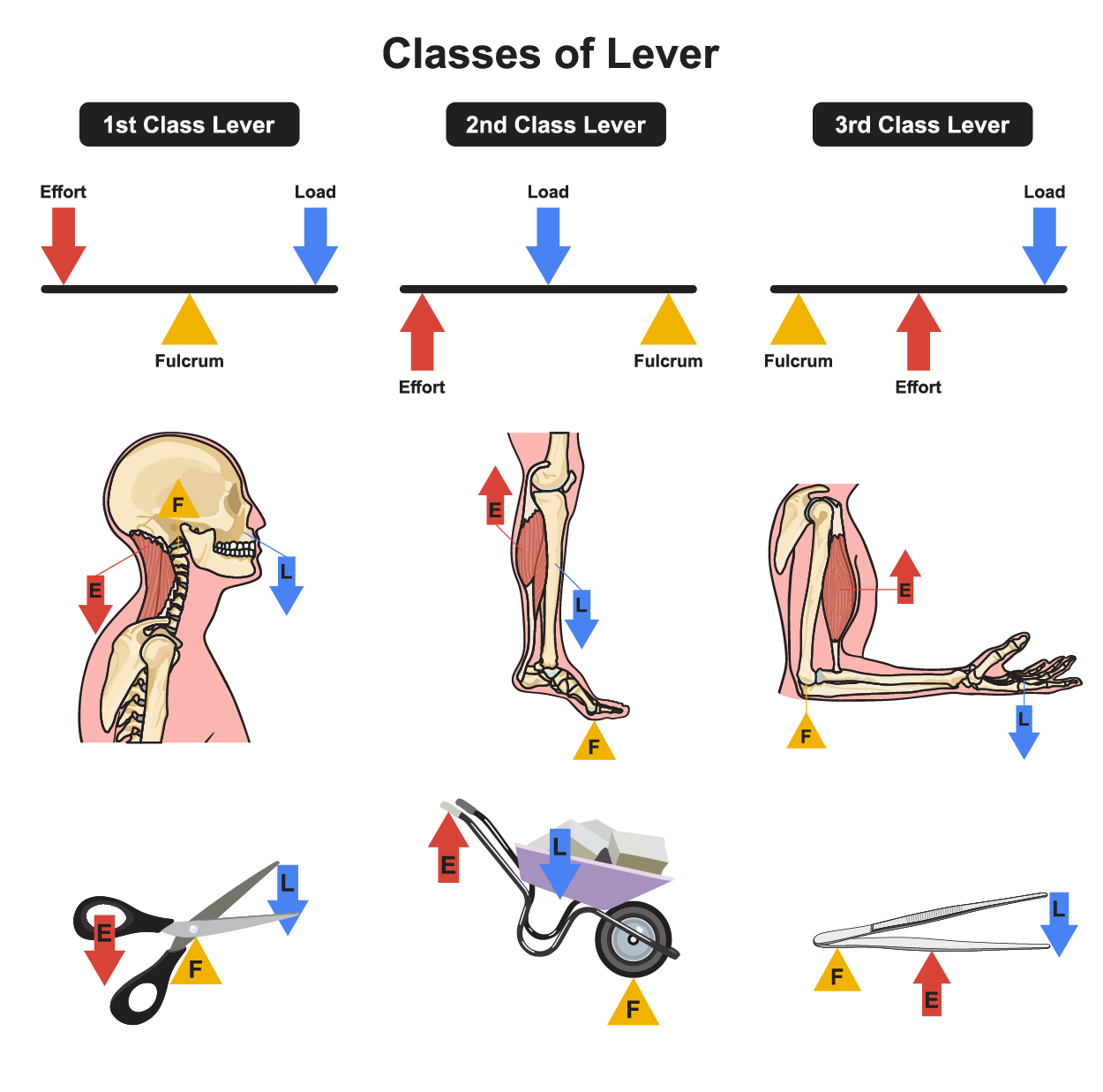
A lever is a simple machine that transfers force and consists of a rigid structure such as a board, metal bar, or bone, placed over a fixed point which creates a pivot, called a fulcrum. When a weight or mass referred to as a load is placed on the lever, an effort, or external force can be applied to the lever to make the load move. In the body, bones are the levers and synovial joints are fulcrums. The parts of our body can represent loads in addition to items that you carry. The contraction of a muscle is the effort that, when sufficient, can cause the load to move.
There are three classes of levers—first, second, and third—which only differ in the arrangement of the load, fulcrum, and effort (see the image below).
Source: THIS TUTORIAL HAS BEEN ADAPTED FROM OPENSTAX “ANATOMY AND PHYSIOLOGY 2E.” ACCESS FOR FREE AT HTTPS://OPENSTAX.ORG/DETAILS/BOOKS/ANATOMY-AND-PHYSIOLOGY-2E. LICENSE: CC ATTRIBUTION 4.0 INTERNATIONAL.



