Table of Contents |
In this challenge, we will explore some strategies and techniques to help you sort through information, including in your reading and writing for this course. The goal is to help you develop your ability to read information you encounter in print or online analytically and evaluatively. We call this skill information literacy. At the end of the challenge, you will have the chance to practice your information literacy skills with a single source. This will be a great chance for you to get some feedback on what you need to look for as you are reading and researching for this course.
Information literacy is the ability to recognize when information is needed and to locate, evaluate, and effectively use that information. This requires a range of skills that we will review in this course, including:
EXAMPLE
Imagine you are writing about a particular historical event and come across a magazine article featuring a biased account of that event. If your purpose is to write a brief but accurate description of the event, then this account is of little use. But what if your purpose is to write a critical analysis of the ways in which misleading media coverage of an event has influenced public perception of it? Suddenly, the biased account becomes useful as a specific example of the media coverage you wish to analyze.Here are some strategies to follow as you practice reading sources critically:
Reading for literal meaning refers to reading to see what’s stated and understanding it. Your goal is to discover the main ideas and supporting details. Whenever you summarize material, you are handling content on its literal level.
Reading to draw inferences involves reading to understand what is suggested or implied but not stated. In other words, reading for inferences is similar to reading for assumptions. An assumption is a statement or idea that writers expect readers to accept without proof. Finding meaning on the inferential level forces you to deal with what is not at first obvious, to figure out what’s being said beneath the literal level. When you read for inferential meaning, you read to infer the author’s purpose or position.
IN CONTEXT
Comparing Literal and Inferential Reading
Imagine you are reading a science report about advances in finding treatments for some types of cancer.
- If you were reading for literal meaning, you might find what specific types of cancer are discussed and the specific medical centers where the advances have been made.
- If you were reading for inferential meaning, you might infer that no treatments have yet been found for cancers not named or that some medical centers or research teams are especially successful in finding treatments for some types of cancer.
Here are some guiding questions you can ask yourself as you are reading:
In every field, any claim you make about a debatable subject must be supported by evidence. Although the nature of evidence varies from one discipline to another, the need for evidence is constant. Collecting accurate and current evidence to support your claim is a key part of research; without it, readers will likely judge you as uninformed and your work as unconvincing. Equally constant is the need to have complete and accurate documentation for these sources. Not all research is done for academic purposes—you may conduct research when choosing a new piece of technology, deciding on a movie to watch, renting an apartment, or even choosing a career path.
Knowing how to write a good research paper is a valuable skill that will serve you well throughout your career. Whether you are developing a new product, studying the best way to perform a procedure, or learning about challenges and opportunities in your field of employment, you will use research techniques to guide your exploration.
You may even need to create a written report of your findings. And because effective communication is essential to any company, employers seek to hire people who can write clearly and professionally.
Sources of information can be found everywhere: on social media, in newspapers, in books, on YouTube, or even the darkest depths of the internet. Some of the sources are more credible than others, but figuring out who to trust is not always easy. When sources are credible and present information in a fair and unbiased manner, they ensure that audiences are not misled by misinformation or manipulation.
Research-based writing assignments in college will often require that you use scholarly sources. These are different from the types of articles found in newspapers or magazines, or even just on the internet in general, even if all of the sources might be considered credible.
Look at this table to compare the difference between popular and scholarly (or academic) sources you may find as you start to research:
| Aspect | Popular Source | Scholarly (or Academic) Source |
|---|---|---|
| Purpose | To inform, entertain, or persuade a general audience | To contribute to knowledge in a specific field through original research, analysis, or theory |
| Intended Audience | The general public | Scholars, researchers, and students |
| Author | Written by journalists, freelance writers, or staff writers who may not have specialized knowledge in the subject | Written by experts, researchers, or academics with credentials in the field |
| Research | Includes quotes from interviews; no bibliography | Includes summaries, paraphrases, and quotations from previous writing done on the subject; footnotes and citations; ends with a bibliography |
| Review Process | Article is reviewed by an editor and proofreader | Article has gone through a peer-review process, where experts in the field have given input before publication |
| Examples | Newspapers, magazines, blogs, general-interest books, Wikipedia | Academic journals, research articles or essays, dissertations, and scholarly books |
In your research, you may encounter both primary and secondary sources. Let’s look at some examples of how primary and secondary sources can relate to one another:
| Discipline | Primary Source Example | Secondary Source Example |
|---|---|---|
| Literature | Wilfred Owen’s poem “Dulce et Decorum est” | Essay analyzing World War I poetry |
| Psychology | Raw data from a study testing the effects of a medication on bipolar disorder | Book evaluating different approaches to treating bipolar disorder in patients |
| Politics and Government | Transcript of John F. Kennedy’s inauguration speech | Student essay analyzing the themes present in John F. Kennedy’s inauguration speech |
| History | Diary of a soldier who fought in the Civil War | Textbook entry about the battles of the Civil War using quotes from the diary to describe the experience |
| Fine Art | Native American pottery | Newspaper article about the importance of honoring Native American art |
| Performing Arts | Recording of a live concert | Critical review of a concert published in a magazine |
Primary sources allow researchers to get as close as possible to original ideas, events, and empirical research. A primary source is an original document containing firsthand information, including original research, about a topic. These sources may include creative works, firsthand or contemporary accounts of events, and the publication of the results of new observations or research.
Primary sources are direct evidence or firsthand accounts of events without secondary analysis or interpretation. A primary source is a work that was created or written contemporarily with the period or subject being studied. Primary sources are documents that provide a full description of the original research.
EXAMPLE
Compare the difference between these primary and secondary sources, which are both about the same topic: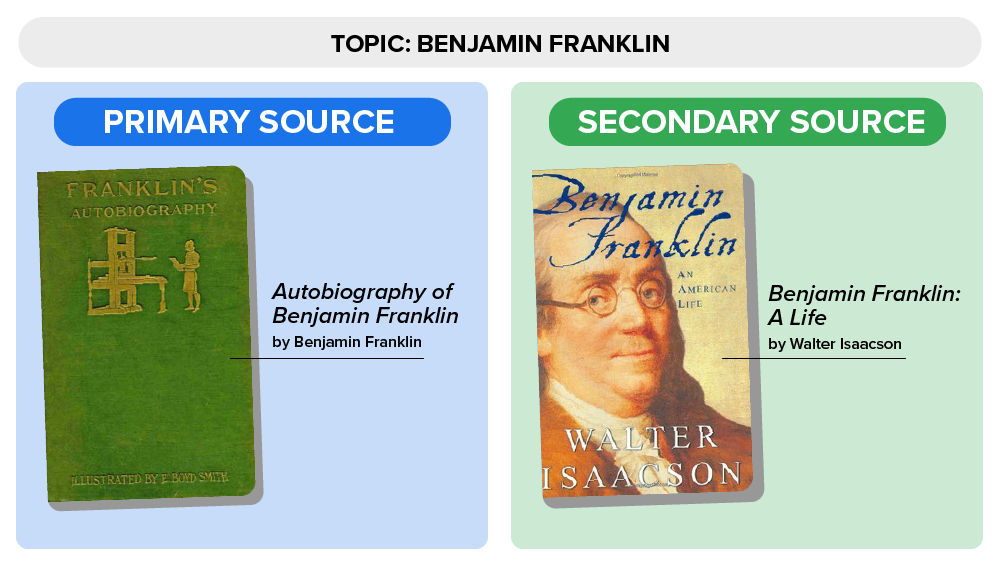
Primary source documents include, but are not limited to, personal narratives and diaries; eyewitness accounts; interviews; original documents such as treaties, official certificates, and government documents detailing laws or acts; speeches; newspaper coverage of events at the time they occurred; and may even include Internet discussions, blogs, and other first-person accounts of events.
Other primary sources may be found on websites such as the Library of Congress, the Historical Text Archive, government websites, and article databases. In all academic areas, primary sources are fact-based, not interpretive. That is, they may be commenting on or interpreting something else, but they themselves are the source.
A secondary source contains commentary on or discussion about a primary source. Its most important feature is that it offers an interpretation of information gathered from primary sources. Secondary sources analyze, review, or summarize information from primary resources and other secondary resources. Even sources presenting facts or descriptions about events are secondary unless they are based on direct participation or observation. You will find that secondary sources often rely on other secondary sources; in fact, it is expected across disciplines to put a new study or analysis in the context of recent scholarly work, so this is a necessity.
EXAMPLE
Compare the difference between these primary and secondary sources, which are both about the same topic: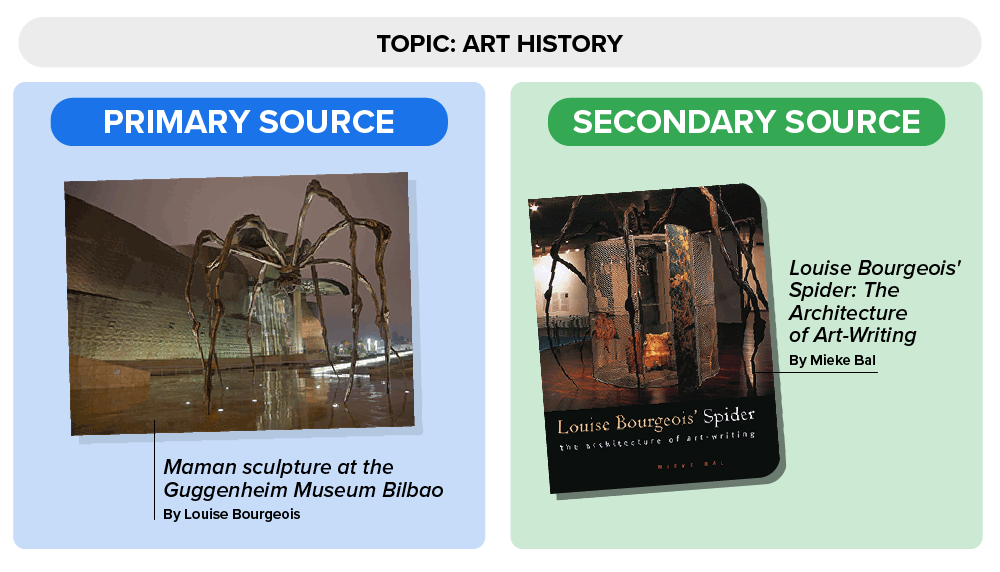
Secondary sources, unlike primary sources, are interpretive. They often provide a secondhand account of an event or research results, analyze or clarify primary sources and scientific discoveries, or interpret a creative work. Secondary sources in the humanities disciplines include biographies, literary criticism, and reviews of the fine arts, among other sources. In the scientific disciplines, secondary sources encompass analyses of scientific studies or clinical trials, reviews of experimental results, and publications about the significance of studies or experiments.
In your research, you will also encounter sources that aggregate information gathered from other resources. These resources often provide data in a convenient form or provide information with context for interpretation and can be a place to start your search. These sources present summaries or condensed versions of materials, usually with references back to primary or secondary sources. They can be a good place to look up facts or to get a general overview of a subject, but they rarely contain original material. Also, these sources are a place where you might start your research, but they do not meet the threshold for academic sources—they are considered popular sources.
Because these sources often condense information, they usually do not provide enough information on their own to support claims. However, they usually (and should!) include citations or weblinks that can help you identify and locate more substantial primary and secondary sources.
EXAMPLE
Jack needs to write about efficiency methods for a business class. He starts with the Wikipedia article on “efficiency” and follows a link to “productivity methods,” which is more suitable for his assignment. He skims the article, then follows the citation links at the bottom to find the original articles in business journals.REFERENCES



