Table of Contents |
In the last tutorial, we learned that  gives information about the concavity of
When a curve has a point where it transitions between being concave up and concave down, and the tangent line exists, the point is called an inflection point (or point of inflection).
Consider the graph shown below, which represents the number of people who have become infected with a disease.
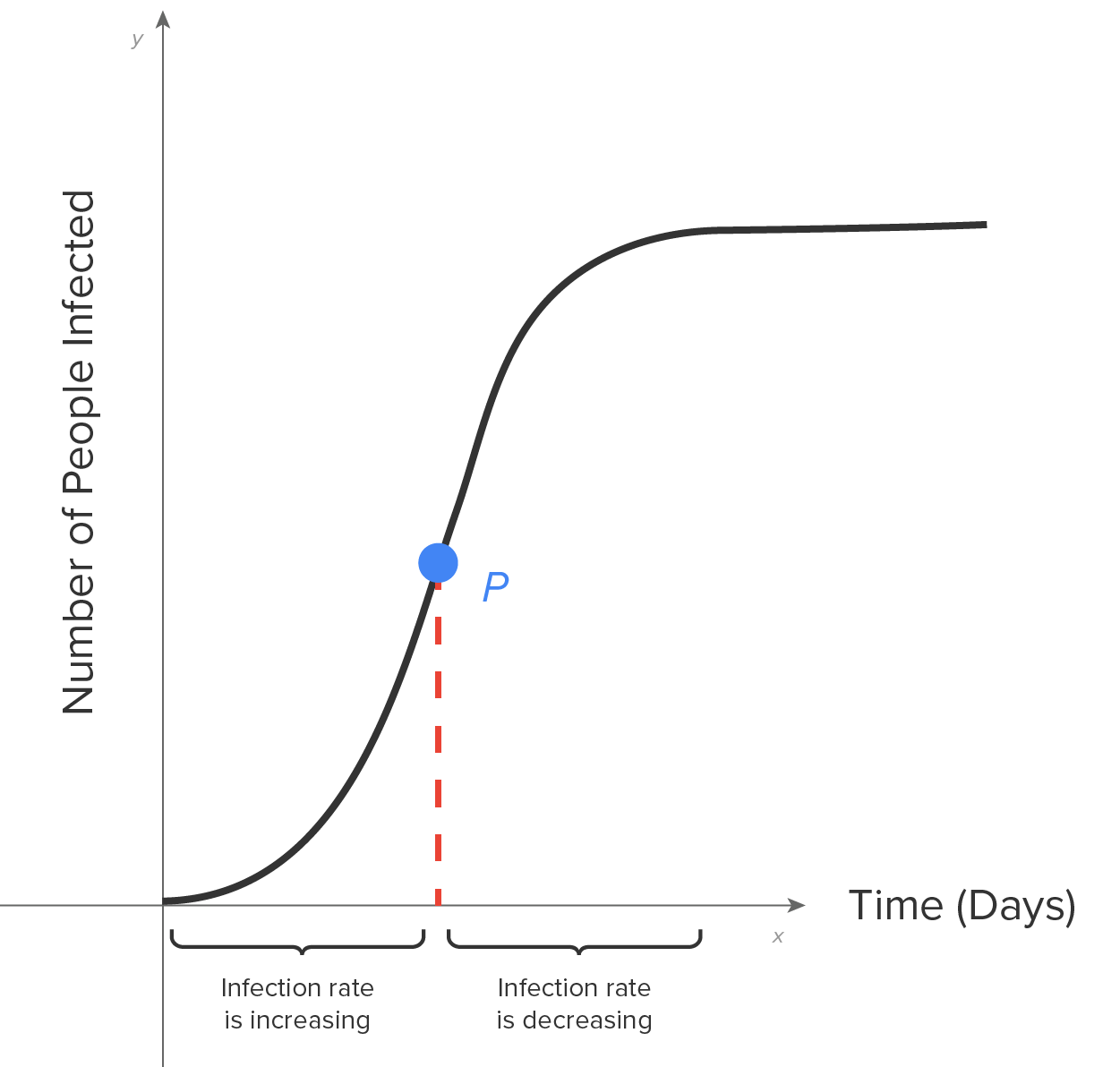
As you can see, the number of cases is increasing over the entire domain.
To the left of point P, the slopes of the tangent lines are increasing. This means that the rate of infection is increasing.
To the right of point P, the slopes of the tangent lines are decreasing. This means that the rate of infection is decreasing.
The inflection point is the transition point between these two events. In terms of disease control, this point is important since it represents the point at which the disease is beginning to get under control.
In the last tutorial, you learned that the graph of  is concave down when
  and the graph of is concave up when
is continuous at  the graph of could have a point of inflection when
  or
or  is undefined. To verify this, make a sign graph of
EXAMPLE
Consider the function Find any points of inflection.

|
Start with the original function; the domain is all real numbers. |

|
Take the first derivative. |

|
Take the second derivative. |

|
Any inflection points could occur when  . (Note: is never undefined.) . (Note: is never undefined.)
|

|
Subtract 36 from both sides. |

|
Divide both sides by -12. |

 and
and  to determine the sign of on that interval:
| Interval |
|
|
|---|---|---|
| Test Value | 0 | 4 |
Value of 
|
36 | -12 |
Behavior of 
|
Concave up | Concave down |
is concave up on the interval and concave down on the interval  Thus, a point of inflection occurs when
 the inflection point is located at
Let’s take a look at a different function.
EXAMPLE
Consider the function Find any points of inflection.

|
Start with the original function; the domain is all real numbers. |

|
Take the first derivative. |

|
Take the second derivative. |

|
Any inflection points could occur when . (Note: is never undefined.)
|

|
Divide both sides by 12. |

|
Take the square root of both sides. |

 and
and  to determine the sign of on that interval:
| Interval |
|
|
|---|---|---|
| Test Value | -1 | 1 |
Value of 
|
12 | 12 |
|
Behavior of
|
Concave up | Concave up |
 there is no inflection point when Since there were no other possible points of inflection, has no points of inflection. As you can see, the graph is always concave up.
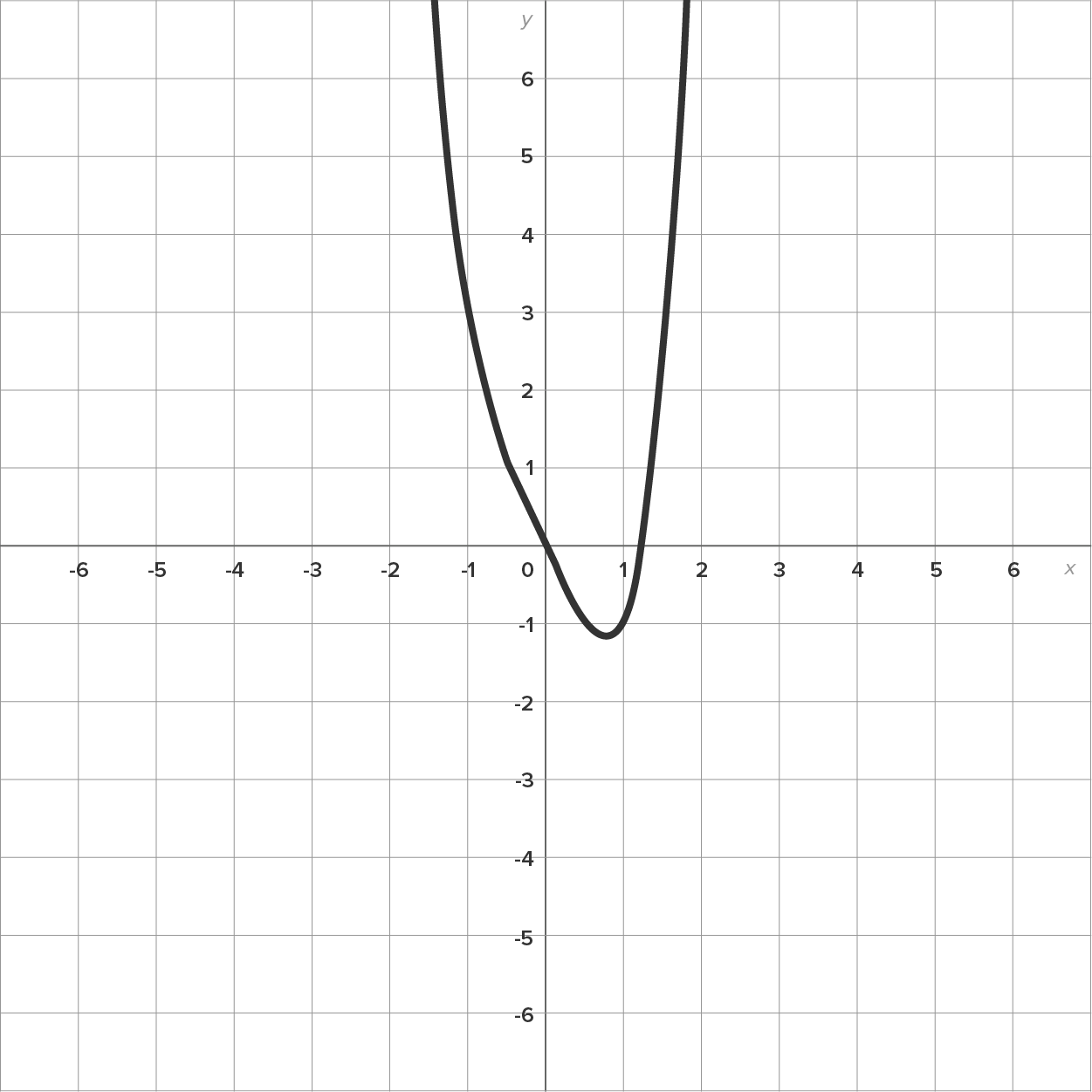
 for points of inflection.
where is either 0 or undefined, then use a graph of the signs of
for points of inflection.
where is either 0 or undefined, then use a graph of the signs of  to determine the x-values where inflection points occur.
Source: THIS TUTORIAL HAS BEEN ADAPTED FROM CHAPTER 3 OF "CONTEMPORARY CALCULUS" BY DALE HOFFMAN. ACCESS FOR FREE AT WWW.CONTEMPORARYCALCULUS.COM. LICENSE: CREATIVE COMMONS ATTRIBUTION 3.0 UNITED STATES.




