Table of Contents |
Diet and nutrition have a major impact on a child’s development from infancy into the adolescent years. A healthy diet not only affects growth, but also immunity, intellectual capabilities, and emotional well-being. One of the most important jobs of parenting is making sure that children receive an adequate amount of needed nutrients to provide a strong foundation for the rest of their lives. The first year of life is an incredible time of growth and development, and an infant’s nutrient needs are very high.
Healthy infants grow steadily, but not always at an even pace.
EXAMPLE
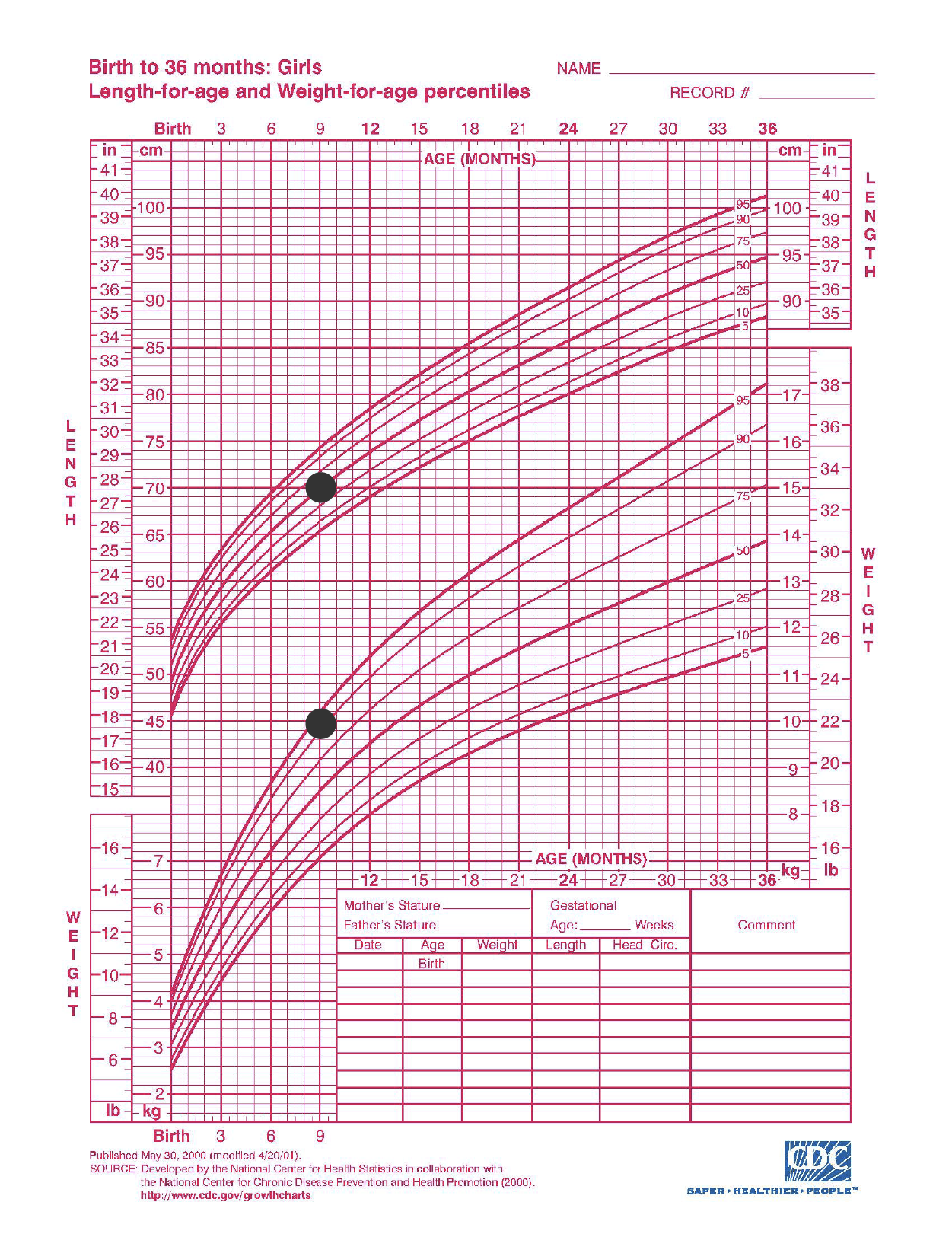
During the first year of life, height increases by 50 percent, while weight triples. Physicians and other health professionals use growth charts to track a baby’s development process. Because infants cannot stand, length is used instead of height to determine the rate of a child’s growth. Other important developmental measurements include head circumference and weight. All of these must be tracked and compared against standard measurements for an infant’s age.Nationally-accepted growth charts are based on data collected by the National Center for Health Statistics. These charts allow for tracking trends over time and comparing with other infants among percentiles within the United States. Growth charts may provide warnings that a child has a medical problem or is malnourished.
You can assess the growth of infants and children by plotting their measurements on a percentile graph. Percentile graphs divide the measures of a population into 100 equal divisions so that half of the population falls at or above the 50th percentile and half falls below. Using percentiles allows for comparisons among people of the same age and gender.
This 9-month-old infant is at the 50th percentile for length and the 95th percentile for weight. Her pediatrician will weigh her again over the next few months and expect the growth curve to follow the same percentile throughout the first year. In general, dramatic changes or measures much above the 80th percentile or much below the 10th percentile may be cause for concern.
Initially, an infant has only breast milk or formula but later begins to eat some foods. Requirements for macronutrients and micronutrients on a per-kilogram basis are higher during infancy than at any other stage in the human life cycle. These needs are affected by the rapid cell division that occurs during growth, which requires energy and protein, along with the nutrients that are involved in DNA synthesis. During this period, children are entirely dependent on their parents or other caregivers to meet these needs.
For almost all infants six months or younger, breast milk is the best source to fulfill nutritional requirements. An infant may require feedings eight to twelve times a day or more in the beginning. After six months, infants can gradually begin to consume solid foods to help meet nutrient needs.
Energy needs relative to size are much greater in an infant than an adult. A baby’s resting metabolic rate is two times that of an adult. The RDA to meet energy needs changes as an infant matures and puts on more weight.
Based on these equations, the estimated energy requirement for infants from zero to six months of age is 472 to 645 kilocalories per day for boys and 438 to 593 kilocalories per day for girls. For infants ages six to twelve months, the estimated requirement is 645 to 844 kilocalories per day for boys and 593 to 768 kilocalories per day for girls. From the age one to age two, the estimated requirement rises to 844–1,050 kilocalories per day for boys and 768–997 kilocalories per day for girls.
The dietary recommendations for infants are based on the nutritional content of human breast milk. Carbohydrates make up about 45 to 65 percent of the caloric content in breast milk, which amounts to a RDA of about 130 grams. Almost all of the carbohydrate in human milk is lactose, which infants digest and tolerate well. In fact, lactose intolerance is practically nonexistent in infants. Protein makes up about 5 to 20 percent of the caloric content of breast milk, which amounts to 13 grams per day. Infants have a high need for protein to support growth and development, though excess protein (which is only a concern with bottle-feeding) can cause dehydration, diarrhea, fever, and acidosis in premature infants.
About 30 to 40 percent of the caloric content in breast milk is made up of fat. A high-fat diet is necessary to encourage the development of neural pathways in the brain and other parts of the body. However, saturated fats and trans fatty acids inhibit this growth. Infants who are over the age of six months, which means they are no longer exclusively breastfed, should not consume foods that are high in these types of fats.
Almost all of the nutrients that infants require can be met if they consume an adequate amount of breast milk. There are a few exceptions, though. Human milk is low in vitamin D, which is needed for calcium absorption and building bone, among other things. Therefore, breastfed children often need to take a vitamin D supplement in the form of drops. Infants at the highest risk for vitamin D deficiency are those with darker skin and no exposure to sunlight. Breast milk is also low in vitamin K, which is required for blood clotting, and deficits could lead to bleeding or hemorrhagic disease.
Babies are born with limited vitamin K, so supplementation may be needed initially and some states require a vitamin K injection after birth. Also, breast milk is not high in iron, but the iron in breast milk is well absorbed by infants. After four to six months, however, an infant needs an additional source of iron other than breast milk.
Infants should be breastfed or bottle-fed exclusively for the first six months of life according to the WHO.
If parents try to feed an infant who is too young or is not ready, their tongue will push the food out, which is called an extrusion reflex. After six months, the suck-swallow reflexes are not as strong, and infants can hold up their heads and move them around, both of which make eating solid foods more feasible.
Solid baby foods can be bought commercially or prepared from regular food using a food processor, blender, food mill, or grinder at home. Usually, an infant cereal can be offered from a spoon between four to six months. By nine months to a year, infants are able to chew soft foods and can eat solids that are well chopped or mashed.
IN CONTEXT
Infants who are fed solid foods too soon are susceptible to developing food allergies. Therefore, as parents and caregivers introduce solids, they should feed their child only one new food at a time (starting with rice cereal, followed by fruits or vegetables), to help identify allergic responses or food intolerances. An iron supplement or iron-fortified cereal is also recommended at this time.
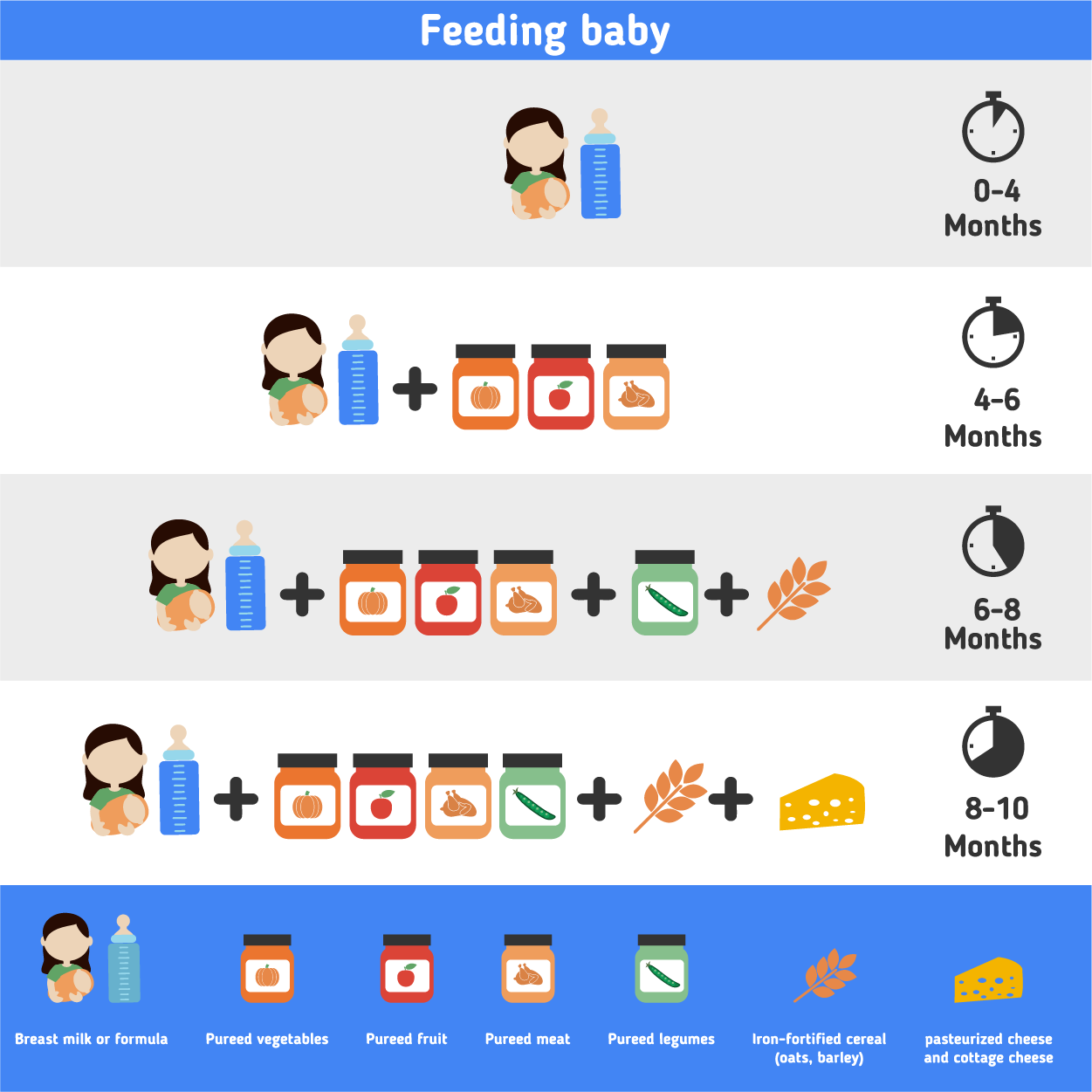
With the introduction of solid foods, young children begin to learn how to handle food and how to feed themselves. At six to seven months, infants can use their whole hand to pick up items (this is known as the palmer grasp). They can lift larger items, but picking up smaller pieces of food is difficult. At eight months, a child might be able to use a pincer grasp, which uses fingers to pick up objects. After the age of one, children slowly begin to use utensils to handle their food. Unbreakable dishes and cups are essential since very young children may play with them or throw them when they become bored with their food.
Parents and caregivers should be mindful of certain diet-related problems that may arise during infancy. Certain foods are choking hazards, including foods with skins or foods that are very small, such as grapes. Other examples of potential choking hazards include raw carrots and apples, raisins, and hard candy. Parents should also avoid adding salt or seasonings to an infant’s food.
IN CONTEXT
Heating an infant’s food presents a risk of accidental injury or burns, which may occur if the food is heated unevenly or excessively. Keep in mind that an infant cannot communicate that the food is too hot. Also, parents and caregivers should never leave a baby alone at mealtime because an infant can accidentally choke on pieces of food that are too big or have not been adequately chewed.
Raw honey and corn syrup both contain spores of Clostridium botulinum. They produce a poisonous toxin in a baby’s intestines, which can cause the foodborne illness botulism. After the age of one, it is safe to give an infant honey or corn syrup. However, honey as an ingredient in food, such as in cereal, is safe for all ages because it has been adequately heat treated.
Overnutrition during infancy is a growing problem. Overfed infants may develop dietary habits and metabolic characteristics that last a lifetime. Parents and other caregivers should restrain from overfeeding and ideally give their infants breast milk to promote health and well-being.
Common food allergens that can appear just before or after the first year include peanut butter, egg whites, wheat, cow’s milk, and nuts. For infants, even a small amount of a dangerous food can prove to be life-threatening. If there is a family history of food allergies, it is a good idea to delay giving a child dairy products until one year of age, eggs until two years of age, and shellfish, fish, and nuts until three years of age.
Primary teeth are at risk for a disorder known as early childhood caries from breast milk, formula, juice, or other drinks fed through a bottle. Liquids can build up in a baby’s mouth, and the natural or added sugars lead to decay. Early childhood caries is caused not only by the kinds of liquids given to an infant, but also by the frequency and length of time that fluids are given. Giving a child a bottle of juice or other sweet liquids several times each day, or letting a baby suck on a bottle longer than a mealtime, either when awake or asleep, can also cause early childhood caries.
In addition, this practice affects the development and position of the teeth and the jaw. The risk of early childhood caries continues into the toddler years as children begin to consume more foods with a high sugar content. Therefore, parents should avoid giving their children sugary snacks and beverages.

Small amounts of spitting up during a feeding is normal. However, there is cause for concern if it is too difficult to feed an infant due to gastroesophageal reflux. This condition occurs when stomach muscles open at the wrong times and allow milk or food to back up into the esophagus.
Symptoms of gastroesophageal reflux in infants include severe spitting up, projectile vomiting, arching of the back as though in pain, refusal to eat or pulling away from the breast during feedings, gagging or problems with swallowing, and slow weight gain. For most infants, making adjustments in feeding practices addresses the issue.
EXAMPLE
A parent can feed their baby in an upright position, wait at least an hour after eating for play time, burp more often, or give a child smaller, more frequent feedings.Diarrhea is often caused by a gastrointestinal infection and can dehydrate an infant. It is characterized by stool frequency and consistency that deviates substantially from the norm. If an infant has had several bouts of this condition, they will need to replace lost fluids and electrolytes. A common recommendation is to give a child an oral rehydration solution. Because of the immunoprotective factors in breast milk, breastfed infants are less likely to contract gastrointestinal viral illness and experience diarrhea.
Infant constipation—which is the passage of hard, dry bowel movements, but not necessarily the absence of daily bowel movements—is another common problem. This condition frequently begins when a baby transitions from breast milk to formula or begins eating solid foods. Pediatricians can provide the best guidance for handling the problem. Common recommendations include applying a small amount of water-based lubricant to an infant’s anus to ease the passage of hard stools, and feeding an infant on solid foods, pureed pears or prunes, or providing barley cereal in place of rice cereal.
Colic is frequent, prolonged, and intense crying or fussiness in a healthy infant. It is defined as crying that lasts longer than three hours per day for at least three days per week and for at least three weeks (which is commonly known as the “rule of 3’s”), and is not caused by a medical problem. About one-fifth of all infants develop colic, usually between the second and third weeks after birth. Crying spells can occur around the clock but often worsen in the early evening. Also, colicky babies may have stomachs that are enlarged or distended with gas.
Whether breastfeeding or bottle-feeding, it is also important not to overfeed infants, which could make them uncomfortable and more likely to have crying fits. In general, it is best to wait between two and three hours from the start of one feeding to the start of the next. If food sensitivity is the cause, colic should cease within a few days of making changes. Eventually, the problem goes away. Symptoms usually begin to dissipate after six weeks and are gone by twelve weeks.
Newborn jaundice can occur within a few days of birth and is characterized by yellowed skin or yellowing in the whites of the eyes, which can be harder to detect in dark-skinned babies. Jaundice typically appears on the face first, followed by the chest, abdomen, arms, and legs. This disorder is caused by elevated levels of bilirubin in a baby’s bloodstream. Bilirubin is a substance created by the breakdown of red blood cells and is removed by the liver. Jaundice develops when a newborn’s liver does not efficiently remove bilirubin from the blood.
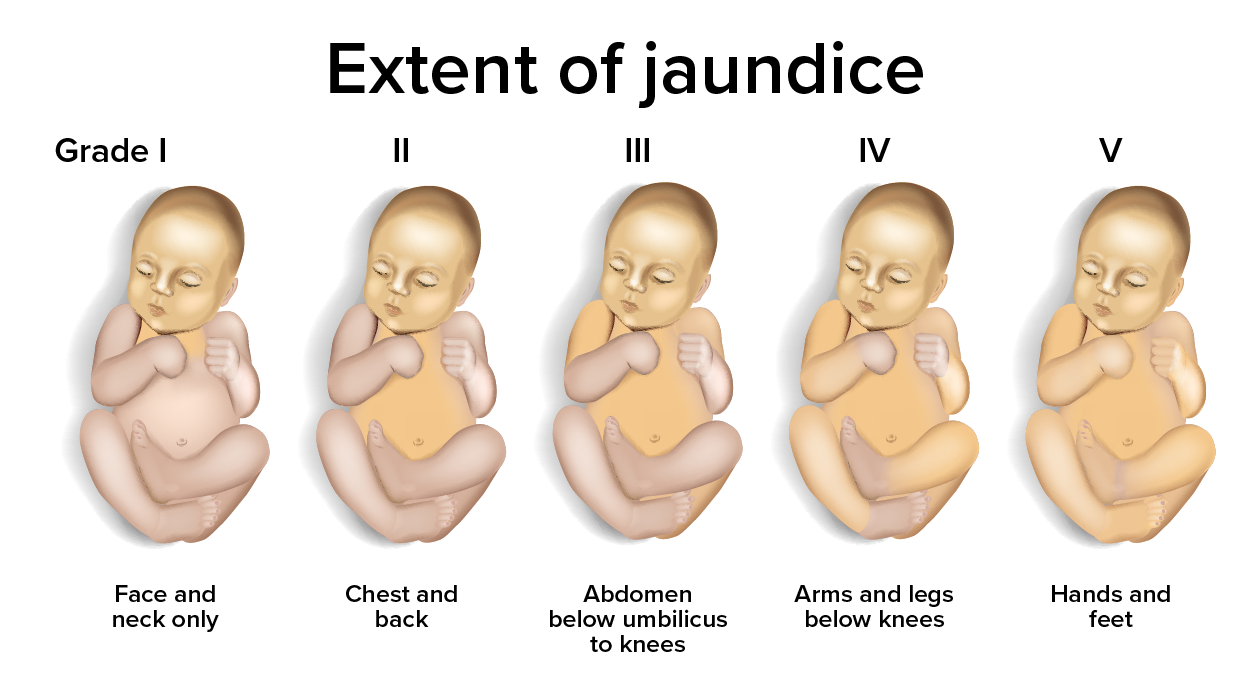
Newborn jaundice is more common in a breastfed baby and tends to last a bit longer. If jaundice is suspected, a pediatrician will run blood tests to measure the amount of bilirubin in an infant’s blood. Treatment often involves increasing the number of feedings to increase bowel movements, which helps to excrete bilirubin. Within a few weeks, as the baby begins to mature and red blood cell levels diminish, jaundice typically subsides with no lingering effects.
Source: THIS TUTORIAL HAS BEEN ADAPTED FROM LUMEN LEARNING’S “NUTRITION FLEXBOOK”. ACCESS FOR FREE AT https://courses.lumenlearning.com/suny-nutrition/. LICENSE: creative commons attribution 4.0 international.



