Table of Contents |
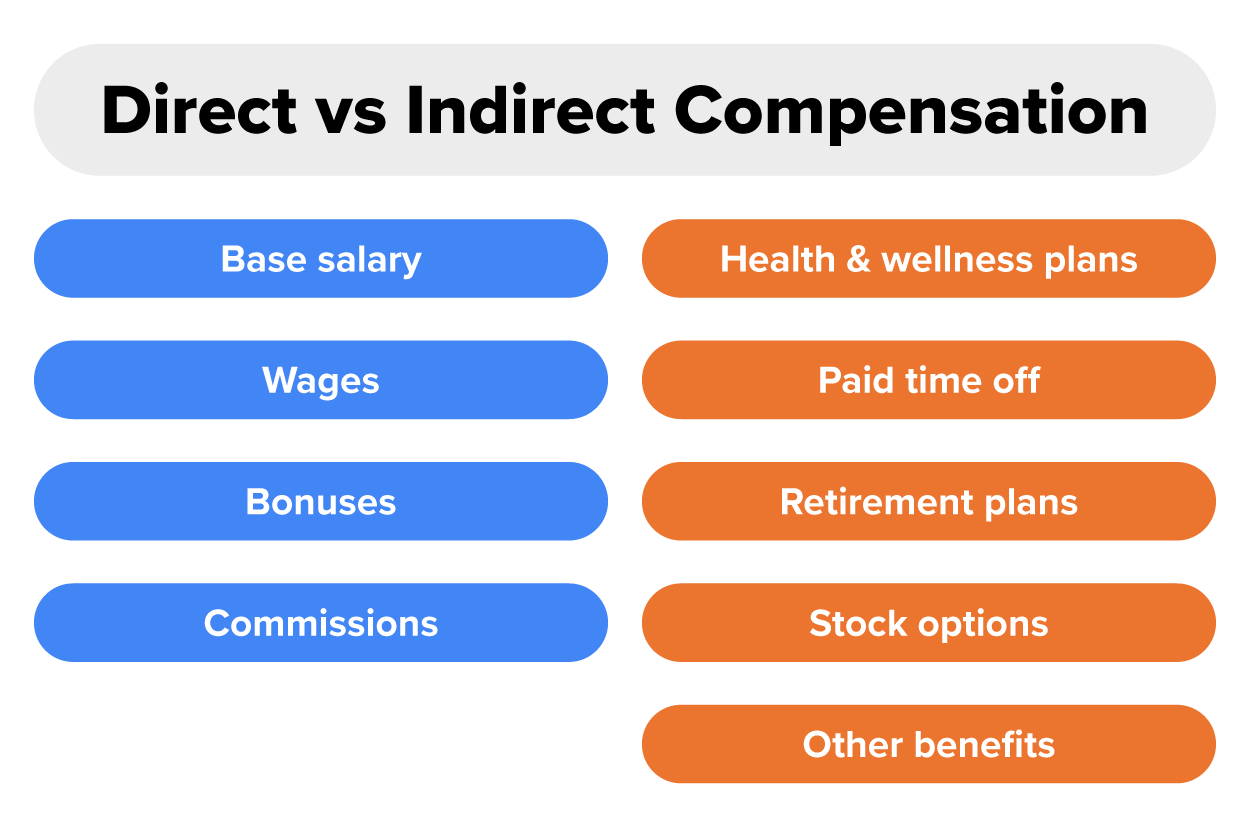
Direct compensation is a fundamental part of an employee’s earnings and plays a role in attracting and retaining talent. It refers to the monetary payments made directly to employees for their work. This includes base salary, wages, bonuses, and commissions. Each of these components serves a specific purpose and is designed to reward employees for their contributions to the organization.
Base salary or wages are the fixed amounts paid to employees on a regular basis, such as weekly, bi-weekly, or monthly. This is the most straightforward form of direct compensation and provides employees with a predictable income. The amount is usually determined by factors such as the employee’s role, experience, education, and industry standards. It forms the foundation of an employee’s earnings and is often used as a benchmark for other types of compensation.
Bonuses are additional payments given to employees based on their performance or the company’s performance. They are typically awarded for achieving specific goals or milestones, such as meeting sales targets, completing projects, or contributing to the company’s overall success. Bonuses can be a powerful motivator, encouraging employees to perform at their best and align their efforts with the company’s objectives. They can be awarded annually, quarterly, or even monthly, depending on the company’s policies.
Commissions are a form of direct compensation commonly used in sales roles. They are payments made to employees based on the sales they generate. This type of compensation directly ties an employee’s earnings to their performance, providing a strong incentive to increase sales and drive revenue for the company. Commissions can be structured in various ways, such as a percentage of sales or a fixed amount for each sale made.
In addition to these primary forms of direct compensation, some companies may offer other monetary rewards, such as profit-sharing or stock options. Profit-sharing involves distributing a portion of the company’s profits to employees, usually based on their salary level or position within the company. Stock options give employees the opportunity to purchase company shares at a discounted price, aligning their interests with the long-term success of the company.
Overtime pay is additional compensation for hours worked beyond the standard 40-hour workweek. It is typically calculated at one and a half times the employee’s regular hourly rate. This extra pay is designed to compensate employees for the additional time they spend working and to discourage employers from overworking their staff.
Not all employees are eligible for overtime pay. The Fair Labor Standards Act (FLSA) sets the rules for who qualifies. Employees who are eligible for overtime pay are known as nonexempt employees as they are “not exempted” from, or are covered by, the FLSA. These are usually hourly workers who do not have managerial or professional duties. Non-exempt employees must be paid overtime for any hours worked over 40 in a week.
On the other hand, exempt employees are not entitled to overtime pay. These employees typically hold positions that are considered executive, administrative, or professional. To be classified as exempt, employees must meet certain criteria set by the FLSA.
EXAMPLE
Exempt employees must be paid on a salary basis, earn above a specific salary threshold, and perform job duties that are considered exempt. This often includes tasks that require independent judgment and decision-making.The distinction between exempt and non-exempt employees is important because it determines who gets overtime pay. Employers must carefully classify their employees to ensure compliance with the FLSA. Misclassifying an employee can lead to legal issues and financial penalties.
In addition to federal regulations, some states have their own overtime laws that may provide greater protections for workers. Employers must comply with both federal and state laws, whichever is more favorable to the employee.
Salaried exempt employees receive a fixed payment regardless of the hours they work, focusing on completing their job duties rather than tracking time. Their compensation remains consistent, reflecting their role and responsibilities. In contrast, hourly nonexempt employees are paid based on the actual hours they work, including overtime for hours beyond the standard 40-hour workweek. This means their earnings can vary depending on the amount of time they spend at work.
It’s important to note that employees can also be salaried nonexempt, meaning they receive a fixed salary but are still eligible for overtime pay. This classification is less common but ensures that employees are compensated for extra hours worked. However, you can only be hourly nonexempt, as hourly employees must be paid for every hour worked, including overtime. The key difference lies in how their pay is structured: salaried exempt employees are paid for the job they do, while hourly nonexempt employees are paid for the time they work.
EXAMPLE
A salaried nonexempt employee might be an administrative assistant who receives a fixed salary but is eligible for overtime, while an hourly nonexempt employee could be a customer service representative who is paid hourly and receives overtime pay for extra hours worked.IN CONTEXT
Salaried vs Hourly Scenario
Imagine a company with three employees: Sofia, an exempt salaried employee; Marcus, a nonexempt hourly employee; and Leila, a nonexempt salaried employee.
Sofia works as a project manager and earns a fixed annual salary. She often works more than 40 hours a week, but she does not receive overtime pay because her role is classified as exempt. Her compensation remains the same regardless of the extra hours she puts in.
Marcus works in the warehouse and is paid by the hour. He earns overtime pay for any hours worked beyond the standard 40-hour workweek. Last week, he worked 45 hours, so he received his regular hourly rate for the first 40 hours and time-and-a-half for the additional 5 hours.
Leila works in customer service and is paid a fixed salary. However, unlike Sofia, Leila is eligible for overtime pay because her role is classified as nonexempt. When she works more than 40 hours a week, she receives overtime pay in addition to her regular salary.
Indirect compensation includes various benefits and perks that employees receive in addition to their direct pay. These benefits are an important part of an employee’s total compensation package and can greatly enhance job satisfaction and loyalty. The table below summarizes the key types of indirect compensation and their descriptions:
| Indirect Compensation | |
|---|---|
| Type | Description |
| Health Insurance | Coverage for medical, dental, and vision care to help manage healthcare expenses. |
| Retirement Plans | Savings plans or pensions, often with employer matching contributions. |
| Paid Time Off (PTO) | Includes vacation days, sick leave, and personal days for maintaining work-life balance. |
| Stock Options | Rights to purchase company shares at a predetermined price, aligning employee and company success. |
| Other Benefits | Additional perks such as life insurance, disability insurance, tuition reimbursement, wellness programs, and employee assistance programs. |
In today’s competitive job market, organizations are increasingly recognizing the importance of non-monetary compensation benefits. These benefits go beyond traditional salary and bonuses, offering employees additional incentives that enhance their overall work experience. Non-monetary benefits can greatly impact employee satisfaction, motivation, and retention by addressing various aspects of their professional and personal lives.
| Non-monetary Compensation Benefits | |
|---|---|
| Example | Description |
| Flexible Work Hours | Allows employees to adjust their work schedules to better fit their personal lives. |
| Professional Development | Access to training programs, workshops, conferences, and tuition reimbursement for further education. |
| Recognition Programs | Programs to acknowledge and reward employees for their hard work and achievements. |
| Positive Work Environment | Fostering a culture of respect, collaboration, and open communication. |
| Work-Life Balance Initiatives | Wellness programs, mental health support, family-friendly policies, and social interaction opportunities. |
Creating a balanced compensation strategy involves more than just offering competitive salaries. It requires a thoughtful mix of direct and indirect compensation to meet the diverse needs of employees. The following table outlines several strategies that organizations can use to achieve this balance. These strategies not only help attract and retain top talent but also foster a positive and supportive work environment. By implementing these approaches, companies can ensure their compensation packages are both comprehensive and appealing.
| Balancing Compensation Strategy | |
|---|---|
| Strategy | Description |
| Personalized Benefits Packages | Tailor benefits to meet the diverse needs of your workforce, offering options like different health plans and flexible work arrangements. |
| Regular Compensation Reviews | Conduct periodic reviews to ensure compensation remains competitive and aligned with industry standards. |
| Transparent Communication | Clearly communicate the value of both direct and indirect compensation to employees. |
| Employee Feedback | Regularly seek and use employee feedback to adjust and improve compensation strategies. |
| Performance-Based Rewards | Incorporate incentives that reward employees for their contributions and achievements. |
| Wellness Programs | Invest in programs that support employees’ physical and mental health, such as gym memberships and mental health resources. |
| Work-Life Balance Initiatives | Promote a healthy work-life balance with flexible work hours, remote work options, and generous leave policies. |
IN CONTEXT
Balance Compensation Strategy Scenario
Imagine you are the HR manager at a mid-sized tech company. Recently, you noticed an increase in employee turnover, particularly among your software developers. To address this, you decide to implement a more balanced compensation strategy.
You start by conducting a survey to gather feedback on what employees value most. The results show that while competitive salaries are important, many employees also seek better work-life balance and professional development opportunities.
Based on this feedback, you introduce flexible work hours and remote work options to help employees manage their personal and professional lives more effectively. You also expand your professional development programs, offering access to online courses, workshops, and conferences.
Additionally, you implement a performance-based reward system, where employees can earn bonuses and additional paid time off based on their achievements. To support overall well-being, you enhance your wellness programs by providing gym memberships and mental health resources.
After six months, you review the impact of these changes. Employee satisfaction surveys show a marked improvement, and turnover rates have decreased. Your balanced approach to direct and indirect compensation has created a more engaged and loyal workforce, contributing to the company’s long-term success.
Source: This Tutorial has been adapted from "Human Resources Management" by Lumen Learning. Access for free at courses.lumenlearning.com/wm-humanresourcesmgmt/. License: CC BY: Attribution.
REFERENCES
Schumann, R. (2003). Compensation from world war II through the great society. www.bls.gov/opub/mlr/cwc/compensation-from-world-war-ii-through-the-great-society.pdf



